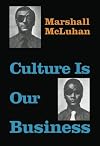
Culture Is Our Business
by Marshall McLuhan
On This Page
Description
Culture Is Our Business is Marshall McLuhan's sequel to The Mechanical Bride: Folklore of Industrial Man. Returning to the subject of advertising newly armed with the electric sensibility that informed The Gutenberg Galaxy, Understanding Media, and The Medium Is the Massage, McLuhan takes on the mad men (a play on the ad men of Madison Avenue) of the sixties. Approaching commercial messages as unacknowledged art forms and cultural artifacts, McLuhan delivers a series of probes that pick show more apart their meanings and underlying values, their paradoxes and paralogisms, and their overt function as persuasion and propaganda. Through humor, satire, and a poetic sensibility, he provides us with a serious exploration of the consumer culture that emerged out of the electronic media environment. In keeping with the participatory ethos of the Internet that McLuhan so clearly anticipated, this is a book that is meant to open the door to further study, reflection, and discussion, and to encourage the development of critical reception on the part of the reader. show lessTags
Recommendations


























Member Reviews
Marshall McLuhan is the challenge author for the month of February for this year's Canadian book read. As he was a communications theorist, I'm sure I've read his work when I was film theory student.
Culture Is Our Business by Marshall McLuhan is a dialectical journal on the state of Western advertising as a reflection of culture at the close of the 1960s. Now separated from the source material, these quips read more like free verse slam poetry than responses to images and slogans that were at one point ubiquitous.
Now, though, looking back at a slice of popular (primarily American, though there are some Canadian, British, and European ads included) culture as represented by headlines, full page (black and white) ads and slogans, it's show more difficult to assess sometimes which are the quotes and which are the responses. So I'm sure a portion (and it might be as high as 50%)
But there were moments when I could see the same old dialog that is still being bandied about — especially worries about the current generation of youth or expectations that they will be fundamentally different because of "new media." Think now of the high expectations we put on Millennials at the expense of the previous generations. I'm apparently too old to know how to use a computer or a Smart Phone but my children are somehow genetically programmed to do both from birth (both are fallacies).
As this is such a dense book, I did some live micro-blogging of what I was reading on my Tumblr site. show less
Culture Is Our Business by Marshall McLuhan is a dialectical journal on the state of Western advertising as a reflection of culture at the close of the 1960s. Now separated from the source material, these quips read more like free verse slam poetry than responses to images and slogans that were at one point ubiquitous.
Now, though, looking back at a slice of popular (primarily American, though there are some Canadian, British, and European ads included) culture as represented by headlines, full page (black and white) ads and slogans, it's show more difficult to assess sometimes which are the quotes and which are the responses. So I'm sure a portion (and it might be as high as 50%)
But there were moments when I could see the same old dialog that is still being bandied about — especially worries about the current generation of youth or expectations that they will be fundamentally different because of "new media." Think now of the high expectations we put on Millennials at the expense of the previous generations. I'm apparently too old to know how to use a computer or a Smart Phone but my children are somehow genetically programmed to do both from birth (both are fallacies).
As this is such a dense book, I did some live micro-blogging of what I was reading on my Tumblr site. show less
Well, he saw what was coming, and now we are awash in an information bath. MM was less punchy in his writing in this early work, but the vision of our future was begining to take shape. This is a useful book for those who wish to be media historians.
Ratings
Members
- Recently Added By
Author Information

56+ Works 8,725 Members
A poetry professor turned media theorist---or media guru, as some in the press called him at the time---Marshall McLuhan startled television watchers during the 1960's with the notion that the medium they were enthralled by was doing more than transmitting messages---it was the message: Its rapid-fire format, mixing programs and advertisements, show more conveyed as much as---or more than---any single broadcast element. McLuhan grew up in the prairie country of the Canadian West and studied English at the University of Manitoba and Cambridge University. As television entered a period of huge growth during the 1950's, McLuhan, then a college professor, became interested in advertising. He thought of it as something to be taken seriously as a new culture form, beyond its obvious capability of selling products. That interest led to his increasing speculation about what media did to audiences. In his unpredictable modern poetry classes at the University of Toronto, he spoke more and more of media. The students he taught were the television generation, the first to grow up with the medium. Many were fascinated by McLuhan's provocative observations that a medium of communication radically alters the experience being communicated. A society, he said, is shaped more by the style than by the content of its media. Thus, the linear, sequential style of printing established a linear, sequential style of thinking, in which one thing is considered after another in orderly fashion: it shaped a culture in which (objective) reason predominated and experience was isolated, compartmentalized, and repeatable. In contrast, the low-density images of television, composed of a mosaic of light and dark dots, established a style of response in which it is necessary to unconsciously reconfigure the dots immediately in order to derive meaning from them. It has shaped a culture in which (subjective) emotion predominates and experience is holistic and unrepeatable. Since television (and the other electronic media) transcends space and time, the world is becoming a global village---a community in which distance and isolation are overcome. McLuhan was crisp and assured in his pronouncements and impatient with those who failed to grasp their import. McLuhan's most famous saying, "the medium is the message," was explicated in the first chapter of his most successful book, "Understanding Media," published in 1966 and still in print. It sold very well for a rather abstruse book and brought McLuhan widespread attention in intellectual circles. The media industry responded by seeking his advice and enthusiastically disseminating his ideas in magazines and on television. These ideas caused people to perceive their environment, particularly their media environment, in radically new ways. It was an unsettling experience for some, liberating for others. Though McLuhan produced some useful insights, he was given to wild generalizations and flagrant exaggerations. Some thought him a charlatan, and he always felt himself an outcast at the university, at least partly because of his disdain for print culture and opposition to academic conventions. He never seemed quite as energetic after an operation in 1967 to remove a huge brain tumor, but he continued to work and teach until he suffered a stroke in 1979. He died a year later. Though today his writings are not discussed as much by the general public, his thesis is still considered valid and his ideas have become widely accepted. (Bowker Author Biography) show less
Classifications
- Genres
- Nonfiction, Sociology, Business, Technology, General Nonfiction
- DDC/MDS
- 301.2 — Society, government, & culture Social sciences, sociology & anthropology Sociology and anthropology Formerly: Culture and cultural processes
- LCC
- P91 .M274 — Language and Literature Philology. Linguistics Communication. Mass media
- BISAC
Statistics
- Members
- 64
- Popularity
- 484,143
- Reviews
- 2
- Rating
- (3.13)
- Languages
- English, Italian
- Media
- Paper, Ebook
- ISBNs
- 5
- ASINs
- 1