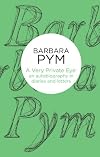
A Very Private Eye: An Autobiography in Diaries and Letters
by Barbara Pym 
On This Page
Description
The stunning autobiography of Barbara Pym, celebrated author of Quartet in Autumn, Jane and Prudence, and Excellent Women. "I'm a huge fan of Barbara Pym." RICHARD OSMAN "Barbara Pym is one of my most favourite novelists. Few other writers have given me more laughter and more pleasure." JILLY COOPER "Could one write a book based on one's diaries over thirty years? I certainly have enough material," wrote Barbara Pym. Selected from the diaries, notebooks, and letters of this beloved novelist show more A Very Private Eye is a unique, continuous narrative autobiography, providing a privileged insight into a writer's mind. Philip Larkin wrote that Barbara Pym had "a unique eye and ear for the small poignancies of everyday life." Her autobiography amply demonstrates this, as it traces her life from exuberant times at Oxford in the Thirties, through the war when, scarred by an unhappy love affair, she joined the WRNS, to the published novelist of the Fifties. It deals with the long period when her novels were out of fashion and no one would publish them, her rediscovery in 1977, and the triumphant success of her last few years. It is now possible to describe a place, situation or person as "very Barbara Pym." At once funny and moving, A Very Private Eye shows the variety and depth of her own story. show lessTags
Recommendations





















Member Recommendations

KayCliff Barbara Pym's diary shows how closely autobiographical this novel is.
Member Reviews
A fascinating and intimate glimpse of a writer who is (in my opinion) highly underrated for her subtle humor and dark comic moments. It was heartbreaking to read about Pym's long struggle with rejection as a writer after an initial burst of success, particularly in the midst of a cancer struggle. Her wicked humor emerges in her letters and diaries, particularly the dig at John Lennon's long hair as emerging from a female Victorian writer (I cackled at that). I've made it my new goal to introduce as many people as I can to Ms. Barbara Pym.
2020 has become my year of rereading the novels of Barbara Pym, my favourite novelist - "favourite" in the sense of "speaks most to my soul", not as in "greatest" or "best"; I believe she would have appreciated the distinction. This is my revised review.
I rate this book 5 stars from the perspective of a Pymhead. I have many reservations, however, for the general reader.
After Barbara Pym's death from cancer in 1980, her sister Hilary and friend Hazel embarked on a decade-long project of ensuring her legacy. This involved the publication of her final work, as well as two other completed novels, four further novellas (collected as Civil to Strangers and Other Writings), a biography (A Lot to Ask: The Life of Barbara Pym), a cookbook(!), show more and this "autobiography", a hefty tome cobbled together from Pym's diary entries and letters. Ultimately they would also compel the founding of the Barbara Pym Society, which continues unabated in 2020 after both ladies have passed on.
Pym was a born correspondent, maintaining lifelong friendships via post and keeping almost 100 notebooks of daily observations and thoughts, both for personal contemplation and for future novels. A Very Private Eye is an undeniably intimate portrait of her life from an Oxford undergraduate in the early 1930s through countless love affairs, service in WWII, early literary success, the devastating years she spent completely neglected by the literary establishment, and then her late-in-life thrilling rediscovery by the public. Pym's entire oeuvre is thirteen books, so anything additional is to be cherished by Pymheads like myself.
Pym was always conscious of her own writing and presentation, and thus many of the diary entries read with a strong narrative sense. Friends would remark after her passing that she took seemingly ordinary moments and found the pathos or humour within - indeed, it is just that power for small moments that make her novels so rewarding. (During the early days of WWII, Pym sees two nuns at Selfridge's, on the hottest day of the year, buying a typewriter, and ponders what they may be doing with it!) For someone whose public image became "tweedy spinster", it is delightful to see twentysomething Barbara pondering that it's a bit "disgraceful" to buy colourful underwear, but she is bearing in mind it may be seen by some young man. Pym's life was not beset by scandal: she worked tirelessly, wrote well, engaged in several ultimately unsatisfactory love affairs, and retired with her spinster sister to the country. In that sense, this is a life portrait for Pym fans, and not the treasure trove of scandals and shocks we might expect from a life portrait of, say, Norman Mailer. But the small details - intimate and historical - make this a treasure.
Yet now I must step back. Hazel and Hilary's determination to preserve Barbara's legacy was aided by strong celebrity supporters (Philip Larkin, Iris Murdoch's husband John Bayley, and Jilly Cooper, among many others) and by the great public interest in her narrative. The stunning rediscovery after 16 years without being published; the surprising depth of her novels unknown to so many readers; the tragedy of her death almost 3 years to the day after the Times Literary Supplement piece that re-launched her career... it was a wonderful narrative that the public rushed to - especially the Americans! So the hefty nature of this volume would have made sense at the time. As an ardent fan, I can't complain; I cherish every page. But if I'm too be objective, I have a few qualms about this book, namely: the length, the lack of intertextual referencing, and the assumptions made. All of which (outlined below) can be traced back to the core problem: is this a book only for obsessives, or is this an all-purpose autobiography?
Simply put, Hazel and Hilary either were unable to be objective, or they simply made the decision that only Pym lifers would commit. The denseness of the Oxford and WWII sections becomes tiring even for a seasoned reader; the historical details are very interesting (among them an ill-fated affair with a young Nazi in the mid-1930s!), but in such numbers, they don't necessarily reveal enough about Pym the novelist, the character we have assumedly come to see. This is compounded by the near-complete absence of correspondence from 1950-1961,. i.e. the period in which Pym first became a published author. Perhaps - with working full-time and writing six novels - she had less time for writing on the side. It's an intriguing lacuna, but disappointing. (Another haze surrounds a young lover of Pym's named only "Jay" in the book; he was in fact the British Conservative MP Julian Amery, who was still alive at the time this was published, so perhaps this explains the ambiguities Holt employs.) In the later sections, Holt will often include letters from Pym to two different people recounting similar events, which suggests a determination to simply cram in as much Pymmian writing as possible.
On its own, the length wouldn't be a dealbreaker, but the un-scholarly nature of the proceedings is disappointing. A few footnotes to clarify things Pym did not note would be appreciated, from the small (did she pass that late-in-life driving test which is foreshadowed in several entries?) to the medium (her Polish acquaintances are said to have been making plans to escape to England in 1938; did they succeed?) to the large (I would have appreciated a note when, for instance, a major character from Barbara's youth is noted in passing as having died - when did they die? did they have any final correspondence with her?). Passing phrases can be frustrating, for instance when two of Barbara's former loves are noted to have died within "months of each other", but - although I cannot find an exact date for one of them - it appears to have been at least a year between the two deaths. And there are a surprising number of errors, one assumes transcription errors from the original papers. (For instance, Barbara is noted as visiting the lying-in-state of King George VI on 1 February 1952, but he didn't die until the following week!) There are clearly incorrect dates, name spellings, and other such throughout (some of which I confirmed via the companion volume, A Lot to Ask). Mine is a 1st ed, so it's possible some of these were corrected subsequently.
Most frustratingly, following from the above, is that the general reader - i.e., they who have not read all of Pym's novels - will feel a bit at sea. Holt digs out moments in Barbara's diaries where she notes an odd occurrence, which she will use years (even decades) later for a novel. But these instances are not footnoted, and all diary entries occur chronologically. So a short diary entry may appear noting an unusual person on the bus or a strange conversation overheard, which seems entirely arbitrary to the reader unaware that they form a scene from, say, A Glass of Blessings.
Hazel and Hilary, like Barbara, were "excellent women". I suffer - very unusually, for me - a sense of betrayal raising these qualms, but it is frustrating to feel a quibble of doubt when reading a note or a date. Still, beyond the surface-level qualms, this is a volume that I adore. I'm not a reader of biographies, so I don't know why I enjoy knowing that Pym's lavatory calendar one year was Shakespeare-based with an over-emphasis on Troilus and Cressida or the names of the final litter of kittens in the Pym household. It's all gold to me - but the world awaits a definitive, thoroughly-researched, literature-focused biography. show less
I rate this book 5 stars from the perspective of a Pymhead. I have many reservations, however, for the general reader.
After Barbara Pym's death from cancer in 1980, her sister Hilary and friend Hazel embarked on a decade-long project of ensuring her legacy. This involved the publication of her final work, as well as two other completed novels, four further novellas (collected as Civil to Strangers and Other Writings), a biography (A Lot to Ask: The Life of Barbara Pym), a cookbook(!), show more and this "autobiography", a hefty tome cobbled together from Pym's diary entries and letters. Ultimately they would also compel the founding of the Barbara Pym Society, which continues unabated in 2020 after both ladies have passed on.
Pym was a born correspondent, maintaining lifelong friendships via post and keeping almost 100 notebooks of daily observations and thoughts, both for personal contemplation and for future novels. A Very Private Eye is an undeniably intimate portrait of her life from an Oxford undergraduate in the early 1930s through countless love affairs, service in WWII, early literary success, the devastating years she spent completely neglected by the literary establishment, and then her late-in-life thrilling rediscovery by the public. Pym's entire oeuvre is thirteen books, so anything additional is to be cherished by Pymheads like myself.
Pym was always conscious of her own writing and presentation, and thus many of the diary entries read with a strong narrative sense. Friends would remark after her passing that she took seemingly ordinary moments and found the pathos or humour within - indeed, it is just that power for small moments that make her novels so rewarding. (During the early days of WWII, Pym sees two nuns at Selfridge's, on the hottest day of the year, buying a typewriter, and ponders what they may be doing with it!) For someone whose public image became "tweedy spinster", it is delightful to see twentysomething Barbara pondering that it's a bit "disgraceful" to buy colourful underwear, but she is bearing in mind it may be seen by some young man. Pym's life was not beset by scandal: she worked tirelessly, wrote well, engaged in several ultimately unsatisfactory love affairs, and retired with her spinster sister to the country. In that sense, this is a life portrait for Pym fans, and not the treasure trove of scandals and shocks we might expect from a life portrait of, say, Norman Mailer. But the small details - intimate and historical - make this a treasure.
Yet now I must step back. Hazel and Hilary's determination to preserve Barbara's legacy was aided by strong celebrity supporters (Philip Larkin, Iris Murdoch's husband John Bayley, and Jilly Cooper, among many others) and by the great public interest in her narrative. The stunning rediscovery after 16 years without being published; the surprising depth of her novels unknown to so many readers; the tragedy of her death almost 3 years to the day after the Times Literary Supplement piece that re-launched her career... it was a wonderful narrative that the public rushed to - especially the Americans! So the hefty nature of this volume would have made sense at the time. As an ardent fan, I can't complain; I cherish every page. But if I'm too be objective, I have a few qualms about this book, namely: the length, the lack of intertextual referencing, and the assumptions made. All of which (outlined below) can be traced back to the core problem: is this a book only for obsessives, or is this an all-purpose autobiography?
Simply put, Hazel and Hilary either were unable to be objective, or they simply made the decision that only Pym lifers would commit. The denseness of the Oxford and WWII sections becomes tiring even for a seasoned reader; the historical details are very interesting (among them an ill-fated affair with a young Nazi in the mid-1930s!), but in such numbers, they don't necessarily reveal enough about Pym the novelist, the character we have assumedly come to see. This is compounded by the near-complete absence of correspondence from 1950-1961,. i.e. the period in which Pym first became a published author. Perhaps - with working full-time and writing six novels - she had less time for writing on the side. It's an intriguing lacuna, but disappointing. (Another haze surrounds a young lover of Pym's named only "Jay" in the book; he was in fact the British Conservative MP Julian Amery, who was still alive at the time this was published, so perhaps this explains the ambiguities Holt employs.) In the later sections, Holt will often include letters from Pym to two different people recounting similar events, which suggests a determination to simply cram in as much Pymmian writing as possible.
On its own, the length wouldn't be a dealbreaker, but the un-scholarly nature of the proceedings is disappointing. A few footnotes to clarify things Pym did not note would be appreciated, from the small (did she pass that late-in-life driving test which is foreshadowed in several entries?) to the medium (her Polish acquaintances are said to have been making plans to escape to England in 1938; did they succeed?) to the large (I would have appreciated a note when, for instance, a major character from Barbara's youth is noted in passing as having died - when did they die? did they have any final correspondence with her?). Passing phrases can be frustrating, for instance when two of Barbara's former loves are noted to have died within "months of each other", but - although I cannot find an exact date for one of them - it appears to have been at least a year between the two deaths. And there are a surprising number of errors, one assumes transcription errors from the original papers. (For instance, Barbara is noted as visiting the lying-in-state of King George VI on 1 February 1952, but he didn't die until the following week!) There are clearly incorrect dates, name spellings, and other such throughout (some of which I confirmed via the companion volume, A Lot to Ask). Mine is a 1st ed, so it's possible some of these were corrected subsequently.
Most frustratingly, following from the above, is that the general reader - i.e., they who have not read all of Pym's novels - will feel a bit at sea. Holt digs out moments in Barbara's diaries where she notes an odd occurrence, which she will use years (even decades) later for a novel. But these instances are not footnoted, and all diary entries occur chronologically. So a short diary entry may appear noting an unusual person on the bus or a strange conversation overheard, which seems entirely arbitrary to the reader unaware that they form a scene from, say, A Glass of Blessings.
Hazel and Hilary, like Barbara, were "excellent women". I suffer - very unusually, for me - a sense of betrayal raising these qualms, but it is frustrating to feel a quibble of doubt when reading a note or a date. Still, beyond the surface-level qualms, this is a volume that I adore. I'm not a reader of biographies, so I don't know why I enjoy knowing that Pym's lavatory calendar one year was Shakespeare-based with an over-emphasis on Troilus and Cressida or the names of the final litter of kittens in the Pym household. It's all gold to me - but the world awaits a definitive, thoroughly-researched, literature-focused biography. show less
This collection of diary entries, brief journal notes, and letters allows the reader to follow the arc of Barbara Pym's life as she moves from besotted college student to WRN to middle-aged office worker, to Booker prize nominee and finally to death from cancer in her sixties. I was surprised at how you could understand how her experiences led her to make certain decisions about her life (joining the WRNS an obvious example, but there were others) and how moving it was to watch her mature and cope with life's many disappointments. Of course you learn much about her novels and about how she wrote her life's experiences into them. Her sense of humor and irony never left her! The chief flaw is with the WRNS section which drags on, in part show more because she was going through a self-absorbed period which thankfully lifted when she returned to London and novel-writing. show less
(? No indication as to where I got this. I suspect the book stall in Greenwich, but I’m not sure)
An autobiography collected by Barbara Pym’s sister and executrix out of her diaries and letters, this is of necessity not as selective or well-shaped as a conventional biography would be. Some of the student writings were pretty gushy, and I found the Stevie Smith-like letters to Elsie almost unbearably pathetic in their attempts at cheer and not caring about her marriage to Pym’s love, Henry; but I did love the letters to Larkin, although I would have liked to read his to her, too), even though the inclusion of these, diary entries and letters to another correspondent gave rather a repetitive effect at times. There was a lot of good show more detail about the writing of all of her books, the background to Quartet in Autumn being particularly interesting (this from someone who claims not to want to know about the authorial intent – oh well!).
On this repetition, I suppose that in 1984, with Pym gone 4 years previously and the posthumous publication of “Civil to Strangers”, etc., not yet completed, this gave people want they wanted – as much more of Pym’s words and writings as they could possibly get. You can’t really argue with that.
I loved the glimpses of Iris Murdoch (of course), and also of Paul Binding, who I met at the Pym Conference, and who actually introduced BP to IM, at his house! show less
An autobiography collected by Barbara Pym’s sister and executrix out of her diaries and letters, this is of necessity not as selective or well-shaped as a conventional biography would be. Some of the student writings were pretty gushy, and I found the Stevie Smith-like letters to Elsie almost unbearably pathetic in their attempts at cheer and not caring about her marriage to Pym’s love, Henry; but I did love the letters to Larkin, although I would have liked to read his to her, too), even though the inclusion of these, diary entries and letters to another correspondent gave rather a repetitive effect at times. There was a lot of good show more detail about the writing of all of her books, the background to Quartet in Autumn being particularly interesting (this from someone who claims not to want to know about the authorial intent – oh well!).
On this repetition, I suppose that in 1984, with Pym gone 4 years previously and the posthumous publication of “Civil to Strangers”, etc., not yet completed, this gave people want they wanted – as much more of Pym’s words and writings as they could possibly get. You can’t really argue with that.
I loved the glimpses of Iris Murdoch (of course), and also of Paul Binding, who I met at the Pym Conference, and who actually introduced BP to IM, at his house! show less
At the risk of repeating myself – I’m really rather bad at reading non-fiction. I have to admit that even when reading a non-fiction book I am really enjoying that there are moments I long for fiction. The fault is all mine, my mind wanders and I get, what I can only call the readers equivalent to the fidgets.
So bearing that in mind, I did enjoy this autobiography in diaries and letters, but there were moments when I enjoyed it more than at others. That is no criticism of the work – I must stress that – it’s my insatiable fiction brain; I do despair of my non-fiction attention span. I do think that reading about somebody through their own words – originally not written with publication in mind, is wonderfully illuminating. show more I read Hazel Holt’s biography of Barbara Pym a few years ago, and so there was a little bit of going over old ground I suppose – although I had forgotten a lot of it – but this was a richer reading experience because reading Barbara’s words was naturally much more intimate.
Each section of the book contains some brief biographical contextualising by Hazel Holt and a short section recalling their early life by Barbara’s sister Hilary Pym.
Part 1 takes us back to Barbara Pym’s years in Oxford, her friendships and heartbreaks – especially her long almost obsessional love for Henry Harvey – are recounted mainly through the diary entries she kept at this time.
“13th March (1934) Oswestry. My photos of Lorenzo (HH) lying in the punt came and I am so pleased with them – they are awfully good and like him too. I felt quite happy in the evening – I wish I could be certain that it would last. What a perilous thing happiness is!”
There is plenty of evidence of Pym’s recognisable wit even in her own diary entries, she clearly loved her time at Oxford, and kept in touch with many of the friends she had then. It was around this time – just after leaving Oxford, of course that Barbara began writing. She began writing ‘Some Tame Gazelle’ about herself, her sister and some of their friends as they might be in thirty years. It was to be however a long time before the book was to be published – thankfully Barbara Pym never gave up.
The second section of the books recounts Barbara Pym’s war; she joined the Wrens and eventually ended up in Italy. She seemed to find the idea of herself as a wren a bit ludicrous and speaks of soon being found out as an imposter. This section of the book is told through diary entries and letters from Barbara to her friends Henry and Elsie Harvey and Bob Smith. These letters are often hilarious – and demonstrate her brilliant sense of humour and ability to poke gentle fun.
The third section – entitled the novelist celebrates the years in which Barbara Pym enjoyed her best success. After 1948 Barbara Pym kept notebooks – in which she recorded in surprising detail her observations, ideas for novels and other day to day things. She was also still writing letters. Barbara didn’t write full time however – she did in fact work for many years at the International African Institute in London, undertaking similar work as so many of her characters. However Barbara Pym’s publishing success came to an abrupt halt in 1963.
“24 March 1963 To receive a bitter blow on an early Spring evening (such as that Cape don’t want to publish An Unsuitable Attachment –but it might be that someone doesn’t love you anymore) – is it worse than on an Autumn or Winter evening? Smell of bonfire (the burning of rose prunings etc), a last hyacinth in the house, forsythia about to burst, a black and white cat on the sofa, a small fire burning in the grate, books and Sunday papers and the remains of tea.”
During these years Barbara kept writing – she sometimes lost heart – but she never gave up – there’s a message in that for us all I am sure. Also during these years she struck up a wonderful epistolary friendship with poet Philip Larkin. In January 1977 the Times Literary Supplement published a list of under-rated writers, chosen by other literary figures. Both Lord David Cecil and Philip Larkin named Barbara Pym (there was apparently no collusion) – almost overnight Barbara found her novels to be back in vogue. Thank goodness for Philip Larkin and Lord David Cecil – but so sad that this final recognition came so late in her life.
Reading this autobiography during Barbara Pym reading week seemed very fitting, and I am glad I did. I certainly feel as if I know Barbara Pym a little better, and I feel sure I would have liked her too. I thoroughly enjoyed the sections of the book that dealt with Barbara Pym at Oxford and her experiences during the war. However I did get a bit bogged down in some of the letters to her friends – despite they being so well written - there were maybe a few too many – all saying very similar things. show less
So bearing that in mind, I did enjoy this autobiography in diaries and letters, but there were moments when I enjoyed it more than at others. That is no criticism of the work – I must stress that – it’s my insatiable fiction brain; I do despair of my non-fiction attention span. I do think that reading about somebody through their own words – originally not written with publication in mind, is wonderfully illuminating. show more I read Hazel Holt’s biography of Barbara Pym a few years ago, and so there was a little bit of going over old ground I suppose – although I had forgotten a lot of it – but this was a richer reading experience because reading Barbara’s words was naturally much more intimate.
Each section of the book contains some brief biographical contextualising by Hazel Holt and a short section recalling their early life by Barbara’s sister Hilary Pym.
Part 1 takes us back to Barbara Pym’s years in Oxford, her friendships and heartbreaks – especially her long almost obsessional love for Henry Harvey – are recounted mainly through the diary entries she kept at this time.
“13th March (1934) Oswestry. My photos of Lorenzo (HH) lying in the punt came and I am so pleased with them – they are awfully good and like him too. I felt quite happy in the evening – I wish I could be certain that it would last. What a perilous thing happiness is!”
There is plenty of evidence of Pym’s recognisable wit even in her own diary entries, she clearly loved her time at Oxford, and kept in touch with many of the friends she had then. It was around this time – just after leaving Oxford, of course that Barbara began writing. She began writing ‘Some Tame Gazelle’ about herself, her sister and some of their friends as they might be in thirty years. It was to be however a long time before the book was to be published – thankfully Barbara Pym never gave up.
The second section of the books recounts Barbara Pym’s war; she joined the Wrens and eventually ended up in Italy. She seemed to find the idea of herself as a wren a bit ludicrous and speaks of soon being found out as an imposter. This section of the book is told through diary entries and letters from Barbara to her friends Henry and Elsie Harvey and Bob Smith. These letters are often hilarious – and demonstrate her brilliant sense of humour and ability to poke gentle fun.
The third section – entitled the novelist celebrates the years in which Barbara Pym enjoyed her best success. After 1948 Barbara Pym kept notebooks – in which she recorded in surprising detail her observations, ideas for novels and other day to day things. She was also still writing letters. Barbara didn’t write full time however – she did in fact work for many years at the International African Institute in London, undertaking similar work as so many of her characters. However Barbara Pym’s publishing success came to an abrupt halt in 1963.
“24 March 1963 To receive a bitter blow on an early Spring evening (such as that Cape don’t want to publish An Unsuitable Attachment –but it might be that someone doesn’t love you anymore) – is it worse than on an Autumn or Winter evening? Smell of bonfire (the burning of rose prunings etc), a last hyacinth in the house, forsythia about to burst, a black and white cat on the sofa, a small fire burning in the grate, books and Sunday papers and the remains of tea.”
During these years Barbara kept writing – she sometimes lost heart – but she never gave up – there’s a message in that for us all I am sure. Also during these years she struck up a wonderful epistolary friendship with poet Philip Larkin. In January 1977 the Times Literary Supplement published a list of under-rated writers, chosen by other literary figures. Both Lord David Cecil and Philip Larkin named Barbara Pym (there was apparently no collusion) – almost overnight Barbara found her novels to be back in vogue. Thank goodness for Philip Larkin and Lord David Cecil – but so sad that this final recognition came so late in her life.
Reading this autobiography during Barbara Pym reading week seemed very fitting, and I am glad I did. I certainly feel as if I know Barbara Pym a little better, and I feel sure I would have liked her too. I thoroughly enjoyed the sections of the book that dealt with Barbara Pym at Oxford and her experiences during the war. However I did get a bit bogged down in some of the letters to her friends – despite they being so well written - there were maybe a few too many – all saying very similar things. show less
Barbara Pym was the Margaret Atwood of her time - well, maybe that's not quite the way to put it since Atwood is world-renowned now and Pym remains on the periphery. Still, Barbara had insights into souls and showed those insights in small, succinct ways in her novels. Her books can be read as "cozies", though they're deeper than her original editors gave her credit for. More is the pity for us through their blindness, because we were owed more of her fiction than we got.
The novels of Barbara Pym feature several indexers. Now this volume of her diaries and letters has been posthumously published. It is fitting that it should have a full and distinctive index, compiled by the writer's sister.
The index is of 20 pages, to a 334-page text, and headed 'Index/Glossary'. As the Note (oddly placed in the prelims) explains, 'The index contains biographical information, with cross-references under Christian names and nicknames, identification of places and vocabulary definitions as well as references to Barbara Pym's novels. Where the reference to an incident or a character is implied (i.e. where no actual reference to the title of the novel is made in the text) the page number is given in italics.'
The imprints show more page even specifies:
Barbara Pym's text, The Early Life and Index © Hilary Walton 1984.
Some entries are indeed so fully expanded as to qualify as original writing. For instance:
Arkesden, Essex (picturesque village favoured by London commuters, home of Gordon Glover)
'Cheesing' (making pleasant conversation at parties)
Dunbabin, Tom (archaeologist who was to become a hero of Crete)
Eno's (fruit salt: fizzy medicinal drink to cure indigestion)
Hartley, Lister and Rex (famous golfing brothers, members of the family jam-making firm)
Harvey, Henry Stanley (nicknamed 'Lorenzo'; b. 1911, but reached his fifties in 1934 when Barbara made him the chief male character in what was to be her first novel, Some Tame Gazelle. After Oxford, where they met, he was at the University of Helsingfors, and later with the British Council)
'Jay' (b. 1919; a romantic encounter in 1938, for which he had all the attributes, including a central European education and political ambitions)
'Prog' (verb, to discipline undergraduates, derived from 'proctor', of which there are two; see John Betjeman, An Oxford University Chest, John Miles, 1938, p. 17)
Turban (wartime fashion for women of wearing a scarf round the head)
'Winter break' (short weekend holiday, arranged with favourable terms by various hotels)
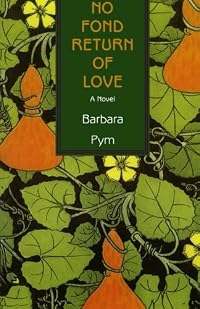
As the Note indicates, there is assiduous detective work in identifying references to the novels that are not specified as such in the text. For example, cited in the index under No Fond Return of Love ('original title A Thankless Task') is 128. This leads to a diary entry describing Barbara Pym's embarrassment, on complaining about the cloakroom basin's being filled with
flowers, at being told by an 'elderly censor' that 'she was taking them to an invalid'. Readers of that tale of romance among indexers will recognize the episode.
The entry for Pym, Barbara, occupies three columns, giving a fairly full summary of the book, with long, detailed subheadings:
she completes the draft of another novel about a provincial university, but has little faith in the future of her kind of writing, 267; . . . has ideas for a novel about people in an office on the verge of retirement, 268-72
But there is a strong tendency through most of the index to substitute a general gloss for breakdown into subheadings, and there are many strings of whole lines of undifferentiated page references: 14 such lines for Philip Larkin, 10 for Robert Liddell. The 9-line gloss for Henry Harvey quoted above is followed by 7. lines of page refer ences. The indexer herself is, modestly, glossed merely as (b. 1916, sister), and has then 11 lines of undifferentiated page references.
However, an index of originality and charm, showing respect and devotion for its text; wholly appropriate for the author who gave us Mildred Lathbury and Dulcie Mainwaring, and wrote so warmly and wittily of indexers' 'thankless task'. show less
The index is of 20 pages, to a 334-page text, and headed 'Index/Glossary'. As the Note (oddly placed in the prelims) explains, 'The index contains biographical information, with cross-references under Christian names and nicknames, identification of places and vocabulary definitions as well as references to Barbara Pym's novels. Where the reference to an incident or a character is implied (i.e. where no actual reference to the title of the novel is made in the text) the page number is given in italics.'
The imprints show more page even specifies:
Barbara Pym's text, The Early Life and Index © Hilary Walton 1984.
Some entries are indeed so fully expanded as to qualify as original writing. For instance:
Arkesden, Essex (picturesque village favoured by London commuters, home of Gordon Glover)
'Cheesing' (making pleasant conversation at parties)
Dunbabin, Tom (archaeologist who was to become a hero of Crete)
Eno's (fruit salt: fizzy medicinal drink to cure indigestion)
Hartley, Lister and Rex (famous golfing brothers, members of the family jam-making firm)
Harvey, Henry Stanley (nicknamed 'Lorenzo'; b. 1911, but reached his fifties in 1934 when Barbara made him the chief male character in what was to be her first novel, Some Tame Gazelle. After Oxford, where they met, he was at the University of Helsingfors, and later with the British Council)
'Jay' (b. 1919; a romantic encounter in 1938, for which he had all the attributes, including a central European education and political ambitions)
'Prog' (verb, to discipline undergraduates, derived from 'proctor', of which there are two; see John Betjeman, An Oxford University Chest, John Miles, 1938, p. 17)
Turban (wartime fashion for women of wearing a scarf round the head)
'Winter break' (short weekend holiday, arranged with favourable terms by various hotels)
As the Note indicates, there is assiduous detective work in identifying references to the novels that are not specified as such in the text. For example, cited in the index under No Fond Return of Love ('original title A Thankless Task') is 128. This leads to a diary entry describing Barbara Pym's embarrassment, on complaining about the cloakroom basin's being filled with
flowers, at being told by an 'elderly censor' that 'she was taking them to an invalid'. Readers of that tale of romance among indexers will recognize the episode.
The entry for Pym, Barbara, occupies three columns, giving a fairly full summary of the book, with long, detailed subheadings:
she completes the draft of another novel about a provincial university, but has little faith in the future of her kind of writing, 267; . . . has ideas for a novel about people in an office on the verge of retirement, 268-72
But there is a strong tendency through most of the index to substitute a general gloss for breakdown into subheadings, and there are many strings of whole lines of undifferentiated page references: 14 such lines for Philip Larkin, 10 for Robert Liddell. The 9-line gloss for Henry Harvey quoted above is followed by 7. lines of page refer ences. The indexer herself is, modestly, glossed merely as (b. 1916, sister), and has then 11 lines of undifferentiated page references.
However, an index of originality and charm, showing respect and devotion for its text; wholly appropriate for the author who gave us Mildred Lathbury and Dulcie Mainwaring, and wrote so warmly and wittily of indexers' 'thankless task'. show less
Members
- Recently Added By
Author Information

27+ Works 14,703 Members
Novelist Barbara Pym was born in Shropshire and educated at Oxford University. An editor of Africa, an anthropological review, for many years, she published her first novel, Some Tame Gazelle, in 1950. Since then, a number of popular works have been published. Often compared with the works of Jane Austen in both manner and subject, Pym's novels show more are apparently guileless evocations of the foibles of aging and isolated characters. She has a sure, if understated, sense of her characters' psychology and of their unintentionally comic revelations about themselves and their futile lives. After the publication of No Fond Return of Love (1961), all her books were out of print until she was cited, coincidentally by both David Cecil and Philip Larkin, as among the most underestimated novelists of the 20th century. She subsequently completed two successful novels, The Sweet Dove Died (1978) and Quartet in Autumn (1978), the latter a comic-pathetic study of two men and two women in their sixties who work in the same office but lead separate, lonely lives outside. Many of her earlier books have since been reprinted, including Excellent Women (1952) and A Glass of Blessings (1958), both perceptive psychological studies of aging women taken advantage of by others. A posthumous novel, A Few Green Leaves (1980), is a superb comedy of provincial village life. (Bowker Author Biography) show less
Barbara Pym has a Legacy Library. Legacy libraries are the personal libraries of famous readers, entered by LibraryThing members from the Legacy Libraries group.
All Editions
Awards and Honors
Distinctions
Common Knowledge
- Original publication date
- 1984
- First words
- It is now possible to describe a place, a situation or a person as `very Barbara Pym'.
- Quotations
- I had a letter from the Editor of the Church Times saying that although they didn't now normally have space for novel reviews he was going to review mine . . . if only because I had given so many splendid free commercials for... (show all) the Church Times
- Last words
- (Click to show. Warning: May contain spoilers.)She died on 11 January 1980.
Classifications
Statistics
- Members
- 415
- Popularity
- 74,304
- Reviews
- 11
- Rating
- (3.92)
- Languages
- English
- Media
- Paper, Ebook
- ISBNs
- 14
- ASINs
- 4