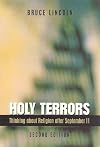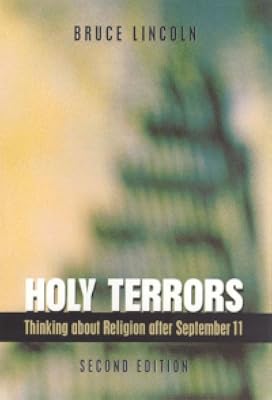
Holy Terrors: Thinking about Religion after September 11
by Bruce Lincoln
On This Page
Description
In the wake of the September 11 terrorist attacks, it is tempting to regard their perpetrators as evil incarnate. But their motives, as Bruce Lincoln shows in this timely offering, were profoundly and intensely religious. What we need, then, after September 11 is greater clarity about what we take religion to be. With rigor and incisiveness, Holy Terrors examines the implications of September 11 for our understanding of religion and how it interrelates with politics and culture. Lincoln show more begins with a gripping dissection of the instruction manual given to each of the hijackers. In their evocation of passages from the Quran, we learn how the terrorists justified acts of destruction and mass murder "in the name of God, the most merciful, the most compassionate." Lincoln then offers a provocative comparison of President Bush's October 7 speech announcing U.S. military action in Afghanistan and Osama bin Laden's videotape released hours later. Each speech, he argues, betrays telling contradictions. Bin Laden, for instance, conceded implicitly that Islam is not unitary, as his religious rhetoric would have it, but is torn by deep political divisions. And Bush, steering clear of religious rhetoric for the sake of political unity, still reassured his constituents through coded allusions that American policy is firmly rooted in faith. Lincoln ultimately broadens his discussion further to consider the role of religion since September 11 and how it came to be involved with such fervent acts of political revolt. In the postcolonial world, he argues, religion is widely considered the most viable and effective instrument of rebellion against economic and social injustices. It is the institution through which unified communities ensure the integrity and continuity of their culture in the wake of globalization. Brimming with insights such as these, Holy Terrors will become one of the essential books on September 11 and a classic study on the character of religion. show lessTags
Recommendations



Member Recommendations
Member Reviews
Lincoln's Holy Terrors is an excellent piece of theorizing about the nature and potentials of religion in the 21st century. It was written in 2003 (although it incorporates texts composed earlier), and takes the September 11 attacks on the World Trade Center and Pentagon as a point of departure.
In the first of six chapters, Lincoln succeeds in providing a longish but successfully comprehensive definition of religion that does not presuppose or depend on concepts of God, spirits, souls, the supernatural, belief, or faith. The definition covers "four domains--discourse, practice, community, and institution," (7) which he later admits are derived from the topics addressed by Kant's treatises which "brought the campaign launched by the show more Enlightenment to a compromise conclusion." (58) He also proposes a spectrum from maximalist to minimalist religious influence in social conduct, using these as rough synonyms for fundamentalist and liberal religion respectively.
The second and third chapters of Holy Terrors maintain the focus on September 11 and public responses to it. In both cases, Lincoln undertakes some careful rhetorical analysis: first to compare the statements of US President G.W. Bush and Osama bin Laden (viewing them as representing societies predicated on minimalist and maximalist religious positions, although complicated by circumstance), and second to anatomize the efforts of American televangelists to use public reaction to the events as fuel for their own religious enterprises. These discussions are buttressed with primary documents appended to the main text.
The fourth chapter is rather brief and quite theoretical, although littered with examples and anecdotes, in an effort to examine the consequences of the different interactions of religion and culture under pre-Enlightenment maximalist conditions and post-Enlightenment minimalist ones. Chapter five goes on to chart a variety of possible processes by which these tensions can be activated and play out in a postcolonial environment.
The final chapter posits the inadequacy of previous social theories of religion, in that they uniformly take religion to be a conservative force favoring the status quo. History provides plenty of counterexamples which Lincoln does not hesitate to list, and he advances three categories beyond "status quo religion" to complete the picture: religions of resistance, religions of revolution, and religions of counter-revolution.
The whole book is only about a hundred pages, and it is well worth serious reflection by those who consider themselves proponents or critics of religion, as well as those concerned with the parameters of political and social change in our time when religious ambitions and conflicts seem to be so inflamed. show less
In the first of six chapters, Lincoln succeeds in providing a longish but successfully comprehensive definition of religion that does not presuppose or depend on concepts of God, spirits, souls, the supernatural, belief, or faith. The definition covers "four domains--discourse, practice, community, and institution," (7) which he later admits are derived from the topics addressed by Kant's treatises which "brought the campaign launched by the show more Enlightenment to a compromise conclusion." (58) He also proposes a spectrum from maximalist to minimalist religious influence in social conduct, using these as rough synonyms for fundamentalist and liberal religion respectively.
The second and third chapters of Holy Terrors maintain the focus on September 11 and public responses to it. In both cases, Lincoln undertakes some careful rhetorical analysis: first to compare the statements of US President G.W. Bush and Osama bin Laden (viewing them as representing societies predicated on minimalist and maximalist religious positions, although complicated by circumstance), and second to anatomize the efforts of American televangelists to use public reaction to the events as fuel for their own religious enterprises. These discussions are buttressed with primary documents appended to the main text.
The fourth chapter is rather brief and quite theoretical, although littered with examples and anecdotes, in an effort to examine the consequences of the different interactions of religion and culture under pre-Enlightenment maximalist conditions and post-Enlightenment minimalist ones. Chapter five goes on to chart a variety of possible processes by which these tensions can be activated and play out in a postcolonial environment.
The final chapter posits the inadequacy of previous social theories of religion, in that they uniformly take religion to be a conservative force favoring the status quo. History provides plenty of counterexamples which Lincoln does not hesitate to list, and he advances three categories beyond "status quo religion" to complete the picture: religions of resistance, religions of revolution, and religions of counter-revolution.
The whole book is only about a hundred pages, and it is well worth serious reflection by those who consider themselves proponents or critics of religion, as well as those concerned with the parameters of political and social change in our time when religious ambitions and conflicts seem to be so inflamed. show less
Lincoln has devoted much time to discussing Religion and Conflict. This book is an exploration and explanation of the religious rhetoric which drives much conflict in society. It is an interesting book but one wonders if his paradigms are too reductionistic (but this is usually expected when someone tries to explain an amorpheus subject such as religion). His discussion on the dilemma created by the nation-state is one worth reading and considering.
Ratings
Members
- Recently Added By
Author Information

21+ Works 656 Members
Bruce Lincoln is Caroline E. Haskell Distinguished Service Professor of the History of Religions in the Divinity School and in the Center for Middle Eastern Studies and Committee on Medieval Studies, and is Associate Faculty in the Departments of Anthropology and Classics at the University of Chicago. His most recent publications include Gods and show more Demons, Priests and Scholars: Critical Explorations in the History of Religions (2012), "Happiness for Mankind". Achaemenian Religion and the Imperial Project (2012), and Comparer en histoire des religions antiques, coedited with Claude Calame (2012). show less
Common Knowledge
- Canonical title
- Holy Terrors: Thinking about Religion after September 11
- Original publication date
- 2002
- Important events
- September 11 Attacks
- Dedication
- for my mother Gerry Grossman
- Blurbers
- Hecht, Richard; Lawrence, Bruce; Euben, Roxanne
- Canonical DDC/MDS
- 291.1787
- Canonical LCC
- BL65.T47
Classifications
- Genres
- Nonfiction, Religion & Spirituality, General Nonfiction, Philosophy, History
- DDC/MDS
- 291.1787 — Religion Other religions [Formerly: General Religious Topics] [formerly: Religious mythology, general classes of religion, interreligious relations and attitudes, social theology. Relocated to 201] Theologies Religions and Particular Groups of People
- LCC
- BL65 .T47 — Philosophy, Psychology and Religion Religions. Mythology. Rationalism Religions. Mythology. Rationalism Philosophy of religion. Psychology of religion. Religion
- BISAC
Statistics
- Members
- 142
- Popularity
- 227,087
- Reviews
- 2
- Rating
- (3.90)
- Languages
- English
- Media
- Paper, Ebook
- ISBNs
- 4
- ASINs
- 1