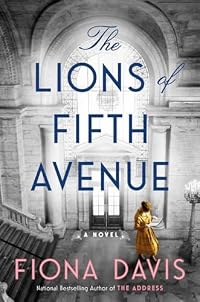
The Lions of Fifth Avenue
by Fiona Davis
On This Page
Description
A Good Morning America Book Club Pick and a New York Times bestseller!“A page-turner for booklovers everywhere! . . . A story of family ties, their lost dreams, and the redemption that comes from discovering truth.”—Adriana Trigiani, bestselling author of The Shoemaker's Wife
In New York Times bestselling author Fiona Davis's latest historical novel, a series of book thefts roils the iconic New York Public Library, leaving two generations of strong-willed women to pick up the show more pieces.
It's 1913, and on the surface, Laura Lyons couldn't ask for more out of life—her husband is the superintendent of the New York Public Library, allowing their family to live in an apartment within the grand building, and they are blessed with two children. But headstrong, passionate Laura wants more, and when she takes a leap of faith and applies to the Columbia Journalism School, her world is cracked wide open. As her studies take her all over the city, she is drawn to Greenwich Village's new bohemia, where she discovers the Heterodoxy Club—a radical, all-female group in which women are encouraged to loudly share their opinions on suffrage, birth control, and women's rights. Soon, Laura finds herself questioning her traditional role as wife and mother. And when valuable books are stolen back at the library, threatening the home and institution she loves, she's forced to confront her shifting priorities head on . . . and may just lose everything in the process.
Eighty years later, in 1993, Sadie Donovan struggles with the legacy of her grandmother, the famous essayist Laura Lyons, especially after she's wrangled her dream job as a curator at the New York Public Library. But the job quickly becomes a nightmare when rare manuscripts, notes, and books for the exhibit Sadie's running begin disappearing from the library's famous Berg Collection. Determined to save both the exhibit and her career, the typically risk-averse Sadie teams up with a private security expert to uncover the culprit. However, things unexpectedly become personal when the investigation leads Sadie to some unwelcome truths about her own family heritage—truths that shed new light on the biggest tragedy in the library's history. show less
Tags
Recommendations













Member Reviews
Did you know that the lions in front of the New York Public Library weren't always named Patience and Fortitude? Neither did I. (For the curious, their names were originally Leo Astor and Leo Lenox, after Jacob Astor and John Lenox, two of the library's founders. They were renamed in the 1930s by Mayor LaGuardia.) This was just one of the many things I learned about the New York Public Library, its history, and its beautiful house on Fifth Avenue.
Lest you think that this is a boring treatise on the NYPL, it most assuredly is not. This is a story of feminism, and not being afraid to fall in love again, and books, and book thefts. Told in two different time periods, we start with Laura Lyons, whose husband is the first superintendent of show more the NYPL. They live with their two children in an apartment in the library itself (and yes, that apartment actually exists, but the Lyons bear no resemblance to the actual family of the first superintendent beyond borrowing their living quarters). Laura loves her family, but is dissatisfied with her role in life and chafes under the gender norms of the early 20th century.
Jump 80 years into the future, and Laura's granddaughter Sadie is the curator of a special collection at the NYPL (she got the job entirely on her own merits, by the way, as no-one there even knows about the family connection). When first editions and valuable papers start disappearing from her collection, though, she must look back to her grandmother's time, when something similar happened. Could the past and future be connected? Why? How?
As Sadie works to solve the mystery of the book thefts, she must also try to answer questions about her family and their life in the library. Sadie is a character to be reckoned with, and her wit and determination shine off the page. Laura, too, is a character not soon to be forgotten, as she tries to solve the mystery of who she is and how she wants to leave her mark on the world. Their stories come together in a heart-pounding mix of whodunit and family saga that will leave readers both satisfied and wishing for a sequel.
For fans of Marie Benedict and Beatriz Williams. show less
Lest you think that this is a boring treatise on the NYPL, it most assuredly is not. This is a story of feminism, and not being afraid to fall in love again, and books, and book thefts. Told in two different time periods, we start with Laura Lyons, whose husband is the first superintendent of show more the NYPL. They live with their two children in an apartment in the library itself (and yes, that apartment actually exists, but the Lyons bear no resemblance to the actual family of the first superintendent beyond borrowing their living quarters). Laura loves her family, but is dissatisfied with her role in life and chafes under the gender norms of the early 20th century.
Jump 80 years into the future, and Laura's granddaughter Sadie is the curator of a special collection at the NYPL (she got the job entirely on her own merits, by the way, as no-one there even knows about the family connection). When first editions and valuable papers start disappearing from her collection, though, she must look back to her grandmother's time, when something similar happened. Could the past and future be connected? Why? How?
As Sadie works to solve the mystery of the book thefts, she must also try to answer questions about her family and their life in the library. Sadie is a character to be reckoned with, and her wit and determination shine off the page. Laura, too, is a character not soon to be forgotten, as she tries to solve the mystery of who she is and how she wants to leave her mark on the world. Their stories come together in a heart-pounding mix of whodunit and family saga that will leave readers both satisfied and wishing for a sequel.
For fans of Marie Benedict and Beatriz Williams. show less
I'm so happy to say that Fiona Davis has done it again! The Lions of Fifth Avenue features all of the elements that make her novels so wonderful - the backstory of an iconic New York City building, dual timelines, strong female characters, a mystery & commentary on the social issues of the times - and combines them in my favorite of her books so far.
The landmark the story revolves around this time is the New York Public Library. When it opens in 1913, the Lyons family lives in an apartment within the library where Jack Lyons is in charge of the building & its staff. Jack's wife, Laura, like many Davis heroines, is a woman ahead of her time & when she is accepted to the Columbia School of Journalism, she's exposed to a world beyond her show more privileged bubble & realizes she wants to be more than just a wife & mother.
Fast forward to 1993. Sadie Donovan works at the NYPL overseeing a collection of rare books & artifacts including a walking stick which belonged to Laura Lyons, who went on to become a renowned feminist writer & is also Sadie's grandmother. When rare books start disappearing, she discovers that something similar occurred back in 1913 when the Lyons family lived there as well. Sadie knows she has to find out who's behind the thefts & her family's possible connection to them before she becomes the main suspect.
The NYPL has always been one of my favorite places & I cannot wait until I can go back to visit to see it through the lens of this novel. I loved all of the details about rare books & literary memorabilia & how important they are to properly preserve. But most of all, I was drawn in by the characters - Laura & Sadie, of course, but also Laura's mother, a woman whose future wasn't her own & is determined to help her daughter find her happy ending; Amelia, a feminist doctor who sees things in Laura she can't see in herself; and Nick, the private investigator brought in to find the book thief.
I read this book in a single day & didn't want it to end. I can't wait to see which legendary NYC spot Davis takes on next!
Thank you to NetGalley, Dutton Books & the author for an advanced review ecopy of the book. show less
The landmark the story revolves around this time is the New York Public Library. When it opens in 1913, the Lyons family lives in an apartment within the library where Jack Lyons is in charge of the building & its staff. Jack's wife, Laura, like many Davis heroines, is a woman ahead of her time & when she is accepted to the Columbia School of Journalism, she's exposed to a world beyond her show more privileged bubble & realizes she wants to be more than just a wife & mother.
Fast forward to 1993. Sadie Donovan works at the NYPL overseeing a collection of rare books & artifacts including a walking stick which belonged to Laura Lyons, who went on to become a renowned feminist writer & is also Sadie's grandmother. When rare books start disappearing, she discovers that something similar occurred back in 1913 when the Lyons family lived there as well. Sadie knows she has to find out who's behind the thefts & her family's possible connection to them before she becomes the main suspect.
The NYPL has always been one of my favorite places & I cannot wait until I can go back to visit to see it through the lens of this novel. I loved all of the details about rare books & literary memorabilia & how important they are to properly preserve. But most of all, I was drawn in by the characters - Laura & Sadie, of course, but also Laura's mother, a woman whose future wasn't her own & is determined to help her daughter find her happy ending; Amelia, a feminist doctor who sees things in Laura she can't see in herself; and Nick, the private investigator brought in to find the book thief.
I read this book in a single day & didn't want it to end. I can't wait to see which legendary NYC spot Davis takes on next!
Thank you to NetGalley, Dutton Books & the author for an advanced review ecopy of the book. show less
I'm a librarian, so I'm terribly biased toward books set in libraries and this book is no exception. Set across two eras, with the main branch of the New York Public Library as its setting, this novel had many of my favorite elements: family secrets, rare books, feminism, and book thieves. Okay, maybe book thieves aren't exactly my favorite kind of people, but I love a story about a librarian investigating a series of rare book robberies and discovering connections to her own family history. I also love the idea of a family living in an apartment within the library and I don't know that one could ask for a more fascinating setting. Overall, I loved this one and I'll certainly be looking for more from this author, even if they're not set show more in libraries. show less
Well, I know I'm probably in the minority here, but I didn't love it. The characters were interesting, and the plot was compelling enough to keep me reading, but I didn't think the whole was very well-crafted. I thought it was kind of insulting to women, though I doubt that was intentional.
At first, I liked it well enough. A book dedicated to librarians and set in a famous library? Great! At the beginning, I thought Laura's 1914 plot was more interesting than Sadie's 1992 plot, so I was delighted to see that the more I read, the more I warmed to Sadie's story. I thought the characters there felt genuine, and I enjoyed the journey. I liked that the author took her time with it. I liked that it kept my interest.
Then, the 1914 plot sort of show more derailed. That storyline's protagonist, Laura, is a married mother of two who is studying to be a journalist so she can help support her family. On the way, she stumbles into a plethora of feminist clichés. I don't say that lightly. I remember being in college and studying history, and we looked (among other things) at the feminist movement and the criticism it drew. There wasn't anyone in my class, as far as I know, who felt women shouldn't vote or shouldn't have jobs, so it was easy for us to kind of roll our eyes at some of the fears of the times. For example, (1) from the mid-1800s, the idea that women shouldn't pursue higher education because they can't handle being told they're wrong. (2) From 1860s-ish, a source suggesting women shouldn't have careers outside the home because they'll be corrupted by sin. (3) From circa 1920, the fear that women shouldn't vote because there will be no one to look after the children. And then, of course, there were the fears the other direction, that (4) powerful men are awful, and that (5) any problem is eclipsed by the larger problem of sexism. As cheap as these criticisms may sound, I hate to say this book reinforced every single one of them.
I get it; things were hard for Laura. Women of my generation have the benefit of seeing how older generations of women balanced work and family. Laura was forging her own path. Fine. But could she have been just a little less TSTL? Take her studies. She and her family sacrificed so much so that she could study journalism. This was, she thought, her career choice. Journalism is what she felt called to do. She took an ethics course. She was told, repeatedly, that journalism was a means of reporting facts, and the she needed to be as objective as possible in her writing. I could tell Laura didn't like factual journalism; she would have been much happier editorializing or working as an activist, but she didn't complain or try to change fields. She just went on through her classes, nodding her head at everything she was told, and then she didn't follow directions on her final project—she gave opinions instead of the objective, factual write-up she had been assigned—and wound up failing. Well, good? I mean, she deserved it. She chose not meet the course's requirements. Then she failed the course. Any sort of learning requires humility, and Laura, for all her gifts, lacks the ability to accept that just because she wants something, that makes it correct. I'm not saying her feelings were wrong, nor that she was wrong to voice them. But she was clearly wrong to turn a specific assignment into her own forum after being expressly told that that particular project was to be an objective description. She was wrong to be so narcissistic as to think that just because she felt it strongly, that made it okay for the project. She was wrong to disregard what the teacher told her just because she didn't like it. She was also wrong to fight the professor after the fact, instead of taking the just criticism. She was wrong to blame her failure on the people around her. Incidentally, I also blame the author here. The problem was Laura's refusal to follow the school's rules, so naturally there had to be a scene showing her teacher as obviously sexist and prejudiced. Why? So his flaws would eclipse Laura's, so that misogyny could steal the scene as the biggest of all problems, and so readers would be distracted from Laura's shortcomings by focusing on someone else's. See numbers (4) and (5) above. That's kind of a cop-out.
It gets worse: Laura herself reinforces a whole bunch of anti-feminism clichés. She couldn't handle school because she didn't want to follow someone else's directions. She started meeting with people to learn about feminism, which led (not kidding!) to moral decline: taking advantage of her mother's time as a free babysitter, lying to her husband about her whereabouts, lying to her friends about her intentions, and invading their privacy for her own gain. As she got better at her journalism, she got more and more impatient with her husband in his work. She became rude, teasing him on purpose about things that bothered him, and she started breaking promises that she had made to him. And the whole time, he seemed to think that all their troubles were somehow his fault; the crueler she was to him, the more he trusted her. She spent time away from her children, oblivious to the troubles that were plaguing them. If the goal here was to show that educating women makes them rude or self-seeking, or turns them into liars, or destroys the home, well good job, Fiona Davis, you nailed it. At the end of the novel, Laura's family (including Laura) is plunged into tragedy because of her. But if she'd stayed a stereotypical, obedient, stay-at-home housewife, everyone would have been happy (including Laura). So the upshot is that anti-feminism is bad. Sexism is bad. (Powerful men are bad.) But also, feminism is bad, and women studying and working is bad. Call me crazy, but I believe it's possible for men to care for their families and for family members to love one another. I believe that men with families can be upright and caring. I also believe that women are capable of studying and working (and yes, being feminist) without sacrificing their honor, character, or morality. I don't believe the patriarchy is incompatible with happiness, nor do I believe that feminism is incompatible with kindness.
Still, if this were as far as it went, Davis might have been able to pull it off. It might have been an illuminating portrait of a more corrupt side of feminism. In a world where little girls are told that they can do or be anything, this would be a novel to show the responsibility and the cost that comes with that power. And in that case, readers—whether feminist or not, whether they agree or not—might appreciate the story that explores those views. Such a story would show one woman's journey as she discovers herself and loses everything in the process. Laura would be seduced by the Dark Side of the Force and become Darth Laura, and I would have been impressed by her strength and sorry for the loss of her innocence and disturbed by the ease with which she let go of the things that are good. But she is not Darth Laura. She is, bizarrely, one of the story's heroes (still!) and all her selfishness seems less a character flaw and more a badge of honor. What a weird little book!
The good:
• The setting
• The emphasis on books
• The insight into rare books (I'm sure that was a lot to research)
• The writing, specifically the way the rare books fit the story. The research and the details felt natural and not at all forced.
• The way the author took her time telling the story.
• The character interactions, especially in the 1992 plotline. I liked the genuine warmth between Sadie and her brother, and I especially liked the sister-in-law. I'm glad this novel avoided clichés like the evil in-law trope; the SIL here was a real class act, and it was refreshing.
As for the rest, just enjoy the story, but don't take it too seriously. show less
At first, I liked it well enough. A book dedicated to librarians and set in a famous library? Great! At the beginning, I thought Laura's 1914 plot was more interesting than Sadie's 1992 plot, so I was delighted to see that the more I read, the more I warmed to Sadie's story. I thought the characters there felt genuine, and I enjoyed the journey. I liked that the author took her time with it. I liked that it kept my interest.
Then, the 1914 plot sort of show more derailed. That storyline's protagonist, Laura, is a married mother of two who is studying to be a journalist so she can help support her family. On the way, she stumbles into a plethora of feminist clichés. I don't say that lightly. I remember being in college and studying history, and we looked (among other things) at the feminist movement and the criticism it drew. There wasn't anyone in my class, as far as I know, who felt women shouldn't vote or shouldn't have jobs, so it was easy for us to kind of roll our eyes at some of the fears of the times. For example, (1) from the mid-1800s, the idea that women shouldn't pursue higher education because they can't handle being told they're wrong. (2) From 1860s-ish, a source suggesting women shouldn't have careers outside the home because they'll be corrupted by sin. (3) From circa 1920, the fear that women shouldn't vote because there will be no one to look after the children. And then, of course, there were the fears the other direction, that (4) powerful men are awful, and that (5) any problem is eclipsed by the larger problem of sexism. As cheap as these criticisms may sound, I hate to say this book reinforced every single one of them.
I get it; things were hard for Laura. Women of my generation have the benefit of seeing how older generations of women balanced work and family. Laura was forging her own path. Fine. But could she have been just a little less TSTL? Take her studies. She and her family sacrificed so much so that she could study journalism. This was, she thought, her career choice. Journalism is what she felt called to do. She took an ethics course. She was told, repeatedly, that journalism was a means of reporting facts, and the she needed to be as objective as possible in her writing. I could tell Laura didn't like factual journalism; she would have been much happier editorializing or working as an activist, but she didn't complain or try to change fields. She just went on through her classes, nodding her head at everything she was told, and then she didn't follow directions on her final project—she gave opinions instead of the objective, factual write-up she had been assigned—and wound up failing. Well, good? I mean, she deserved it. She chose not meet the course's requirements. Then she failed the course. Any sort of learning requires humility, and Laura, for all her gifts, lacks the ability to accept that just because she wants something, that makes it correct. I'm not saying her feelings were wrong, nor that she was wrong to voice them. But she was clearly wrong to turn a specific assignment into her own forum after being expressly told that that particular project was to be an objective description. She was wrong to be so narcissistic as to think that just because she felt it strongly, that made it okay for the project. She was wrong to disregard what the teacher told her just because she didn't like it. She was also wrong to fight the professor after the fact, instead of taking the just criticism. She was wrong to blame her failure on the people around her. Incidentally, I also blame the author here. The problem was Laura's refusal to follow the school's rules, so naturally there had to be a scene showing her teacher as obviously sexist and prejudiced. Why? So his flaws would eclipse Laura's, so that misogyny could steal the scene as the biggest of all problems, and so readers would be distracted from Laura's shortcomings by focusing on someone else's. See numbers (4) and (5) above. That's kind of a cop-out.
It gets worse: Laura herself reinforces a whole bunch of anti-feminism clichés. She couldn't handle school because she didn't want to follow someone else's directions. She started meeting with people to learn about feminism, which led (not kidding!) to moral decline: taking advantage of her mother's time as a free babysitter, lying to her husband about her whereabouts, lying to her friends about her intentions, and invading their privacy for her own gain. As she got better at her journalism, she got more and more impatient with her husband in his work. She became rude, teasing him on purpose about things that bothered him, and she started breaking promises that she had made to him. And the whole time, he seemed to think that all their troubles were somehow his fault; the crueler she was to him, the more he trusted her. She spent time away from her children, oblivious to the troubles that were plaguing them. If the goal here was to show that educating women makes them rude or self-seeking, or turns them into liars, or destroys the home, well good job, Fiona Davis, you nailed it. At the end of the novel, Laura's family (including Laura) is plunged into tragedy because of her. But if she'd stayed a stereotypical, obedient, stay-at-home housewife, everyone would have been happy (including Laura). So the upshot is that anti-feminism is bad. Sexism is bad. (Powerful men are bad.) But also, feminism is bad, and women studying and working is bad. Call me crazy, but I believe it's possible for men to care for their families and for family members to love one another. I believe that men with families can be upright and caring. I also believe that women are capable of studying and working (and yes, being feminist) without sacrificing their honor, character, or morality. I don't believe the patriarchy is incompatible with happiness, nor do I believe that feminism is incompatible with kindness.
Still, if this were as far as it went, Davis might have been able to pull it off. It might have been an illuminating portrait of a more corrupt side of feminism. In a world where little girls are told that they can do or be anything, this would be a novel to show the responsibility and the cost that comes with that power. And in that case, readers—whether feminist or not, whether they agree or not—might appreciate the story that explores those views. Such a story would show one woman's journey as she discovers herself and loses everything in the process. Laura would be seduced by the Dark Side of the Force and become Darth Laura, and I would have been impressed by her strength and sorry for the loss of her innocence and disturbed by the ease with which she let go of the things that are good. But she is not Darth Laura. She is, bizarrely, one of the story's heroes (still!) and all her selfishness seems less a character flaw and more a badge of honor. What a weird little book!
The good:
• The setting
• The emphasis on books
• The insight into rare books (I'm sure that was a lot to research)
• The writing, specifically the way the rare books fit the story. The research and the details felt natural and not at all forced.
• The way the author took her time telling the story.
• The character interactions, especially in the 1992 plotline. I liked the genuine warmth between Sadie and her brother, and I especially liked the sister-in-law. I'm glad this novel avoided clichés like the evil in-law trope; the SIL here was a real class act, and it was refreshing.
As for the rest, just enjoy the story, but don't take it too seriously. show less
I really enjoyed this story set in the NYPL. In the story, in 1913, the Lyons family lives in the library. Jack, the superintendent of the library, is working on a manuscript. His wife, Laura, wants to become a journalist. She is accepted to Columbia Journalism School. However, Jack believes she needs to stay home with the children. Another storyline takes place in 1993, with Sadie Donovan being named interim curator of the Berg Collection, which houses rare books and artifacts at the NYPL. Interestingly, Sadie is a descendant of the Lyons.
In both timelines, rare books go missing, and the Lyons/Sadie are suspects.
I enjoyed the parts of the story about the architecture of the NYPL, the work that goes on in libraries, the interesting show more collections, and the story of women’s issues in 1913 vs. now.
Thanks to Edelweiss for the ARC. show less
In both timelines, rare books go missing, and the Lyons/Sadie are suspects.
I enjoyed the parts of the story about the architecture of the NYPL, the work that goes on in libraries, the interesting show more collections, and the story of women’s issues in 1913 vs. now.
Thanks to Edelweiss for the ARC. show less
I could write a whole blog post about how much I love libraries, and all the ways libraries have been great friends all my life. But this is a book review, so I’ll just say that library love was the main reason I picked up The Lions of Fifth Avenue (2020) by Fiona Davis. And just like the actual libraries, this book did not disappoint me.
The first magical thing to know is that part of the premise is absolutely true: From 1910 to 1940, the superintendent of the New York Public Library’s newly built Fifth Avenue main building lived with his family inside the library in a seven-room apartment. Can you imagine?! Of course, his job to keep the library’s technical systems and physical plant running was a 24/7 job, so I’m sure it was show more not nearly as glamorous as it seems from this distance. On the other hand, what fun for his children, one of whom went on to be the library’s chief engineer, though he did not live inside the library as an adult.
But now I’ve gotten totally off track, which is just what happens when a book captures your imagination so thoroughly. The family in Davis’ book, Jack and Laura Lyons and their children, Harry and Pearl, bear little or no resemblance to the true story that inspired the novel. Our story opens in 1913, shortly after Jack and his family move into the brand-new library. While Jack is handy with tools and knows a lot about keeping the library running, his not-so-secret ambition is to be a writer and have his own books catalogued and shelved inside his new home. Laura wants to do whatever she can to help him realize his dreams. She presses Jack to let her attend Columbia University to earn a journalism degree that can help her get a job so Jack can write full-time. Gender attitudes being what they were at the time, Jack is dubious about this plan but gives his tentative approval. Laura hadn’t counted on all the new people and experiences to which she would be exposed at university, and she finds herself changing in profound ways that affect her family.
That storyline alone would have been enough to keep me interested, but Davis also works in a contemporary timeline, featuring Jack and Laura’s granddaughter Sadie. Sadie never met her grandparents and her mother refused to talk about growing up in the library, but Sadie has nevertheless found her own employment at the NYPL, as the curator of a special collection. As she helps to plan a fundraising gala to spotlight the collection, a series of events bears an uncanny resemblance to things that happened while her grandparents lived in the library. But can she figure out the connections in time to save the reputation of her family — and herself?
The dual timelines aren’t hard to keep straight, and I found myself almost equally interested in both (with a slight preference for Jack and Laura in the 1910s). But they come together in a satisfying ending that neatly wraps up pretty much every dangling storyline. I think lovers of libraries and historical fiction will find a lot to like here. show less
The first magical thing to know is that part of the premise is absolutely true: From 1910 to 1940, the superintendent of the New York Public Library’s newly built Fifth Avenue main building lived with his family inside the library in a seven-room apartment. Can you imagine?! Of course, his job to keep the library’s technical systems and physical plant running was a 24/7 job, so I’m sure it was show more not nearly as glamorous as it seems from this distance. On the other hand, what fun for his children, one of whom went on to be the library’s chief engineer, though he did not live inside the library as an adult.
But now I’ve gotten totally off track, which is just what happens when a book captures your imagination so thoroughly. The family in Davis’ book, Jack and Laura Lyons and their children, Harry and Pearl, bear little or no resemblance to the true story that inspired the novel. Our story opens in 1913, shortly after Jack and his family move into the brand-new library. While Jack is handy with tools and knows a lot about keeping the library running, his not-so-secret ambition is to be a writer and have his own books catalogued and shelved inside his new home. Laura wants to do whatever she can to help him realize his dreams. She presses Jack to let her attend Columbia University to earn a journalism degree that can help her get a job so Jack can write full-time. Gender attitudes being what they were at the time, Jack is dubious about this plan but gives his tentative approval. Laura hadn’t counted on all the new people and experiences to which she would be exposed at university, and she finds herself changing in profound ways that affect her family.
That storyline alone would have been enough to keep me interested, but Davis also works in a contemporary timeline, featuring Jack and Laura’s granddaughter Sadie. Sadie never met her grandparents and her mother refused to talk about growing up in the library, but Sadie has nevertheless found her own employment at the NYPL, as the curator of a special collection. As she helps to plan a fundraising gala to spotlight the collection, a series of events bears an uncanny resemblance to things that happened while her grandparents lived in the library. But can she figure out the connections in time to save the reputation of her family — and herself?
The dual timelines aren’t hard to keep straight, and I found myself almost equally interested in both (with a slight preference for Jack and Laura in the 1910s). But they come together in a satisfying ending that neatly wraps up pretty much every dangling storyline. I think lovers of libraries and historical fiction will find a lot to like here. show less
I loved this dual timeline novel about the Lyons family. The 1913 timeline features the Lyons family, living in an apartment in the New York Public Library since Mr. Lyons is superintendent there. His wife, Laura, wants to be more than the traditional wife and mother, and while this creates tension, even more appears when valuable books are stolen from the library.
In 1993, Sadie Donovan is curator at the New York Public Library and the granddaughter of Laura Lyons, the famous essayist. Rare books, notes, and manuscripts for the exhibit she's running begin disappearing, causing her to team up with a private security expert. The investigation soon becomes personal.
The inner workings of the library, the characters of Laura and Sadie, the show more mystery of the disappearing books and manuscripts, the dual timelines all combined to create a read that kept a stranglehold on my attention. A Best Read of 2025. show less
In 1993, Sadie Donovan is curator at the New York Public Library and the granddaughter of Laura Lyons, the famous essayist. Rare books, notes, and manuscripts for the exhibit she's running begin disappearing, causing her to team up with a private security expert. The investigation soon becomes personal.
The inner workings of the library, the characters of Laura and Sadie, the show more mystery of the disappearing books and manuscripts, the dual timelines all combined to create a read that kept a stranglehold on my attention. A Best Read of 2025. show less
Members
- Recently Added By
Lists

Historical Fiction
889 works; 91 members

Books Read in 2020
4,379 works; 123 members
Author Information

11 Works 6,700 Members
Some Editions
Awards and Honors
Distinctions
Common Knowledge
- Canonical title
- The Lions of Fifth Avenue
- Original publication date
- 2020-07
- People/Characters
- Laura Lyons; Sadie Donovan; Jack Lyons; Harold "Harry" Lyons; Pearl Lyons; Dr. Anderson (show all 20); Marlene Jenkinson; Claude Racine; Humphrey Hooper; Lonnie Donovan; LuAnn Donovan; Valentina Donovan; Robin Larkin; Dr. Amelia Potter; Nick Adriano; Mr. Babenko; Professor George Wakeman; Hilary Quinn; Red Paddy; Richard Jones-Ebbing
- Important places
- New York, New York, USA; New York Public Library, New York, New York, USA; Columbia University, New York, New York, USA; London, England, UK
- Dedication
- For librarians everywhere
- First words
- She had to tell Jack.
- Quotations
- She supposed a death in the family did that, made you dredge up the silt from the bottom of your life.
Her future was in her hands, a book yet to be written. How she chose to fill its pages was entirely up to her. - Last words
- (Click to show. Warning: May contain spoilers.)It was time to head uptown, back to the library, back home.
- Blurbers
- Trigiani, Andrianna; Santopolo, Jill; Harmel, Kristin; Brown, Karma; Stratford, Sarah-Jane; Rosen, Renée (show all 7); Schafer, Whitney
- Canonical DDC/MDS
- 813.6
Classifications
Statistics
- Members
- 1,254
- Popularity
- 19,490
- Reviews
- 73
- Rating
- (3.72)
- Languages
- English, French, Italian, Spanish
- Media
- Paper, Audiobook, Ebook
- ISBNs
- 18
- ASINs
- 4