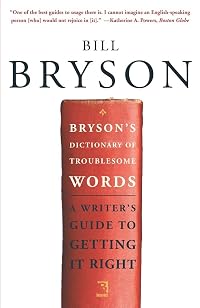
Bryson's Dictionary of Troublesome Words
by Bill Bryson
On This Page
Description
One of the English language’s most skilled and beloved writers guides us all toward precise, mistake-free grammar.As usual Bill Bryson says it best: “English is a dazzlingly idiosyncratic tongue, full of quirks and irregularities that often seem willfully at odds with logic and common sense. This is a language where ‘cleave’ can mean to cut in half or to hold two halves together; where the simple word ‘set’ has 126 different meanings as a verb, 58 as a noun, and 10 as a show more participial adjective; where if you can run fast you are moving swiftly, but if you are stuck fast you are not moving at all; [and] where ‘colonel,’ ‘freight,’ ‘once,’ and ‘ache’ are strikingly at odds with their spellings.” As a copy editor for the London Times in the early 1980s, Bill Bryson felt keenly the lack of an easy-to-consult, authoritative guide to avoiding the traps and snares in English, and so he brashly suggested to a publisher that he should write one. Surprisingly, the proposition was accepted, and for “a sum of money carefully gauged not to cause embarrassment or feelings of overworth,” he proceeded to write that book—his first, inaugurating his stellar career.
Now, a decade and a half later, revised, updated, and thoroughly (but not overly) Americanized, it has become Bryson’s Dictionary of Troublesome Words, more than ever an essential guide to the wonderfully disordered thing that is the English language. With some one thousand entries, from “a, an” to “zoom,” that feature real-world examples of questionable usage from an international array of publications, and with a helpful glossary and guide to pronunciation, this precise, prescriptive, and—because it is written by Bill Bryson—often witty book belongs on the desk of every person who cares enough about the language not to maul or misuse or distort it. show less
Tags
Recommendations











Member Reviews
Some of this is useful as a reference. Most of it is boring as reading material. It feels like his personal notes on words that bother him, sometimes because he mixes them up, sometimes because others do.
Now and again Bryson shows that he doesn't know German. Baron Munchhausen is known to most German-speakers (legend), not 'almost exclusively in medical circles'. Luxembourg is the French form of the name, Luxemburg the German (not anglicized). Both languages are official in the country that calls itself Groussherzogtum Lëtzebuerg in its own language. Little failures like these in research make me question his other statements.
This refers to the 2015 edition.
Now and again Bryson shows that he doesn't know German. Baron Munchhausen is known to most German-speakers (legend), not 'almost exclusively in medical circles'. Luxembourg is the French form of the name, Luxemburg the German (not anglicized). Both languages are official in the country that calls itself Groussherzogtum Lëtzebuerg in its own language. Little failures like these in research make me question his other statements.
This refers to the 2015 edition.
Before finding fame as a travel writer with The Lost Continent and Notes from a Small Island, Bill Bryson had been a sub-editor at the Times struggling with the nuances of the English language. What is the difference between flouting and flaunting; what exactly does it mean to imply and to infer; can one use the word either in reference to more than two alternatives? Unable to find a single, concise guide to which he could refer to for such ‘troublesome words’, Bryson contacted Penguin and offered to write one himself.
Troublesome Words, the 2001 revised and updated edition of Bryson’s original 1984 book (The Penguin Dictionary of Troublesome Words), is an A – Z guide to words and phrases commonly misused in print. Drawing from show more more than 40 respected works on linguistics, Bryson provides advice and suggestions to everyday grammatical problems and helpfully illustrates them with real-life examples of misuse. He explains that culminate, for example, “does not signify any result or outcome, but rather one marking a high point” and cites an a news clipping from The Times which reads “The company’s financial troubles culminated in the resignation of the chairman last June”. The example highlights Bryson’s lesson. A series of financial gains could culminate in the chairman receiving a bonus but financial troubles do not culminate in a resignation. Helpfully, he not only warns against words that are used incorrectly, but also those which are often used redundantly, such as basically; a word which in most contexts “is basically unnecessary, as here.”
Unfortunately, the somewhat narrow breadth of the guide does betray its (and Bryson’s) Fleet Street origins. Almost every example of misuse hails from newspaper pieces and, furthermore, usually from the business pages. So Bryson provides the correct spelling for the name of the household products company, Procter & Gamble but no guide to using, for example, the word breadth, as appears at the top of this paragraph (incorrectly as it happens, the phrase used should be “narrow scope”). As such, one can’t help but feel the dictionary would be improved by a slight shift in emphasis toward the general writer.
These are minor gripes though, and Bryson is both a thoughtful and entertaining guide. Without bloating the book he peppers his definitions with etymology, anecdotes and, where appropriate, his trademark dry humour. He tells us, for example, that “the belief that and should not be used to begin a sentence is without foundation. And that’s all there is to it”; and that “barbecue is the only acceptable spelling in serious writing. Any journalist or other formal user of English who believes that the word is spelled barbeque or, worse still, bar-b-q is not ready for unsupervised employment’. As such, Troublesome Words is one of those rare things: a reference work which can be dipped into time and again yet remains a joy when read cover-to-cover. show less
Troublesome Words, the 2001 revised and updated edition of Bryson’s original 1984 book (The Penguin Dictionary of Troublesome Words), is an A – Z guide to words and phrases commonly misused in print. Drawing from show more more than 40 respected works on linguistics, Bryson provides advice and suggestions to everyday grammatical problems and helpfully illustrates them with real-life examples of misuse. He explains that culminate, for example, “does not signify any result or outcome, but rather one marking a high point” and cites an a news clipping from The Times which reads “The company’s financial troubles culminated in the resignation of the chairman last June”. The example highlights Bryson’s lesson. A series of financial gains could culminate in the chairman receiving a bonus but financial troubles do not culminate in a resignation. Helpfully, he not only warns against words that are used incorrectly, but also those which are often used redundantly, such as basically; a word which in most contexts “is basically unnecessary, as here.”
Unfortunately, the somewhat narrow breadth of the guide does betray its (and Bryson’s) Fleet Street origins. Almost every example of misuse hails from newspaper pieces and, furthermore, usually from the business pages. So Bryson provides the correct spelling for the name of the household products company, Procter & Gamble but no guide to using, for example, the word breadth, as appears at the top of this paragraph (incorrectly as it happens, the phrase used should be “narrow scope”). As such, one can’t help but feel the dictionary would be improved by a slight shift in emphasis toward the general writer.
These are minor gripes though, and Bryson is both a thoughtful and entertaining guide. Without bloating the book he peppers his definitions with etymology, anecdotes and, where appropriate, his trademark dry humour. He tells us, for example, that “the belief that and should not be used to begin a sentence is without foundation. And that’s all there is to it”; and that “barbecue is the only acceptable spelling in serious writing. Any journalist or other formal user of English who believes that the word is spelled barbeque or, worse still, bar-b-q is not ready for unsupervised employment’. As such, Troublesome Words is one of those rare things: a reference work which can be dipped into time and again yet remains a joy when read cover-to-cover. show less
像字典一樣條列出容易出錯的單字,有可能是容易拼錯的、音近但意思不同的、亂用造成文法錯誤的、或是同義堆疊形成贅詞的。
算是相當實用、隨時可以拿來參考的工具書。其中不少提醒讀者不要拼錯的地方:譬如 -ci 和 -si,-able 和 -ible;還有發音相同但拼法不同的學校或機構。立意很好,可是看多了不免反而讓人更混亂。這種字與其硬記,不如使用前確實查個字典或相關資料就好。
算是相當實用、隨時可以拿來參考的工具書。其中不少提醒讀者不要拼錯的地方:譬如 -ci 和 -si,-able 和 -ible;還有發音相同但拼法不同的學校或機構。立意很好,可是看多了不免反而讓人更混亂。這種字與其硬記,不如使用前確實查個字典或相關資料就好。
Quirky, informative guide to common errors in written English. I found it a useful and enjoyable read but I have never consulted it as a reference book.
A friend asked if this is worth getting. I replied,
Hm, it's certainly briefer than Garner's modern usage, which I am reading cover to cover. But less meaty might be just right. (In Garner I hiccuped my wonted plodding A-to-Z to see what Garner says about which's increasing use as a conjunction. Surprisingly (to me), he doesn't mention it.)
Some of Bryson's explanations I doubt you need (antennae or antennas, auger v. augur), but your students might. Some I don't care about (short of publication), such as that All Souls College doesn't take an apostrophe. Some are just Bryson's superiority: "Alas! Poor Yorick. I knew him (-well), Horatio" doesn't belong in a dictionary. If he includes that he should include "Play it again, Sam, too" (he show more doesn't).
Some are his Britishness: He tells how to pronounce British (Gonville and) Caius College and Pall Mall but not Usan places such as Gloucester, Peabody, and Worcester. He gives the spelling bit not the pronunciation f the Welsh word "eisteddfod."
Perhaps a quarter of the entries on nuances of meaning I do appreciate (e.g., ambiguous v. equivocal). I remember being taking to task for writing "complacent" when I meant "complaisant." show less
Hm, it's certainly briefer than Garner's modern usage, which I am reading cover to cover. But less meaty might be just right. (In Garner I hiccuped my wonted plodding A-to-Z to see what Garner says about which's increasing use as a conjunction. Surprisingly (to me), he doesn't mention it.)
Some of Bryson's explanations I doubt you need (antennae or antennas, auger v. augur), but your students might. Some I don't care about (short of publication), such as that All Souls College doesn't take an apostrophe. Some are just Bryson's superiority: "Alas! Poor Yorick. I knew him (-well), Horatio" doesn't belong in a dictionary. If he includes that he should include "Play it again, Sam, too" (he show more doesn't).
Some are his Britishness: He tells how to pronounce British (Gonville and) Caius College and Pall Mall but not Usan places such as Gloucester, Peabody, and Worcester. He gives the spelling bit not the pronunciation f the Welsh word "eisteddfod."
Perhaps a quarter of the entries on nuances of meaning I do appreciate (e.g., ambiguous v. equivocal). I remember being taking to task for writing "complacent" when I meant "complaisant." show less
What I like about this is its not some stuffy grammar book. Its a book that clarifies words you really do get stuck with every day if you're writing 'proper stuff', it's not just a mass of clever obscurities of syntax for geeks.
Its a practical book that you can reach for when you're stuck, and it explains without needing to refer to the reference section in the front of a dictionary. And its a cosy paperback - doesn't take itself too seriously.
Its a practical book that you can reach for when you're stuck, and it explains without needing to refer to the reference section in the front of a dictionary. And its a cosy paperback - doesn't take itself too seriously.
(Alistair) For those of you wondering whatever happened to my non-fiction progress, it never quite went away. It just slowed down some, which I really must do something about, even if my current non-fiction is a hard enough read not to be one of the quickest.
This slender little volume, its predecessor, is one that actually does me some practical good, too, for the proofreading part of my job, being a collection of many linguistic difficulties that people run into. It's not perfectly aligned with my requirements, since given Mr. Bryson's earlier career it's somewhat slanted to those that come up in journalism (and, indeed, many of the examples of bad usage within the book are headlines or newspaper extracts), but he covers lots of common show more ground as well that would probably be useful to any English speaker.
Also, as you might expect if you've read any of his other books, particularly Made in America or The Mother Tongue, larded with delightful dry wit and anecdote that make it a pleasure to read, as well as refer to.
Recommended.
( http://weblog.siliconcerebrate.com/cerebrate/2009/04/troublesome_words_bill_brys... ) show less
This slender little volume, its predecessor, is one that actually does me some practical good, too, for the proofreading part of my job, being a collection of many linguistic difficulties that people run into. It's not perfectly aligned with my requirements, since given Mr. Bryson's earlier career it's somewhat slanted to those that come up in journalism (and, indeed, many of the examples of bad usage within the book are headlines or newspaper extracts), but he covers lots of common show more ground as well that would probably be useful to any English speaker.
Also, as you might expect if you've read any of his other books, particularly Made in America or The Mother Tongue, larded with delightful dry wit and anecdote that make it a pleasure to read, as well as refer to.
Recommended.
( http://weblog.siliconcerebrate.com/cerebrate/2009/04/troublesome_words_bill_brys... ) show less
Members
- Recently Added By
Lists

Etymology
26 works; 7 members
Author Information

70+ Works 136,293 Members
Bill Bryson was born in Des Moines, Iowa on December 8, 1951. In 1973, he went backpacking in England, where he eventually decided to settle. He wrote for the English newspapers The Times and The Independent, as well as supplementing his income by writing travel articles. He moved back to the United States in 1995. His first travel book, The Lost show more Continent: Travels in Small-Town America, was published in 1989. His other books include I'm a Stranger Here Myself, In a Sunburned Country, Bill Bryson's Dictionary of Troublesome Words, Neither Here nor There: Travels in Europe, Made in America, The Mother Tongue, Bill Bryson's African Diary, A Short History of Nearly Everything, At Home: A Short History of Private Life, Walk About, and Seeing Further: The Story of Science, Discovery, the Genius of the Royal Society. A Walk in the Woods was adapted into a movie starring Robert Redford and Nick Nolte. Bryson's titles, The Road to Little Dribbling: Adventures of an American in Britain, Notes from a Small Island and Neither Here Nor There made the New York Times bestseller list in 2016. (Bowker Author Biography) show less
Work Relationships
Common Knowledge
- Canonical title
- Bryson's Dictionary of Troublesome Words
- Original title
- The Penguin Dictionary of Troublesome Words
- Alternate titles
- Bryson's Dictionary of Troublesome Words: A Writer's Guide to Getting It Right; Troublesome Words
- Original publication date
- 1984 (1st edition) (1st edition); 1987 (2nd edition) (2nd edition)
- First words
- The physicist Richard Feynman once remarked that every time a colleague from the humanities department complained that his students couldn't spell a common word like seize or accommodate, Feynman wanted to reply, "Well there ... (show all)must be somethings wrong with the way you spell it." -Introduction
- Canonical DDC/MDS
- 423.1
- Canonical LCC
- PE1460
Classifications
Statistics
- Members
- 2,212
- Popularity
- 9,187
- Reviews
- 17
- Rating
- (3.68)
- Languages
- Chinese, English, Hungarian
- Media
- Paper, Ebook
- ISBNs
- 20
- ASINs
- 10