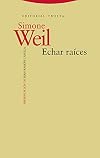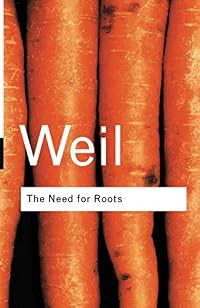
The Need for Roots: Prelude to a Declaration of Duties Towards Mankind
by Simone Weil
On This Page
Description
"One of the foremost French philosophers of the last century, Simone Weil has been described by André Gide as "the patron saint of all outsiders" and by Albert Camus as "the only great spirit of our time." In this, her most famous work, she diagnoses the malaise at the heart of modern life: uprootedness, from the past and from community. Written towards the end of World War II for the Free French Army, Weil's work is an indispensable and perpetually intriguing text for readers and students show more of philosophy everywhere. The book discusses the political, cultural and spiritual currents that ought to be nurtured so that people have access to sources of energy which will help them lead fulfilling, joyful and morally good lives" -- show lessTags
Recommendations












































Member Reviews
There is a Zen Buddhist saying or proverb which dictates that when hungry, eat and when thirsty, drink. It is with this sort of concrete, un-layered reality that Simone Weil presents her take on Christianity to us in The Need for Roots. We are advised to remain in the here and now, the geometric realm of reality and leave the layered, abstract and algebraic dimensions alone. Weil believes the hungry have a right to food and it is our obligation to feed them; it’s as simple as that. No algebra needed. I found The Need of Roots a clear presentation of her philosophical bent; more so than the over-hyped Grace & Glory which I found poorly edited, to say the least.
Weil is the Honey Badger of actively melding philosophy and religion into show more something that reflects a universal higher being and still remains true to our concrete human obligations to each other. To Weil, all we have are each other and only in our interpersonal conduct do we mimic the good of heaven. Weil is less interested in the Being-for-Itself, in-Itself mishmash that Heidegger and Sartre toy with, and is instead more concerned with Nazi’s and how a moral philosophy steeped in a Goodness (imagine a Being-for-Good, or Being-in-Good) might impel her fellow countrymen to rebuild their country less philosophically and morally vulnerable to the next foreign incursion.
The first part of the book, the introduction of the fourteen, seemingly conflicting, rights of the human soul, could stand as a tome on its own. The contrasting rights, like Order and Liberty, Risk and Security, bring together opposites in a direct reflection of the actual cross itself. The soul requires balance. Both sides are critical.
I want to believe that if I read this book a few more times, I may begin to approach the level of human responsibility laid out in this book as a goal for us all. show less
Weil is the Honey Badger of actively melding philosophy and religion into show more something that reflects a universal higher being and still remains true to our concrete human obligations to each other. To Weil, all we have are each other and only in our interpersonal conduct do we mimic the good of heaven. Weil is less interested in the Being-for-Itself, in-Itself mishmash that Heidegger and Sartre toy with, and is instead more concerned with Nazi’s and how a moral philosophy steeped in a Goodness (imagine a Being-for-Good, or Being-in-Good) might impel her fellow countrymen to rebuild their country less philosophically and morally vulnerable to the next foreign incursion.
The first part of the book, the introduction of the fourteen, seemingly conflicting, rights of the human soul, could stand as a tome on its own. The contrasting rights, like Order and Liberty, Risk and Security, bring together opposites in a direct reflection of the actual cross itself. The soul requires balance. Both sides are critical.
I want to believe that if I read this book a few more times, I may begin to approach the level of human responsibility laid out in this book as a goal for us all. show less
With this reading of a fourth book by/on Weil, I'm beginning to understand that her astounding and mystical insights into man and God are not sullied by the almost absurd naivety of her "solutions" to the problems that exist which, when implemented or taken seriously, end ironically in the hellish nightmare of an inhuman bureaucracy, the kind of which we see today sprouting up all over the West. Weil is to be looked at for inner understanding and not for temporal advice.
There is a scarcity of unique perspectives, and Simone Weil fits the bill. You'll find yourself struggling to place her on a political compass, and that's because she does not really fall under any broad category. This work is opinionated, genuine, and well-intentioned. I found myself in disagreement with some of her infeasible (and in my opinion, sometimes harmful) proposals, but for the most part, her overall message is valid, and we should all acknowledge the problem of lack of well-rooted lives that is super relevant today.
Simone Weil was a moralist, emphasizing the duty of man towards eternity and his fellows. Her life intertwined the spiritual and the neurotic, and she demonstrated an unusual capacity for identifying herself with the suffering of others. She tended to put her opinions immediately into practice in her personal life. Her originality as a thinker lay in the way she consistently fused experience, thought and action into one single indivisible whole. She was not a systematic writer, but L' Enracinement was her one sustained and comprehensive effort toward a systematic statement. It was an impressive attempt to put "Christian democracy" into writing, based on a conservative and traditional critique of society combined with socialism. She was show more influenced by Kierkegaardian existentialism, the rationalism of Alain, the socialism of Proudhon and Marx and the theology and sociology of the Catholic Church. She condemned the influence of Rome on Europe and the Catholic Church, and was a trenchant critic of the Church. She converted to Christianity but never entered the Catholic Church. She condemned France for the suppression of the Albigensians and other minorities, repudiated both the Ancien Regime and the French Revolution and found the roots of French defeat in 1940 in the moral and intellectual degradation of the French elite. Some of her political views were absurd, utopian and anti-democratic such as her proposed limitations on freedom of the press and her condemnation of political parties on the grounds that they are all potentially totalitarian. Like Charles Peguy, she is one of those lonely figures belonging to no party yet claimed by all.[1951] show less
The Washington Post called the book "the vexing political-treatise-cum-mystical-tract." They wrote, "Weil’s vision for a postwar France — and, more generally, for a utopian society — begins with her rejection of rights in favor of “obligations.” “A right is not effective on its own,” she writes, “but solely in relation to the obligation to which it corresponds.” A right derives its moral force from a law, a mere contrivance, but “there is an obligation towards every human being through the mere fact that they are a human being."”
THIS IS THE WORK THAT WEIL COMPLETED JUST BEFORE HER DEATH IN ENGLAND IN 1943. HOW IT CONTRIBUTED TO THE FREE FRENCH WAR EFFORT IS A MYSTERY YET THIS WORK IS A BIBLE OF THE DUTIES OF A CITIZEN TODAY
Simone Weil keeps popping up, and I keep writing about her thought. Here's the latest: https://zwieblein.bearblog.dev/back-to-the-blackboard-revisiting-tests-in-patien...
Members
- Recently Added By
Lists

Church Times 100 Best Christian Books
106 works; 26 members

Reading LIst
648 works; 1 member

Other
2 works; 1 member

Books Read in 2025
4,090 works; 97 members

In Our Time books
4,934 works; 2 members
Author Information

217+ Works 7,416 Members
Born in Paris, Weil came from a highly intellectual family. After a brilliant academic career at school and university, she taught philosophy interspersed with periods of hard manual labor on farms and in factories. Throughout her life she combined sophisticated and scholarly interests with an extreme moral intensity and identification with the show more poor and oppressed. A twentieth-century Pascal (see Vol. 4), this ardently spiritual woman was a social thinker, sensitive to the crises of modern humanity. Jewish by birth, Christian by vocation, and Greek by aesthetic choice, Weil has influenced religious thinking profoundly in the years since her death. "Humility is the root of love," she said as she questioned traditional theologians and held that the apostles had badly interpreted Christ's teaching. Christianity was, she thought, to blame for the heresy of progress. During World War II, Weil starved herself to death, refusing to eat while victims of the war still suffered. (Bowker Author Biography) show less
Some Editions
Series
Belongs to Publisher Series
Work Relationships
Is contained in
Common Knowledge
- Canonical title
- The Need for Roots: Prelude to a Declaration of Duties Towards Mankind
- Original title
- L'enracinement
- Original publication date
- 1949
- First words*
- La nozione di obbligo sovrasta quella di diritto, che le è relativa e subordinata.
- Quotations
- Distress is a culture broth for false problems. It creates obsessions. The way to appease them is not to provide what they insist upon, but to bring about the disappearance of the distress. If a man is thirsty because of a wo... (show all)und in the stomach, drink is not what he requires, but to have his wound cured.
The State is a cold concern which cannot inspire love, but itself kills, suppresses everything that might be loved; so one is forced to love it, because there is nothing else. That is the moral torment to which all of us toda... (show all)y are exposed.
Criminal dishonesty in matters connected with the State on the part of men in public life must also be effectively punished, and more severely so than armed robbery.
A man who takes the trouble to draw up an apology for slavery cannot be a lover of justice. - Last words*
- (Click to show. Warning: May contain spoilers.)Il ritorno alla verità farebbe apparire, tra l'altro, la verità del lavoro fisico.
- Original language*
- Francese
- Canonical DDC/MDS
- 303.372
- Canonical LCC
- HM665.W4513
*Some information comes from Common Knowledge in other languages. Click "Edit" for more information.
Classifications
- Genres
- Philosophy, Nonfiction, Religion & Spirituality, General Nonfiction
- DDC/MDS
- 303.372 — Society, Government, and Culture Social sciences, sociology & anthropology Social processes Coordination and control Social norms Belief systems and customs
- LCC
- HM665 .W4513 — Social sciences Sociology (General) Sociology Social control
- BISAC
Statistics
- Members
- 873
- Popularity
- 30,924
- Reviews
- 13
- Rating
- (4.04)
- Languages
- 9 — Catalan, English, Finnish, French, German, Italian, Portuguese, Spanish, Swedish
- Media
- Paper, Ebook
- ISBNs
- 43
- UPCs
- 1
- ASINs
- 28