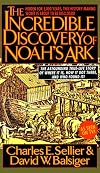
In Search of Noah's Ark
by David Balsiger, Charles E. Sellier
On This Page
Tags
Recommendations






























Member Reviews
I was a teenager in 1976, when David Balsiger's and Charles Sellier's In Search of Noah's Ark was published. I enjoyed reading the book then, and talking about it with friends at the time. Thirty-five years later, I still recall it fondly (occasionally), although I've retained a more general sense of it than any specific details.
In a nutshell (spoiler alert?), the book recounts a mid-20th-Century discovery of frozen, prehistoric wood fragments embedded in ice on a culturally significant mountain-top in Turkey, which show signs of having been worked with tools, and from trees found elsewhere in the Middle East but far from the mountains of Turkey. The authors' primary purpose, it seems, is to affirm pre-history accounts of the Great show more Flood and the Hebrew tradition of God's saving Noah in the Ark. To this end, Balsiger and Sellier interweave then-contemporary, "scientific" data, research and exploration with mild suppositions and interpretation, in ways that support viewing these legends as based in fact.
It's not a challenging book to read; I'd be curious now to see a Lexile score for it. Apparently, the authors' intended audience was a broad spectrum of readers among the general public (there presumably was such thing in 1976), and the book isn't either particularly persuasive or particularly off-putting. I don't recall that the authors "beat you over the head" with polemics, doctrine or argumentation -- an absence I appreciated in 1976 and find even rarer today. There's probably some nascent sensationalism here, endemic to the "speculative journalism" genre; but it's by no means the quick-cut, e-media techno-frenzy we've grown accustomed to, nor Bermuda Triangle-style astonishment / intrigue, nor even a garden-variety "this dark, grainy still photo shows Nessie, because I was there." Rather, the book purports to offer objective reporting, and invites readers to consider some interesting possibilities as to its meaning.
For me, the real benefit of this work came from later reflection on the authors' conclusions, and on reactions of friends who read it when I did. Those reflections may have given me insight on, and patience for, religious perspectives often dismissed today as "literalist," "fundamentalist" or "evangelical." If one simply approaches the book with a willingness to suspend disbelief, its reasoned suppositions can afford the reader an appealing view of what might actually have been -- and, by extension, some significance of legendary events to faith and belief today. show less
In a nutshell (spoiler alert?), the book recounts a mid-20th-Century discovery of frozen, prehistoric wood fragments embedded in ice on a culturally significant mountain-top in Turkey, which show signs of having been worked with tools, and from trees found elsewhere in the Middle East but far from the mountains of Turkey. The authors' primary purpose, it seems, is to affirm pre-history accounts of the Great show more Flood and the Hebrew tradition of God's saving Noah in the Ark. To this end, Balsiger and Sellier interweave then-contemporary, "scientific" data, research and exploration with mild suppositions and interpretation, in ways that support viewing these legends as based in fact.
It's not a challenging book to read; I'd be curious now to see a Lexile score for it. Apparently, the authors' intended audience was a broad spectrum of readers among the general public (there presumably was such thing in 1976), and the book isn't either particularly persuasive or particularly off-putting. I don't recall that the authors "beat you over the head" with polemics, doctrine or argumentation -- an absence I appreciated in 1976 and find even rarer today. There's probably some nascent sensationalism here, endemic to the "speculative journalism" genre; but it's by no means the quick-cut, e-media techno-frenzy we've grown accustomed to, nor Bermuda Triangle-style astonishment / intrigue, nor even a garden-variety "this dark, grainy still photo shows Nessie, because I was there." Rather, the book purports to offer objective reporting, and invites readers to consider some interesting possibilities as to its meaning.
For me, the real benefit of this work came from later reflection on the authors' conclusions, and on reactions of friends who read it when I did. Those reflections may have given me insight on, and patience for, religious perspectives often dismissed today as "literalist," "fundamentalist" or "evangelical." If one simply approaches the book with a willingness to suspend disbelief, its reasoned suppositions can afford the reader an appealing view of what might actually have been -- and, by extension, some significance of legendary events to faith and belief today. show less
Full of crap? Yes. But you can remove the horrid bits, though they be many, and find some gems, but very few.
The only reason I keep this book in my library is to show the quality of the research in this field.
Ratings
Members
- Recently Added By
Author Information
20+ Works 676 Members
18+ Works 934 Members
Work Relationships
Has the adaptation
Classifications
Statistics
- Members
- 316
- Popularity
- 101,229
- Reviews
- 3
- Rating
- (2.92)
- Languages
- Dutch, English, Hungarian
- Media
- Paper
- ISBNs
- 4
- ASINs
- 6