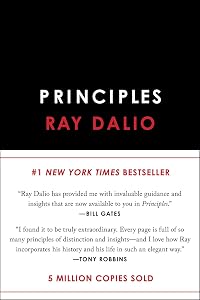
Principles: Life and Work
by Ray Dalio
On This Page
Description
#1 New York Times Bestseller"Significant...The book is both instructive and surprisingly moving." —The New York Times
Ray Dalio, one of the world's most successful investors and entrepreneurs, shares the unconventional principles that he's developed, refined, and used over the past forty years to create unique results in both life and business—and which any person or organization can adopt to help achieve their goals.
In 1975, Ray Dalio founded an investment firm, Bridgewater show more Associates, out of his two-bedroom apartment in New York City. Forty years later, Bridgewater has made more money for its clients than any other hedge fund in history and grown into the fifth most important private company in the United States, according to Fortune magazine. Dalio himself has been named to Time magazine's list of the 100 most influential people in the world. Along the way, Dalio discovered a set of unique principles that have led to Bridgewater's exceptionally effective culture, which he describes as "an idea meritocracy that strives to achieve meaningful work and meaningful relationships through radical transparency." It is these principles, and not anything special about Dalio—who grew up an ordinary kid in a middle-class Long Island neighborhood—that he believes are the reason behind his success.
In Principles, Dalio shares what he's learned over the course of his remarkable career. He argues that life, management, economics, and investing can all be systemized into rules and understood like machines. The book's hundreds of practical lessons, which are built around his cornerstones of "radical truth" and "radical transparency," include Dalio laying out the most effective ways for individuals and organizations to make decisions, approach challenges, and build strong teams. He also describes the innovative tools the firm uses to bring an idea meritocracy to life, such as creating "baseball cards" for all employees that distill their strengths and weaknesses, and employing computerized decision-making systems to make believability-weighted decisions. While the book brims with novel ideas for organizations and institutions, Principles also offers a clear, straightforward approach to decision-making that Dalio believes anyone can apply, no matter what they're seeking to achieve.
Here, from a man who has been called both "the Steve Jobs of investing" and "the philosopher king of the financial universe" (CIO magazine), is a rare opportunity to gain proven advice unlike anything you'll find in the conventional business press. show less
Tags
Recommendations


Member Reviews
The first hundred pages I read very closely. I skimmed the rest.
Dalio is an obsessively competitive person and he carefully architects how he succeeds.
His mental discipline for success is extremely rigorous, I'll say impossible.
For all the billions of dollars he has earned I don't understand what tangible assets he's created.
This book may be the wrong source for what I seek.
Dalio compares himself to Steve Jobs. Jobs developed computer devices that expand and enrich the lives of millions of people. Dalio managed the most successful hedge fund making rich people richer. Both are wealthy and Jobs created thousands of jobs and enriched consumers lives, I don't know what Dalio invented, it's all advanced mathematics of hedge funds. A few show more thousand people work at Dalio's Bridgewater Capital. All the clients are American elites.
While Steve Jobs' iPhone is used by rural Chinese.
I think Dalio's goals are contribute to making excessive greed an admirable quality in the USA. His competitive nature makes for a life filled with success and no meaning.
If you are ultra competitive, greedy alpha perfectionist, this is the book for you.
I'm an artist who seeks beauty and meaning, so this book rates low on my scale. show less
Dalio is an obsessively competitive person and he carefully architects how he succeeds.
His mental discipline for success is extremely rigorous, I'll say impossible.
For all the billions of dollars he has earned I don't understand what tangible assets he's created.
This book may be the wrong source for what I seek.
Dalio compares himself to Steve Jobs. Jobs developed computer devices that expand and enrich the lives of millions of people. Dalio managed the most successful hedge fund making rich people richer. Both are wealthy and Jobs created thousands of jobs and enriched consumers lives, I don't know what Dalio invented, it's all advanced mathematics of hedge funds. A few show more thousand people work at Dalio's Bridgewater Capital. All the clients are American elites.
While Steve Jobs' iPhone is used by rural Chinese.
I think Dalio's goals are contribute to making excessive greed an admirable quality in the USA. His competitive nature makes for a life filled with success and no meaning.
If you are ultra competitive, greedy alpha perfectionist, this is the book for you.
I'm an artist who seeks beauty and meaning, so this book rates low on my scale. show less
Ray Dalio became famous through founding and building his company Bridgewater Associates into an economic powerhouse over decades. Of course, many became interested in how he did it. This book narrates his personal story, but it does more. He ran his company through a series of principles as if it were a machine he and his associates built. This book also chronicles those principles at length to communicate Dalio's and Bridgewater's vision of how a good company operates.
The foundation for Dalio's principles lie in "meaningful work and meaningful relationships." Interestingly for an investment firm, money is merely an instrument towards those ends. Of course, he is realistic about the challenges of running a company, but he claims to be show more value-based and demonstrates that ethic through his philosophies.
To extrapolate from that foundation, he uses "radical truth and radical transparency" to build an "idea meritocracy." He pusshes good ideas to rise to the front, regardless of an employee's rank. He hopes to avoid an autocracy or democracy in the decision-making process. Instead of making only those in power feel good or having everyone vote about what feels good, he wants to place maximal pressure on producing profitable ideas that help people. Through the principles or company rules, he illustrates how he's not afraid of aggressively pursuing those ends even when it hurts or creates conflict.
This book offers a contrast to an ego-driven pursuit of power. It shows how to run an organization that makes maximal use of smart people's ideas. Not everyone wants to run a company, but most motivated folks want to use their hard-wrought talents towards noble ends. Managers and organizational leaders who want to help people - and help others help people - while earning a profit should pay attention. show less
The foundation for Dalio's principles lie in "meaningful work and meaningful relationships." Interestingly for an investment firm, money is merely an instrument towards those ends. Of course, he is realistic about the challenges of running a company, but he claims to be show more value-based and demonstrates that ethic through his philosophies.
To extrapolate from that foundation, he uses "radical truth and radical transparency" to build an "idea meritocracy." He pusshes good ideas to rise to the front, regardless of an employee's rank. He hopes to avoid an autocracy or democracy in the decision-making process. Instead of making only those in power feel good or having everyone vote about what feels good, he wants to place maximal pressure on producing profitable ideas that help people. Through the principles or company rules, he illustrates how he's not afraid of aggressively pursuing those ends even when it hurts or creates conflict.
This book offers a contrast to an ego-driven pursuit of power. It shows how to run an organization that makes maximal use of smart people's ideas. Not everyone wants to run a company, but most motivated folks want to use their hard-wrought talents towards noble ends. Managers and organizational leaders who want to help people - and help others help people - while earning a profit should pay attention. show less
I appreciated the higher level principles... but often found the sub points not well aligned the section titles. Many points were truisms without enough specificity for someone to implement them. I think there is a lot of valuable material in this book, but it would have to be mined.
This book isn't perfect, but I'm glad I read it.
Basically three parts: 1) background on Dalio and Bridgewater (interesting, but only if you're into biographies or accounts of important companies); 2) advice for how to live one's own life 3) principles for engineering and managing a company. 2 is probably of the widest appeal, and 3 is what I found the most interesting (although also the most hit-or-miss).
I'm friends with an ex-Bridgewater employee, and I knew of Dalio and Bridgewater but not in any great detail. The biography was interesting to me, but didn't really go into great detail; it's maybe on par with a long-form magazine article about the man and his firm.
Dalio's advice for individuals and companies basically boils down to show more harnessing the power of feedback, iteration, and improvement in response to failure. Simple to say, but hard to implement, and much of his advice was how to create systems (individually or for an organization) to accomplish this. For an individual, the challenge is primarily psychological -- being able to reflect on one's actions at a higher meta level than just doing the work itself, because you're always both the do-er and the manager. For organizations, the challenge is essentially the central problems of economics -- aligning incentives, culture, and unintended consequences. This is where he had some of the best concrete advice, about tools Bridgewater developed and used (and which he says he will release), and also about the need for greater organizational controls once he wasn't directly running things. I don't think he went far enough in admitting the problems with the bridgewater model, and lack of applicability -- it only really works when everyone has aligned incentives, which I believe is only possible in small groups or in organizations throwing off so much cash that no one is concerned about scarcity -- the Bridgewater management style would not be a viable way to run a large retail empire like Wal-mart, and he didn't seem to understand or admit this.
Overall, it's a good book. The individual principles are good to have in one's toolbox, and the organizational structuring advice is good if not taken as gospel or in isolation. I do wish I'd worked at Bridgewater when Dalio was there, to see this stuff happen in realtime, but maybe I'll be able to implement some of these tools with my own teams in the future. show less
Basically three parts: 1) background on Dalio and Bridgewater (interesting, but only if you're into biographies or accounts of important companies); 2) advice for how to live one's own life 3) principles for engineering and managing a company. 2 is probably of the widest appeal, and 3 is what I found the most interesting (although also the most hit-or-miss).
I'm friends with an ex-Bridgewater employee, and I knew of Dalio and Bridgewater but not in any great detail. The biography was interesting to me, but didn't really go into great detail; it's maybe on par with a long-form magazine article about the man and his firm.
Dalio's advice for individuals and companies basically boils down to show more harnessing the power of feedback, iteration, and improvement in response to failure. Simple to say, but hard to implement, and much of his advice was how to create systems (individually or for an organization) to accomplish this. For an individual, the challenge is primarily psychological -- being able to reflect on one's actions at a higher meta level than just doing the work itself, because you're always both the do-er and the manager. For organizations, the challenge is essentially the central problems of economics -- aligning incentives, culture, and unintended consequences. This is where he had some of the best concrete advice, about tools Bridgewater developed and used (and which he says he will release), and also about the need for greater organizational controls once he wasn't directly running things. I don't think he went far enough in admitting the problems with the bridgewater model, and lack of applicability -- it only really works when everyone has aligned incentives, which I believe is only possible in small groups or in organizations throwing off so much cash that no one is concerned about scarcity -- the Bridgewater management style would not be a viable way to run a large retail empire like Wal-mart, and he didn't seem to understand or admit this.
Overall, it's a good book. The individual principles are good to have in one's toolbox, and the organizational structuring advice is good if not taken as gospel or in isolation. I do wish I'd worked at Bridgewater when Dalio was there, to see this stuff happen in realtime, but maybe I'll be able to implement some of these tools with my own teams in the future. show less
I really wanted to like this book. And it has some good ideas in it. But I think Ray Dalio is a little too in love with his principles, and I fear it blinds him to the possibility that his ideas my not be as readily exploitable by others as he may wish.
The book is part the biography of Ray Dalio, and his is quite candid about his successes and failures. I take no issue with that section. He has been wildly successful, and he can point to many learning experiences that lead to his success.
It's when he extracts general principles from these experiences and explores their implementation in his own successful investment firm that things start to get a little less coherent. The principles appeared to me to fall into three broad categories: show more intuitively obvious, not intuitively obvious (and therefore needed more evidence to be accepted as "true"), and wrong (that is, with a little thought I can come up with counterexamples from my own experiences that show the principle does not have broad applicability).
The first category is easy to follow. It's the second and third that worry me. When one makes a claim about a general principle, it's okay if there are situations or edge conditions where that principle is not applicable - but if you want to make a broad claim, you need to have lots of evidence. One successful business in one industry run by one person is not enough data to generalize from - the reader has no way to determine how much of that success is due to the simple combination of factors. And the author has no incentive to look for and test their claims outside of their realm of expertise. I'm no statistician myself, but that was an obvious flaw to me.
In fact, the example of a "wrong" principle that sticks in my mind is one that deals with a statistical fallacy and healthcare. Two issues here: if he makes statistical inference errors that I can identify when he reaches outside of his purported area of expertise, should I not also suspect the inferences he makes in ALL areas outside of his expertise? And if I can (accurately) describe his mistakes as fundamental or simple, should they not have been caught and corrected by others in the editing and proofreading process?
(NOTE: the mistake I'm referring to is later in the book, regarding a health scare the author suffered. He has some rare issue discovered by a screening test, consulted multiple doctors about the treatment with different expected outcomes, and ultimately ended up doing nothing because it was a non-issue. This sort of statistical mistake is handled by Nassim Taleb in his books, and well understood by statisticians who use Bayes Theorem. Also, the author makes no mention of the drag on the healthcare system that would occur if his principle were broadly applied) show less
The book is part the biography of Ray Dalio, and his is quite candid about his successes and failures. I take no issue with that section. He has been wildly successful, and he can point to many learning experiences that lead to his success.
It's when he extracts general principles from these experiences and explores their implementation in his own successful investment firm that things start to get a little less coherent. The principles appeared to me to fall into three broad categories: show more intuitively obvious, not intuitively obvious (and therefore needed more evidence to be accepted as "true"), and wrong (that is, with a little thought I can come up with counterexamples from my own experiences that show the principle does not have broad applicability).
The first category is easy to follow. It's the second and third that worry me. When one makes a claim about a general principle, it's okay if there are situations or edge conditions where that principle is not applicable - but if you want to make a broad claim, you need to have lots of evidence. One successful business in one industry run by one person is not enough data to generalize from - the reader has no way to determine how much of that success is due to the simple combination of factors. And the author has no incentive to look for and test their claims outside of their realm of expertise. I'm no statistician myself, but that was an obvious flaw to me.
In fact, the example of a "wrong" principle that sticks in my mind is one that deals with a statistical fallacy and healthcare. Two issues here: if he makes statistical inference errors that I can identify when he reaches outside of his purported area of expertise, should I not also suspect the inferences he makes in ALL areas outside of his expertise? And if I can (accurately) describe his mistakes as fundamental or simple, should they not have been caught and corrected by others in the editing and proofreading process?
(NOTE: the mistake I'm referring to is later in the book, regarding a health scare the author suffered. He has some rare issue discovered by a screening test, consulted multiple doctors about the treatment with different expected outcomes, and ultimately ended up doing nothing because it was a non-issue. This sort of statistical mistake is handled by Nassim Taleb in his books, and well understood by statisticians who use Bayes Theorem. Also, the author makes no mention of the drag on the healthcare system that would occur if his principle were broadly applied) show less
This is hands down one of the best reads this year!
The book is divided into three parts: the life story of the author, Life Principles, and Work Principles. Even though I find the first part exciting and inspiring, the actual value for me lies in the last two parts. Ray Dalio has distilled the principles from all the lessons learned through his quite extraordinary life and career and shared it to the world.
I could especially relate to work principles. While reading them, I've found some of the matching principles which I had to discover the hard way - by trial and error and came to similar conclusions, giving even more credibility to other principles from my point of view and a feeling of urgency to try and implement them.
It is very show more rare to find such a concentration of knowledge in one book. Having this in mind this book might be one of the most impactful reads, especially if you have the power and will to change things in the organization for the better.
The main concepts: idea meritocracy, believability, radical truth, and transparency and many others already found a way into my daily life and our organization. I believe that in the long run, it can make an enormous impact on both. show less
The book is divided into three parts: the life story of the author, Life Principles, and Work Principles. Even though I find the first part exciting and inspiring, the actual value for me lies in the last two parts. Ray Dalio has distilled the principles from all the lessons learned through his quite extraordinary life and career and shared it to the world.
I could especially relate to work principles. While reading them, I've found some of the matching principles which I had to discover the hard way - by trial and error and came to similar conclusions, giving even more credibility to other principles from my point of view and a feeling of urgency to try and implement them.
It is very show more rare to find such a concentration of knowledge in one book. Having this in mind this book might be one of the most impactful reads, especially if you have the power and will to change things in the organization for the better.
The main concepts: idea meritocracy, believability, radical truth, and transparency and many others already found a way into my daily life and our organization. I believe that in the long run, it can make an enormous impact on both. show less
Imagine for a moment you were able to sit down for long conversation with a wise old man, who happened to have unimaginable success. That is this book. Ray Dalio is one who likes to think, and here he outlines his principles.
The book truly is three books. The first is a concise biography. The second are his personal (individual) principles for life. And the third are the principles he incorporates in his company, his corporate principles.
It is a book of intense practical advice. Most of what he says feels like sounds "common sense," which means it feels true, yet is hardly common. I will say, undoubtedly, he has cornered the market on identifying truth. And let me explain what I mean by that. Bridgewater, Ray Dalio's company, which he show more built from nothing out his 2 bedroom apartment, is one of the largest most successful hedge funds in the world. They deal with making money, which is a straightforward black or white enterprise. You know very quickly whether you've made a good decision or a bad one - there don't seem to be gray areas. And this is where Dalio's approach seems most effective, namely what he calls an "idea meritocracy - radical truth, radical transparency:" a phrase he repeats a lot.
This comes from an interview and feels very similar to the book:
Other ideas that are noteworthy (and have likely influenced the world) are:
-- computer aided decision making. Dalio started using computers way back to aid in objective decision making, utilizing algorithm optimization years before most people had computers in their homes.
-- diversified asset portfolios. No doubt others did this too, but it seems like Dalio and Bridgewater have come close to perfecting it.
-- a systematic approach to group interactions, including making baseball cards for employees.
-- rewarding failure. This encourages employees to not only come forward when mistakes are made (rather than hide them), and take risks, which leads to growth.
If interested, you might find his TED talk, which is a great intro. Or you can also download the e-book for free on your phone. The app is called oddly enough Principles. My only complaints with the book are many of the ideas are redundant because you get similar or the same thing in all three books. Second, it can be pretty dry. That being said, the advice is pretty solid.
If you have interest in making money, if you have interest in finding truth, if you lead a company or group of people, I'd recommend this book. Good solid advice worth hearing! show less
The book truly is three books. The first is a concise biography. The second are his personal (individual) principles for life. And the third are the principles he incorporates in his company, his corporate principles.
It is a book of intense practical advice. Most of what he says feels like sounds "common sense," which means it feels true, yet is hardly common. I will say, undoubtedly, he has cornered the market on identifying truth. And let me explain what I mean by that. Bridgewater, Ray Dalio's company, which he show more built from nothing out his 2 bedroom apartment, is one of the largest most successful hedge funds in the world. They deal with making money, which is a straightforward black or white enterprise. You know very quickly whether you've made a good decision or a bad one - there don't seem to be gray areas. And this is where Dalio's approach seems most effective, namely what he calls an "idea meritocracy - radical truth, radical transparency:" a phrase he repeats a lot.
This comes from an interview and feels very similar to the book:
The key to our success has been to have a real idea meritocracy. To have a successful idea meritocracy, you have to do three things: 1. Put your honest thoughts out on the table, 2. Have thoughtful disagreements in which people are willing to shift their opinions as they learn, and 3. Have agreed-upon ways of deciding if disagreements remain so that you can move beyond them without resentments. And to do this well, you need to be radically truthful and radically transparent, by which I mean you need to allow people to see and say almost anything. If you're not transparent, people won't know enough about what's going on to have good, independent opinions, and if you don't expect the truth of people, you'll never know whether or not they're telling you want they really think.
Other ideas that are noteworthy (and have likely influenced the world) are:
-- computer aided decision making. Dalio started using computers way back to aid in objective decision making, utilizing algorithm optimization years before most people had computers in their homes.
-- diversified asset portfolios. No doubt others did this too, but it seems like Dalio and Bridgewater have come close to perfecting it.
-- a systematic approach to group interactions, including making baseball cards for employees.
-- rewarding failure. This encourages employees to not only come forward when mistakes are made (rather than hide them), and take risks, which leads to growth.
If interested, you might find his TED talk, which is a great intro. Or you can also download the e-book for free on your phone. The app is called oddly enough Principles. My only complaints with the book are many of the ideas are redundant because you get similar or the same thing in all three books. Second, it can be pretty dry. That being said, the advice is pretty solid.
If you have interest in making money, if you have interest in finding truth, if you lead a company or group of people, I'd recommend this book. Good solid advice worth hearing! show less
Members
- Recently Added By
Lists

Men's healing resources
747 works; 1 member
Author Information

24 Works 3,324 Members
Ray Dalio is an American investor, hedge fund manager, and philanthropist. He began investing at age 12, when he bought shares of Northeast Airlines for $300 and tripled his investment. Dalio received a bachelor's degree in finance from Long Island University and an MBA from Harvard Business School. In 1975, he founded the Westport, Connecticut show more based investment management firm, Bridgewater Associates which in 2012 became the largest hedge fund in the world, as it is today, with over $160 billion in assets under management, as of October 2014. show less
Awards and Honors
Notable Lists
Common Knowledge
Classifications
- Genres
- Business, General Nonfiction, Nonfiction, Biography & Memoir
- DDC/MDS
- 650.1 — Applied science & technology Management & public relations Business Skills & Management Personal success in business
- LCC
- HF5386 .D167 — Social sciences Commerce Commerce Business Vocational guidance. Career devlopment
- BISAC
Statistics
- Members
- 2,204
- Popularity
- 9,188
- Reviews
- 25
- Rating
- (3.96)
- Languages
- 11 — Dutch, English, Estonian, German, Italian, Romanian, Russian, Spanish, Portuguese (Portugal), Portuguese (Brazil), Chinese, traditional
- Media
- Paper, Audiobook, Ebook
- ISBNs
- 39
- ASINs
- 13