On This Page
Description
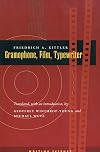
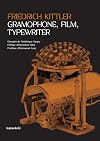
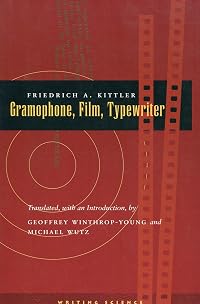
"Toward the end of the nineteenth century, the hegemony of the printed word was shattered by the arrival of media technologies that offered new ways of communicating and storing data. Previously, writing had operated by way of symbolic mediation, but phonography, photography, and cinematography stored physical effects of the real in the shape of sound waves and light. The entire question of referentiality had to be recast in light of these new media technologies. Part technological history show more of the emergent new media in the late nineteenth century, part theoretical discussion of the responses to these media - including texts by Rilke, Kafka, and Heidegger - Gramophone, Film, Typewriter analyzes this momentous shift using insights from the work of Foucault, Lacan, and McLuhan. It is a continuation as well as a detailed elaboration of the second part of the author's Discourse Networks, 1800/1900 (Stanford, 1990)." http://www.loc.gov/catdir/description/cam029/98037243.html. show lessTags
Recommendations



















Member Reviews
I'm completely puzzled about how to rate this one. Kittler's presentation of the development of certain media was really interesting—but he so often makes argumentative leaps that seem to need more support. He might also make too many assumptions about how much a nonspecialist in certain aspects of German history/literature will know about certain individuals, groups, developments, etc. Still: really glad I read the book, and it's provided a good deal of food for further thought.
Gramophone is the simulation of the primal sound. Film is realer than the reality. Typewriter inverts the gender of writing and thus transform its material basis.
Kittler's amazing book unpacks these assertions in a somewhat old fashioned literary style. The book certainly has its dull moments and unless you are accustomed to long-winded classical rants, its not an easy read. However, having a computational contextual bias, I really enjoyed the overall import as well as choice of included supplementary texts.
Recommended to anyone who has considered Marshall McLuhan the foremost media theorist and decided to stop at that.
Kittler's amazing book unpacks these assertions in a somewhat old fashioned literary style. The book certainly has its dull moments and unless you are accustomed to long-winded classical rants, its not an easy read. However, having a computational contextual bias, I really enjoyed the overall import as well as choice of included supplementary texts.
Recommended to anyone who has considered Marshall McLuhan the foremost media theorist and decided to stop at that.
Ratings
Members
- Recently Added By
Lists

99
19 works; 1 member

Books in the Bibliography of Digital Lethargy by Tung-Hui Hu
151 works; 3 members
Author Information
35+ Works 918 Members
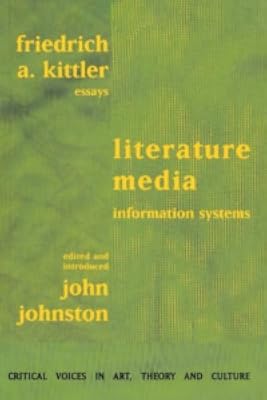
Friedrich Kittler (1943-2011) combined the study of literature, music, technology, and philosophy in a manner sufficiently novel to be recognized as a new field of academic endeavor in his native Germany. "Media studies," as Kittler conceived it, meant turning away from the "interpretation" of cultural artifacts to focus instead on their varying show more social functions and material constitutions, as well as the epistemological openings that such constitutions entail. This volume collects writings from all stages of the author's prolific career. Rich in counterintuitive proposals, sly humor, and vast erudition, they challenge premises and well institutionalized narratives both in the humanities and in the "hard sciences." Together, these twenty-three essays document the intellectual itinerary of one of the most original thinkers in recent times-sometimes baffling, often controversial, and always stimulating. show less
Series

Common Knowledge
- Canonical title
- Gramophone, Film, Typewriter
- Original title
- Grammophon Film Typewriter
- Original publication date
- 1986
Classifications
- Genres
- Nonfiction, Literature Studies and Criticism, Technology, General Nonfiction, Philosophy, History
- DDC/MDS
- 302.2 — Society, government, & culture Social sciences, sociology & anthropology Mass Communication & Media Communication
- LCC
- P96 .T42 .K5713 — Language and Literature Philology. Linguistics Communication. Mass media
- BISAC
Statistics
- Members
- 234
- Popularity
- 139,489
- Reviews
- 2
- Rating
- (4.50)
- Languages
- English, French, German
- Media
- Paper
- ISBNs
- 4
- ASINs
- 2