Exquisite : the poetry and life of Gwendolyn Brooks
by Suzanne Slade
On This Page
Description
A picture-book biography of celebrated poet Gwendolyn Brooks, the first Black person to win the Pulitzer PrizeGwendolyn Brooks (1917–2000) is known for her poems about "real life." She wrote about love, loneliness, family, and poverty—showing readers how just about anything could become a beautiful poem. Exquisite follows Gwendolyn from early girlhood into her adult life, showcasing her desire to write poetry from a very young age. This picture-book biography explores the intersections show more of race, gender, and the ubiquitous poverty of the Great Depression—all with a lyrical touch worthy of the subject. Gwendolyn Brooks was the first Black person to win the Pulitzer Prize, receiving the award for poetry in 1950. And in 1958, she was named the poet laureate of Illinois. A bold artist who from a very young age dared to dream, Brooks will inspire young readers to create poetry from their own lives.
. show less
Tags
Recommendations






Member Reviews
Gwendolyn Elizabeth Brooks was born on June 7, 1917, growing up to become the first Black author to win the Pulitzer Prize. As the Poetry Foundation observes, “Gwendolyn Brooks is one of the most highly regarded, influential, and widely read poets of 20th-century American poetry. She was a much-honored poet, even in her lifetime . . . .”
The author of this book for readers aged 6 and up reports that young Gwendolyn received a great deal of support from her parents, who had a bookcase filled with poems in their home. Each night, her father read some poems aloud, and Gwendolyn memorized them. When she was seven, Gwendolyn began writing poems of her own. Her mother praised her, saying, "You are going to be the lady Paul Laurence show more Dunbar." Dunbar, also a Black poet, was Gwendolyn’s favorite.
Writing became a part of Gwendolyn:
“ . . . It was something she just had to do. She carefully strung words together like elegant jewels in perfect meter and time.”
At age eleven, she mailed four of her poems to a newspaper and magazine. They were published, but then the Great Depression began. Money for the arts dried up, and for a while, all of her poems were rejected. Gwendolyn went to college, still reading and writing poetry, while working at menial jobs to support herself. She married another poet, and continued honing her craft. Eventually, her poems won contests and began to appear in print. She kept dreaming, the author writes, and collected her work into a book which she sent to a book publisher in New York. The publisher loved it, even asking for more poems, and the book eventually became A Street in Bronzeville.. A second book followed, Annie Allen, for which she won the greatest prize in poetry: the Pulitzer.
An Author’s Note tells readers that Gwendolyn Brooks went on to write fourteen more books. In her later years, she taught writing classes and sponsored contests to help inspire young poets. There is also a timeline, list of sources, and bibliography.
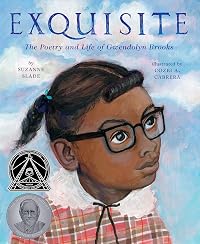
Illustrator Cozbi A. Cabrera used acrylics to create expressive pictures showing the aspects of Gwendolyn’s life depicted by the text.
You can read some of Brooks’ poems here.
Evaluation: Like other books about persistent girls with dreams who let nothing stand in their way, this one could well have been titled: “Nothing Stopped Gwendolyn!” Young readers will find encouragement and inspiration in her story. show less
The author of this book for readers aged 6 and up reports that young Gwendolyn received a great deal of support from her parents, who had a bookcase filled with poems in their home. Each night, her father read some poems aloud, and Gwendolyn memorized them. When she was seven, Gwendolyn began writing poems of her own. Her mother praised her, saying, "You are going to be the lady Paul Laurence show more Dunbar." Dunbar, also a Black poet, was Gwendolyn’s favorite.
Writing became a part of Gwendolyn:
“ . . . It was something she just had to do. She carefully strung words together like elegant jewels in perfect meter and time.”
At age eleven, she mailed four of her poems to a newspaper and magazine. They were published, but then the Great Depression began. Money for the arts dried up, and for a while, all of her poems were rejected. Gwendolyn went to college, still reading and writing poetry, while working at menial jobs to support herself. She married another poet, and continued honing her craft. Eventually, her poems won contests and began to appear in print. She kept dreaming, the author writes, and collected her work into a book which she sent to a book publisher in New York. The publisher loved it, even asking for more poems, and the book eventually became A Street in Bronzeville.. A second book followed, Annie Allen, for which she won the greatest prize in poetry: the Pulitzer.
An Author’s Note tells readers that Gwendolyn Brooks went on to write fourteen more books. In her later years, she taught writing classes and sponsored contests to help inspire young poets. There is also a timeline, list of sources, and bibliography.
Illustrator Cozbi A. Cabrera used acrylics to create expressive pictures showing the aspects of Gwendolyn’s life depicted by the text.
You can read some of Brooks’ poems here.
Evaluation: Like other books about persistent girls with dreams who let nothing stand in their way, this one could well have been titled: “Nothing Stopped Gwendolyn!” Young readers will find encouragement and inspiration in her story. show less
Suzanne Slade presents another fantastic picture book about a historical figure. This time the author turns their pen to Gwendloyn Brooks, the Poet Lauret from Illinois, and the first Black woman to win a Pulitzer Prize. The book is a great tale. I do think it ends in an awkward place, but it gives the reader an idea of who Gwendolyn was and might make them interested in learning more.
Exquisite does a really great job describing the life story of poet Gwendolyn Brooks while also interweaving some of her original poetry throughout the book. The illustrations are beautiful and it even provides a timeline of her life and a full poem of hers at the end.
K-Gr 3—Poet Gwendolyn Brooks, the first Black person to win the Pulitzer Prize, was determined to realistically
capture the world she saw. Her indomitable pursuit of cloudlike dreams, even as the lights are being turned off at her
home again, is remarkable. Elegant acrylic paintings and text reflect Brooks's exquisite poetry.
capture the world she saw. Her indomitable pursuit of cloudlike dreams, even as the lights are being turned off at her
home again, is remarkable. Elegant acrylic paintings and text reflect Brooks's exquisite poetry.
This book would be good for intermediate students. This book is "Exquisite: The Poetry and Life of Gwendolyn Brooks" by Suzanna Slade, illustrated by Cozbi A. Cabrera, published in 2020. This book is about a girl named Gwendolyn and she grew up in a lower class family, but even if her family didn't have a lot of money, she still had poetry. She took inspiration from everything around her and wrote them down in beautiful poems. She turned in her poems to multiple places and kept getting rejected and also got rejected by her classmates for her skin being dark. She eventually found success after persevering a lot and won the Pulitzer Prize! Her hardworking had finally paid off. I would for sure have this book in my classroom to teach about show more a person from a different culture and to teach kids that hard work pays off. show less
I hate marking this down, as it is important we are reminded of Brooks still relevant & enjoyable poems, but this biography just didn't do much for me. I'm not a fan of the art, especially how the heads of the people are often truncated/ off page. The small font, often white on pastel, is almost impossible to read online. Also, I didn't feel like I got to know Brooks at all. If I were a young reader I would not find her inspiring.
Well, that is, until I read her books, and the poems that were read to her when she was a child. I have loved a fair bit of it, and I def. recommend [b:Bronzeville Boys and Girls|225755|Bronzeville Boys and Girls|Gwendolyn show more Brooks|https://i.gr-assets.com/images/S/compressed.photo.goodreads.com/books/1348289710l/225755._SX50_.jpg|2685190]. show less
Well, that is, until I read her books, and the poems that were read to her when she was a child. I have loved a fair bit of it, and I def. recommend [b:Bronzeville Boys and Girls|225755|Bronzeville Boys and Girls|Gwendolyn show more Brooks|https://i.gr-assets.com/images/S/compressed.photo.goodreads.com/books/1348289710l/225755._SX50_.jpg|2685190]. show less
The book is about Gwendolyn from and early age and into her adult life, this is around the Great Depression ear. In the book it does explore race, gender and poverty, but it also illiterates Gwendolyn love for writing and poetry. This book would be good for any students that feels as if their background will only hurt them, that’s not the case. Very positive and up lifting.
Members
- Recently Added By
Lists

Robert F. Sibert Informational Book Medal
102 works; 1 member
Author Information

134 Works 3,135 Members
All Editions
Awards and Honors
Awards
Distinctions
Notable Lists
Common Knowledge
- Canonical title
- Exquisite : the poetry and life of Gwendolyn Brooks
- Original publication date
- 2020
- People/Characters
- Gwendolyn Brooks
- Important places
- Chicago, Illinois, USA
- First words
- Gwendolyn grew up in the big city of Chicago with little money to spare.
- Last words
- (Click to show. Warning: May contain spoilers.)Outside, exquisite clouds exploded in the sunset sky, because Gwendolyn had won the greatest prize in poetry!
- Original language
- English
Classifications
Statistics
- Members
- 178
- Popularity
- 184,020
- Reviews
- 13
- Rating
- (4.44)
- Languages
- English
- Media
- Paper, Ebook
- ISBNs
- 3
- ASINs
- 1