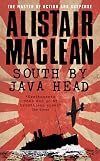
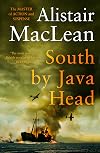
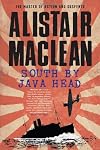
South by Java Head
by Alistair MacLean
On This Page
Description
The 50th anniversary edition of this classic World War 2 adventure set in south-east Asia. February, 1942: Singapore lies burning and shattered, defenseless before the conquering hordes of the Japanese Army, as the last boat slips out of the harbor into the South China Sea. On board are a desperate group of people, each with a secret to guard, each willing to kill to keep that secret safe. Who or what is the dissolute Englishman, Farnholme? The elegant Dutch planter, Van Effen? The strangely show more beautiful Eurasian girl, Gudrun? The slave trader, Siran? The smiling and silent Nicholson who is never without his gun? Only one thing is certain: the rotting tramp steamer is a floating death trap, carrying a cargo of human TNT. Dawn sees them far out to sea but with the first murderous dive bombers already aimed at their ship. Thus begins an ordeal few are to survive, a nightmare succession of disasters wrought by the hell-bent Japanese, the unrelenting tropical sun and by the survivors themselves, whose hatred and bitterness divides them one against the other. Written after the acclaimed and phenomenally successful HMS Ulysses and The Guns of Navarone, this was MacLean's third book, and it contains all the hallmarks of those other two classics. Rich with stunning visual imagery, muscular narrative power, brutality, courage and breathtaking excitement, the celebration of the 50th anniversary of South by Java Head offers readers a long-denied chance to enjoy one of the greatest war novels ever written. - Originally published in 1958 but long out of print, this classic tale of World War 2 adventure celebrates its 50th anniversary with a stunning new package. - Reissued as part of a major repackaging of the key MacLean backlist titles. - This volume is part of a new effort to re-establish Alistair Maclean as the UK's foremost writer of thrillers and wartime adventures. - Alistair MacLean's books have sold over 30 million copies worldwide - Many have been turned into award-winning blockbuster films, including The Guns of Navarone, Where Eages Dare, The Satan Bug and Ice Station Zebra. show lessTags
Recommendations














Member Reviews
I read this book because a MacLean fan of my acquaintance insisted that the literary hell I was put through by "Where Eagles Dare" was a fluke, and that his other books were better. Big mistake. This one is worse.
MacLean has an infuriating habit of writing military commanders who perpetually endanger their soldiers, their missions, and other innocents through an inexplicable refusal to kill enemy combatants. In "Where Eagles Dare," the supposedly heroic mission leader makes a ridiculous and irrelevant effort to arrest a pair of Nazis in Germany during wartime and bring them home to face a trial--yes, a trial--instead of just shooting the stinking Nazis like any good soldier would do. The eventual result is that the Nazis die anyway, show more but not before they make corpses out of most of his soldiers. So: no trial, and a whole lot of Allied families are needlessly bereaved because of our hero.
"South by Java Head" turns out to be no different. In this case, a captain must shepherd a stricken and parched lifeboat full of wounded survivors through Japanese-infested waters to reach safety in Australia. And just to spice things up, guess what additional passengers the captain thinks it's vitally important to bring back on his boat: a full crew of pirates! Why? To stand trial, of course! If you know MacLean, then the result is predictable: there's no trial, because the pirates wind up dead en route, but only after taking a bunch of innocents with them.
I console myself by picturing MacLean proudly and dramatically explaining to the bereaved families the senseless vanity that their sons and husbands were sacrificed to, and then those families beating the stuffing out of him.
(Incidentally, after a while it becomes almost comical the way MacLean seems unable to describe Japanese people without throwing in the adjectives "leering" and "yellow.")
This is, I swear on all that is sacred, the last MacLean I'll ever read. I don't care if it turns out he ghost-wrote Harry Potter; I'm done with him. show less
MacLean has an infuriating habit of writing military commanders who perpetually endanger their soldiers, their missions, and other innocents through an inexplicable refusal to kill enemy combatants. In "Where Eagles Dare," the supposedly heroic mission leader makes a ridiculous and irrelevant effort to arrest a pair of Nazis in Germany during wartime and bring them home to face a trial--yes, a trial--instead of just shooting the stinking Nazis like any good soldier would do. The eventual result is that the Nazis die anyway, show more but not before they make corpses out of most of his soldiers. So: no trial, and a whole lot of Allied families are needlessly bereaved because of our hero.
"South by Java Head" turns out to be no different. In this case, a captain must shepherd a stricken and parched lifeboat full of wounded survivors through Japanese-infested waters to reach safety in Australia. And just to spice things up, guess what additional passengers the captain thinks it's vitally important to bring back on his boat: a full crew of pirates! Why? To stand trial, of course! If you know MacLean, then the result is predictable: there's no trial, because the pirates wind up dead en route, but only after taking a bunch of innocents with them.
I console myself by picturing MacLean proudly and dramatically explaining to the bereaved families the senseless vanity that their sons and husbands were sacrificed to, and then those families beating the stuffing out of him.
(Incidentally, after a while it becomes almost comical the way MacLean seems unable to describe Japanese people without throwing in the adjectives "leering" and "yellow.")
This is, I swear on all that is sacred, the last MacLean I'll ever read. I don't care if it turns out he ghost-wrote Harry Potter; I'm done with him. show less
Alistair MacLean's third novel takes us to Singapore in the Second World War. The Japanese are about to capture the city, and the Allies are fleeing in any craft they can find. A ragtag group of soldiers meets up with a group of nurses and a little boy lost in the streets. Their perilous adventures as they attempt to escape the enemy make for nail-biting reading, and the pace hardly lets up. Many of the characters get hero moments, with my favourite being the unflappable cool of Miss Plenderleith, calmly knitting her way through a crisis.
I did object to the portrayal of the Japanese as less than human (e.g. describing their eyes as "porcine" and their shouting as "insane gibberish"). Yes, they were the antagonists of the book, but there show more was no call for that. I guess I should be grateful that none of them spoke in heavily accented English rendered phonetically :-/ And in terms of the story, there is a great deal of disbelief needing to be suspended -- "Not ANOTHER impossible-to-beat-the-odds situation!" you might exclaim. But I think it helps to read this book with a really pulpy cover, to get in the right frame of mind for suspending disbelief.
This is not quite as good as, say, The Guns of Navarone or Ice Station Zebra, but it is very good nonetheless. show less
I did object to the portrayal of the Japanese as less than human (e.g. describing their eyes as "porcine" and their shouting as "insane gibberish"). Yes, they were the antagonists of the book, but there show more was no call for that. I guess I should be grateful that none of them spoke in heavily accented English rendered phonetically :-/ And in terms of the story, there is a great deal of disbelief needing to be suspended -- "Not ANOTHER impossible-to-beat-the-odds situation!" you might exclaim. But I think it helps to read this book with a really pulpy cover, to get in the right frame of mind for suspending disbelief.
This is not quite as good as, say, The Guns of Navarone or Ice Station Zebra, but it is very good nonetheless. show less
Filled with purple prose, cliched feelings, and static characters, South By Java Head nevertheless is meticulously plotted and overflowing with over the top action scenes. It is everything a teenage boy or an undiscriminating adult male reader would enjoy back in the 1950s and early 1960s. And that is not so much of a put down as one might think. I doubt the same target audience today could deal with the book. They haven't the concentration, the vocabulary, or patience to deal with much of the nautical and geographic terms that would undoubtedly overwhelm them. Not so back during the days of the book's launch. The target audience for mass paperback adventure stories was not only larger than today but more intelligent.
Another fault? show more There is the feel occasionally that South By Java Head veers close to being a romance novel. Especially during the last two or three chapters I almost expected it to resort to the language of a bodice ripper. At times it seems a cross between John Carter of Mars and a Barbara Cartland novel.
So why read this book? It does become tiresome at points and the characters never exhibit the slightest indication of growth. They are just the same at the end as at the beginning, expressing noble values, justice, and fair play. But then there are those action passages. Pretty good. No wonder Alistair MacLean did so well when translated to film. And there is another reason. Written in 1957, this novel about World War II, the Fall of Singapore, and a motley group of survivors who survive torpedo attacks, starvation at sea, and chases through jungles actually works at another level. It's a Cold War novel. It's not just the British against the Japanese. It's the Western world against an inhuman Oriental totalitarian ideology. Without spoiling the plot, just let it be said that White Europeans come together to see their common heritage under assault from a bloodthirsty foe who morally is somewhere between Ming the Merciless and Mao Zedong. show less
Another fault? show more There is the feel occasionally that South By Java Head veers close to being a romance novel. Especially during the last two or three chapters I almost expected it to resort to the language of a bodice ripper. At times it seems a cross between John Carter of Mars and a Barbara Cartland novel.
So why read this book? It does become tiresome at points and the characters never exhibit the slightest indication of growth. They are just the same at the end as at the beginning, expressing noble values, justice, and fair play. But then there are those action passages. Pretty good. No wonder Alistair MacLean did so well when translated to film. And there is another reason. Written in 1957, this novel about World War II, the Fall of Singapore, and a motley group of survivors who survive torpedo attacks, starvation at sea, and chases through jungles actually works at another level. It's a Cold War novel. It's not just the British against the Japanese. It's the Western world against an inhuman Oriental totalitarian ideology. Without spoiling the plot, just let it be said that White Europeans come together to see their common heritage under assault from a bloodthirsty foe who morally is somewhere between Ming the Merciless and Mao Zedong. show less
February, 1942: Singapore lies burning and shattered, defenceless before the conquering hordes of the Japanese Army, as the last boat slips out of the harbour into the South China Sea. On board are a desperate group of people, each with a secret to guard, each willing to kill to keep that secret safe.
Who or what is the dissolute Englishman, Farnholme? The elegant Dutch planter, Van Effen? The strangely beautiful Eurasian girl, Gudrun? The slave trader, Siran? The smiling and silent Nicholson who is never without his gun? Only one thing is certain: the rotting tramp steamer is a floating death trap, carrying a cargo of human TNT.
Dawn sees them far out to sea but with the first murderous dive bombers already aimed at their ship. Thus show more begins an ordeal few are to survive, a nightmare succession of disasters wrought by the hell-bent Japanese, the unrelenting tropical sun and by the survivors themselves, whose hatred and bitterness divides them one against the other.
Written after the acclaimed and phenomenally successful HMS Ulysses and The Guns of Navarone, this was MacLean’s third book, and it contains all the hallmarks of those other two classics. Rich with stunning visual imagery, muscular narrative power, brutality, courage and breathtaking excitement, the celebration of the 50th anniversary of South by Java Head offers readers a long-denied chance to enjoy one of the greatest war novels ever written. show less
Who or what is the dissolute Englishman, Farnholme? The elegant Dutch planter, Van Effen? The strangely beautiful Eurasian girl, Gudrun? The slave trader, Siran? The smiling and silent Nicholson who is never without his gun? Only one thing is certain: the rotting tramp steamer is a floating death trap, carrying a cargo of human TNT.
Dawn sees them far out to sea but with the first murderous dive bombers already aimed at their ship. Thus show more begins an ordeal few are to survive, a nightmare succession of disasters wrought by the hell-bent Japanese, the unrelenting tropical sun and by the survivors themselves, whose hatred and bitterness divides them one against the other.
Written after the acclaimed and phenomenally successful HMS Ulysses and The Guns of Navarone, this was MacLean’s third book, and it contains all the hallmarks of those other two classics. Rich with stunning visual imagery, muscular narrative power, brutality, courage and breathtaking excitement, the celebration of the 50th anniversary of South by Java Head offers readers a long-denied chance to enjoy one of the greatest war novels ever written. show less
South by Java Head, a review.
I was woolgathering in my library the other day and my glance fell on an old book, on the shelves for a long time it had been gathering dust and had about it a film of neglect. And such a shame for it to have been so neglected. Written by Alistair MacLean and published in 1958, the story is set in February 1942, in the immediate aftermath of the Battle of Singapore. As the British stronghold of Singapore falls to the invading Imperial Japanese Army, a mixed collection of soldiers, nurses, fleeing civilians, a small boy, and at least one spy attempt to escape the burning city aboard the Kerry Dancer, a battered freighter manned by a disreputable captain and crew. The Kerry Dancer is crippled by Japanese show more aircraft, and the refugees are rescued by the Viroma, a tanker also fleeing Singapore; however, the Viroma is also sunk by the Japanese, and the survivors take to open boats open sea. Led by stalwart First Officer Nicholson, they attempt to flee to safety across the South China Sea, facing death by thirst and exposure, typhoons, and pursuit by the relentless Japanese. As tension amount in the small boat, Nicholson realizes that they are equally at risk from traitors in their midst.
Having spent two years in Indonesia as the Air Attache and being fortunate enough to have been brought to fluency in Bahasa Indonesia courtesy of the US State Department, the novel awakens memories. Taking part in several memorials to Indonesian intellectuals murdered by the Japanese and hearing their stories, made the events in South by Java Head very poignant.
Of course one truism that can be said of Mr. MacLean’s heroes, they are typically a male character who is depicted as physically and morally indestructible. The kind of character all men aspire to. Unlike the “tainted hero” who skirts or outright flaunts a disregard for law and justice to obtain the correct outcome, MacLean’s protagonists adhere to the straight and narrow and overcome what appears to be insurmountable odds. With conversation frequently laced with a dry, sardonic, self-deprecating humour, the hero guides us on to a satisfying end. show less
I was woolgathering in my library the other day and my glance fell on an old book, on the shelves for a long time it had been gathering dust and had about it a film of neglect. And such a shame for it to have been so neglected. Written by Alistair MacLean and published in 1958, the story is set in February 1942, in the immediate aftermath of the Battle of Singapore. As the British stronghold of Singapore falls to the invading Imperial Japanese Army, a mixed collection of soldiers, nurses, fleeing civilians, a small boy, and at least one spy attempt to escape the burning city aboard the Kerry Dancer, a battered freighter manned by a disreputable captain and crew. The Kerry Dancer is crippled by Japanese show more aircraft, and the refugees are rescued by the Viroma, a tanker also fleeing Singapore; however, the Viroma is also sunk by the Japanese, and the survivors take to open boats open sea. Led by stalwart First Officer Nicholson, they attempt to flee to safety across the South China Sea, facing death by thirst and exposure, typhoons, and pursuit by the relentless Japanese. As tension amount in the small boat, Nicholson realizes that they are equally at risk from traitors in their midst.
Having spent two years in Indonesia as the Air Attache and being fortunate enough to have been brought to fluency in Bahasa Indonesia courtesy of the US State Department, the novel awakens memories. Taking part in several memorials to Indonesian intellectuals murdered by the Japanese and hearing their stories, made the events in South by Java Head very poignant.
Of course one truism that can be said of Mr. MacLean’s heroes, they are typically a male character who is depicted as physically and morally indestructible. The kind of character all men aspire to. Unlike the “tainted hero” who skirts or outright flaunts a disregard for law and justice to obtain the correct outcome, MacLean’s protagonists adhere to the straight and narrow and overcome what appears to be insurmountable odds. With conversation frequently laced with a dry, sardonic, self-deprecating humour, the hero guides us on to a satisfying end. show less
This engrossing tale takes place during WWII just after the fall of Singapore to the Japanese. A motley group of evacuees strive to not only evade the enemy but also survive the elements with a traitor on board. Very good almost to the ending, which unfortunately was a tad weak. Still, it's another good story by MacLean.
St. Bart's 2014 #9 - This nail-biting adventure from MacLean that is so chock-full of David vs. Goliath encounters between some horribly outgunned sailors and civilians at sea and the evil WWII Japanese fighting force, that it is almost exhausting to read. In fact, that is a possible reason 4 is as high as I was willing or go...it borders on too much. And there is some inherent unbelievability throughout this that also keeps my rating down. But with that all said, I did enjoy the book quite bit.....you can't help but root for the 'Davids,' especially when they have no chance to survive, and then the odds get worse....and I kept asking myself, could I have thought of that??? Anyway, fun stuff and a great read for my final book of my 2014 show more island vacation. show less
Members
- Recently Added By
Lists

Books With Body Parts in the Title
153 works; 9 members
Author Information

107+ Works 28,604 Members
Alistair MacLean was born in Glasgow, Scotland on April 28, 1922. During World War II, he served in the Royal Navy. He graduated with a degree in English from Glasgow University. Before becoming a full-time author, he was a teacher. He wrote numerous books including HMS Ulysses, The Guns of Navarone, Ice Station Zebra, Where Eagles Dare, Dark show more Crusader, Satan Bug, Captain Cook: A Biography, and Santorini. He also wrote The Black Shrike and The Satan Bug under the pseudonym Ian Stuart. Several of his books were adapted into movies including The Secret Ways, Fear Is the Key, and When Eight Bells Toll. He also wrote several original screenplays including Breakheart Pass and conceived an adventure drama for television entitled The Hostage Towers. He died of heart failure on February 2, 1987 at the age of 64. (Bowker Author Biography) show less
Some Editions
Series
Belongs to Publisher Series
Work Relationships
Common Knowledge
- Canonical title
- South by Java Head
- Original title
- South by Java Head
- Original publication date
- 1958
- People/Characters
- Van Effen; Nicolson; Miss. Plenderleith; Farnholme; McKinnon; Siran [in South by Java Head] (show all 7); Fraser [in South by Java Head] (Corporal)
- Important places
- Singapore
- Important events
- World War II (1939 | 1945); World War II, Pacific Theater (1941-12-07 | 1945-09-02); Fall of Singapore (1941 | 1942)
- Dedication
- To Ian
- First words
- Choking, dense, impenetrable, the black smoke lay pall-like over the dying city.
- Last words
- (Click to show. Warning: May contain spoilers.)They rendezvoused with H.M.A.S Kenmore, a Q-class destroyer, at half past two in the morning.
Classifications
- Genres
- Fiction and Literature, Suspense & Thriller, Historical Fiction
- DDC/MDS
- 823.914 — Literature & rhetoric English & Old English literatures English fiction 1900- 1901-1999 1945-1999
- LCC
- PZ4 — Language and Literature Fiction and juvenile belles lettres Fiction and juvenile belles lettres Fiction in English
- BISAC
Statistics
- Members
- 879
- Popularity
- 30,887
- Reviews
- 17
- Rating
- (3.51)
- Languages
- 12 — Danish, Dutch, English, Finnish, German, Marathi, Norwegian (Bokmål), Norwegian, Polish, Slovenian, Spanish, Swedish
- Media
- Paper, Audiobook, Ebook
- ISBNs
- 46
- ASINs
- 39