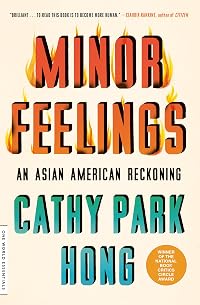
Minor Feelings: An Asian American Reckoning
by Cathy Park Hong
On This Page
Description
"Asian Americans inhabit a purgatorial status: neither white enough nor black enough, unmentioned in most conversations about racial identity. In the popular imagination, Asian Americans are all high-achieving professionals. But in reality, this is the most economically divided group in the country, a tenuous alliance of people with roots from South Asia to East Asia to the Pacific Islands, from tech millionaires to service industry laborers. How do we speak honestly about the Asian American show more condition--if such a thing exists? Poet and essayist Cathy Park Hong fearlessly and provocatively confronts this thorny subject, blending memoir, cultural criticism, and history to expose the truth of racialized consciousness in America. Binding these essays together is Hong's theory of "minor feelings." As the daughter of Korean immigrants, Cathy Park Hong grew up steeped in shame, suspicion, and melancholy. She would later understand that these "minor feelings" occur when American optimism contradicts your own reality--when you believe the lies you're told about your own racial identity. With sly humor and a poet's searching mind, Hong uses her own story as a portal into a deeper examination of racial consciousness in America today. This intimate and devastating book traces her relationship to the English language, to shame and depression, to poetry and artmaking, and to family and female friendship. A radically honest work of art, Minor Feelings forms a portrait of one Asian American psyche--and of a writer's search to both uncover and speak the truth"-- show lessTags
Recommendations






Member Reviews
"Minor feelings" writes poet Cathy Park Hong "occur when American optimism is enforced upon you, which contradicts your own racialized reality, thereby creating a static of cognitive dissonance." In seven personal essays, she explores her own minor feelings, "the racialized range of emotions that are negative, dysphoric, and therefore untelegenic, built from the sediments of everyday racial experience and the irritant of having one's perception of reality constantly questioned or dismissed."
Hong tackles a variety of topics, writing often from her own experiences, but bringing in thoughts from other writers and thinkers. She writes in "Stand Up" about audience, and how many people of color are expected to write for a white audience or show more only about specific topics, and her own relationship to Richard Pryor's stand up works. In "Bad English" she ruminates on the ways in which making fun of the Asian accent is still acceptable, and also how she as a poet whose second language was English uses the language to her own purposes. "An Education" discusses the sometimes fraught friendship she had with two other Asian American artists in college. She ruminates on whether she as a Korean American can speak only to her specific experiences or more broadly as Asian American, which covers such a variety of identities and experiences as immigrants and their descendants in the U.S. And this is just the tip of the iceberg. Her thoughts are personal and far-reaching, she's writing for herself and for everyone, but she doesn't slow down to explain if you're not following along with her narrative. I feel like I'd have to read it a second time through, take notes and talk back, to get even more out of it. show less
Hong tackles a variety of topics, writing often from her own experiences, but bringing in thoughts from other writers and thinkers. She writes in "Stand Up" about audience, and how many people of color are expected to write for a white audience or show more only about specific topics, and her own relationship to Richard Pryor's stand up works. In "Bad English" she ruminates on the ways in which making fun of the Asian accent is still acceptable, and also how she as a poet whose second language was English uses the language to her own purposes. "An Education" discusses the sometimes fraught friendship she had with two other Asian American artists in college. She ruminates on whether she as a Korean American can speak only to her specific experiences or more broadly as Asian American, which covers such a variety of identities and experiences as immigrants and their descendants in the U.S. And this is just the tip of the iceberg. Her thoughts are personal and far-reaching, she's writing for herself and for everyone, but she doesn't slow down to explain if you're not following along with her narrative. I feel like I'd have to read it a second time through, take notes and talk back, to get even more out of it. show less
The poetry editor of the New Republic discusses her experiences living and working in a culture hostile to expressions of Asian individuality and identity.
In this memoir in essays, Hong (Engine Empire, 2012, etc.) offers a fierce and timely meditation on race and gender issues from her perspective as a Korean American woman. She begins by reflecting on her struggles with depression, which she traces to being forced into the role of model minority. Working harder than everyone else for recognition as an artist, she describes how she watched herself disappear into the “vague purgatorial” no-man’s land inhabited by other Asian Americans. The author details how her experiences developing bonds with other talented Asian American women show more in college taught her to take herself seriously in a world that stereotyped Asians as “math-crunching middle managers.” She began developing a greater sense of race consciousness when watching comedian Richard Pryor, which she explores in the essay “Stand Up.” His no-holds-barred comedic monologues embodied racialized “negative [and] dysphoric” emotions with which she immediately identified. In turn, Hong attempted to access those “minor feelings” through her own brief foray into stand-up comedy. Like the experiments with language she discusses in “Bad English,” the author was seeking a way to speak honestly about her own experiences with racism in an effort to end “white innocence,” a concept she addresses sharply in a separate essay. As she sees it, the United States has achieved dominance through “the capitalist accumulation of white supremacy.” In “Portrait of an Artist,” Hong discusses Asian female invisibility by delving into the groundbreaking work of artist and novelist Theresa Hak Kyung Cha. Seeking to force confrontation with Cha’s largely undiscussed murder, Hong examines how Cha died while suggesting that Cha’s preoccupation with discursive erasure was a manifestation of revolutionary—rather than “feminine” self-silencing—impulses. Candid and unapologetically political, Hong’s text deftly explores the explosive emotions surrounding race in ways sure to impact the discourse surrounding Asian identity as well as race and belonging in America.
A provocatively incisive debut nonfiction book. show less
In this memoir in essays, Hong (Engine Empire, 2012, etc.) offers a fierce and timely meditation on race and gender issues from her perspective as a Korean American woman. She begins by reflecting on her struggles with depression, which she traces to being forced into the role of model minority. Working harder than everyone else for recognition as an artist, she describes how she watched herself disappear into the “vague purgatorial” no-man’s land inhabited by other Asian Americans. The author details how her experiences developing bonds with other talented Asian American women show more in college taught her to take herself seriously in a world that stereotyped Asians as “math-crunching middle managers.” She began developing a greater sense of race consciousness when watching comedian Richard Pryor, which she explores in the essay “Stand Up.” His no-holds-barred comedic monologues embodied racialized “negative [and] dysphoric” emotions with which she immediately identified. In turn, Hong attempted to access those “minor feelings” through her own brief foray into stand-up comedy. Like the experiments with language she discusses in “Bad English,” the author was seeking a way to speak honestly about her own experiences with racism in an effort to end “white innocence,” a concept she addresses sharply in a separate essay. As she sees it, the United States has achieved dominance through “the capitalist accumulation of white supremacy.” In “Portrait of an Artist,” Hong discusses Asian female invisibility by delving into the groundbreaking work of artist and novelist Theresa Hak Kyung Cha. Seeking to force confrontation with Cha’s largely undiscussed murder, Hong examines how Cha died while suggesting that Cha’s preoccupation with discursive erasure was a manifestation of revolutionary—rather than “feminine” self-silencing—impulses. Candid and unapologetically political, Hong’s text deftly explores the explosive emotions surrounding race in ways sure to impact the discourse surrounding Asian identity as well as race and belonging in America.
A provocatively incisive debut nonfiction book. show less
I do not share some of Hong's grander assessments of America's past actions and future likely paths (others are unassailably historically correct or certainly possible) but her lived experience is hers and it is instructive and fascinating. It also supports her opinions. Her story moved the needle on my perception of America and Americans. There is an urgency to it in this time when anti-Asian violence seems to rise each week. Hong tells a story about being assaulted with hate speech in a subway station and having a white friend make it all about her (the friend) and her pain at having experienced this. I am not trying to be that woman. I am just bearing witness that I have never had that happen while with Asian friends until the past show more 17 months, during which time it has happened twice, both times on the subway, and that I am rarely on the subway these days with work being remote. These assholes diminishing strangers, othering them, should sicken us all. The "minor feelings" of the title are these things and others, the phrase is, I think, roughly synonymous with microaggression (the acts of aggression themselves and the impact of the microaggessions.) Park puts together an analysis of the ethnic Asian experience in the US, through a string of essays intermittently personal, political and historical (all steeped in cultural criticism) that at least for me moved my understanding of microaggression from intellectual understanding to clouds parting empathic and intellectual understanding. I did not know what I did not know.
I appreciated how Park used the stories of others as well as her own. Her deconstruction of Richard Pryor was spectacular as were her narratives and interpretations of the lives and sanitized legacies of other artists and revolutionaries. She may want to lay off the Amiri Baraka. She may have chosen to sanitize that legacy herself, forgetting his violent misogyny and antisemitism. Shame on a poet whose whole life is built on the importance of language for lionizing and quoting as gospel (repeatedly in this book) the words of a man who wrote:
"Smile, jew. Dance, jew. Tell me you love me, jew...I got the extermination blues, jewboys. I got the hitler syndrome figured"
It doesn't mean he did not write and do important things, but he was no antidote to Trump, he was just as malignant, just less powerful.
All in all Minor Feelings is brilliant, wide ranging but still cohesive, instructive, beautifully written. (Her discussions of shaping her second language to her will, assaulting the orthodoxy of language was one of my favorite themes. I have often thought Nabokov did the same, that he created beautiful prose by attacking rather than embracing his new tongue.) I believe building authentic understanding is the greatest thing a writer can do. Park has done that. Every American should read this book. show less
I appreciated how Park used the stories of others as well as her own. Her deconstruction of Richard Pryor was spectacular as were her narratives and interpretations of the lives and sanitized legacies of other artists and revolutionaries. She may want to lay off the Amiri Baraka. She may have chosen to sanitize that legacy herself, forgetting his violent misogyny and antisemitism. Shame on a poet whose whole life is built on the importance of language for lionizing and quoting as gospel (repeatedly in this book) the words of a man who wrote:
"Smile, jew. Dance, jew. Tell me you love me, jew...I got the extermination blues, jewboys. I got the hitler syndrome figured"
It doesn't mean he did not write and do important things, but he was no antidote to Trump, he was just as malignant, just less powerful.
All in all Minor Feelings is brilliant, wide ranging but still cohesive, instructive, beautifully written. (Her discussions of shaping her second language to her will, assaulting the orthodoxy of language was one of my favorite themes. I have often thought Nabokov did the same, that he created beautiful prose by attacking rather than embracing his new tongue.) I believe building authentic understanding is the greatest thing a writer can do. Park has done that. Every American should read this book. show less
This book blasted my heart to pieces. A complex set of essays about Asian American identity and Korean American immigration in particular, and art and poetry and history and racism and violence. Hong's ability to make the historical. the structural, the cultural personal and emotional is the through line through this collection. that veers between wide cultural moments, niche artists, viral videos, and her own life.
I read this during a readathon, and while it was amazing to sit down and read this in one sitting, I would love to come back to this someday when I can spend ore time with each essay, because there's SO MUCH to unpack here.
I read this during a readathon, and while it was amazing to sit down and read this in one sitting, I would love to come back to this someday when I can spend ore time with each essay, because there's SO MUCH to unpack here.
there's so much to like here in these essays. she's a poet so her writing is thoughtful and powerful.
what was most impactful for me:
- she said that the japanese internment camps were used as a basis for the muslim registry that trump and his allies tried to implement early in his presidency. i don't remember that being used as justification and am disgusted if it was. i thought we'd all roundly disavowed that awfulness in our past, but to use it to move forward with the demonizing of another group?
- a quote from jess row, in his book white flights: "America's great and possibly catastrophic failure is its failure to imagine what it means to live together."
-"Whether it's through retribution or indebtedness, who are we when we become show more better than them in a system that destroyed us?"
-a quote from lorraine o'grady in 2018: "In the future, white supremacy will no longer need white people."
and, without a doubt, what i most take away from this book is the idea that she talks about when she talks about the immigrant and diverse stories that the publishing industry has championed, and the books that i've loved as a reader. are they books that specifically appeal to some stereotypes or messages directed to white people? do i like them because they tell a certain story? is it a comfortable story that makes me feel like i'm getting the perspective of a person of color but it's really whitewashed for my benefit? i don't know the answer but i've never really considered the question in a way that i should have. i will be thinking about it now. show less
what was most impactful for me:
- she said that the japanese internment camps were used as a basis for the muslim registry that trump and his allies tried to implement early in his presidency. i don't remember that being used as justification and am disgusted if it was. i thought we'd all roundly disavowed that awfulness in our past, but to use it to move forward with the demonizing of another group?
- a quote from jess row, in his book white flights: "America's great and possibly catastrophic failure is its failure to imagine what it means to live together."
-"Whether it's through retribution or indebtedness, who are we when we become show more better than them in a system that destroyed us?"
-a quote from lorraine o'grady in 2018: "In the future, white supremacy will no longer need white people."
and, without a doubt, what i most take away from this book is the idea that she talks about when she talks about the immigrant and diverse stories that the publishing industry has championed, and the books that i've loved as a reader. are they books that specifically appeal to some stereotypes or messages directed to white people? do i like them because they tell a certain story? is it a comfortable story that makes me feel like i'm getting the perspective of a person of color but it's really whitewashed for my benefit? i don't know the answer but i've never really considered the question in a way that i should have. i will be thinking about it now. show less
I won a copy of this in a Goodreads giveaway, but I would've gotten a copy of my own, likely (it comes out on 2/25/20 next week!)
These essays are autobiographical but also examine the place Asian Americans have in the American consciousness (and what does that term even mean, because while it began as a political statement of solidarity has it fallen into a banal umbrella grouping?)
There are so, so many chunks of essay where I felt seen to my core- how to grapple with being a minority, the only one in your class at school while also being treated as white-adjacent (I recall in middle school, a peer made a joke about tennis shoes being made by children in China and when I made a face he was like, "why should you care? You're show more American!"), or by noting the privacy of hiding our trauma (and yet, it seems like that's the only story we're allowed to tell even though to be frank, Asian American history *is* full of trauma). At the same time she ponders a broad history/consciousness, she is intensely personal- thinking about the parallel specificity between her family and [a:Theresa Hak Kyung Cha|52223|Theresa Hak Kyung Cha|https://images.gr-assets.com/authors/1286468056p2/52223.jpg]'s, between whether or not it is lurid or shedding light on Theresa's rape and murder.
I'm going to be thinking about this one for a while, and will probably revisit it during APAHM. show less
These essays are autobiographical but also examine the place Asian Americans have in the American consciousness (and what does that term even mean, because while it began as a political statement of solidarity has it fallen into a banal umbrella grouping?)
There are so, so many chunks of essay where I felt seen to my core- how to grapple with being a minority, the only one in your class at school while also being treated as white-adjacent (I recall in middle school, a peer made a joke about tennis shoes being made by children in China and when I made a face he was like, "why should you care? You're show more American!"), or by noting the privacy of hiding our trauma (and yet, it seems like that's the only story we're allowed to tell even though to be frank, Asian American history *is* full of trauma). At the same time she ponders a broad history/consciousness, she is intensely personal- thinking about the parallel specificity between her family and [a:Theresa Hak Kyung Cha|52223|Theresa Hak Kyung Cha|https://images.gr-assets.com/authors/1286468056p2/52223.jpg]'s, between whether or not it is lurid or shedding light on Theresa's rape and murder.
I'm going to be thinking about this one for a while, and will probably revisit it during APAHM. show less
I don’t remember how this got on my radar—I’d never heard of Hong before—but I was glad this essay collection came my way. As a rule, I don’t go looking for poetry, so I doubt I’ll seek out Hong’s poetry collections, but after reading her excellent prose, I’m tempted.
I appreciated how honest Hong was about her experiences as a Korean woman from an immigrant family, growing up in the 90’s. I estimate her to be around 10 years younger than I am. When I was growing up, I thought racism was the exception rather than the rule, and hearing about people being bullied because of race would fill me with rage. Looking back, I’m sure I had plenty of my own blind spots, but reading about the bullying the author endured, and the show more especially the episode of cruelty her grandmother experienced from white children, brought back that incredulous rage, even though I shouldn’t really be surprised.
I’m pretty sure Hong’s essay about the rape and murder of artist and poet Theresa Hak Kyung Cha was behind a dream I had, from which I woke up screaming this morning. The essay wasn’t sensationalist or gratuitous, but it was a powerful portrayal of a horrifying crime and the lack of public acknowledgment of it.
There are moments of beauty and light in these essays too, and I loved when she wrote about her father. One of my favorites was when they were out of town checking out a college and were looking for a Korean restaurant in the area. Her father looked in the phone book for people with the surname Kim and called the first one. The strangers who answered the phone not only gave a recommendation, they offered to show them around town.
This book gave me a perspective on American life that I wasn’t familiar with, and I’m glad Hong wrote it. show less
I appreciated how honest Hong was about her experiences as a Korean woman from an immigrant family, growing up in the 90’s. I estimate her to be around 10 years younger than I am. When I was growing up, I thought racism was the exception rather than the rule, and hearing about people being bullied because of race would fill me with rage. Looking back, I’m sure I had plenty of my own blind spots, but reading about the bullying the author endured, and the show more especially the episode of cruelty her grandmother experienced from white children, brought back that incredulous rage, even though I shouldn’t really be surprised.
I’m pretty sure Hong’s essay about the rape and murder of artist and poet Theresa Hak Kyung Cha was behind a dream I had, from which I woke up screaming this morning. The essay wasn’t sensationalist or gratuitous, but it was a powerful portrayal of a horrifying crime and the lack of public acknowledgment of it.
There are moments of beauty and light in these essays too, and I loved when she wrote about her father. One of my favorites was when they were out of town checking out a college and were looking for a Korean restaurant in the area. Her father looked in the phone book for people with the surname Kim and called the first one. The strangers who answered the phone not only gave a recommendation, they offered to show them around town.
This book gave me a perspective on American life that I wasn’t familiar with, and I’m glad Hong wrote it. show less
Members
- Recently Added By
Lists

Top Five Books of 2020
982 works; 350 members

21 Books for a Better You
21 works; 4 members

BookTok Adult
115 works; 2 members

History: Asia
103 works; 1 member

Books in the Bibliography of Digital Lethargy by Tung-Hui Hu
151 works; 3 members

Patriarchy and white supremacy de-programming
69 works; 1 member
Author Information

6+ Works 1,248 Members
Cathy Park Hong is the author of Translating Mo'um and Dance Dance Revolution, winner of the Barnard Women Poets Prize. She lives in New York.
Some Editions
Awards and Honors
Awards
Distinctions
Notable Lists
Series
Belongs to Publisher Series
Common Knowledge
- Original publication date
- 2020
- Dedication
- For Meret
- First words
- My depression began with an imaginary tic.
- Last words
- (Click to show. Warning: May contain spoilers.)We were always here.
- Blurbers
- Rankine, Claudia; Nelson, Maggie; Chee, Alexander; Laymon, Kiese; Jacob, Mira; Nguyen, Viet Thanh
Classifications
- Genres
- Biography & Memoir, General Nonfiction, Nonfiction
- DDC/MDS
- 305.4895 — Society, government, & culture Social sciences, sociology & anthropology Social group - Age, Gender, Ethnicity Women Specific groups of women
- LCC
- E184 .O6 .H64 — History of the United States United States Elements in the population Afro-Americans
- BISAC
Statistics
- Members
- 1,030
- Popularity
- 25,213
- Reviews
- 31
- Rating
- (4.07)
- Languages
- English
- Media
- Paper, Audiobook, Ebook
- ISBNs
- 9
- ASINs
- 3