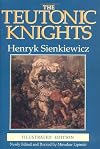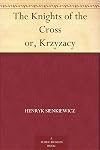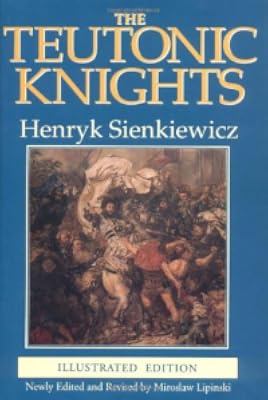
The Teutonic Knights
by Henryk Sienkiewicz
On This Page
Description
Krzyzacy tells the story of a young nobleman, Zbyszko of Bogdaniec, who together with his uncle Macko of Bogdaniec returns from the war against the Order (Knights of the Cross) in nearby Lithuania. In a tavern inn Zbyszko falls in love with the lovely Danusia, who is traveling with the court of the Duchess Anna. He swears to her his knight's oath and promises to bring her three trophies from the Teutonic Knights.Tags
Recommendations
















Member Reviews
Historical novel about the age of knights. It's relatively fast pacing and interesting but I have a feeling that I would've enjoyed it much more in my teenage years. Now the dated look of life, glorification of war, the blind faith infiltrating the everyday life and treating women as second rate beings just alienating me.
This book was a major disappointment. I am a big fan of Sienkiewicz's Trilogy and was excited about the prospect of reading this book which was reputed to be his masterpiece. The plot was plodding and dull and the characters were universally unappealing. The main character was an unattractive humorless numb-skull.
The book abounded in the colorful descriptions of medieval life in Poland which make Sienkiewicz's books so readable. Plus, there is plenty of interesting historical stuff that you didn't know about. However, long descriptions of the scenery were clouded by the knowledge that Sienkiewicz never saw Poland and was mostly making that stuff up. Makes you wonder about how much of the other stuff he made up. But his descriptions of show more the clothing and customs? I don't think you can make that stuff up, I love it.
My biggest disappointment was the almost total lack of humor. The Trilogy has tons of very funny laugh-out-loud dialogue, characters, and situations. I don't think I so much as chuckled through TTK.
One final point n the book's favor - there are some interesting and strong women in this story who are more than just decoration or baby boy generators (plenty of that, though. Seems like manly men only have male offspring, makes you wonder where the women come from.). They actually play important roles and exert influence in the events.
This book is only for die hard fans. show less
The book abounded in the colorful descriptions of medieval life in Poland which make Sienkiewicz's books so readable. Plus, there is plenty of interesting historical stuff that you didn't know about. However, long descriptions of the scenery were clouded by the knowledge that Sienkiewicz never saw Poland and was mostly making that stuff up. Makes you wonder about how much of the other stuff he made up. But his descriptions of show more the clothing and customs? I don't think you can make that stuff up, I love it.
My biggest disappointment was the almost total lack of humor. The Trilogy has tons of very funny laugh-out-loud dialogue, characters, and situations. I don't think I so much as chuckled through TTK.
One final point n the book's favor - there are some interesting and strong women in this story who are more than just decoration or baby boy generators (plenty of that, though. Seems like manly men only have male offspring, makes you wonder where the women come from.). They actually play important roles and exert influence in the events.
This book is only for die hard fans. show less
this has to be my favorite book of all time. the main characters are two Polish warriors - one a knight, the other his nephew and squire. so was taken a little by surprise as i read the story since the Teutonic Knights in the title were more a supporting character group.
the tale proceeds more as the Polish knights, and the knights of other countries they come across, interact with and against the Teutonic Order messing around in Poland & Lithuania in the 14th Century.
the writing was well done - imagery waas breathe-taking, action was fierce and fluid, the characters were spot on - the "good guys" were likable, the bad guys were bastards and the few that fence-sat or switched sides believably did so.
i can't rave enough about this book! show more but realize it was written in a time and place where authors recieved a price per page. every page was worth it, but it will take you a while to get through. and DON'T drop it on your foot, even in a paperback edition: it's a hefty tome! show less
the tale proceeds more as the Polish knights, and the knights of other countries they come across, interact with and against the Teutonic Order messing around in Poland & Lithuania in the 14th Century.
the writing was well done - imagery waas breathe-taking, action was fierce and fluid, the characters were spot on - the "good guys" were likable, the bad guys were bastards and the few that fence-sat or switched sides believably did so.
i can't rave enough about this book! show more but realize it was written in a time and place where authors recieved a price per page. every page was worth it, but it will take you a while to get through. and DON'T drop it on your foot, even in a paperback edition: it's a hefty tome! show less
One of the classical 19th c. Polish novels. Set in the beginning of the 15th century the book tells a story of Polish knights - Maćko and Zbyszko z Bogdańca. It follows their quest to find Zbyszko's fiancee abducted by Teutonic Knights while the surrounding world prepares for a war between Polish Kingdom and Great Duchy of Lithuania against the Teutonic Order. A great epic novel.
One of the excellent epic historical novels by this author, of the great European upheavals that centered around Poland during the time of chivalry.
Not very good, perhaps, but I very much enjoyed it.
Members
- Recently Added By
Lists

Best Historical Fiction
620 works; 261 members

Historical Fiction
889 works; 91 members
Author Information

332+ Works 7,141 Members
Far more celebrated than any of his positivist contemporaries, Henryk Sienkiewicz began as a journalist and achieved considerable renown with his account of a two-year journey to the United States. Between 1882 and 1888 he wrote three historical novels dealing with political and military events in seventeenth-century Poland: With Fire and Sword, show more The Deluge (1886), and Fire in the Steppe (1888, also translated as Pan Michael). Although superficial in its analysis of historical events, the trilogy gained enormous popularity both in Poland and in other Slavic countries thanks to Sienkiewicz's masterful use of epic techniques and of the seventeenth-century colloquial idiom. Even more popular, if artistically far weaker, was his Quo Vadis? (1896), a novel about Rome in the age of Nero (Sienkiewicz's fame in the West is chiefly based on this work). Another historical novel, The Teutonic Knights (1900), deals with the fifteenth-century struggle between Poland-Lithuania and the Teutonic Order. Henryk Sienkiewicz was awarded The Nobel prize in Literature for 1905 "because of his outstanding merits as an epic writer". (Bowker Author Biography) show less
Awards and Honors
Series
Belongs to Publisher Series
Common Knowledge
- Canonical title
- The Teutonic Knights
- Original title
- Krzyżacy; Krzyzacy
- Original publication date
- 1900 (original Polish) (original Polish)
- Related movies*
- Krzyzacy (1960 | IMDb)
- First words*
- Unweit der Fähre, in der zur Abtei von Tyniec gehörenden Herberge zum "Grimmigen Auerochsen" sassen mehrere Männer.
- Last words*
- (Click to show. Warning: May contain spoilers.)Der alte Ritter erfreute sich eines langen Lebens, und Zbyszko erlebte noch im blühenden Mannesalter jenen glücklichen Augenblick, wo der letzte Grossmeister der Kreuzritter mit Tränen in den Augen durch das eine Tor Marienburg verliess und durch das andere ein Woiwode an der Spitze eines polnischen Heeres einzog, um im Namen des Königs die Stadt und das Land bis zu den Ufern des Baltischen Meeres in Besitz zu nehmen.
- Original language
- Polish
- Disambiguation notice
- Original title: Krzyzacy
*Some information comes from Common Knowledge in other languages. Click "Edit" for more information.
Classifications
- Genres
- Fiction and Literature, General Fiction, Historical Fiction
- DDC/MDS
- 891.8536 — Literature & rhetoric Literatures of other languages East Indo-European and Celtic literatures West and South Slavic languages (Bulgarian, Slovene, Polish, Czech, Slovak, Serbo-Croatian, and Macedonian) Polish Polish fiction 1795–1919
- LCC
- PG7158 .S4 .K73 — Language and Literature Slavic languages and literatures. Baltic languages. Albanian language Slavic. Baltic. Albanian Slavic Polish
- BISAC
Statistics
- Members
- 373
- Popularity
- 84,063
- Reviews
- 8
- Rating
- (3.69)
- Languages
- 14 — Czech, English, Estonian, Finnish, French, German, Hungarian, Italian, Lithuanian, Norwegian (Bokmål), Polish, Russian, Serbian, Spanish
- Media
- Paper, Ebook
- ISBNs
- 82
- ASINs
- 15