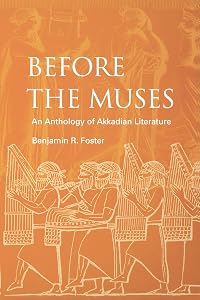
Before the Muses: An Anthology of Akkadian Literature
by Benjamin R. Foster
On This Page
Description
Comprehensive collection of ancient Akkadian literature spanning three millennia. This larger, completely new, 3rd edition contains many compositions not in the previous editions; new translations of previously included compositions; incorporation of new text fragments identified or excavated since the last publication; all new footnotes; references and commentary brought up to date to reflect scholarly work of the last 10 years; and 100 more pages than the old two-volume edition.Tags
Recommendations






Member Reviews
Knowing the mythological corpus of Akkad only briefly and supporting myself with historical volumes of Cambridge Ancient History altogether with some text on Babylonian-Assyrian astrology, I found it a pure treasury of ancient theology, which by and large may be derived from this tome. I've made some retro-active attempts at reconstructing certain magical techniques (later Hellenic bionic statues, in which spirits were scried into a statue), magickal blockades and all forms of spells and incantantations that had a well thought-over syntax of work. The charming scenario of Gods-as-friends to humanity in which the Great Lords are summoned even to help at childbirth, in which poor Ereshkigal moans over Nergal, while Erra-Nergal wreaks show more bloodthirsty destruction upon the land. A great stasis is threading behind all of those magnificent stories, both of astronomical, astrological, and cosmogenic proportions, a great stasis in which stories about Gods and forces at work are thin and blurry. All aspects of life were covered in myth, all consolation is found therein. All theology is interpretation, some is phantasy, what works has a grain of truth in it. Forewarned by Julian in his Hymn to Helios, that myths are for toothing children, it was to look beyond the fabric of words to peer into the cosmic events that in the eternal return of the sanctified narration are granting something new forever more. I have abolished many misconceptions, for example that mortals could no join Gods and they were condemned to the netherworlds by and large. It seems that there were ways of growing wings post-mortem and joining the mighty lot. With landscape populated with hungry ghosts, phantoms, cacodaimons and spirits, with mighty sorcerers and witches there was woe and extreme suffering, yet there were also remedies, joys and a great 'yes' to life. People of Mesopotamia had no issue with trafficking with Gods, spirits, yet constituting one of the greatest civilization(s) ever, building great libraries and rallying armies to destroy disobedient foes. Who knows, maybe Sun-Disked Igigi revealing themselves to you one day will embrace your mortal toil, so that you may taste the plums of the Tree of Life. show less
Knowing the mythological corpus of Akkad only briefly and supporting myself with historical volumes of Cambridge Ancient History altogether with some text on Babylonian-Assyrian astrology, I found it a pure treasury of ancient theology, which by and large may be derived from this tome. I've made some retro-active attempts at reconstructing certain magical techniques (later Hellenic bionic statues, in which spirits were scried into a statue), magickal blockades and all forms of spells and incantantations that had a well thought-over syntax of work. The charming scenario of Gods-as-friends to humanity in which the Great Lords are summoned even to help at childbirth, in which poor Ereshkigal moans over Nergal, while Erra-Nergal wreaks show more bloodthirsty destruction upon the land. A great stasis is threading behind all of those magnificent stories, both of astronomical, astrological, and cosmogenic proportions, a great stasis in which stories about Gods and forces at work are thin and blurry. All aspects of life were covered in myth, all consolation is found therein. All theology is interpretation, some is phantasy, what works has a grain of truth in it. Forewarned by Julian in his Hymn to Helios, that myths are for toothing children, it was to look beyond the fabric of words to peer into the cosmic events that in the eternal return of the sanctified narration are granting something new forever more. I have abolished many misconceptions, for example that mortals could no join Gods and they were condemned to the netherworlds by and large. It seems that there were ways of growing wings post-mortem and joining the mighty lot. With landscape populated with hungry ghosts, phantoms, cacodaimons and spirits, with mighty sorcerers and witches there was woe and extreme suffering, yet there were also remedies, joys and a great 'yes' to life. People of Mesopotamia had no issue with trafficking with Gods, spirits, yet constituting one of the greatest civilization(s) ever, building great libraries and rallying armies to destroy disobedient foes. Who knows, maybe Sun-Disked Igigi revealing themselves to you one day will embrace your mortal toil, so that you may taste the plums of the Tree of Life. show less
Knowing the mythological corpus of Akkad only briefly and supporting myself with historical volumes of Cambridge Ancient History altogether with some text on Babylonian-Assyrian astrology, I found it a pure treasury of ancient theology, which by and large may be derived from this tome. I've made some retro-active attempts at reconstructing certain magical techniques (later Hellenic bionic statues, in which spirits were scried into a statue), magickal blockades and all forms of spells and incantantations that had a well thought-over syntax of work. The charming scenario of Gods-as-friends to humanity in which the Great Lords are summoned even to help at childbirth, in which poor Ereshkigal moans over Nergal, while Erra-Nergal wreaks show more bloodthirsty destruction upon the land. A great stasis is threading behind all of those magnificent stories, both of astronomical, astrological, and cosmogenic proportions, a great stasis in which stories about Gods and forces at work are thin and blurry. All aspects of life were covered in myth, all consolation is found therein. All theology is interpretation, some is phantasy, what works has a grain of truth in it. Forewarned by Julian in his Hymn to Helios, that myths are for toothing children, it was to look beyond the fabric of words to peer into the cosmic events that in the eternal return of the sanctified narration are granting something new forever more. I have abolished many misconceptions, for example that mortals could no join Gods and they were condemned to the netherworlds by and large. It seems that there were ways of growing wings post-mortem and joining the mighty lot. With landscape populated with hungry ghosts, phantoms, cacodaimons and spirits, with mighty sorcerers and witches there was woe and extreme suffering, yet there were also remedies, joys and a great 'yes' to life. People of Mesopotamia had no issue with trafficking with Gods, spirits, yet constituting one of the greatest civilization(s) ever, building great libraries and rallying armies to destroy disobedient foes. Who knows, maybe Sun-Disked Igigi revealing themselves to you one day will embrace your mortal toil, so that you may taste the plums of the Tree of Life. show less
Ratings
Members
- Recently Added By
Lists

Author Information

13+ Works 856 Members
Common Knowledge
- Original title
- Before the Muses: An Anthology of Akkadian Literature
- Original publication date
- 2005 (this ed.) (this ed.); 1996 (1st ed.) (1st ed.)
- Important places
- Assyria; Babylon; Mesopotamia
Classifications
- Genre
- Fiction and Literature
- DDC/MDS
- 892.1 — Literature & rhetoric Literatures of other languages Afro-Asiatic literatures Akkadia, Babylon, Mesopotamia, and Sumer
- LCC
- PJ3951 .B44 — Language and Literature Oriental languages and literatures Oriental philology and literature Assyriology. Akkadian Literature. Inscriptions
- BISAC
Statistics
- Members
- 144
- Popularity
- 227,268
- Reviews
- 3
- Rating
- (4.50)
- Languages
- English
- Media
- Paper
- ISBNs
- 4