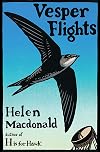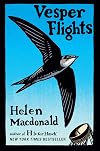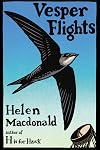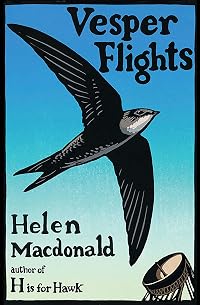
Vesper Flights
by Helen Macdonald
On This Page
Description
Nature. Nonfiction. Animals don't exist in order to teach us things, but that is what they have always done, and most of what they teach us is what we think we know about ourselves. From the bestselling author of H is for Hawk comes Vesper Flights, a transcendent collection of essays about the human relationship to the natural world. Helen Macdonald brings together a collection of her best-loved writing along with new pieces covering a thrilling range of subjects. There are essays here on show more headaches, on catching swans, on hunting mushrooms, on twentiethcentury spies, on numinous experiences and high-rise buildings; on nests and wild pigs and the tribulations of farming ostriches. Vesper Flights is a book about observation, fascination, time, memory, love and loss and how we make the world around us. Moving and frank, personal and political, it confirms Helen Macdonald as one of this century's greatest nature writers. show lessTags
Recommendations







Member Reviews
As an emotional vampire, I had worried that my obsession with H is for Hawk was due to my thirst for others' tragedies. That MacDonald's grief was the main drawcard, TH White's sadomasochism a close second, and the training and history of goshawk a lucky bonus.
So it was a relief that I loved Vesper Flights, a collection of essays on nature and animals, all overlaid with my favourite of MacDonald's tendency: to turn everything into symbols and metaphors. Every essay was laden with what was physically there (the nature descriptions were exquisite and evocative) and what they represented. So much so that two-to-three essays per day was the most I could handle before collapsing under all that weight.
Macdonald very artfully wove nature with show more politics and memories, but ultimately always returned to their main love of the outdoors and wildlife. I'm jealous of people who can recognise trees and plants and birds and animals, and various facts about them. And MacDonald was expert at cramming in the lush descriptors so that I felt immersed in all the words and nature that they inspire. It was actually jarring whenever they mentioned driving or interacted with anything manmade.
So even if I can't completely rule out being a Colin Robinson, I can at least more confidently claim that I like MacDonald for their nature writing.
Best essay: Goats show less
So it was a relief that I loved Vesper Flights, a collection of essays on nature and animals, all overlaid with my favourite of MacDonald's tendency: to turn everything into symbols and metaphors. Every essay was laden with what was physically there (the nature descriptions were exquisite and evocative) and what they represented. So much so that two-to-three essays per day was the most I could handle before collapsing under all that weight.
Macdonald very artfully wove nature with show more politics and memories, but ultimately always returned to their main love of the outdoors and wildlife. I'm jealous of people who can recognise trees and plants and birds and animals, and various facts about them. And MacDonald was expert at cramming in the lush descriptors so that I felt immersed in all the words and nature that they inspire. It was actually jarring whenever they mentioned driving or interacted with anything manmade.
So even if I can't completely rule out being a Colin Robinson, I can at least more confidently claim that I like MacDonald for their nature writing.
Best essay: Goats show less
Alone among the literate world, I was made uncomfortable by the relationship between naturalist Macdonald and Mabel the formerly wild hawk told in H is for Hawk. These essays on many topics are written in Author Macdonald's justly celebrated elegant prose, and include so many aperçus that my commonplace book blew up. If you don't share my unease with people venerating wildness while taming it out of a fellow being, you'll enjoy this collection without my unshakeable unease.
So much to admire: the writing which is both straightforward but full of riches of all kinds; MacDonald's introspective honesty and hard-won self-awareness; her willingness to work hard and sensitivity to her surroundings, oh, and just plain old knowledge on top of all that. She knows her birds, plants, mushrooms, trees and animals and has learned to notice what she doesn't yet know. One of MacDonald's gifts is to connect some current obsession or sudden awareness of a bird or animal with (to paraphrase) something she is in need of learning in her life, a truly magical synergy that the 'science' side has trouble acknowledging the importance of. The essay on deer is painful but the fact that she discovers on a walk that she has, show more heretofore, simply ignored learning about deer is an example, of how sometimes you resist in order to preserve mystery, but while you do that you could be reducing the realities of that animal to your own imagined needs, that there is a place in-between you can arrive at with care. MacDonald explores this border, between what animals and birds really are, and how we imagine they are and the resulting dissonances. Another essay along this theme (I could mention something about each and every essay, but I will spare you) touches on the way an animal will often make itself present at a time of duress in a person's life. Very often an animal that is highly unusual--almost everyone has a story. For me it was finding a pheasant roosting on the garden wall between our house and the neighbor in Philadelphia at 6 a.m. (this, a totally urban environment in center city) at a turning point in my life. Virtually everyone has a similar story. The screech owl out the window three nights in a row after my aunt's husband died; a deer encounter, all three of us staring at one another for as long as a minute at no more than ten feet (my daughter 2 1/2 in a pack on my back) that I witnessed launching her into an awareness of the existence of a whole world out there apart from her. show less
This is a collection of essays. Naturally, any collection is going to have some that are better than others, some that speak to a reader more than others, but this collection is remarkably consistent and coherent.
Many of the essays are biographical, so Macdonald talks a lot about her strange but often delightful childhood and her growing love of nature, as well as her career as a naturalist and writer.
One of the major themes found throughout the book is the relationship between humans and nature, with a particular focus on what the relationship between humans and animals says about human identity, particularly national identity. She is British, and wrote a lot of these essays during and after Brexit, so there are several essays about show more the role birds play in British nationalism. There are also a lot of more personal essays about the role animals have played in her life and her understanding of her own identity and place in the world.
"Animals don’t exist in order to teach us things, but that is what they have always done, and most of what they teach us is what we think we know about ourselves." show less
Many of the essays are biographical, so Macdonald talks a lot about her strange but often delightful childhood and her growing love of nature, as well as her career as a naturalist and writer.
One of the major themes found throughout the book is the relationship between humans and nature, with a particular focus on what the relationship between humans and animals says about human identity, particularly national identity. She is British, and wrote a lot of these essays during and after Brexit, so there are several essays about show more the role birds play in British nationalism. There are also a lot of more personal essays about the role animals have played in her life and her understanding of her own identity and place in the world.
"Animals don’t exist in order to teach us things, but that is what they have always done, and most of what they teach us is what we think we know about ourselves." show less
I will read anything this woman writes, as uneven as it might be sometimes. [b:H is for Hawk|18803640|H is for Hawk|Helen Macdonald|https://i.gr-assets.com/images/S/compressed.photo.goodreads.com/books/1442151714l/18803640._SY75_.jpg|26732095] is deservedly among the ranks of classic nature writing for its intense intelligence, close study, in-depth knowledge, and exquisite writing - and we get all of that in this new collection of essays and articles. Both Hawk and Vesper Flights are - for me - occasionally marred by some overwrought emotional spasms. The essay called "Eclipse" is occasion for an almost bizarre dissection of her emotional reaction: "The exhilaration is barely contained terror. I am tiny and huge all at once...there are show more no human words to express all this...a total eclipse makes history laughable,...makes the inclinations of the world incomprehensible, like someone trying to engage a stone in discussions about the price of a celebrity magazine." Umm, really? I've watched a total eclipse myself, and it's a wonderment, enchanting, fascinating, occasion for strangers to gather and marvel and share. But this is just a bit too much, and much more about Helen Macdonald than about an eclipse.
But... there is so much to admire, so much that moves here. I confess to being pleased to find I am not the only former dinosaur-mad child whose middle-aged eyes filled with tears when that apatosaurus first strolls across the screen in Jurassic Park. "Rescue" is a lovely piece in honor of those who serve up carefully carved crickets to save swifts, sleep with orphaned baby elephants, and handfeed infant hummingbirds (and please see Julie Zickefoose's superb and poignant NPR story on this subject). Macdonald describes it perfectly as "the intoxicating process of coming to know something quite unlike you, to understand it well enough not only to keep it alive but also to put it back, like a puzzle piece, into the gap in the world it left behind." She is also brilliant with what you might call "ordinary" science journalism, as in "Swan Upping": the natural history of swans, their centuries-old association with English royalty, the experience of drifting down a green waterway on a hot July day, of cradling a cygnet that feels like "it had a silk wrapping on it," craft knowledge, Brexit, and the strange and brilliant artist Stanley Spencer - all woven into a gorgeous, sensual tapestry of humans, history, and nature.
In "Wicken," Macdonald sets out with her little niece on a walk through a preserved fen, a precious scrap remaining of original miles of marshland. They see and hear owls, snipe, cuckoos, and rails. As the little girl watches a furry caterpillar trundling across the path, she asks, "When they made this place, where did they get all the animals from?" Macdonald doesn't quite understand what she's asking. "There are so many animals here. Did they come from a zoo?" And Macdonald's heart breaks a little. So did mine. show less
But... there is so much to admire, so much that moves here. I confess to being pleased to find I am not the only former dinosaur-mad child whose middle-aged eyes filled with tears when that apatosaurus first strolls across the screen in Jurassic Park. "Rescue" is a lovely piece in honor of those who serve up carefully carved crickets to save swifts, sleep with orphaned baby elephants, and handfeed infant hummingbirds (and please see Julie Zickefoose's superb and poignant NPR story on this subject). Macdonald describes it perfectly as "the intoxicating process of coming to know something quite unlike you, to understand it well enough not only to keep it alive but also to put it back, like a puzzle piece, into the gap in the world it left behind." She is also brilliant with what you might call "ordinary" science journalism, as in "Swan Upping": the natural history of swans, their centuries-old association with English royalty, the experience of drifting down a green waterway on a hot July day, of cradling a cygnet that feels like "it had a silk wrapping on it," craft knowledge, Brexit, and the strange and brilliant artist Stanley Spencer - all woven into a gorgeous, sensual tapestry of humans, history, and nature.
In "Wicken," Macdonald sets out with her little niece on a walk through a preserved fen, a precious scrap remaining of original miles of marshland. They see and hear owls, snipe, cuckoos, and rails. As the little girl watches a furry caterpillar trundling across the path, she asks, "When they made this place, where did they get all the animals from?" Macdonald doesn't quite understand what she's asking. "There are so many animals here. Did they come from a zoo?" And Macdonald's heart breaks a little. So did mine. show less
I normally shy away from essay collections, I really can't explain why, I just do, but I so thoroughly enjoyed H is for Hawk that I had to pick up this book (actually, my wife and I gave it to each other for Christmas (returned one copy and ended up walking out with three more books)). Some of the essays are more engaging than others, but all are coming from Ms. Macdonald's heart. She writes how I feel.
A lovely collection of essays about nature. Ho hum, you say? No, no! These are truly lovely. Helen MacDonald uses lyrical prose to take the reader on quiet, profound, thought-provoking sojourns which cause the reader to realize that quiet understanding of nature's subtleties can provide visions of our human frailties, meaning where there had been none, and beauty absolutely everywhere. On these sojourns we meet hawks, swans, cuckoos and more creatures, each of whom enlightens the reader, once the reader quietens themselves enough to observe and absorb. MacDonald is a treasure! You might want to also read, " H Is For Hawk".
Members
- Recently Added By
Lists

Best Biographies, Autobiographies and Memoirs
465 works; 160 members

Top Five Books of 2020
982 works; 350 members

Top Five Books of 2022
736 works; 272 members

Science: Zoology
107 works; 1 member

Five star books
1,767 works; 110 members

Books Read in 2021
5,361 works; 114 members

Books Read in 2022
5,168 works; 114 members
Club Read's Recommended Nonfiction Written by Women
618 works; 30 members

Favorite Animal Non-Fiction
293 works; 144 members
Author Information

Awards and Honors
Awards
Distinctions
Notable Lists
Series
Belongs to Publisher Series
Llibres Anagrama (88)
Common Knowledge
- Original publication date
- 2020
- First words
- Back in the sixteenth century, a curious craze began to spread through the halls, palaces and houses of Europe.
- Quotations
- In my experience if you go out hoping for revelation you will merely get rained on.
- Last words
- (Click to show. Warning: May contain spoilers.)Our separate lives coincided, and all my self-absorbed anxiety vanished in that one fugitive moment, when a bird in the sky on its way somewhere else sent a glance across the divide and stitched me back into a world where both of us have equal billing.
Classifications
Statistics
- Members
- 951
- Popularity
- 27,892
- Reviews
- 41
- Rating
- (4.01)
- Languages
- 8 — Dutch, English, Finnish, French, German, Italian, Spanish, Swedish
- Media
- Paper, Audiobook, Ebook
- ISBNs
- 33
- ASINs
- 8