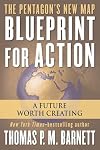
Blueprint for Action: A Future Worth Creating
by Thomas P. M. Barnett
On This Page
Description
Senior adviser and military analyst Barnett tells us how we get to the future he envisioned in The Pentagon's New Map. In this pragmatic, thought-provoking, and optimistic book, he explores both the long- and short-term pathways for governments, institutions, and individuals alike. Paying particular attention to such nations and regions as Iran, Iraq, and the Middle East, China, North Korea, Latin America, and Africa, he outlines the strategies to pursue, the entities to create, the pitfalls show more to overcome.--From publisher description. show lessTags
Recommendations
































Member Recommendations
Member Reviews
This is not as successfully argued as his first book, The Pentagon's New Map. Pity the poor pundit as Barnett optimistically posits a positive appraisal for the Pentagon and Americans. No such blueprint could possibly exist since the world we are in is much more precarious than Barnett seems to believe. There is much that is wishful thinking here.
In contrast to his first work, he does expand on an Islamic global presence.
In contrast to his first work, he does expand on an Islamic global presence.
The United States stands at a threshold. It can withdraw into itself. Or it can seize a moment to forge the most peaceful period in human history, where war becomes unknown. Thomas P. M. Barnett, a former at the U.S. Naval War College professor and advisor to the Office of the Secretary of Defense maps a sweeping vision for the U.S. military in this the sequel to his influential The Pentagon's New Map.
Barnett argues the U.S. military has a massive doctrinal flaw. It possesses unrivaled power to win wars. Yet has little ability to win the peace. Take Iraq. No thought was given to postwar stabilization and reconstruction.
He advocates creating a new Department of Global Security. He foresees it being tasked with restoring countries after show more an armed intervention by U.S. forces. He argues the new department would also work to reduce economic and social instability in regions of the developing world that currently are “outside the map.”
Barnett is an original foreign policy thinker. This book answers many of the questions left hanging with his first. For me, his insights place our foreign policy in a context I rarely see in my other reading.
Penned by the Pointed Pundit
August 15, 2006
8:50:42 PM show less
Barnett argues the U.S. military has a massive doctrinal flaw. It possesses unrivaled power to win wars. Yet has little ability to win the peace. Take Iraq. No thought was given to postwar stabilization and reconstruction.
He advocates creating a new Department of Global Security. He foresees it being tasked with restoring countries after show more an armed intervention by U.S. forces. He argues the new department would also work to reduce economic and social instability in regions of the developing world that currently are “outside the map.”
Barnett is an original foreign policy thinker. This book answers many of the questions left hanging with his first. For me, his insights place our foreign policy in a context I rarely see in my other reading.
Penned by the Pointed Pundit
August 15, 2006
8:50:42 PM show less
Ratings
Members
- Recently Added By
Author Information

7+ Works 946 Members
Thomas P.M. Barnett is a strategic planner who has worked in national security affairs since the end of the Cold War and has operated his own consulting practice (Barnett Consulting) since 1998. Dr. Barnett is best known as the author of The Pentagon's New Map: War and Peace in the Twenty-First Century (New York: G.P. Putnam's Sons, 2004). He has show more a BA from the University of Wisconsin. Following Wisconsin, Dr. Barnett earned an AM in Regional Studies: Russia, Eastern Europe and Central Asia and a PhD in Political Science from Harvard University. (Bowker Author Biography) show less
Awards and Honors
Awards
Common Knowledge
- Important places
- Pentagon, Arlington, Virginia, USA
Classifications
- Genres
- Nonfiction, Politics and Government, General Nonfiction, History
- DDC/MDS
- 327.73 — Society, Government, and Culture Political science International Relations: Spies North America United States
- LCC
- JZ1480 .B36 — Political Science International relations International relations Scope of international relations. Political theory. Scope of international relations with regard to
- BISAC
Statistics
- Members
- 158
- Popularity
- 206,559
- Reviews
- 2
- Rating
- (3.43)
- Languages
- English
- Media
- Paper, Ebook
- ISBNs
- 3
- ASINs
- 2