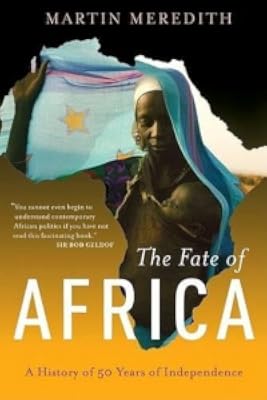
The Fate of Africa: A History of Fifty Years of Independence
by Martin Meredith
On This Page
Description
Presents a narrative of the last fifty years of African history, analyzing the factors which account for the political chaos, financial troubles, and civil wars which prevail in many African countries today.Tags
Recommendations
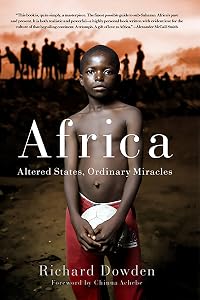
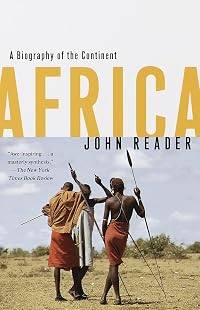
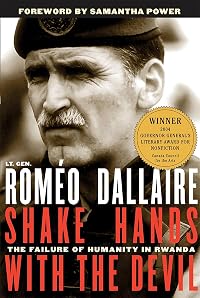
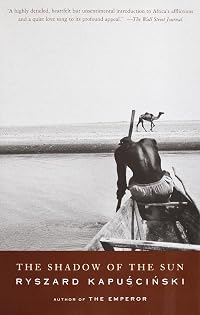




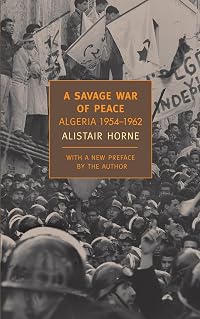

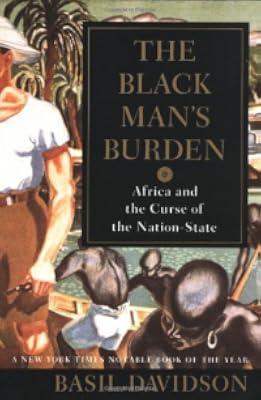
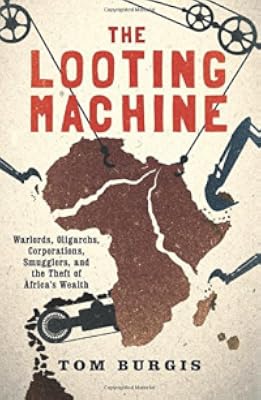
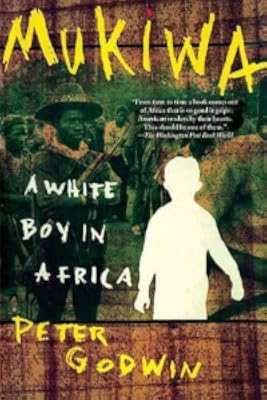






Member Reviews
In the late 19th century, European powers went to work dividing up the continent of Africa among themselves. Great Britain, France, Belgium, Germany, Portugal, and Italy each took a piece in hope of increasing their own economies and their own power. By the 1950s, however, African population groups began to declare independence from their European overseers. One by one, countries emerged to form a modern Africa, but then, one by one, those same countries began to crumble under their own problems. Rampant cronyism, unmitigated illness, poor education, and a severe lack of infrastructure have led the continent of Africa to the state it’s in now. Martin Meredith’s The Fate of Africa is an unflinching look at the people and processes show more that have formed Africa as we know it today.
Each chapter of Meredith’s enormous treatise is a case study in poor governmental choices. Dictator after dictator emerges, corruption plagues the populace, and proper services cannot reach those that need them. Meredith makes no apologies for his views, but neither does he offer solutions. The problems are too complex for easy, book-length answers. It is true that the global community is still sending aid to Africa, but improper oversight of that aid means that it oftentimes ends up in the wrong areas or the wrong hands. Meredith’s history is replete with sadness, misery, and pain, but we as readers should not look away. In some cases, it is the only time we do look. A heavy but eye-opening book. show less
Each chapter of Meredith’s enormous treatise is a case study in poor governmental choices. Dictator after dictator emerges, corruption plagues the populace, and proper services cannot reach those that need them. Meredith makes no apologies for his views, but neither does he offer solutions. The problems are too complex for easy, book-length answers. It is true that the global community is still sending aid to Africa, but improper oversight of that aid means that it oftentimes ends up in the wrong areas or the wrong hands. Meredith’s history is replete with sadness, misery, and pain, but we as readers should not look away. In some cases, it is the only time we do look. A heavy but eye-opening book. show less
An impressive work, covering the post-war experience of a number of African countries in a set of short, crisp chapters that makes it easy to read despite its length. The subject matter, however, makes for grim reading, and may be traumatic for the average reader, although the author narrates the history in a dispassionate and methodical manner. The reader is left wondering whether there is some deficiency in human nature that makes such awful and self-defeating cruelty possible. The chapter on South Africa's search for freedom and reconciliation is one of the few causes for hope.
A massive work, over 700 pages, as demanded by the subject. However, the style is crisp and engaging, individual chapters are to the point and workmanlike, show more making the overall reading less arduous than it could have been. show less
A massive work, over 700 pages, as demanded by the subject. However, the style is crisp and engaging, individual chapters are to the point and workmanlike, show more making the overall reading less arduous than it could have been. show less
From now on, when I'm trying to explain to someone what 'irony' does not mean, I'll use this example: while I was on a plane between LA and Phillie, the entire world was watching a half hour documentary about a repulsive lunatic, and being encouraged to start a war in Uganda (i.e., the wrong country) in order to 'bring him to justice.' I finished this book just as we landed (I'd started it before I flew; it's very, very long), checked my email, and... you can guess the rest. That is not irony. It's just sad.
This book should be mandatory reading for human beings. Meredith writes beautifully about the twentieht century's biggest cluster-cuff, patiently showing how pretty much everything that could have gone wrong for Africa did go wrong; show more how almost every legitimate attempt to help out was ruined by African politicians, Western politicians and businessmen, and Soviet/Chinese politicians. It's incredibly depressing, but you know what? It is depressing. It's no use banging on about how 'we have to believe in hope' and 'you shouldn't deny Africans' agency'. Of course we do. But the history of Africa's problems is complex, and so is the present; part of that complexity is the fact that the heads of state in Africa are almost inevitably 'cut the Gordian knot' types; that type of person tends to deny the 'agency' of his/her population. Hope without some understanding of the situation leads to... Kony2012.
It's a little frustrating that Meredith offers no solutions to even localized problems, but it's also to his credit that he avoids simplistic solutions or explanations. Creating 'civil society' won't help much when rich countries pay their farmers to produce food that could be produced more cheaply, for export, in Africa. Cutting those tariffs won't do much good unless someone puts a stop to the insanity that is African politics. Improving leadership won't do much good if 'investors' continue to treat the continent like their own private money tree. And so on. This is not a rejection of hope, it's a demand that *everyone* accepts their part of the blame, and works to pay off their debts to the unluckiest people on the planet.
Note: there's a new edition of this book out, which, as far as I can tell, lengthens the chapters on Sudan, Zimbabwe and South Africa, for obvious reasons. show less
This book should be mandatory reading for human beings. Meredith writes beautifully about the twentieht century's biggest cluster-cuff, patiently showing how pretty much everything that could have gone wrong for Africa did go wrong; show more how almost every legitimate attempt to help out was ruined by African politicians, Western politicians and businessmen, and Soviet/Chinese politicians. It's incredibly depressing, but you know what? It is depressing. It's no use banging on about how 'we have to believe in hope' and 'you shouldn't deny Africans' agency'. Of course we do. But the history of Africa's problems is complex, and so is the present; part of that complexity is the fact that the heads of state in Africa are almost inevitably 'cut the Gordian knot' types; that type of person tends to deny the 'agency' of his/her population. Hope without some understanding of the situation leads to... Kony2012.
It's a little frustrating that Meredith offers no solutions to even localized problems, but it's also to his credit that he avoids simplistic solutions or explanations. Creating 'civil society' won't help much when rich countries pay their farmers to produce food that could be produced more cheaply, for export, in Africa. Cutting those tariffs won't do much good unless someone puts a stop to the insanity that is African politics. Improving leadership won't do much good if 'investors' continue to treat the continent like their own private money tree. And so on. This is not a rejection of hope, it's a demand that *everyone* accepts their part of the blame, and works to pay off their debts to the unluckiest people on the planet.
Note: there's a new edition of this book out, which, as far as I can tell, lengthens the chapters on Sudan, Zimbabwe and South Africa, for obvious reasons. show less
A big, depressing book that focuses each chapter on a country or a few countries near each other and explains what challenges they faced, especially in building democratic institutions out of the rubble that colonial powers left behind. Transitions to self-government were fast, mostly because Africans wanted it that way, but the Europeans took/destroyed stuff on the way out and hadn’t invited participation before that, so the newly “independent” nations were left without the infrastructure of governance. In many cases, they also had to deal with ethnic divisions that had been exploited by the Europeans to hold on to power. Coup after coup, slaughter after slaughter resulted.
Had I been asked to review this work midway through, I would have given it at least four stars. However, the second half of the book began to read like a repeat of the first. I guess it is not the author's fault that the history of African development since independence has been the political equivalent of Groundhog Day (the movie).
This book is not a bad beginning for anyone just beginning to study recent African history, especially post colonial sub-Saharan Africa. When you consider that in just under 700 pages, the author covers virtually every country on the continent, you begin to get an idea of just how cursory the analysis is in many instances.
The recipe for this book is as follows: Begin with a region sporting literally show more thousands of disparate tribes and cultures. Mix in colonial powers who create political subdivisions without any regard for these cultures. Remove the colonial powers and entrust governance to native populations with no education and no experience in self government. Add the emergence of local "strong men" and the inevitable ethnic cleansing, corruption and large scale looting of government assets. Lather, rinse and repeat and repeat and repeat and repeat. You get the idea.
Almost without exception, despite in many cases the presence of abundant natural resources and even on ocassion (though extremely rarely) honest politicians, each and every independent sub-Saharan African country has regressed since independence, and usually by an extremely wide margin. It is little wonder that most nations have begun to suffer from foreign aid fatigue in the face of failure after failure.
The author of this work is not without his biases. He doesn't pretend neutrality in most instances and for that I was grateful. There is evil in the world and evil is abetted in an effort to display moral relativism. The author also heaps generous scorn on the United Nations and in particular Boutros Boutros-Ghali, Secretary General during much of the period in question.
All in all a very depressing work. I suspect that after finishing the book, you will be glad you are done because the capacity for misery is finite and after about 400 pages, I had reached mine. show less
This book is not a bad beginning for anyone just beginning to study recent African history, especially post colonial sub-Saharan Africa. When you consider that in just under 700 pages, the author covers virtually every country on the continent, you begin to get an idea of just how cursory the analysis is in many instances.
The recipe for this book is as follows: Begin with a region sporting literally show more thousands of disparate tribes and cultures. Mix in colonial powers who create political subdivisions without any regard for these cultures. Remove the colonial powers and entrust governance to native populations with no education and no experience in self government. Add the emergence of local "strong men" and the inevitable ethnic cleansing, corruption and large scale looting of government assets. Lather, rinse and repeat and repeat and repeat and repeat. You get the idea.
Almost without exception, despite in many cases the presence of abundant natural resources and even on ocassion (though extremely rarely) honest politicians, each and every independent sub-Saharan African country has regressed since independence, and usually by an extremely wide margin. It is little wonder that most nations have begun to suffer from foreign aid fatigue in the face of failure after failure.
The author of this work is not without his biases. He doesn't pretend neutrality in most instances and for that I was grateful. There is evil in the world and evil is abetted in an effort to display moral relativism. The author also heaps generous scorn on the United Nations and in particular Boutros Boutros-Ghali, Secretary General during much of the period in question.
All in all a very depressing work. I suspect that after finishing the book, you will be glad you are done because the capacity for misery is finite and after about 400 pages, I had reached mine. show less
Martin Meredith's history of Africa since independence provides a critical service to the general reader -- telling clearly and comprehensively what has happened in Africa since 1960. In so doing, he covers an vast amount of material. There are at present over 50 African states, and they vary enormously, in terms of culture, resources, history, and on and on. Meredith discusses all of the major and most of the minor countries individually, moving forward through time in what is a triumph of organization. If I want in future to review the recent history of one or another African country -- or of some cross-border phenomena -- I shall know where to turn.
It is probably too much to expect an explanation at the end of this chronicle. Mr. show more Meredith's history presents a harrowing account of war after war, dictator after dictator, famine after famine, and mass murder after mass murder. They differ from country to country, of course, but the pattern of kleptocracy combined with monomania emerges again and again. At the end, one has to wonder why, and Mr. Meredith does not really present many answers. It may not be possible to do so, but I wish he had tried.
Upon finishing this book, I went back to Amazon to see if there is another on the same topic -- is Africa's history since independence really so totally hopeless? I didn't find anything of anything like Mr. Meredith's level of seriousness that presented a less pessimistic view, at least not based on writeups and reviews. For now, I remain stunned, and curious. show less
It is probably too much to expect an explanation at the end of this chronicle. Mr. show more Meredith's history presents a harrowing account of war after war, dictator after dictator, famine after famine, and mass murder after mass murder. They differ from country to country, of course, but the pattern of kleptocracy combined with monomania emerges again and again. At the end, one has to wonder why, and Mr. Meredith does not really present many answers. It may not be possible to do so, but I wish he had tried.
Upon finishing this book, I went back to Amazon to see if there is another on the same topic -- is Africa's history since independence really so totally hopeless? I didn't find anything of anything like Mr. Meredith's level of seriousness that presented a less pessimistic view, at least not based on writeups and reviews. For now, I remain stunned, and curious. show less
I finished reading The State of Africa by Martin Meredith the other day. It’s a political history of post-independence Africa, and is it ever depressing.
The book itself is fantastic, a really in-depth look at just about every African country and how each has evolved politically in the last fifty years. From apartheid in South Africa to radical Islam in the north, via tribal genocides in the centre of the continent, nary a stone is left uncovered.
But it makes for a thoroughly downbeat assessment. Essentially, the European countries who colonised the continent and then abandoned it post-WWII fucked it over at first. Then Cold War struggles meant ruthless dictators were kept in power by the superpowers, as long as they didn’t turn to show more the other side.
Many military coups took place, with each takeover followed by promises to open up the country to democracy and the rule of law. Of course, each military-backed ruler merely consolidated his position, and used ethnic/tribal tensions to maintain it. This led to horrific numbers of deaths, most notably in Rwanda and Sudan.
Then there was the rampant racism in countries like South Africa (whites on blacks) and Sudan (Muslims on blacks), as well as more general tensions between the north and south. The onset of HIV in the 90s and 00s added to the generally sombre tone.
There were positive points, especially towards the end. Democracy is arriving there, in leaps and bounds, but it is still held back in places like Zimbabwe.
Meredith is utterly exhaustive in his coverage, and there are some great snippets of information throughout, as well as some truly disturbing anecdotes from what can only be called “survivors”. This book is brilliant, and I highly recommend it to anyone who has even the vaguest interest in Africa, African politics and modern African history. show less
The book itself is fantastic, a really in-depth look at just about every African country and how each has evolved politically in the last fifty years. From apartheid in South Africa to radical Islam in the north, via tribal genocides in the centre of the continent, nary a stone is left uncovered.
But it makes for a thoroughly downbeat assessment. Essentially, the European countries who colonised the continent and then abandoned it post-WWII fucked it over at first. Then Cold War struggles meant ruthless dictators were kept in power by the superpowers, as long as they didn’t turn to show more the other side.
Many military coups took place, with each takeover followed by promises to open up the country to democracy and the rule of law. Of course, each military-backed ruler merely consolidated his position, and used ethnic/tribal tensions to maintain it. This led to horrific numbers of deaths, most notably in Rwanda and Sudan.
Then there was the rampant racism in countries like South Africa (whites on blacks) and Sudan (Muslims on blacks), as well as more general tensions between the north and south. The onset of HIV in the 90s and 00s added to the generally sombre tone.
There were positive points, especially towards the end. Democracy is arriving there, in leaps and bounds, but it is still held back in places like Zimbabwe.
Meredith is utterly exhaustive in his coverage, and there are some great snippets of information throughout, as well as some truly disturbing anecdotes from what can only be called “survivors”. This book is brilliant, and I highly recommend it to anyone who has even the vaguest interest in Africa, African politics and modern African history. show less
Members
- Recently Added By
Lists

Most Popular Books Tagged Africa
35 works; 3 members

Reading list
170 works; 1 member

r/History Recommended Reading List
603 works; 12 members

r/AskHistorians' Recommended Books
1,068 works; 18 members
Author Information

26 Works 3,146 Members
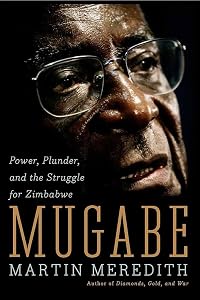
Martin Meredith is a journalist, biographer and historian who has written extensively on Africa and its recent history. His previous books include Mugabe and The Fate of Africa. He lives near Oxford, England
Some Editions
Awards and Honors
Work Relationships
Is an expanded version of
Common Knowledge
- Original title
- The State of Africa
- Alternate titles
- The Fate of Africa
- Original publication date
- 2005
- Important places
- Africa
- First words
- During the scramble for Africa at the end of the nineteenth century, European powers staked claims to virtually the entire continent.
- Last words
- (Click to show. Warning: May contain spoilers.)Indeed, far from being able to provide aid and protection to their citizens, African governments and the vampire-like politicians who run them are regarded by the populations they rule as yet another burden they have to bear in the struggle for survival.
- Original language*
- Englisch
*Some information comes from Common Knowledge in other languages. Click "Edit" for more information.
Classifications
Statistics
- Members
- 1,599
- Popularity
- 14,201
- Reviews
- 25
- Rating
- (4.21)
- Languages
- English, Polish
- Media
- Paper, Audiobook, Ebook
- ISBNs
- 20
- ASINs
- 5