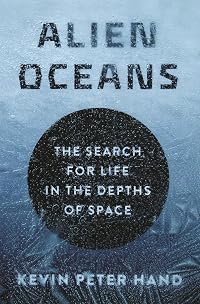
Alien Oceans: The Search for Life in the Depths of Space
by Kevin Hand
On This Page
Description
"Inside the epic quest to find life on the water-rich moons at the outer reaches of the solar system. Where is the best place to find life beyond Earth? We often look to Mars as the most promising site in our solar system, but recent scientific missions have revealed that some of the most habitable real estate may actually lie farther away. Beneath the frozen crusts of several of the small, ice-covered moons of Jupiter and Saturn lurk vast oceans that may have been in existence for as long show more as Earth, and together may contain more than fifty times its total volume of liquid water. Could there be organisms living in their depths? Alien Oceans reveals the science behind the thrilling quest to find out. Kevin Peter Hand is one of today's leading NASA scientists, and his pioneering research has taken him on expeditions around the world. In this captivating account of scientific discovery, he brings together insights from planetary science, biology, and the adventures of scientists like himself to explain how we know that oceans exist within moons of the outer solar system, like Europa, Titan, and Enceladus. He shows how the exploration of Earth's oceans is informing our understanding of the potential habitability of these icy moons, and draws lessons from what we have learned about the origins of life on our own planet to consider how life could arise on these distant worlds. Alien Oceans describes what lies ahead in our search for life in our solar system and beyond, setting the stage for the transformative discoveries that may await us."-- show lessTags
Recommendations





























Member Reviews
Who would have thought, until very recently, that the best places to look for life elsewhere in our solar system, might not be Mars at all, but the frozen moons orbiting Jupiter and Saturn?
In the last couple of decades, scientists looking for life elsewhere have absorbed a radical shift of perspective. Our one known case of life in the universe biased our speculations about what kind of environment was conducive to the origin and development of life. After all, we live on the surface of a temperate world, with a robust cycle of rainfall, large bodies of surface water, and an evaporation cycle. Our initial thinking about life elsewhere led us to look for the same types of worlds.
But explorations and analyses of the other bodies in our show more solar system have led to a far more common and promising environment. Planetary moons with underground oceans are abundant in our own solar system and seem to offer the characteristics under which life could well develop.
Kevin Peter Hand is a JPL scientist with skills as a science writer. As a lead on solar system probe missions, he is in a great position to tell this story.
Hand’s focus in his JPL work is Europa, but there may be subsurface oceans on a number of moons of the outer planets. The most promising so far are Europa, Enceladus, and Titan, orbiting Jupiter and Saturn.
What makes these moons promising for life? The discoveries of subsurface oceans on moons so far from the sun were surprises. We hadn’t understood the presence and effects of tidal forces between large planets and their moons.
The differences in gravitational forces from those massive planets on the near and far sides of their moons, coupled with the moons’ elliptical orbits, produce tidal frictions within the moons’ interiors. Those frictions are sufficient to heat the moons’ interiors enough to maintain water in a liquid state below their surfaces, even while the surfaces themselves are frozen solid.
The result is a layering of hard, frozen surface crust covering a liquid subsurface ocean, and then at least in some of the moons, a rocky layer beneath the ocean that allows for passage of materials, such as carbon, from the rocky layer into the liquid ocean.
That rock/ocean interface is crucial, according to our current understanding of how life may originate. Water itself is a great solvent and medium for the chemical reactions that support life, but it requires materials, “building blocks,” for living things. The bare minimum required goes by the acronym CHNOPS, for carbon, hydrogen, nitrogen, oxygen, potassium, and sulfur. Components not present in the water itself, or not separable from water except through other chemical reactions, require a source. Hence the importance of the rock interface.
As little as we really do understand the origin of life on Earth, we know it includes at least those essential components, plus, as Hand characterizes them, an architecture and builders — some sort of structural plan that can be replicated from instance to instance and some processing mechanism to enact the plan and construct living things from it. For Earth life, those roles are taken by DNA and RNA.
Energy is also required for those chemical reactions. We don’t actually know, again, how life originated on Earth, but scientists hypothesize either an origin within surface water, with the sun as the energy source, or deep within the ocean, around hydrothermal vents where the sun cannot reach but where heat within the planet’s interior provides the needed energy.
Just as we hadn’t until recently understood the role that tidal heating could play in otherwise frozen moons, we hadn’t either understood the importance of those deep, hydrothermal vents on our own planet — vents that may be duplicated on those same distant moons.
We have no idea if there are hydrothermal vents within those moons, much less that biological processes are going at their mouths, as happens at the bottom of our own ocean. We only know that the conditions we know of for such things are present.
Hand takes us step by step through the speculations and discoveries, beginning with the discoveries of the subsurface oceans of Europa, Enceladus, and Titan, going into some detail about the roles of spectroscopy, gravitational measurements, and magnetic field detection and measurement.
In the cases of Europa and Enceladus, scientists rely on instrumented probes, like the Galileo and Cassini missions as well as the more recent Juno mission, performing flybys.
Titan is a special case altogether, given that it not only appears to have a subsurface ocean but a (to us) bizarre surface environment with its own evaporation cycle, bodies of surface liquid, and rainfall, but primarily methane, not water. And Titan has been probed and imaged upclose with the Huygens lander.
Hand doesn’t neglect other moons and bodies that may have subsurface oceans, including Ganymede, Callisto, Triton, and even Pluto.
From there, he moves on to speculations about life, what it requires, how it might originate, and finally what special characteristics subsurface ocean life might have as compared with life on Earth. Things get very speculative there, in an already very speculative field, but, hey, that’s where the fun is and where the leading edge takes us.
Finally, Hand talks about the future of exploration. The realities of funding are like a cloud over all the enthusiasm for future probes to analyze the moons from orbit, landers to examine their surfaces and probe their interiors, and missions to melt or drill through the frozen surfaces and explore the oceans themselves with submersibles. Some of those missions are funded and in development, through NASA and international partnerships.
I think Hand’s book fills a sparse niche in (semi)popular writing on life beyond Earth. There’s a lot written about the search for intelligent life and techno-signals, about detection and study of planets in the traditional “habitable” zones of stars, and even about the chemistry of life. But not much that focuses on the possibilities of life specifically in subsurface ocean worlds. That’s what got me to read the book in the first place.
The style and level of the book give away that Hand is a scientist first, and a “popularizer” second. He does go into some of the technical details, especially in chapters on the detection of oceans and analysis of their characteristics, although you won’t need a math or geology degree to follow him. I’d put him on the more technical end of the “popular” spectrum (yes, I hate that word!).
And if you’re interested in following future missions, like the Europa Clipper mission or the European Space Agency’s JUICE mission, this serves as a great primer. Those missions are funded and in development. They won’t be launching next year, or the year after that, and we won’t be able to hold our breath until we get their results, but for now, all this stuff is just a lot of fun. show less
In the last couple of decades, scientists looking for life elsewhere have absorbed a radical shift of perspective. Our one known case of life in the universe biased our speculations about what kind of environment was conducive to the origin and development of life. After all, we live on the surface of a temperate world, with a robust cycle of rainfall, large bodies of surface water, and an evaporation cycle. Our initial thinking about life elsewhere led us to look for the same types of worlds.
But explorations and analyses of the other bodies in our show more solar system have led to a far more common and promising environment. Planetary moons with underground oceans are abundant in our own solar system and seem to offer the characteristics under which life could well develop.
Kevin Peter Hand is a JPL scientist with skills as a science writer. As a lead on solar system probe missions, he is in a great position to tell this story.
Hand’s focus in his JPL work is Europa, but there may be subsurface oceans on a number of moons of the outer planets. The most promising so far are Europa, Enceladus, and Titan, orbiting Jupiter and Saturn.
What makes these moons promising for life? The discoveries of subsurface oceans on moons so far from the sun were surprises. We hadn’t understood the presence and effects of tidal forces between large planets and their moons.
The differences in gravitational forces from those massive planets on the near and far sides of their moons, coupled with the moons’ elliptical orbits, produce tidal frictions within the moons’ interiors. Those frictions are sufficient to heat the moons’ interiors enough to maintain water in a liquid state below their surfaces, even while the surfaces themselves are frozen solid.
The result is a layering of hard, frozen surface crust covering a liquid subsurface ocean, and then at least in some of the moons, a rocky layer beneath the ocean that allows for passage of materials, such as carbon, from the rocky layer into the liquid ocean.
That rock/ocean interface is crucial, according to our current understanding of how life may originate. Water itself is a great solvent and medium for the chemical reactions that support life, but it requires materials, “building blocks,” for living things. The bare minimum required goes by the acronym CHNOPS, for carbon, hydrogen, nitrogen, oxygen, potassium, and sulfur. Components not present in the water itself, or not separable from water except through other chemical reactions, require a source. Hence the importance of the rock interface.
As little as we really do understand the origin of life on Earth, we know it includes at least those essential components, plus, as Hand characterizes them, an architecture and builders — some sort of structural plan that can be replicated from instance to instance and some processing mechanism to enact the plan and construct living things from it. For Earth life, those roles are taken by DNA and RNA.
Energy is also required for those chemical reactions. We don’t actually know, again, how life originated on Earth, but scientists hypothesize either an origin within surface water, with the sun as the energy source, or deep within the ocean, around hydrothermal vents where the sun cannot reach but where heat within the planet’s interior provides the needed energy.
Just as we hadn’t until recently understood the role that tidal heating could play in otherwise frozen moons, we hadn’t either understood the importance of those deep, hydrothermal vents on our own planet — vents that may be duplicated on those same distant moons.
We have no idea if there are hydrothermal vents within those moons, much less that biological processes are going at their mouths, as happens at the bottom of our own ocean. We only know that the conditions we know of for such things are present.
Hand takes us step by step through the speculations and discoveries, beginning with the discoveries of the subsurface oceans of Europa, Enceladus, and Titan, going into some detail about the roles of spectroscopy, gravitational measurements, and magnetic field detection and measurement.
In the cases of Europa and Enceladus, scientists rely on instrumented probes, like the Galileo and Cassini missions as well as the more recent Juno mission, performing flybys.
Titan is a special case altogether, given that it not only appears to have a subsurface ocean but a (to us) bizarre surface environment with its own evaporation cycle, bodies of surface liquid, and rainfall, but primarily methane, not water. And Titan has been probed and imaged upclose with the Huygens lander.
Hand doesn’t neglect other moons and bodies that may have subsurface oceans, including Ganymede, Callisto, Triton, and even Pluto.
From there, he moves on to speculations about life, what it requires, how it might originate, and finally what special characteristics subsurface ocean life might have as compared with life on Earth. Things get very speculative there, in an already very speculative field, but, hey, that’s where the fun is and where the leading edge takes us.
Finally, Hand talks about the future of exploration. The realities of funding are like a cloud over all the enthusiasm for future probes to analyze the moons from orbit, landers to examine their surfaces and probe their interiors, and missions to melt or drill through the frozen surfaces and explore the oceans themselves with submersibles. Some of those missions are funded and in development, through NASA and international partnerships.
I think Hand’s book fills a sparse niche in (semi)popular writing on life beyond Earth. There’s a lot written about the search for intelligent life and techno-signals, about detection and study of planets in the traditional “habitable” zones of stars, and even about the chemistry of life. But not much that focuses on the possibilities of life specifically in subsurface ocean worlds. That’s what got me to read the book in the first place.
The style and level of the book give away that Hand is a scientist first, and a “popularizer” second. He does go into some of the technical details, especially in chapters on the detection of oceans and analysis of their characteristics, although you won’t need a math or geology degree to follow him. I’d put him on the more technical end of the “popular” spectrum (yes, I hate that word!).
And if you’re interested in following future missions, like the Europa Clipper mission or the European Space Agency’s JUICE mission, this serves as a great primer. Those missions are funded and in development. They won’t be launching next year, or the year after that, and we won’t be able to hold our breath until we get their results, but for now, all this stuff is just a lot of fun. show less
I've read a number of books on alien worlds and they have been mostly forgettable, still, it's interesting and important enough to keep looking. This one I will not forget anytime soon. It is about a specific type of alien place, those with a frozen ocean. Our solar system has a few moons such as Europa and some others that are frozen ocean worlds. Kevin Hand is not a journalist but an expert and he goes into depth on how we know this, what we know, and what we can conclude or reasonably guess. It turns out there is a pretty good possibility of life in these oceans, and it would be strange life, if you can imagine an ocean 300,000 feet deep with a similar depth ice cap over top. There's a lot of science here but it makes you feel show more smarter and at some point you start to enter this new world that he describes unlike anything I have ever experienced. It's not SciFi its better.
He also mentioned a theory that life originated as a way to increase entropy in the universe, through metabolism. As we consume things it moves the universe from order to disorder. Think of the damage humans are causing to the natural world for example, we are literally entropy machines. If this is true, then the universe wants us to expand and continue increasing entropy. Maybe. Wishful thinking perhaps that it's OK to kill off other species and the environment. We probably will not know what's in these oceans for 40-80 years, unless there is a dramatic budget increase or private venture, so for our lifetimes all we can do speculate and imagine through the great insights of scientists like Kevin Hand. show less
He also mentioned a theory that life originated as a way to increase entropy in the universe, through metabolism. As we consume things it moves the universe from order to disorder. Think of the damage humans are causing to the natural world for example, we are literally entropy machines. If this is true, then the universe wants us to expand and continue increasing entropy. Maybe. Wishful thinking perhaps that it's OK to kill off other species and the environment. We probably will not know what's in these oceans for 40-80 years, unless there is a dramatic budget increase or private venture, so for our lifetimes all we can do speculate and imagine through the great insights of scientists like Kevin Hand. show less
Now that I've wrapped up this work, I'm left with the sense that the title is a little misleading. What one really has here is a history of Jet Propulsion Lab probes to the gas giant planets of our solar system, and what the information that we've gleaned tells us about the potential for life on some of the moons of those planets. This is besides providing a lot of basic background on the biochemistry of life. If this sounds less than inviting you would be wrong, as Hand does a good job of dishing up the history and the hard science in an entertaining fashion, with just enough memoir to give you a sense of the man himself. Recommended.
An excellent overview of the subject of the search for life in the oceans of the moons of the outer planets. He's quite good at making complex things understandable and relatable, and his enthusiasm is contagious. The book drags a little at the end when he comes up against the problems of actually doing the exploring, but that's inevitable. I would rate this a must-read for anyone interested in space exploration in general and the search for extraterrestrial life specifically.
A look at the moons of the solar system that have, or might have, oceans underneath a layer of ice, and the prospects for life on such worlds. The book does go into a fair amount of scientific detail, and while it does explain the basic concepts of physics, chemistry, and biology behind the ideas it's talking about, I'd say it's the kind of science writing where you do have to be pretty into the nitty-gritty science-y stuff, as opposed to just wanting a gosh-wow interplanetary travelogue. The writing isn't really engaging enough to be satisfying in itself, either, although it's perfectly fine. But if you are into the nitty-gritty science-y details, they can get pretty interesting. The description of the indirect methods used to figure show more out the composition of moons during spacecraft flybys elicited an "Oh, that's really cool!" out of me when I read about it, it was just such a clever combination of various kinds of scientific reasoning.
Most of the discussion of the possibilities for life on these places is very much what the author refers to as "fun speculation," and even if it's speculation very much informed by scientific understanding, it is important to note that it is 100% speculative, sometimes very imaginatively so. It is fun, though, if you're interesting in thinking about, say, how life forms that evolve around geothermal vents underwater might develop something that could be considered farming. For instance. show less
Most of the discussion of the possibilities for life on these places is very much what the author refers to as "fun speculation," and even if it's speculation very much informed by scientific understanding, it is important to note that it is 100% speculative, sometimes very imaginatively so. It is fun, though, if you're interesting in thinking about, say, how life forms that evolve around geothermal vents underwater might develop something that could be considered farming. For instance. show less
Alien Oceans: The Search for Life in the Depths of Space
by Kevin Peter Hand
Definitely need to be in a brainy mood for part of this book. I took astronomy in college but that's been ages ago! Chapter 2 is mostly a lot of calculations and things that went over my head. The rest of the book mostly broke down the hard to follow calculations into concepts that are easy to understand.
The author described his search for life in the oceans of planets and moons, mainly the moons of Saturn. He also described being in a deep sea diving expedition and things went south! I listened to the audio version and he sounded calm but I would have been frantic! He also described the wonders he saw!
He is on the team to send a mission to explore Saturn's show more moons. The author's enthusiasm is contagious. I wonder if any life will be found in those unique oceans? I hope I live long enough to find out! show less
by Kevin Peter Hand
Definitely need to be in a brainy mood for part of this book. I took astronomy in college but that's been ages ago! Chapter 2 is mostly a lot of calculations and things that went over my head. The rest of the book mostly broke down the hard to follow calculations into concepts that are easy to understand.
The author described his search for life in the oceans of planets and moons, mainly the moons of Saturn. He also described being in a deep sea diving expedition and things went south! I listened to the audio version and he sounded calm but I would have been frantic! He also described the wonders he saw!
He is on the team to send a mission to explore Saturn's show more moons. The author's enthusiasm is contagious. I wonder if any life will be found in those unique oceans? I hope I live long enough to find out! show less
Ratings
Members
- Recently Added By
Lists

Science: Astronomy
62 works; 2 members
Author Information

1+ Work 118 Members
Awards and Honors
Awards
Distinctions
Common Knowledge
- Original publication date
- 2020
- Important places
- Callisto (a moon of Jupiter); Europa (a moon of Jupiter); Ganymede (a moon of Jupiter); Io (a moon of Jupiter); Triton (a moon of Jupiter); Titan (a moon of Saturn) (show all 8); Enceladus (a moon of Saturn); Pluto
- Important events
- Exploration of the Solar System
- Dedication
- TO MY PARENTS,
Peter and Marybeth Hand,
for providing a childhood
few in fences but full of
nets - First words
- We are stuck on the bottom. (Prologue)
If we have learned anything from life on Earth, it is that where you find water, you generally find life. - Last words
- (Click to show. Warning: May contain spoilers.)Europa, and the many alien oceans of our solar system, await.
- Publisher's editor
- Jessica Yao; Arthur Werneck; Brigette Pelner; Eric Henney; Susan Matheson (copyeditor)
- Blurbers
- Ing, Simon
Classifications
Statistics
- Members
- 118
- Popularity
- 276,222
- Reviews
- 6
- Rating
- (4.05)
- Languages
- English
- Media
- Paper, Audiobook, Ebook
- ISBNs
- 6
- ASINs
- 2