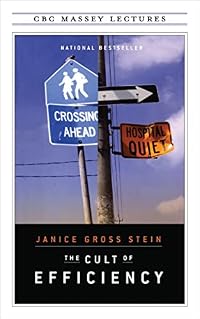
The Cult of Efficiency
by Janice Gross Stein
On This Page
Description
We live in an age dominated by the cult of efficiency. Efficiency in the raging debate about public goods is often used as a code word to advance political agendas. When it is used correctly, efficiency is important: it must always be part of the conversation when resources are scarce and citizens and governments have important choices to make among competing priorities. Even when the language of efficiency is used carefully, that language alone is not enough. Unilingualism will not do. We show more need to go beyond the cult of efficiency to talk about accountability. Much of the democratic debate of the next decade will turn on how accountability becomes part of our public conversation and whether it is imposed or negotiated. Janice Gross Stein draws on public education and universal health care, locally and globally, as flashpoints in the debate about their efficiency. She argues that what will define the quality of education from Ontario to India and the quality of health care from China to Alberta is whether citizens and governments can negotiate new standards of accountability. The cult of efficiency will not take us far enough. show lessTags
Recommendations



























Member Reviews
This was good though it required concentration to digest the argument. Basically, our call for government to be efficient with our tax dollars has changed the nature of government from provider of services to arbiters of services that are provided by a public market (not a private market like the stock market). This is a market created and regulated by the state. As a result, the state is now in the business of keeping privately run services employed by the state accountable to the public. The problem is that there is sometimes a disconnect between the primary users of these privately run services (citizens) and the regulators of those services (the state). JGS argues that this change in how the welfare state is run is a result of show more increased security since WW II and the fall of the Berlin Wall and has spawned a culture of choice as a perceived right. It is the public’s right to be able to choose which services they use, how they use them, and who supplies them. This culture is only possible when citizens feel secure. JGS uses education and health care as case studies and finds there are different pros and cons in both cases.
She ends her book wondering if the culture of choice as right will survive the war on terror of the 2000s or if citizens will abdicate rights to the state in exchange for increased security. In the 2020s this question is relevant in terms of the threat of rising imperialism among the militarily strong states that threaten the weaker. show less
She ends her book wondering if the culture of choice as right will survive the war on terror of the 2000s or if citizens will abdicate rights to the state in exchange for increased security. In the 2020s this question is relevant in terms of the threat of rising imperialism among the militarily strong states that threaten the weaker. show less
We live in an age dominated by the cult of efficiency. Efficiency in the raging debate about public goods is often used as a code word to advance political agendas. When it is used correctly, efficiency is important: it must always be part of the conversation when resources are scarce and citizens and governments have important choices to make among competing priorities.
Even when the language of efficiency is used carefully, that language alone is not enough. Unilingualism will not do. We need to go beyond the cult of efficiency to talk about accountability. Much of the democratic debate of the next decade will turn on how accountability becomes part of our public conversation and whether it is imposed or negotiated.
Janice Gross Stein show more draws on public education and universal health care, locally and globally, as flashpoints in the debate about their efficiency. She argues that what will define the quality of education from Ontario to India and the quality of health care from China to Alberta is whether citizens and governments can negotiate new standards of accountability. The cult of efficiency will not take us far enough.
http://www.anansi.ca/titles.cfm?pub_id=180 show less
Even when the language of efficiency is used carefully, that language alone is not enough. Unilingualism will not do. We need to go beyond the cult of efficiency to talk about accountability. Much of the democratic debate of the next decade will turn on how accountability becomes part of our public conversation and whether it is imposed or negotiated.
Janice Gross Stein show more draws on public education and universal health care, locally and globally, as flashpoints in the debate about their efficiency. She argues that what will define the quality of education from Ontario to India and the quality of health care from China to Alberta is whether citizens and governments can negotiate new standards of accountability. The cult of efficiency will not take us far enough.
http://www.anansi.ca/titles.cfm?pub_id=180 show less
Ratings
Members
- Recently Added By
Lists

The (So-Called) Canada Pill
150 works; 1 member
Author Information

10+ Works 216 Members
Janice Gross Stein is the Harrowston Professor of Conflict Management in the Department of Political Science and the director of the Munk Centre for International Studies at the University of Toronto.
Awards and Honors
Series
Belongs to Publisher Series
CBC Massey Lectures (2001)
Common Knowledge
- Canonical title
- The Cult of Efficiency
Classifications
- Genres
- Nonfiction, Politics and Government, General Nonfiction, Philosophy
- DDC/MDS
- 361.613 — Society, Government, and Culture Social problems and social services Social problems and services Welfare State, Government Involvement Social Policy
- LCC
- JC329.5 .S74 — Political Science Political theory Political theory. The state. Theories of the state Patriotism
- BISAC
Statistics
- Members
- 102
- Popularity
- 315,453
- Reviews
- 2
- Rating
- (3.00)
- Languages
- English
- Media
- Paper, Audiobook, Ebook
- ISBNs
- 4
- ASINs
- 1