
Diane Ravitch
Author of The Death and Life of the Great American School System
About the Author
Diane Ravitch is the Research Professor of Education at New York University and a historian of education. She is the former assistant secretary of education and a former member of the National Assessment Governing Board. The author of ten books, including Reign of Error: The Hoax of the show more Privatization Movement and the Danger to America's Public Schools, Ravitch lives in Brooklyn, New York. show less
Image credit: © 2003 Lisa Wolfe
Series
Works by Diane Ravitch
Reign of Error: The Hoax of the Privatization Movement and the Danger to America's Public Schools (2013) 349 copies, 7 reviews
The Democracy reader: Classic and modern speeches, essays, poems, declarations, and documents on freedom and human rights worldwide (1992) — Editor — 120 copies, 2 reviews
Slaying Goliath: The Passionate Resistance to Privatization and the Fight to Save America's Public Schools (2020) 67 copies, 1 review
What Do Our 17-Year-Olds Know: A Report on the First National Assessment of History and Literature (1987) 63 copies, 1 review
Associated Works
Forgotten Heroes: Inspiring American Portraits from Our Leading Historians (1999) — Contributor — 123 copies, 1 review
Knowing, Teaching, and Learning History: National and International Perspectives (2000) — Contributor — 50 copies
Tagged
Common Knowledge
- Other names
- Silvers, Diana (birth)
- Birthdate
- 1938-07-01
- Gender
- female
- Education
- Columbia University (PhD)
Wellesley College - Occupations
- editorial assistant
historian
educational policy analyst
professor
Assistant Secretary of Education - Organizations
- The New Leader
- Short biography
- New York Times columnist David Brooks called Diane Ravitch "the nation’s most vocal educational historian." Writing about education policy for 45 years, she has criticized both left-wing and right-wing activists who try to stifle the study and expression of subjects or views they deem politically incorrect or unworthy for children to learn.
- Nationality
- USA
- Birthplace
- Houston, Texas, USA
- Places of residence
- Brooklyn, New York, USA
- Associated Place (for map)
- USA
Members
Reviews
Reign of error : the hoax of the privatization movement and the danger to America's public schools by Diane Ravitch
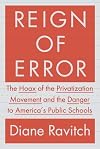
This is the most important book I've read all year and one that I think every American should read. Educational historian Diane Ravitch unravels the multi-pronged attack of the "school reform" movement on public education, teachers, and the core principles of democracy. While school reformers appropriate the language of the civil rights movement, Ravitch details how their programs are often untested (despite grandiose claims), increase segregation, and divert public money earmarked for the show more the least privileged communities to corporate interests.
Ravitch doesn't just criticize and complain, though, as she also offers solutions that will address educational achievement gaps in schools as well as addressing the crisis of poverty that often undermines even the best intended educational programs. I've listed them below, but please be aware that each solution is accompanied by a chapter-long description and action plan.
Favorite Passages:
Ravitch doesn't just criticize and complain, though, as she also offers solutions that will address educational achievement gaps in schools as well as addressing the crisis of poverty that often undermines even the best intended educational programs. I've listed them below, but please be aware that each solution is accompanied by a chapter-long description and action plan.
- Solution No. 1: Provide good prenatal care for every pregnant woman.
- Solution No. 2: Make high-quality early-childhood education available to all children.
- Solution No. 3: Every school should have a full, balanced and rich curriculum, including the arts, science, history, literature, civics, geography, foreign languages, mathematics, and physical education.
- Solution No. 4: Reduce class sizes to improve student achievement and behavior.
- Solution No. 5: Ban for-profit charters and charter chains and ensure that charter schools collaborate with public schools to support better education for all children.
- Solution No. 6: Provide the medical and social services that poor children need to keep up with their advantaged peers.
- Solution No. 7: Eliminate high-stakes standardized testing and rely instead on assessments that allow students to demonstrate what they know and can do.
- Solution No. 8: Insist that teachers, principals and superintendents be professional educators.
- Solution No. 9: Public schools should be controlled by elected school boards or by boards in large cities appointed for a set term for more than one elected official.
- Solution No. 10: Devise actionable strategies and specific goals to reduce racial segregation and poverty.
- Solution No. 11: Recognize that public education is a public responsibility, not a consumer good.
Favorite Passages:
"In this book, I show that the schools are in crisis because of persistent, orchestrated attacks on them and their teachers and principals, and attacks on the very principle of public responsibility for public education. These attacks create a false sense of crisis and serve the interests of those who want to privatize the public schools."show less
"I contend that their solutions are not working. Some are demonstrably wrong. Some, like charter schools, have potential if the profit motive were removed, and if the concept were redesigned to meet the needs of the communities served rather than the plans of entrepreneurs. It is far better to stop and think than to plunge ahead vigorously, doing what is not only ineffective but wrong."
"Testing in the early grades should be used sparingly, not to rank students, but diagnostically, to help determine what they know and what they still need to learn. Test scores should remain a private matter between parents and teachers, not shared with the district or the state for any individual student. The district or state may aggregate scores for entire schools but should not judge teachers or schools on the basis of these scores."
"If you want a society organized to promote the survival of the fittest and the triumph of the most advantaged, then you will prefer the current course of action, where children and teachers and schools are “racing to the top.” But if you believe the goal of our society should be equality of opportunity for all children and that we should seek to reduce the alarming inequalities children now experience, then my program should win your support."
"The “reformers” say they want excellent education for all; they want great teachers; they want to “close the achievement gap”; they want innovation and effectiveness; they want the best of everything for everyone. They pursue these universally admired goals by privatizing education, lowering the qualifications for future teachers, replacing teachers with technology, increasing class sizes, endorsing for-profit organizations to manage schools, using carrots and sticks to motivate teachers, and elevating standardized test scores as the ultimate measure of education quality. “Reform” is really a misnomer, because the advocates for this cause seek not to reform public education but to transform it into an entrepreneurial sector of the economy. The groups and individuals that constitute today’s reform movement have appropriated the word “reform” because it has such positive connotations in American political discourse and American history. But the roots of this so-called reform movement may be traced to a radical ideology with a fundamental distrust of public education and hostility to the public sector in general."
"Disabling or eliminating teachers’ unions removes the strongest voice in each state to advocate for public education and to fight crippling budget cuts. In every state, classroom teachers are experts in education; they know what their students need, and their collective voice should be part of any public decision about school improvement. Stripping teachers of their job protections limits academic freedom. Evaluating teachers by the test scores of their students undermines professionalism and encourages teaching to the test. Claiming to be in the forefront of a civil rights movement while ignoring poverty and segregation is reactionary and duplicitous."
"The states of Massachusetts, Minnesota, and Colorado, which volunteered to participate in TIMSS, ranked among the top-performing nations in the world. Massachusetts, had it been an independent nation would have been ranked second in the world, behind Singapore."
"Eliminating unions does not produce higher achievement, better teachers, or even higher test scores. Eliminating unions silences the most powerful advocate for public education in every state. It assures that there will be no one at the table to object when the governor or legislature wants to cut the budget for public schools. The union’s main role is to advocate for better working conditions and better compensation for its members. Better working conditions translate into better learning conditions for students, such as reduced class size and more resources for the schools. Better compensation attracts and retains teachers, which reduces teacher attrition. That too benefits students."
"The claims made by Teach for America distract the nation from the hard work of truly reforming the education profession. Instead of building a profession that attracts well-qualified candidates to make a career of working in the nation’s classrooms, our leaders are pouring large sums of money into a richly endowed organization that supplies temporary teachers. If we were serious about improving teacher quality, we would encourage all future teachers to get a solid education and preparation for teaching, and we would expect districts and states to construct a support system to help them get better every year. Instead of expending so much energy on whom to fire, we would focus energy on making teaching a prestigious profession in which classroom teachers have considerable professional autonomy over what and how they teach."
"Charter schools satisfied a long-standing ideological drive by libertarians to remove schools from government control and shift public assets into private hands. ALEC—the American Legislative Exchange Council—immediately saw the possibilities. ALEC, an organization of some two thousand state legislators and business leaders, promotes privatization and corporate interests. ALEC’s model law for charter schools is called the Next Generation Charter Schools Act. It has several key points: first, it insists that charter schools are public schools, even though they may be controlled by private boards and operate for profit; second, charter schools should be exempt from most state laws and regulations applied to public schools; third, charter schools may be authorized by multiple agencies, such as the state board of education, universities, and charter-friendly organizations, which maximizes the opportunities to open new charters; and fourth, the governor should have the power to appoint a board to authorize charters and override local school boards, which are often reluctant to grant these charters because they drain resources from the school system whose interests they are elected to protect. This legislation encourages the acceleration of privatization and undermines local control of schools. The corporate agenda of privatization and free markets, in this instance, takes precedence over the traditional conservative belief in small government and local control. In that sense, the reform agenda is not really a conservative agenda but a radical attack on local control that serves corporate interests, not Main Street."
"At present, our national policy relies on the belief that constant testing will improve the education of children in the poorest neighborhoods. But this is the cheapest way to supply schooling, not the best way or the right way. The children with the greatest needs are the most expensive to educate. They will not have equality of educational opportunity if their schools focus relentlessly on preparing them to take state tests. Like children in elite private schools and affluent suburbs, they need the arts and sports and science laboratories and libraries and social workers; they need school nurses and guidance counselors. They need to learn history and civics, to read literature and learn foreign languages. They need the latest technology and opportunities to learn to play musical instruments, to sing in groups, to make videos, and to perform in plays. They need beautiful campuses too. It will not be cost-effective to give them what they need. It is expensive. What is needed most cannot be achieved by cutting costs, hiring the least experienced teachers, increasing class size, or replacing teachers with computers."
The Death and Life of the Great American School System: How Testing and Choice Are Undermining Education by Diane Ravitch
Despite what you might think, Ravitch is ultimately a conservative; her arguments are tinged with nostalgia for a more formal, rigorous, idealistic type of education. Those of us who are true believers in public education also believe in the transformative power of, say, classic literature, or a understanding of the romance and awe of scientific exploration.
The battle is still underway to reclaim our schools from the supply-side marketing gurus who think that free markets and deregulation show more cure all of society's ills. I completely agree with Ravitch in that we have to define what it means to be an educated citizen - instead of debating this absolutely essential question, we are caught up in trying to "process" our way to better schools.
I also think that most people have a fundamental ignorance about what teachers do, or what happens in school every day. Teachers are the target of the new educational gurus because, there is no way to reduce or simplify the experience of education. I often say that the students learn just as much or more from each other than they do from their teachers - but they also learn from great authors, from their families, from their experiences. All of these combine to form an education - schools and teachers help to facilitate this learning and growth. show less
The battle is still underway to reclaim our schools from the supply-side marketing gurus who think that free markets and deregulation show more cure all of society's ills. I completely agree with Ravitch in that we have to define what it means to be an educated citizen - instead of debating this absolutely essential question, we are caught up in trying to "process" our way to better schools.
I also think that most people have a fundamental ignorance about what teachers do, or what happens in school every day. Teachers are the target of the new educational gurus because, there is no way to reduce or simplify the experience of education. I often say that the students learn just as much or more from each other than they do from their teachers - but they also learn from great authors, from their families, from their experiences. All of these combine to form an education - schools and teachers help to facilitate this learning and growth. show less
The death and life of the great American school system : how testing and choice are undermining education by Diane Ravitch
Mea culpa and cri de coeur of a former reformer who looked at the data and found that the popular solutions to America’s educational woes were being pushed on schools despite the absence of evidence to support them and substantial evidence that a focus on testing math and reading harms the curriculum, demoralizes teachers, and encourages cheating and other efforts to make sure underperforming students are someone else’s problem, which is pretty much the opposite of helping them. Ravitch show more argues that demanding test score improvement on math and literacy is not the same thing as having a curriculum, which is really what’s needed. By focusing on math and reading reformers have harmed schools and teachers—especially the ones whose students need the most—by denying them time, energy, and rewards for teaching history, social studies, science, art, and PE.
Ravitch also makes a nice point about the way in which culture wars in the US have given way to/are in fact about serving the desires of the 1%. She notes that, even as school voucher proponents won court victories that paved the way for large-scale voucher programs that would’ve allowed religious schools to get a lot of money from the government, reform ideology shifted to charter schools, which are considered public and can’t be religious but can be for-profit. “Choice” is now about entrepreneurship and opening up a new money funnel for investors—kids with state money strapped to their backs—not about parents selecting the values they want their children to learn. The book is repetitive because the stories of attacks on teachers and the failure of reforms to make things better are repetitive. (Also, one of Ravitch’s big points is that we aren’t in decline; Americans in general have never done well on international tests since the tests began, and wealthy districts perform at the top of the international rankings. We have a poverty problem and therefore we have an education problem.) show less
Ravitch also makes a nice point about the way in which culture wars in the US have given way to/are in fact about serving the desires of the 1%. She notes that, even as school voucher proponents won court victories that paved the way for large-scale voucher programs that would’ve allowed religious schools to get a lot of money from the government, reform ideology shifted to charter schools, which are considered public and can’t be religious but can be for-profit. “Choice” is now about entrepreneurship and opening up a new money funnel for investors—kids with state money strapped to their backs—not about parents selecting the values they want their children to learn. The book is repetitive because the stories of attacks on teachers and the failure of reforms to make things better are repetitive. (Also, one of Ravitch’s big points is that we aren’t in decline; Americans in general have never done well on international tests since the tests began, and wealthy districts perform at the top of the international rankings. We have a poverty problem and therefore we have an education problem.) show less
The Death and Life of the Great American School System: How Testing and Choice Are Undermining Education by Diane Ravitch
Actually giving one star to this combination of regret and restatement of the obvious is being generous. Ravitch basically spent her time in the 80s and early 90s promoting the testing and "choice" trends that now dominate a lot of the education establishment. She basically now had a change of heart and is going against most of what she actively promoted. This is a history of American education mostly looking at the end of the 20th century into today. If you have kept up with what has been show more going on, this book will not tell you anything new. In my case, all I have to do is look at my daughter's school and their constant obsession with standardized testing and how they pretty much teach to the test to see the results of Ravitch and her ilk: a major stifling of creativity and independent thinking, students who graduate mostly with one skill--the ability to fill bubbles on a multiple choice sheet, and who are barely knowledgeable of basic skills or the information and knowledge they need to be good, informed civic-minded active citizens.
Her conclusions are not that much better. Yes, we need major changes. Yes, we need a major exercise of collective will for the public good. Yes, we need stronger curricula, stronger instruction, better teachers (who are better paid as well, something Ravitch barely touches). Yes, we need to stop thinking of schools as businesses. These are things that others have said before, and they have said them much more eloquently. To me, as a former teacher and now librarian, this book seems like too little too late. The damage is already done, and it is going to take a lot of effort and will, things seriously lacking in a society that does not value education, and where anti-intellectualism is becoming the norm, to fix things. And there lies the tragedy, well, for the U.S. Meanwhile the rest of the world will continue to do better on skills tests overall than the U.S. given they have things like strong curricula, teachers and resources. These are things we could have and that we could do, but as a society we choose not to. Tragic indeed. show less
Her conclusions are not that much better. Yes, we need major changes. Yes, we need a major exercise of collective will for the public good. Yes, we need stronger curricula, stronger instruction, better teachers (who are better paid as well, something Ravitch barely touches). Yes, we need to stop thinking of schools as businesses. These are things that others have said before, and they have said them much more eloquently. To me, as a former teacher and now librarian, this book seems like too little too late. The damage is already done, and it is going to take a lot of effort and will, things seriously lacking in a society that does not value education, and where anti-intellectualism is becoming the norm, to fix things. And there lies the tragedy, well, for the U.S. Meanwhile the rest of the world will continue to do better on skills tests overall than the U.S. given they have things like strong curricula, teachers and resources. These are things we could have and that we could do, but as a society we choose not to. Tragic indeed. show less
Lists
Awards

You May Also Like


Associated Authors
Statistics
- Works
- 32
- Also by
- 3
- Members
- 3,148
- Popularity
- #8,112
- Rating
- 3.9
- Reviews
- 47
- ISBNs
- 94
- Languages
- 1
- Favorited
- 1