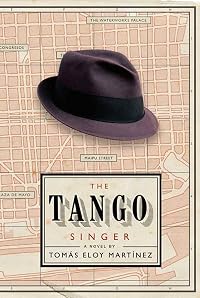
The Tango Singer
by Tomás Eloy Martínez
On This Page
Description
Bruno Cadogan has flown from New York to Buenos Aires in search of the elusive and legendary Julio Martel, a tango singer whose voice has never been recorded yet is said to be so beautiful it is almost supernatural. Bruno is increasingly drawn to the mystery of Martel and his strange and evocative performances in a series of apparently arbitrary sites around the city. As Bruno tries to find Martel, he begins to untangle the story of the singer's life, and to believe that Martel's show more increasingly rare performances map a dark labyrinth of the city's past. show lessTags
Recommendations















































Member Reviews
A very good work by the Argentine writer Eloy Martinez. The novel revolves around an NYU graduate Bruno Cadogan who on hearing of a tango singer--one Julio Martel from an acquaintance--heads off to Buenos Aires to track him down. Interspersed with his investigation into the whereabouts of the elusive Martel is another investigation to find the Aleph of the renowned Argentine writer Jorge Luis Borges. The plot focuses around these two threads and the sometimes bringing to the fore episodes from the very violent political history of Argentina--in doing so Eloy Martinez makes the city of Buenos Aires into as much a character as any of his human ones. It's not an unheard of achievement but still one very much worth remarking on. The tango show more singer Martel is a very old and frail man who has refused to ever have been recorded who re-invents the tangos of long ago that no one else but the most ancient have ever heard--the lyrics of which are no longer quite understandable. He in his way is giving back to his city its own history of not only the culture but the blood and violence of another time. He picks the most mysterious locations for impromptu 2-3- or 4 song performances and then disappears until it's time for another. Bruno much as he tries to discover the times and places for these events finds himself exasperatedly always one step behind. As for the Aleph he is certain where to find it--at the bottom of the 19th step of a cellar at the location of the Borges story--a cellar now occupied by one Sesostris Bonorino--a man busy compiling his own encyclopedia. He has no visual means of support and is simply living there without paying any rent. El Tucumano a kind of friend and guide of Bruno's advises him to turn him in and though Bruno has made friends with Bonorino he goes ahead and betrays hims anyway. Not that it matters because the authorities are already in the process of relocating everyone at the location and thereabouts including Bruno himself. Both of Bruno's quests will eventually come up empty but in doing so we see the sights and read the stories about numerous events from the Jewish gangsters of the Migdal who would return to Eastern Europe to marry women and then take them back to Argentina to sell them into prostitution to the dirty war and the disappearances of thousands of people in the late 70's and early 80's.
I have to say I really enjoyed this book and would recommend it highly especially to those interested in Latin American literature. show less
I have to say I really enjoyed this book and would recommend it highly especially to those interested in Latin American literature. show less
NYU grad student heads to Buenos Aires in search of an elusive tango singer and also is looking for Borges' Aleph to complete his dissertation. Quirky characters, chilling descriptions of Argentina's recent political turmoil (5 presidents in 1 year) entwined with the songs of the tango.
NYU grad student heads to Buenos Aires in search of an elusive tango singer and also is looking for Borges' Aleph to complete his dissertation. Quirky characters, chilling descriptions of Argentina's recent political turmoil (5 presidents in 1 year) entwined with the songs of the tango.
Tomás Eloy Martínez (1934-) was a journalist and film critic in Buenos Aires and Paris for many years before moving to Venezuela in 1975, to escape the political strife occurring in Argentina. He moved to the US in 1983, where he initially taught at the U. of Maryland. Since 1995 he has been the director of the Latin American Studies program at Rutgers. He has written several novels and nonfictional works, most notably The Perón Novel, Santa Evita and Flight of the Queen.
The Tango Singer is Martinez's latest novel. The narrator, Bruno Cadogan, is a graduate student in literature at NYU, who travels to Buenos Aires in order to complete his Ph.D. dissertation on Borges' essays on the origin of the tango. He soon learns about Julio show more Martel, a mysterious tango singer who is considered to be even better than Carlos Gardel, the greatest of all tango singers.
Cadogan sets off on a search for Martel throughout the city, which he describes as as a labyrinth. His paths are frequently blocked by demonstrators and crowds watching spontaneous tango performances, and the "street names change from one week to tne next", which causes even long time residents of the city to become lost outside of their own neighborhoods.
Eventually he meets and befriends Martel, but in doing so he discovers the dark side of Argentinian history, and achieves a greater understanding of Borges and his story "The Aleph", which describes a point in space that contains all other points.
Although it was a well written novel, I didn't enjoy it as much as I thought I would. The frequent references to streets, neighborhoods and sections of Buenos Aires and a lack of knowledge of Argentinian history made this a tedious read for me. I've heard good things about his other novels, and I'm willing to give them a try. I think that anyone with better knowledge about Argentina would enjoy this book far more than I did. show less
The Tango Singer is Martinez's latest novel. The narrator, Bruno Cadogan, is a graduate student in literature at NYU, who travels to Buenos Aires in order to complete his Ph.D. dissertation on Borges' essays on the origin of the tango. He soon learns about Julio show more Martel, a mysterious tango singer who is considered to be even better than Carlos Gardel, the greatest of all tango singers.
Cadogan sets off on a search for Martel throughout the city, which he describes as as a labyrinth. His paths are frequently blocked by demonstrators and crowds watching spontaneous tango performances, and the "street names change from one week to tne next", which causes even long time residents of the city to become lost outside of their own neighborhoods.
Eventually he meets and befriends Martel, but in doing so he discovers the dark side of Argentinian history, and achieves a greater understanding of Borges and his story "The Aleph", which describes a point in space that contains all other points.
Although it was a well written novel, I didn't enjoy it as much as I thought I would. The frequent references to streets, neighborhoods and sections of Buenos Aires and a lack of knowledge of Argentinian history made this a tedious read for me. I've heard good things about his other novels, and I'm willing to give them a try. I think that anyone with better knowledge about Argentina would enjoy this book far more than I did. show less
I chose this book because I was curious about the work of Tomás Eloy Martínez, who passed away in January. My public library had two of his books, and I chose this one because it looked more interesting. It is the story of a New York University graduate student who uses a Fulbright scholarship to travel to Buenos Aires, where he plans to work on his dissertation on Borges´ writings on the origins of the tango. Shortly before leaving, he hears about an elusive tango singer with an unforgettable voice, supposedly better than Gardel himself. The student, Bruno Cadogan, spends his time in Buenos Aires searching for the tango singer, Julián Martel, yearning to hear him sing at least a few tangos and hoping that if he succeeds and hears show more the tango singer, he will understand what he is doing in Buenos Aires and how he should proceed with his scholarly work. He also spends some time trying to lure a man named Bonarino out of the basement of the pension that he´s staying at, so that a character named el Tucumano can lead tourists to the 19th step of the stairs down to the basement, where Jorge Luis Borges´ Aleph can supposedly be seen. As the plot moves forward, the author describes moments and places in Buenos Aires history, such as the Palacio de Aguas Corrientes and the labyrinthic neighborhood of Parque Chas, where the streets don´t follow the normal grid pattern followed in the rest of the city. The final chapter of the book takes place in December, 2001, when the Argentine economy collapsed and days of panic and anger ensued amongst the people of Buenos Aires.
I believe that this book, both its plot and its depiction of the city of Buenos Aires, would be appealing to many people. I, however, did not find it very compelling. I thought that Bruno Cadogan was boring, naïve and at times downright stupid. He spent his time in Buenos Aires on a quest to find magical things, whether a tango singer or a fictional point in the world where all knowledge is contained. He does so with absolute seriousness, and while he often wonders whether what he´s doing will ever add up, he never stops to consider that what he´s doing might be ridiculous or absurd. I don´t doubt that Buenos Aires is a magical place for many people, but I still think that any 21st century quest for mythical figures in foreign countries should at least be tinged with a small amount of irony. Cadogan was a serious fellow, to the point that I could not take him seriously.
I also found the descriptions of Buenos Aires to be lacking somewhat in depth. There were moments when I found the stories about the city´s past and present compelling, such as the tale of a member of the Montoneros and his double-kidnapping of ex-President Aramburu, and a taxi ride taken by a Scandinavian woman in search for the old library of Buenos Aires, where she is to meet up with the rest of her tour group on a tour of sites related to the life of Borges. However, I often felt that the author relied on superficial and clichéd elements of the city´s past and present, without showing me anything that I didn´t already know about the city, or that I couldn´t find in a Lonely Planet Buenos Aires tourist guide to the city. I believe that the author wanted the descriptions to align with the perspective of a foreigner seeing and experiencing the city for the first time, and with that in mind maybe I shouldn´t be too disappointed. I suppose that my disappointment, though, has more to do with my expectations for the book. I hoped to read about the Buenos Aires that I didn´t know, and what I got instead was an overview of the main and noteworthy sites of the city.
I did, however, enjoy reading a story written by an Argentine about an American student´s trip to Buenos Aires. When I was in college I was lucky to spend a year in Argentina, so my perspective was tied to the protagonist´s through our shared experience as students in the city. I think, in the end, that what held me back was that I didn´t like the protagonist and his silly, romantic quest for “authenticity,” which I did not find compelling. I don’t think that I would recommend this book to my friends, because there´s quite a few other literary portraits of Buenos Aires that I would rather show them. show less
I believe that this book, both its plot and its depiction of the city of Buenos Aires, would be appealing to many people. I, however, did not find it very compelling. I thought that Bruno Cadogan was boring, naïve and at times downright stupid. He spent his time in Buenos Aires on a quest to find magical things, whether a tango singer or a fictional point in the world where all knowledge is contained. He does so with absolute seriousness, and while he often wonders whether what he´s doing will ever add up, he never stops to consider that what he´s doing might be ridiculous or absurd. I don´t doubt that Buenos Aires is a magical place for many people, but I still think that any 21st century quest for mythical figures in foreign countries should at least be tinged with a small amount of irony. Cadogan was a serious fellow, to the point that I could not take him seriously.
I also found the descriptions of Buenos Aires to be lacking somewhat in depth. There were moments when I found the stories about the city´s past and present compelling, such as the tale of a member of the Montoneros and his double-kidnapping of ex-President Aramburu, and a taxi ride taken by a Scandinavian woman in search for the old library of Buenos Aires, where she is to meet up with the rest of her tour group on a tour of sites related to the life of Borges. However, I often felt that the author relied on superficial and clichéd elements of the city´s past and present, without showing me anything that I didn´t already know about the city, or that I couldn´t find in a Lonely Planet Buenos Aires tourist guide to the city. I believe that the author wanted the descriptions to align with the perspective of a foreigner seeing and experiencing the city for the first time, and with that in mind maybe I shouldn´t be too disappointed. I suppose that my disappointment, though, has more to do with my expectations for the book. I hoped to read about the Buenos Aires that I didn´t know, and what I got instead was an overview of the main and noteworthy sites of the city.
I did, however, enjoy reading a story written by an Argentine about an American student´s trip to Buenos Aires. When I was in college I was lucky to spend a year in Argentina, so my perspective was tied to the protagonist´s through our shared experience as students in the city. I think, in the end, that what held me back was that I didn´t like the protagonist and his silly, romantic quest for “authenticity,” which I did not find compelling. I don’t think that I would recommend this book to my friends, because there´s quite a few other literary portraits of Buenos Aires that I would rather show them. show less
I loved this book! Partly for the story itself, but more for the picture it paints of one of the most amazing cities I've ever visited. I found myself recognising so many landmarks, restaurants, even the Quilmes that he drinks. Well worth the read if you've ever been.
A graduate student from the United States is looking for Julio Martel, the wondrous tango singer, but he proves to be very elusive. The deceased Borges tries to be a guide but is not always helpful because of his blindness. Martel is well known and has just just seen but Bruno Cadogan must go through a lot before he does The chaos of Argentinian political life threatens to dim his quest. People no longer see there relatives and friends and this is deeply felt. Bruno gets lost in a Buenos Aires labyrinth, or is it the one mapped in Borges' mind, which he can't find his way out of. Martel is in a hospital on the other side of the labyrinth, but the sightless administrators prevent his entry. He seeks out the boarding house on Garay Street show more but doesn't see it because it has been reduced to rubble it. But the voice, the sound of the singer, is unforgettable and inhabits his mind. show less
Members
- Recently Added By
Lists

Top Five Books of 2017
757 works; 231 members
Author Information

27 Works 1,668 Members
Tomás Eloy Martínez was born in San Miguel de Tucumán, Argentina on July 16, 1934. He received an undergraduate degree in Spanish and Latin American literature from the National University of Tucumán and a master's degree from the University of Paris. He was a novelist, journalist, essayist and critic. In the early 1970s, he conducted long show more interviews with Juan Domingo Perón in Madrid, where the general was living in exile. In 1975, while eating lunch in a Buenos Aires restaurant, he received word that when he stepped outside, he would be assassinated by a right-wing paramilitary group. Since there was no back door, he decided to document his own murder and phoned his newspaper requesting a photographer. When a swarm of photographers descended, the assassins scattered. He fled the country and eventually ended up in the United States, where he taught at the University of Maryland in the mid-1980s. His works include The Perón Novel (La Novela de Perón), Santa Evita, and The Tango Singer (El Cantor de Tango). He taught at Rutgers University from 1995 until his death. He died as the result of a brain tumor on January 31, 2010 at the age of 75. (Bowker Author Biography) show less
Awards and Honors
Notable Lists
Common Knowledge
- Canonical title
- The Tango Singer
- Original title
- El cantor de tango
- Original publication date
- 2004
- People/Characters
- Bruno Cadogan; Julio Martel
- Important places
- Buenos Aires, Argentina
- Important events
- Argentine Economic Crisis (December 2001)
- Blurbers
- Marquez, Gabriel Garcia
Classifications
- Genres
- Fiction and Literature, General Fiction
- DDC/MDS
- 863.64 — Literature & rhetoric Spanish Literature Spanish fiction 20th Century 1945-2000
- LCC
- PQ7798.23 .A692 .C36 — Language and Literature French, Italian, Spanish and Portuguese literatures Spanish literature Provincial, local, colonial, etc. Spanish America
- BISAC
Statistics
- Members
- 251
- Popularity
- 129,612
- Reviews
- 10
- Rating
- (3.52)
- Languages
- 9 — Danish, Dutch, English, French, German, Portuguese, Slovenian, Spanish, Turkish
- Media
- Paper, Ebook
- ISBNs
- 17
- ASINs
- 3