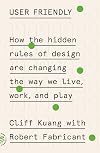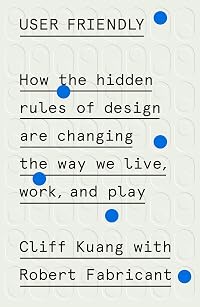
User Friendly: How the Hidden Rules of Design Are Changing the Way We Live, Work, and Play
by Cliff Kuang, Robert Fabricant
On This Page
Description
AMAZON BEST BOOKS OF 2019 PICKFORTUNE WRITERS AND EDITORS' RECOMMENDED BOOKS OF 2019 PICK
"User Friendly is a tour de force, an engrossing fusion of scholarly research, professional experience and revelations from intrepid firsthand reporting."
—EDWARD TENNER, The New York Times Book Review
In User Friendly, Cliff Kuang and Robert Fabricant reveal the untold story of a paradigm that quietly rules our modern lives: the assumption that machines should anticipate what we need. Spanning over show more a century of sweeping changes, from women's rights to the Great Depression to World War II to the rise of the digital era, this book unpacks the ways in which the world has been—and continues to be—remade according to the principles of the once-obscure discipline of user-experience design.
In this essential text, Kuang and Fabricant map the hidden rules of the designed world and shed light on how those rules have caused our world to change—an underappreciated but essential history that's pieced together for the first time. Combining the expertise and insight of a leading journalist and a pioneering designer, User Friendly provides a definitive, thoughtful, and practical perspective on a topic that has rapidly gone from arcane to urgent to inescapable. In User Friendly, Kuang and Fabricant tell the whole story for the first time—and you'll never interact with technology the same way again.
. show less
Tags
Recommendations
















Member Reviews
As technology has evolved, so too has our interaction with it. At first, inventions were made and humans were expected to adapt to them: this resulted in situations such as the partial meltdown of a nuclear reactor at Three Mile Island, where the design of the control room contributed to the delay in identifying the actual problem. As industry and society learned from such accidents, user-centric design became recognized as a valid principle. The authors of this book trace the history of design, how users became centred in design (at least sometimes), and how our interactions with our devices change, and change us.
The book is very well written and interesting. I found the chapter on personalization incredibly creepy — the idea of show more creating a frictionless world where vacationers at Disney World or on a cruise ship are having non-stop fun and excitement, and that technology enables staff to monitor people for signs of dissatisfaction and quickly stop them, is rather more dystopian than appealing. My perspective could at least partly be based on the fact that cruise ships and Disney World are already my idea of hell, but part of me figures we need to know how to deal with a range of emotions, including annoyance and impatience. People coddled by personalized tech sound like very emotionally limited people.
I would recommend this book if you’re interested in the history of tech, want to know about how our world is constructed, or want to know how people figure out what makes people tick. show less
The book is very well written and interesting. I found the chapter on personalization incredibly creepy — the idea of show more creating a frictionless world where vacationers at Disney World or on a cruise ship are having non-stop fun and excitement, and that technology enables staff to monitor people for signs of dissatisfaction and quickly stop them, is rather more dystopian than appealing. My perspective could at least partly be based on the fact that cruise ships and Disney World are already my idea of hell, but part of me figures we need to know how to deal with a range of emotions, including annoyance and impatience. People coddled by personalized tech sound like very emotionally limited people.
I would recommend this book if you’re interested in the history of tech, want to know about how our world is constructed, or want to know how people figure out what makes people tick. show less
Возможно, когда вы читаете этот журнал, рядом с вами находится телефон, на котором каждый раз, когда ваша концентрация ослабевает, вы проверяете электронную почту или набиваете текстовые сообщения. В этом случае можно сказать, что вы являетесь конечным пользователем целого ряда изобретений, возникновением которых мы обязаны людям с ограниченными возможностями. В данном случае это клавиатура, show more телекоммуникации и электронная почта. В 1808 году Пеллегрино Турри сконструировал первую пишущую машинку для того, чтобы его слепая возлюбленная могла писать письма более разборчиво. В 1872 году Александр Грэм Белл изобрел телефон, чтобы профинансировать свою основную деятельность по помощи глухим. А в 1972 году Винтон Серф создал первые почтовые протоколы для зарождающегося интернета. Он горячо верил в силу электронных писем, потому что электронные сообщения представлялись ему лучшим способом общения с глухой женой, пока он был на работе.
Хотя эти ситуации почти соответствуют клише о том, что нужда мать смекалки, точнее было бы сказать, что каждый из этих изобретателей, сопереживая кому-то, смог создать вещи, которые он, возможно, никогда бы не создал лишь для себя. Очевидно, что эмпатия является одной из основных движущих сил прогресса. Прогрессу в области создания удобных в применении устройств и вещей и посвящена эта книга. Дело в том, что нужды и особые потребности не всегда столь очевидны, как слепота или глухота. К интуитивно понятному расположению приборов на контрольной панели самолетов приходили через человеческие жертвы. Дико неудобное распределение датчиков машинного зала поспособствовало аварии на американской АЭС в 1979 г..
Удобство использования может, естественно, играть и на руку новаторам: неожиданно, одним из главных усовершенствований XXI века считается функция-кнопка 1-Click, введенная онлайн-магазином Amazon. Дело в том, что почти 70% набранных в виртуальную корзину покупок бросались не оплаченными. Убрав все промежуточные барьеры этой кнопкой, Amazon значительно поднял продажи. Более того, компания затем заработала миллиарды, поделившись технологией с Apple для только что запущенного ею тогда магазина iTunes.
Неудобство, кстати, может быть не случайным: неэргономичную раскладку клавиатуры QWERTY придумали именно для того, чтобы снизить скорость печати (иначе печатные машинки быстро ломались). Двери автомобилей Бентли можно было бы делать практически невесомыми, но бренд строится на солидности, это ведь не какая-то «легковесная» KIA.
Удобство в использовании и интуитивно понятные интерфейсы плавно подготовили нас к тому, что теперь машины и устройства не только откликаются на наши запросы, но и пытаются предвидеть их. Раньше об этом с ужасом писали в антиутопиях фантасты, однако, судя по всему, мы уже «вкатились» в этот дивный новый мир: уже 10% всех сообщений в Gmail составляют ответы, предложенные системой. show less
Хотя эти ситуации почти соответствуют клише о том, что нужда мать смекалки, точнее было бы сказать, что каждый из этих изобретателей, сопереживая кому-то, смог создать вещи, которые он, возможно, никогда бы не создал лишь для себя. Очевидно, что эмпатия является одной из основных движущих сил прогресса. Прогрессу в области создания удобных в применении устройств и вещей и посвящена эта книга. Дело в том, что нужды и особые потребности не всегда столь очевидны, как слепота или глухота. К интуитивно понятному расположению приборов на контрольной панели самолетов приходили через человеческие жертвы. Дико неудобное распределение датчиков машинного зала поспособствовало аварии на американской АЭС в 1979 г..
Удобство использования может, естественно, играть и на руку новаторам: неожиданно, одним из главных усовершенствований XXI века считается функция-кнопка 1-Click, введенная онлайн-магазином Amazon. Дело в том, что почти 70% набранных в виртуальную корзину покупок бросались не оплаченными. Убрав все промежуточные барьеры этой кнопкой, Amazon значительно поднял продажи. Более того, компания затем заработала миллиарды, поделившись технологией с Apple для только что запущенного ею тогда магазина iTunes.
Неудобство, кстати, может быть не случайным: неэргономичную раскладку клавиатуры QWERTY придумали именно для того, чтобы снизить скорость печати (иначе печатные машинки быстро ломались). Двери автомобилей Бентли можно было бы делать практически невесомыми, но бренд строится на солидности, это ведь не какая-то «легковесная» KIA.
Удобство в использовании и интуитивно понятные интерфейсы плавно подготовили нас к тому, что теперь машины и устройства не только откликаются на наши запросы, но и пытаются предвидеть их. Раньше об этом с ужасом писали в антиутопиях фантасты, однако, судя по всему, мы уже «вкатились» в этот дивный новый мир: уже 10% всех сообщений в Gmail составляют ответы, предложенные системой. show less
Maybe a little computer and phone centric but still a brilliant history and analysis of modern design for the lay man. I really enjoyed the deconstruction of the social media tinkering by Trump and the Russians that got the evil ginger elected. Unexpected consequences of social media platform design. It’s never the technology it’s evil but rather the uses it’s put to.
Largely ignores women in design, overplays the fears and reach of technology, quite biased but may be good as an introduction to the history of product design.
This is a journalistic account of what is nowadays called UX design or human-centered design, and how it came about. It is heavily California-centric and very much an outsider’s perspective, perhaps illustrating how our discipline is perceived in (North American) society and business today. The book is potentially a useful read for students and others who are interested in deploying UX design in practice.
A decent reflection of human-centered design over the years.
“A world that is lived without thought.”
Members
- Recently Added By
Author Information
2+ Works 246 Members
2 Works 246 Members
Some Editions
Awards and Honors
Awards
Common Knowledge
- Original publication date
- 2019
Classifications
Statistics
- Members
- 245
- Popularity
- 132,291
- Reviews
- 7
- Rating
- (3.63)
- Languages
- English, Polish
- Media
- Paper, Audiobook, Ebook
- ISBNs
- 10
- ASINs
- 3