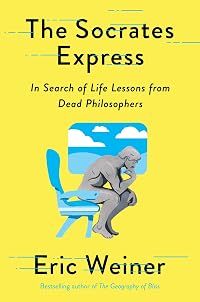
The Socrates Express: In Search of Life Lessons from Dead Philosophers
by Eric Weiner
On This Page
Description
Retraces the journeys of forefront intellectuals from Epicurus and Gandhi to Thoreau and Beauvoir to illuminate how their practical and spiritual lessons can be applied in today's unsettled world.Tags
Recommendations










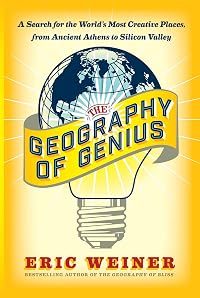


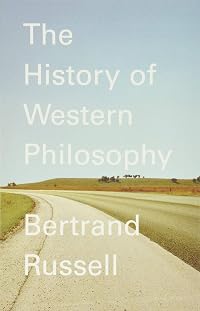






Member Reviews
Philosophy is most beneficial, not when treated as a lifeless academic exercise, but as a way of life that forces one to see the world in a new light. While science can provide us with information and knowledge (organized information), it is philosophy and the related fields in the humanities that furnishes us with wisdom.
The deepest questions regarding reality, knowledge, existence, morality, and politics cannot be solved by crunching numbers or running experiments; they must be solved by a process of deep reflection and logical rigor—at least for those interested in thinking for themselves. The manner in which you form your beliefs, treat others, and develop your character are all philosophical problems that you either figure out show more for yourself or else allow others to figure out for you.
That’s what makes books like the Socrates Express beneficial; for those with limited exposure to philosophy, it can force them to ask uncomfortable questions and challenge their most fundamental beliefs, leading to drastic changes in thought and behavior and a greater sense of intellectual independence (e.g., freedom from dogma).
In The Socrates Express, Eric Weiner takes the reader on a journey as he travels the world reading and reflecting on the works and ideas of 14 great philosophers from across history. Each chapter is devoted to a particular philosopher and idea that can help us to lead more examined and ultimately more fulfilling and rewarding lives. The reader will learn how to grapple with the big questions and apply the lessons from philosophy to develop gratitude, become more attentive and present, build character, cultivate generosity, better handle adversity, and much more. In this sense, the book works.
On the other hand, for seasoned readers of philosophy, the treatment of each philosopher will at times feel rather shallow. If you strip away the biographical details and personal commentary about the author's life and travels, you’re left with very superficial accounts of the actual ideas. If you are interested mainly in the ideas, don’t be surprised if you lose patience with the author’s digressions and constant attempts at humor.
Take the first chapter on the Meditations of Marcus Aurelius as a case in point. The Meditations is a brilliant work of philosophy with countless examples of deep philosophical wisdom, worthy of extended analysis and reflection. However, the author condenses all of this down into a few quotes and a couple brief comments about getting out of bed in the morning and fulfilling your duties. The rest of the chapter is devoted to the author’s experience on the train and some biographical details of Marcus. While some chapters are better than others, the coverage often feels superficial—almost like the author could have read an encyclopedia article on each philosopher and then wrote the chapter based on that alone.
The bottom line: some people are going to love the book while others are going to lose patience quickly. I’m somewhere in the middle. But before we criticize too harshly, we should remember that philosophy can be studied and practiced on multiple levels. If we insist that philosophy must always be highly technical, a wider audience cannot be reached, and instead of philosophy people will flock to religion and related forms of dogma. This is what we should want to avoid. While this may not be the most rigorous philosophy book you’ve ever encountered, it’s valuable in that it exposes the reader to fundamental questions in an entertaining and easily accessible manner. And, considering the entire subject of philosophy is essentially ignored in our public education system, there’s always a need for this. show less
The deepest questions regarding reality, knowledge, existence, morality, and politics cannot be solved by crunching numbers or running experiments; they must be solved by a process of deep reflection and logical rigor—at least for those interested in thinking for themselves. The manner in which you form your beliefs, treat others, and develop your character are all philosophical problems that you either figure out show more for yourself or else allow others to figure out for you.
That’s what makes books like the Socrates Express beneficial; for those with limited exposure to philosophy, it can force them to ask uncomfortable questions and challenge their most fundamental beliefs, leading to drastic changes in thought and behavior and a greater sense of intellectual independence (e.g., freedom from dogma).
In The Socrates Express, Eric Weiner takes the reader on a journey as he travels the world reading and reflecting on the works and ideas of 14 great philosophers from across history. Each chapter is devoted to a particular philosopher and idea that can help us to lead more examined and ultimately more fulfilling and rewarding lives. The reader will learn how to grapple with the big questions and apply the lessons from philosophy to develop gratitude, become more attentive and present, build character, cultivate generosity, better handle adversity, and much more. In this sense, the book works.
On the other hand, for seasoned readers of philosophy, the treatment of each philosopher will at times feel rather shallow. If you strip away the biographical details and personal commentary about the author's life and travels, you’re left with very superficial accounts of the actual ideas. If you are interested mainly in the ideas, don’t be surprised if you lose patience with the author’s digressions and constant attempts at humor.
Take the first chapter on the Meditations of Marcus Aurelius as a case in point. The Meditations is a brilliant work of philosophy with countless examples of deep philosophical wisdom, worthy of extended analysis and reflection. However, the author condenses all of this down into a few quotes and a couple brief comments about getting out of bed in the morning and fulfilling your duties. The rest of the chapter is devoted to the author’s experience on the train and some biographical details of Marcus. While some chapters are better than others, the coverage often feels superficial—almost like the author could have read an encyclopedia article on each philosopher and then wrote the chapter based on that alone.
The bottom line: some people are going to love the book while others are going to lose patience quickly. I’m somewhere in the middle. But before we criticize too harshly, we should remember that philosophy can be studied and practiced on multiple levels. If we insist that philosophy must always be highly technical, a wider audience cannot be reached, and instead of philosophy people will flock to religion and related forms of dogma. This is what we should want to avoid. While this may not be the most rigorous philosophy book you’ve ever encountered, it’s valuable in that it exposes the reader to fundamental questions in an entertaining and easily accessible manner. And, considering the entire subject of philosophy is essentially ignored in our public education system, there’s always a need for this. show less
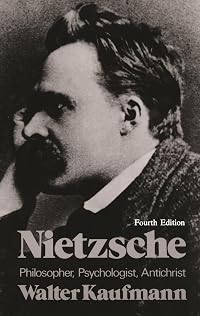
Each chapter describes a different philosopher, and is introduced by a particular train trip that the author recalls. This is philosophy as therapy and finding a meaning or purpose, and is cleverly presented. The first chapter, entitled "How to Get Out of Bed", discusses Marcus Aurelius, the second "How to Wonder" is about Socrates. My favorite chapter title is "How to Have No Regrets like Nietzsche". I was happy to find uncommon philosophers discussed, such as Gandhi, Simone Weill, and Sei Shonagon. I was motivated to read some of Simon Weill, Marcus Aurelius, and to purchase The World as Will and Representation to try again to understand Schopenhauer. I was amused by the discussion of the primitive conditions of "Stoic Camp" a program show more of the University of Wyoming, where the author and others read Epictetus' Handbook, discussing various points around a fireplace, during a snowstorm. I marked one quote, out of many that I should have, and I also want to remember the epigram of the book, by Maurice Riseling: "Sooner or later, life makes philosophers of us all"
"This brings us to another vaccine in the Stoic dispensary: premeditatio malorum, or "premeditation of adversity". Anticipate the arrows of Fortune, says Seneca. Imagine the worst scenarios and "rehearse them in your mind: exile, torture, war, shipwreck" show less
"This brings us to another vaccine in the Stoic dispensary: premeditatio malorum, or "premeditation of adversity". Anticipate the arrows of Fortune, says Seneca. Imagine the worst scenarios and "rehearse them in your mind: exile, torture, war, shipwreck" show less
I highly suggest reading The Socrates Express. A good read as well as being enlightening.
https://polymathtobe.blogspot.com/2026/02/book-review-socrates-express-by-eric.h...
https://polymathtobe.blogspot.com/2026/02/book-review-socrates-express-by-eric.h...
Ratings
Members
- Recently Added By
Author Information

5+ Works 3,340 Members
Eric Weiner is an award-winning journalist, bestselling author, and speaker. His books include The Geography of Bliss and The Geography of Genius, as well as the spiritual memoir Man Seeks God. His books have been translated into more than twenty languages. Weiner is a former foreign correspondent for NPR and reporter for the New York Times. He is show more a regular contributor to the Washington Post and AFAR, among other publications. show less
Awards and Honors
Distinctions
Classifications
Statistics
- Members
- 302
- Popularity
- 106,386
- Reviews
- 3
- Rating
- (4.19)
- Languages
- English, Italian, Spanish
- Media
- Paper, Audiobook, Ebook
- ISBNs
- 9
- ASINs
- 4