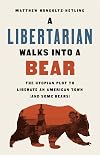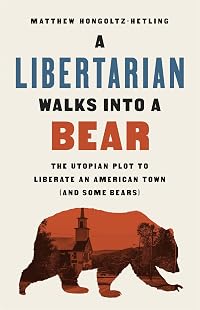
A Libertarian Walks Into a Bear: The Utopian Plot to Liberate an American Town and Some Bears
by Matthew Hongoltz-Hetling
On This Page
Description
"Once upon a time, a group of libertarians got together and hatched the Free Town Project, a plan to take over an American town and completely eliminate its government. In 2004, Grafton, NH, a barely populated settlement with one paved road, turned that plan into reality. Public funding for pretty much everything shrank: the fire department, the library, the schoolhouse. State and federal laws didn't disappear, but they got quieter: meek suggestions barely heard in the town's thick show more wilderness. The bears, on the other hand, were increasingly visible. Grafton's freedom-loving citizens ignored hunting laws and regulations on food disposal. They built a tent city, in an effort to get off the grid. And with a large and growing local bear population, conflict became inevitable. A Libertarian Walks Into a Bear is both a screwball comedy and the story of a radically American commitment to freedom. Full of colorful characters, puns and jokes, and one large social experiment, it is a quintessentially American story, a bearing of our national soul"-- show lessTags
Recommendations































Member Reviews
This is a book about the Free Town Project, in which a bunch of libertarians from across the country moved to Grafton, New Hampshire, which already had a long anti-government history even for the back hills of the Granite State, and made it even more lawless: carrying guns everywhere, lighting fires on dry days, not paying taxes. It turns out bears really love lawlessness too: flimsy trash cans, underfunded game wardens, the freedom to put out a buffet of doughnuts and grain for a scrawny-looking bear (!) who soon brings his friends. It's hilarious and terrifying and written with a lot of personality.
What would a town run by libertarians look like? Wild, happy freedom? Prosperity for all? In Matthew Hongoltz-Hetling’s A Libertarian Walks into a Bear, the answer is much more uncomfortable. Libertarians have issues – with every one and every thing. They are miserable in their “freedom”.
Grafton, New Hampshire has always had a libertarian streak. Before they completed the US Constitution, Grafton was already trying to secede from the USA. Any hint of tax or authority set the residents off. It has been slashing budgets and avoiding services ever since.
In this century, libertarians were drawn to Grafton by the promise of turning “a stodgy and unattractive thicket of burdensome regulations into an ‘anything goes’ frontier show more where…citizens could assert certain inalienable rights, such as the right to have more than two junk cars on private property, the right to gamble, the right to engage in school truancy, the right to traffic drugs and the right to have incestual intercourse…the right to traffic organs, the right to hold duels, and the God-given, underappreciated right to organize so-called bum fights, in which people who are homeless or otherwise indigent are paid small amounts of money to engage in fisticuffs.” This was the Free Town Project, and the pitches are from its website. It promised no or minimal taxation and no interference by any authority, of which there would simply be none. After all, New Hampshire was the home of the “Live Free or Die” license plate.
The people pushing this policy had their own reasons, rather than a consistent political philosophy. They were not successful in life. Some were sexual predators trying to start over with no boundaries (or ID). They were not builders or entrepreneurs, but arguers. Freedom was about the only word they had in common.
They attacked Grafton with an aim to tear it down to nothing, requiring no taxes and providing no services. Freedom from participating in the community was the goal. Every home was a castle to its owner, and private property was all that mattered. The government’s sole role in their scenario was to protect property rights. Roads, lights, fire parks, social services and police held no places in their vision.
“Grafton’s municipal office deteriorated from a state of mere shabbiness to downright decrepitude,” Hetling says. Buildings fell well below code. The public library could open for just three hours, on Wednesday mornings. Its bathroom was a refurbished Port-A-Potty, bolted to a wall. Potholed roads received no attention. The volunteer fire department relied on nearby towns. Stores disappeared. So did the school. By the time this book was written, the last retail establishment was gone. Life in Grafton kept deteriorating, while the nearby towns of Canaan and Enfield, with triple the tax revenues, were blossoming, accommodating, comfortable and inviting. And growing. In Grafton, police chiefs had to work, interview people and store records in their own homes over a stretch of 82 years. The contrasts with real government were stark.
One long subplot in the book involves a man who bought the old church, announced he was the new pastor, and ran it into the ground. Every year he refused to pay taxes. Every year he applied for a non-profit exemption. But as a dyed-in-the-wool libertarian, he refused to apply to the IRS for 501(3)C non-profit status. Without it, the town refused his applications. But not believing the IRS to be a legitimate institution, he would not lower himself to deal with it. Instead, he fought off annual seizures, lived like a hermit and eventually, penniless, died in a fire in the church. Such is the price of freedom, libertarian style.
The town’s budget kept shrinking, and it could not keep up with normal commitments. People sued the town over everything, driving up legal costs in a budget that never even covered the basics.
Grafton libertarians seemed to spend all their time griping about their freedoms, but they had none. They felt the need to be armed, overwhelmingly. They were always on guard for the slightest challenge to their so-called freedoms. One walked around with a video recorder always on to prove to one and all every little slight he suffered on a daily basis. Hetling shows how he taunted people into such situations so he could claim martyrdom. Libertarians are constantly on their guard.
Graftonites got into arguments and fights. For the first time in decades, there were murders. Police calls soared. When fire broke out, neighbors rushed to help carry belongings out of the house, but then others stole them out of the fields. Sex offender registrations more than tripled in four years. A tent city took shape. Anything that required raising money for the town got voted down. Angrily.
There were absurd arguments over everything. When the state recommended a tax holiday for the blind, voters in Grafton tried to shout it down, claiming every blind millionaire in the world would move to Grafton, take over and raise everyone else’s taxes. The motion passed, but no millionaires descended. Civil discourse and common sense seem to have little role to play in a libertarian society.
Hetling spent four years getting to know the locals. It could be a struggle at times. Often, they clammed up simply because he was a journalist. Others because they had things to hide. They lied to him, and he knew it. The hostility was palpable: “Knocking on doors in Grafton has left me with the nervous reflex of tensing up every time the door opens. You just never know when you’re going to get Friendly Advice,” Hetling said.
The tension level was far higher in the land of the free of Grafton, and with no services or infrastructure, and no prospects for work or success, residents left, making the problem worse. This also allowed the forest to reclaim it, bit by bit.
This is where the bears come in, literally. Grafton is in bear country, and it was always noticeable, without being a big problem. But recently, residents started to feed them or made it easy for them to feed themselves. Where other towns enjoyed seeing the occasional bear, in Grafton they were considered a plague. Every other chapter in the book is a standalone bear story.
The book tries really hard to weave a parallel story of bears into the main drama of libertarianism. But it doesn’t fit and it doesn’t work. The libertarian book stands on its own, without any reference to bears needed, or adding any value to the politics. The bear chapters make it bulky and balky.
Every chapter in the book begins with an epigraph quoting someone famous, most often Shakespeare, mentioning the word bear. It is as if Hetling went through Bartlett’s Quotations, and found two dozen quotes with the word bear, and placed them at the top of his chapters. None of them connects to the chapter ahead. And none of them has to anything to do with libertarianism. They have no relevance to the bear issues in Grafton, and certainly nothing whatever to do with the politics of American-style libertarianism. It is forced, off topic, and really only supports the jokey title – A Libertarian Walks into a Bear.
Hetling does a terrific job of getting under his characters’ skins. He makes readers understand where they’ve been and how they came to this place at this time. He even followed one to Arizona, where she was finally able to relax, regain her composure, confidence and strength, and surprised herself by becoming independent again and enjoying her new community.
His research back to the time of independence builds a solid foundation for the deterioration to come. And he does it with humor, setting up situations and cashing with a sly remark. He also likes subtlety. Sarcasm adds a laugh or two along the way, too. Hetling tells a good story. Or two in this case. Just largely unconnected and unconnectable.
The message is that Ayn Rand was very wrong. Given the total freedom they seek, Americans cringe in fear. They fear losing any part of their freedoms. They fear their neighbors. They fear any kind of authority. Their community crumbles before their eyes at their own instigation. There is no cohesion, only suspicion. The libertarian ethic is anti-everything, pro-nothing, and a horrible way to live.
David Wineberg show less
Grafton, New Hampshire has always had a libertarian streak. Before they completed the US Constitution, Grafton was already trying to secede from the USA. Any hint of tax or authority set the residents off. It has been slashing budgets and avoiding services ever since.
In this century, libertarians were drawn to Grafton by the promise of turning “a stodgy and unattractive thicket of burdensome regulations into an ‘anything goes’ frontier show more where…citizens could assert certain inalienable rights, such as the right to have more than two junk cars on private property, the right to gamble, the right to engage in school truancy, the right to traffic drugs and the right to have incestual intercourse…the right to traffic organs, the right to hold duels, and the God-given, underappreciated right to organize so-called bum fights, in which people who are homeless or otherwise indigent are paid small amounts of money to engage in fisticuffs.” This was the Free Town Project, and the pitches are from its website. It promised no or minimal taxation and no interference by any authority, of which there would simply be none. After all, New Hampshire was the home of the “Live Free or Die” license plate.
The people pushing this policy had their own reasons, rather than a consistent political philosophy. They were not successful in life. Some were sexual predators trying to start over with no boundaries (or ID). They were not builders or entrepreneurs, but arguers. Freedom was about the only word they had in common.
They attacked Grafton with an aim to tear it down to nothing, requiring no taxes and providing no services. Freedom from participating in the community was the goal. Every home was a castle to its owner, and private property was all that mattered. The government’s sole role in their scenario was to protect property rights. Roads, lights, fire parks, social services and police held no places in their vision.
“Grafton’s municipal office deteriorated from a state of mere shabbiness to downright decrepitude,” Hetling says. Buildings fell well below code. The public library could open for just three hours, on Wednesday mornings. Its bathroom was a refurbished Port-A-Potty, bolted to a wall. Potholed roads received no attention. The volunteer fire department relied on nearby towns. Stores disappeared. So did the school. By the time this book was written, the last retail establishment was gone. Life in Grafton kept deteriorating, while the nearby towns of Canaan and Enfield, with triple the tax revenues, were blossoming, accommodating, comfortable and inviting. And growing. In Grafton, police chiefs had to work, interview people and store records in their own homes over a stretch of 82 years. The contrasts with real government were stark.
One long subplot in the book involves a man who bought the old church, announced he was the new pastor, and ran it into the ground. Every year he refused to pay taxes. Every year he applied for a non-profit exemption. But as a dyed-in-the-wool libertarian, he refused to apply to the IRS for 501(3)C non-profit status. Without it, the town refused his applications. But not believing the IRS to be a legitimate institution, he would not lower himself to deal with it. Instead, he fought off annual seizures, lived like a hermit and eventually, penniless, died in a fire in the church. Such is the price of freedom, libertarian style.
The town’s budget kept shrinking, and it could not keep up with normal commitments. People sued the town over everything, driving up legal costs in a budget that never even covered the basics.
Grafton libertarians seemed to spend all their time griping about their freedoms, but they had none. They felt the need to be armed, overwhelmingly. They were always on guard for the slightest challenge to their so-called freedoms. One walked around with a video recorder always on to prove to one and all every little slight he suffered on a daily basis. Hetling shows how he taunted people into such situations so he could claim martyrdom. Libertarians are constantly on their guard.
Graftonites got into arguments and fights. For the first time in decades, there were murders. Police calls soared. When fire broke out, neighbors rushed to help carry belongings out of the house, but then others stole them out of the fields. Sex offender registrations more than tripled in four years. A tent city took shape. Anything that required raising money for the town got voted down. Angrily.
There were absurd arguments over everything. When the state recommended a tax holiday for the blind, voters in Grafton tried to shout it down, claiming every blind millionaire in the world would move to Grafton, take over and raise everyone else’s taxes. The motion passed, but no millionaires descended. Civil discourse and common sense seem to have little role to play in a libertarian society.
Hetling spent four years getting to know the locals. It could be a struggle at times. Often, they clammed up simply because he was a journalist. Others because they had things to hide. They lied to him, and he knew it. The hostility was palpable: “Knocking on doors in Grafton has left me with the nervous reflex of tensing up every time the door opens. You just never know when you’re going to get Friendly Advice,” Hetling said.
The tension level was far higher in the land of the free of Grafton, and with no services or infrastructure, and no prospects for work or success, residents left, making the problem worse. This also allowed the forest to reclaim it, bit by bit.
This is where the bears come in, literally. Grafton is in bear country, and it was always noticeable, without being a big problem. But recently, residents started to feed them or made it easy for them to feed themselves. Where other towns enjoyed seeing the occasional bear, in Grafton they were considered a plague. Every other chapter in the book is a standalone bear story.
The book tries really hard to weave a parallel story of bears into the main drama of libertarianism. But it doesn’t fit and it doesn’t work. The libertarian book stands on its own, without any reference to bears needed, or adding any value to the politics. The bear chapters make it bulky and balky.
Every chapter in the book begins with an epigraph quoting someone famous, most often Shakespeare, mentioning the word bear. It is as if Hetling went through Bartlett’s Quotations, and found two dozen quotes with the word bear, and placed them at the top of his chapters. None of them connects to the chapter ahead. And none of them has to anything to do with libertarianism. They have no relevance to the bear issues in Grafton, and certainly nothing whatever to do with the politics of American-style libertarianism. It is forced, off topic, and really only supports the jokey title – A Libertarian Walks into a Bear.
Hetling does a terrific job of getting under his characters’ skins. He makes readers understand where they’ve been and how they came to this place at this time. He even followed one to Arizona, where she was finally able to relax, regain her composure, confidence and strength, and surprised herself by becoming independent again and enjoying her new community.
His research back to the time of independence builds a solid foundation for the deterioration to come. And he does it with humor, setting up situations and cashing with a sly remark. He also likes subtlety. Sarcasm adds a laugh or two along the way, too. Hetling tells a good story. Or two in this case. Just largely unconnected and unconnectable.
The message is that Ayn Rand was very wrong. Given the total freedom they seek, Americans cringe in fear. They fear losing any part of their freedoms. They fear their neighbors. They fear any kind of authority. Their community crumbles before their eyes at their own instigation. There is no cohesion, only suspicion. The libertarian ethic is anti-everything, pro-nothing, and a horrible way to live.
David Wineberg show less
A Libertarian Walks Into a Bear is an often funny, often tragic account of two major threads in American life that crossed in the small town of Grafton, New Hampshire.
The first is the Ideal of Liberty (caps intended), the notion that America was founded as a place where you could be free to live your life as you want, without inconvenient laws and regulations and especially taxes. Grafton has a long history of collective and individual tax evasion, backed by rural Yankee skinflint attitudes towards money. In 2004, a few of the locals decided that Grafton would be an ideal location for their Free Town experiment. They'd recruit Libertarians from the internet and pack the apparatuses of government with supporters, and then dismantle the show more state from the inside.
There were a few problems with this plan. First, Grafton is incredibly economically depressed, with essentially zero industry or commerce. While land is cheap, transportation is not. Second, internet libertarians willing to move to a small town are by definition difficult people. As newcomers squatted in various wooded shacks and tent encampments, tempers boiled over in a thousand small way, stressing the town's legal system. And third, there were the bears.
The bears are the second major theme. White settlement in New Hampshire was literally hacked from bear infested woods with musket and axe. But as small farms retreated and the conservation movement rose, bears returned in force. Bears are clever survivors, and humans leave lots of food lying around their property, from chicken coops to bird feeders to trash. Donut Lady, a local resident who started feeding the bears, is the headline, but the real story is a new ecology at the ursine-human interface, with bears as very large and very dangerous racoons. The bear population of New Hampshire has exploded, leaving Fish and Game totally overwhelmed. And one Grafton resident was mauled, while many suffered close scares.
Libertarian attitudes of "I do what I want" haven't helped the bear problem, with complications from laissez faire trash disposal to deliberately feeding the bears, but even organized state responses seem insufficient. The much more prosperous town of Hanover (Dartmouth College) had a celebrity bear, Mink, who was repeatedly trapped and tranqed by fish and game and relocated to deep wilderness at immense expense. Tahoe has a current (March 2022) problem with Hank the Tank, a bear that breaks into vacation homes. What worked, at least temporarily, was a vigilante effort in Grafton that illegally hunted bears and killed at least a dozen. The bear problem would rapidly disappear if people were allowed to open fire on bears sniffing around their garbage cans, use bait, and attack bears in their dens. But such actions are cowardly and despicable, whether done by private individuals or organized under the aegis of the public good.
A Libertarian Walks Into a Bear is a fun story, and a good display of contemporary libertarian politics as emotional reaction against community and responsibility, rather than any kind of actual intellectualism or politics. It points towards changes in how Americans relate to nature, and a possible curve in the conversation movement, though one that hasn't happened yet. Charismatic megafauna is charismatic. show less
The first is the Ideal of Liberty (caps intended), the notion that America was founded as a place where you could be free to live your life as you want, without inconvenient laws and regulations and especially taxes. Grafton has a long history of collective and individual tax evasion, backed by rural Yankee skinflint attitudes towards money. In 2004, a few of the locals decided that Grafton would be an ideal location for their Free Town experiment. They'd recruit Libertarians from the internet and pack the apparatuses of government with supporters, and then dismantle the show more state from the inside.
There were a few problems with this plan. First, Grafton is incredibly economically depressed, with essentially zero industry or commerce. While land is cheap, transportation is not. Second, internet libertarians willing to move to a small town are by definition difficult people. As newcomers squatted in various wooded shacks and tent encampments, tempers boiled over in a thousand small way, stressing the town's legal system. And third, there were the bears.
The bears are the second major theme. White settlement in New Hampshire was literally hacked from bear infested woods with musket and axe. But as small farms retreated and the conservation movement rose, bears returned in force. Bears are clever survivors, and humans leave lots of food lying around their property, from chicken coops to bird feeders to trash. Donut Lady, a local resident who started feeding the bears, is the headline, but the real story is a new ecology at the ursine-human interface, with bears as very large and very dangerous racoons. The bear population of New Hampshire has exploded, leaving Fish and Game totally overwhelmed. And one Grafton resident was mauled, while many suffered close scares.
Libertarian attitudes of "I do what I want" haven't helped the bear problem, with complications from laissez faire trash disposal to deliberately feeding the bears, but even organized state responses seem insufficient. The much more prosperous town of Hanover (Dartmouth College) had a celebrity bear, Mink, who was repeatedly trapped and tranqed by fish and game and relocated to deep wilderness at immense expense. Tahoe has a current (March 2022) problem with Hank the Tank, a bear that breaks into vacation homes. What worked, at least temporarily, was a vigilante effort in Grafton that illegally hunted bears and killed at least a dozen. The bear problem would rapidly disappear if people were allowed to open fire on bears sniffing around their garbage cans, use bait, and attack bears in their dens. But such actions are cowardly and despicable, whether done by private individuals or organized under the aegis of the public good.
A Libertarian Walks Into a Bear is a fun story, and a good display of contemporary libertarian politics as emotional reaction against community and responsibility, rather than any kind of actual intellectualism or politics. It points towards changes in how Americans relate to nature, and a possible curve in the conversation movement, though one that hasn't happened yet. Charismatic megafauna is charismatic. show less
So this was different. Entertaining non-fiction account of two things: Grafton, New Hampshire. Libertarians. And black bears. Yes, three things because I forgot about the bears. The bears don't deserve to be grouped with the other two, though, because they didn't create that circus. Plus, they're the smartest ones in the story. The more I know about libertarians, the more puzzled I am that anyone believes this is a viable construct for a society, unless none of the prerequisites to qualify as a society include characteristics such as civilized or effective or organized. And perhaps intelligent? Tent city put up a sign that said, "No bears allowed." Yes, good, I guess, that these people were too busy combating bears to procreate? Oh, show more dear, I'd like to hope so anyway. And another libertarian used his life's savings to buy a historic church that he had no plan for being able to afford to run, assuming (perhaps?) that, if he's not paying taxes on it, he'll have money to pay for things like heating? His final solution to avoid the tax bill he ultimately couldn't avoid was to give away the church and his property so that the government had nothing to confiscate. Alas, the story ends more tragically than that.
We learn at the end that the state of "Live free or die" has nothing in its constitution to prevent eventual secession. Look, I do see the humor in it all, but I might not if I were one of the single women who were blamed for their own bear attack while a neighbor was feeding them donuts, or my property burnt to the ground because locals refused to fund a fully functioning fire department, or I had to watch a historic building almost reduced to cinders. While not mentioned in the book, I do have to wonder about the number of sexual assaults that took place up there, although statistics of accountability are poor enough in responsible jurisdictions that I can only imagine the futility of even bothering to report a rape in a place like that. What was there -- one police officer? "Live free or die" doesn't sound like a place for women.
This story reminds me of the libertarians that moved to Acapulco thinking they were escaping living under a government by abandoning their current one in exchange for a foreign one. Vive la Liberté!
This is a well-researched, humorous account of what began in Grafton, NH in the early 2000's, and the author has done a great job of including sufficient detail to flesh out key characters in the story. While the political landscape continues to unfold in NH, I felt like the story of the individuals was complete. It doesn't sound like Grafton is a place I'll ever want to visit, but I do wish the bears luck. show less
We learn at the end that the state of "Live free or die" has nothing in its constitution to prevent eventual secession. Look, I do see the humor in it all, but I might not if I were one of the single women who were blamed for their own bear attack while a neighbor was feeding them donuts, or my property burnt to the ground because locals refused to fund a fully functioning fire department, or I had to watch a historic building almost reduced to cinders. While not mentioned in the book, I do have to wonder about the number of sexual assaults that took place up there, although statistics of accountability are poor enough in responsible jurisdictions that I can only imagine the futility of even bothering to report a rape in a place like that. What was there -- one police officer? "Live free or die" doesn't sound like a place for women.
This story reminds me of the libertarians that moved to Acapulco thinking they were escaping living under a government by abandoning their current one in exchange for a foreign one. Vive la Liberté!
This is a well-researched, humorous account of what began in Grafton, NH in the early 2000's, and the author has done a great job of including sufficient detail to flesh out key characters in the story. While the political landscape continues to unfold in NH, I felt like the story of the individuals was complete. It doesn't sound like Grafton is a place I'll ever want to visit, but I do wish the bears luck. show less
Absolutely wild from beginning to end.
When scores of diehard Libertarians move to the small town of Grafton New Hampshire they have the noble goal of freeing it from all forms of government tyranny, like building permits, zoning laws, and fire departments. Chaos and problems ensue, not the least of which are epidemic numbers of wild, human fed, possibly dementia addled, black bears.
The author weaves the current (from around 2001-2016) bear based craziness with Grafton’s own unique history of iconoclasm and vociferous tax avoidance, dating back to the revolutionary war. A uniquely readable brand of dry humor, meticulous research, and numerous interviews make for a distinctive, constantly fascinating read.
When scores of diehard Libertarians move to the small town of Grafton New Hampshire they have the noble goal of freeing it from all forms of government tyranny, like building permits, zoning laws, and fire departments. Chaos and problems ensue, not the least of which are epidemic numbers of wild, human fed, possibly dementia addled, black bears.
The author weaves the current (from around 2001-2016) bear based craziness with Grafton’s own unique history of iconoclasm and vociferous tax avoidance, dating back to the revolutionary war. A uniquely readable brand of dry humor, meticulous research, and numerous interviews make for a distinctive, constantly fascinating read.
I love the title and premise of this book about a small town in New Hampshire that was taken over simultaneously by a group of libertarians and bears. If you know anything about me, it is that I detest libertarians and now I have another reason, they are really "logical" anarchists. But their logic is internally focused and it always boils down to "rules for thee, but not for me." This book proves that case. There are a lot of good examples of why you don't want a group of libertarians to try and take over your town or government.
The book was written pre-pandemic and published during the pandemic. It would be interesting to have it written post-pandemic and included more about how libertarians have joined with the Maga cult. I feel show more either a follow-on or a new book.
The book did meander a bit, and I think it could have used a good development edit to make it a four-star book. But I love the premise and there are some good stories in here. show less
The book was written pre-pandemic and published during the pandemic. It would be interesting to have it written post-pandemic and included more about how libertarians have joined with the Maga cult. I feel show more either a follow-on or a new book.
The book did meander a bit, and I think it could have used a good development edit to make it a four-star book. But I love the premise and there are some good stories in here. show less
This book is about Grafton, NH, the Free Town Project (a libertarian plan to take over an American town and eliminate its government), and New Hamphire's bears.
I believe this book got on my radar via Obsidian's review. In a way that occasionally feels a bit roundabout, Hongoltz-Hetling writes about Grafton, NH's beginnings, how it contained the seeds that allowed the Free Town Project to take root, and how that then exacerbated and exposed Grafton's various issues.
Grafton was depicted as a place that had been hanging on by its fingernails even before the Free Towners got there. The Free Towners took Grafton and tried their best to abolish as many laws and regulations as possible, or cripple the town's ability to enforce them, leaving show more residents even more vulnerable to things like fire and the area's growing bear population than they were before. As the town's problems mounted, things like guns, fences, and occasional neighborly support (which could be nonexistent, or not enough, or downright scary) were viewed as potential solutions. Literally everything but taxes.
I came away from this book with feelings of horror and anger about New Hampshire in general (the Free State Project gives me chills), Grafton in particular, and the various similarities I see in my own state. If you ever really want to appreciate taxes and what they can do for communities, this is the book to read.
The one bright spot: Soule, a Grafton resident who I'd been worrying about since the author described her difficulties moving around in her own home and making everything more accessible, and who'd basically become a shut-in due to concerns about bears, eventually ended up someplace that sounded genuinely healthier and better for her overall.
(Original review posted on A Library Girl's Familiar Diversions.) show less
I believe this book got on my radar via Obsidian's review. In a way that occasionally feels a bit roundabout, Hongoltz-Hetling writes about Grafton, NH's beginnings, how it contained the seeds that allowed the Free Town Project to take root, and how that then exacerbated and exposed Grafton's various issues.
Grafton was depicted as a place that had been hanging on by its fingernails even before the Free Towners got there. The Free Towners took Grafton and tried their best to abolish as many laws and regulations as possible, or cripple the town's ability to enforce them, leaving show more residents even more vulnerable to things like fire and the area's growing bear population than they were before. As the town's problems mounted, things like guns, fences, and occasional neighborly support (which could be nonexistent, or not enough, or downright scary) were viewed as potential solutions. Literally everything but taxes.
I came away from this book with feelings of horror and anger about New Hampshire in general (the Free State Project gives me chills), Grafton in particular, and the various similarities I see in my own state. If you ever really want to appreciate taxes and what they can do for communities, this is the book to read.
The one bright spot: Soule, a Grafton resident who I'd been worrying about since the author described her difficulties moving around in her own home and making everything more accessible, and who'd basically become a shut-in due to concerns about bears, eventually ended up someplace that sounded genuinely healthier and better for her overall.
(Original review posted on A Library Girl's Familiar Diversions.) show less
Members
- Recently Added By
Lists

Favorite Animal Non-Fiction
293 works; 144 members

Hachette Book Group
152 works; 6 members
Author Information

3+ Works 417 Members
Some Editions
Awards and Honors
Notable Lists
Common Knowledge
- Canonical title
- A Libertarian Walks Into a Bear: The Utopian Plot to Liberate an American Town and Some Bears
- Original publication date
- 2020-09
- Important places
- Grafton, New Hampshire, USA
- Dedication
- To Kimberly, who has spent the last eighteen years filling our home with kindness, reason, ethics, and love
- Blurbers
- Woodard, Colin; Ratliff, Evan; Finkel, Michael
Classifications
- Genres
- General Nonfiction, Nonfiction, History, Science & Nature
- DDC/MDS
- 974.2 — History & geography History of North America Northeastern United States (New England and Middle Atlantic states) New Hampshire
- LCC
- F44 .G75 .H66 — Local History of the United States, Canada and Latin America United States local history New Hampshire
- BISAC
Statistics
- Members
- 355
- Popularity
- 88,755
- Reviews
- 25
- Rating
- (3.73)
- Languages
- English, Polish, Spanish
- Media
- Paper, Audiobook, Ebook
- ISBNs
- 8
- ASINs
- 2