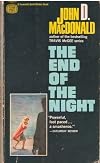
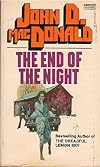
The End of the Night
by John D. MacDonald
On This Page
Description
The End of the Night, one of many classic novels from crime writer John D. MacDonald, the beloved author of Cape Fear and the Travis McGee series, is now available as an eBook.They’re known as the notorious “Wolf Pack”: three men and a beautiful girl on a cross-country terror spree, a coast-to-coast rampage of theft, destruction, and murder. But who are they? Where have they come from? And what motivates their terrifying capacity for mayhem? Somewhere in the grotesque inner world show more of four drug-crazed young sadists, a violent lust lies hidden between mischief and madness . . . waiting unseen for some innocent and helpless stranger.
Features a new Introduction by Dean Koontz
Praise for John D. MacDonald
“The great entertainer of our age, and a mesmerizing storyteller.”—Stephen King
“My favorite novelist of all time.”—Dean Koontz
“To diggers a thousand years from now, the works of John D. MacDonald would be a treasure on the order of the tomb of Tutankhamen.”—Kurt Vonnegut
“A master storyteller, a masterful suspense writer . . . John D. MacDonald is a shining example for all of us in the field. Talk about the best.”—Mary Higgins Clark. show less
Tags
Recommendations



















Member Reviews
The End of the Night was my first John D. Macdonald and it was quite the read. A hard boiled thriller about 4 people who head across America on a cross-country trip spreading terror as they go. Robbery, rape and murder mean nothing to these three men and one woman. They are up to their eyebrows in drugs and have no thought of consequences.
The book is told in hindsight while the four are lined up for execution, it is a tale of brutality and darkness, and reminded me of some of the black and white B crime movies from the 1950s. Although the violence was obvious, the author avoided the more disgusting graphic descriptions of the damage caused by the these four psychopaths, instead leaving it up to the reader to fill in the blanks.
A quick, show more vivid story told from various viewpoints that made for a bleak and uncomfortable read, yet held me bound to the book until the last page. I don’t know exactly what I was expecting from this author but I was pleasantly surprised at how atmospheric and well plotted this story was. I will definitely be looking for more books by John D. MacDonald. show less
The book is told in hindsight while the four are lined up for execution, it is a tale of brutality and darkness, and reminded me of some of the black and white B crime movies from the 1950s. Although the violence was obvious, the author avoided the more disgusting graphic descriptions of the damage caused by the these four psychopaths, instead leaving it up to the reader to fill in the blanks.
A quick, show more vivid story told from various viewpoints that made for a bleak and uncomfortable read, yet held me bound to the book until the last page. I don’t know exactly what I was expecting from this author but I was pleasantly surprised at how atmospheric and well plotted this story was. I will definitely be looking for more books by John D. MacDonald. show less
The synopsis made me hesitate a bit.
As a kid, I always had better luck finding John D. MacDonald's Travis McGee books than in locating the non-series tales. I ran across A Bullet for Cinderella on a spinner rack while visiting relatives in Camden, Arkansas, but that was the exception.
The rest of the long list of non-series books you'd find in the front of McGee titles eluded me, though I was intrigued by titles such as One Monday We Killed Them All, The Last One Left and Dead Low Tide.
I've worked at acquiring the stand-alone books for a while now, right after my love for MacDonald's work was re-activated when I was living in Texas and ran across The Crossroads in a shop mostly devoted to collectible hardcovers.
When I stumbled on an show more article mentioning Stephen King's praise of The End of the Night (1960) recently, I was happy to find it was among MacDonald Bookmooch acquisitions waiting on my shelf. Then, as mentioned above: that synopsis.
"Four drug-crazed young sadists--a world of damage. Driven by random, violent lusts they could barely articulate and understand, they embarked on a cross-country terror spree that left a trail of victims in its wake."
I don't shy away from grim tales, but I wasn't sure it was what I was in the mood for a criminal-focused tale with dark results.
Still, I figured there must be something to King's assertion that it was "one of the greatest American novels of the 20th century." I cracked the cover and read the opening passage, a missive from a prison guard recounting the executions of said drug-crazed young sadists.
That's a bold opening move, telling us how things end before falling back to reveal how events converged to drive everything to that point. I kept reading and discovered the piece never lacked for suspense despite the early reveal.
I read on and was drawn in, because the MacDonald magic took over, mesmerizing with a collection of well-drawn characters plus trial memos, death house diary entries and outside accounts that reveal the dark happenstance that connect killers and victims.
Riker Deems Owen, attorney for the four, perhaps defending his courtroom loss, defines their relationships and prepares the way for a framing and engrossing account of Helen Wister, a young woman trying to let an infatuated suitor down as she plans for her marriage to another, a young architect.
Then we drop into the eloquent journal of Kirby Stassen, college dropout turned participant in the crime spree, and we learn of his long path from New York and brushes with show business to Acapulco and a misguided romance with an older woman that primed him for his soul-dead excursion with the Sander Golden who's manipulating brutish Robert Hernandez and Nanette Koslov. Perhaps his diary is too eloquent and perceptive for his years, but that's a bit of license worth granting this novel.
Once connected the four are dubbed the Wolf Pack by the press, and their spree gains national notoriety with reverberations of Charles Starkweather's spree and the Richard Hickcock/Perry Smith In Cold Blood murder case.
Stassen recounts their humiliation and murder of a tile salesman but chooses not to delve into even more brutal events in Nashville where even he admits things were woefully out of hand.
Objectively the story continues via a never-named narrator who details the FBI dragnet and the fateful encounter between Wister and the band, building toward a culmination and epilogue that reveals tiniest glimmer of affirmation.
Its power is in both its exploration of the random, circuitous paths that lead to destruction, and its glimpse into at least a part of what drives random killers even beyond drug-induced dissociation.
Given King's affection for the work and his friendship with and admiration for MacDonald, I suspect it was an influence on the complexly-structured It, which features an architect protagonist as well.)
The End of the Night is a dark ride, but I'm glad I pushed past the synopsis because it's not as nihilistic as the cover might suggest. Don't judge a book by it's back cover. show less
As a kid, I always had better luck finding John D. MacDonald's Travis McGee books than in locating the non-series tales. I ran across A Bullet for Cinderella on a spinner rack while visiting relatives in Camden, Arkansas, but that was the exception.
The rest of the long list of non-series books you'd find in the front of McGee titles eluded me, though I was intrigued by titles such as One Monday We Killed Them All, The Last One Left and Dead Low Tide.
I've worked at acquiring the stand-alone books for a while now, right after my love for MacDonald's work was re-activated when I was living in Texas and ran across The Crossroads in a shop mostly devoted to collectible hardcovers.
When I stumbled on an show more article mentioning Stephen King's praise of The End of the Night (1960) recently, I was happy to find it was among MacDonald Bookmooch acquisitions waiting on my shelf. Then, as mentioned above: that synopsis.
"Four drug-crazed young sadists--a world of damage. Driven by random, violent lusts they could barely articulate and understand, they embarked on a cross-country terror spree that left a trail of victims in its wake."
I don't shy away from grim tales, but I wasn't sure it was what I was in the mood for a criminal-focused tale with dark results.
Still, I figured there must be something to King's assertion that it was "one of the greatest American novels of the 20th century." I cracked the cover and read the opening passage, a missive from a prison guard recounting the executions of said drug-crazed young sadists.
That's a bold opening move, telling us how things end before falling back to reveal how events converged to drive everything to that point. I kept reading and discovered the piece never lacked for suspense despite the early reveal.
I read on and was drawn in, because the MacDonald magic took over, mesmerizing with a collection of well-drawn characters plus trial memos, death house diary entries and outside accounts that reveal the dark happenstance that connect killers and victims.
Riker Deems Owen, attorney for the four, perhaps defending his courtroom loss, defines their relationships and prepares the way for a framing and engrossing account of Helen Wister, a young woman trying to let an infatuated suitor down as she plans for her marriage to another, a young architect.
Then we drop into the eloquent journal of Kirby Stassen, college dropout turned participant in the crime spree, and we learn of his long path from New York and brushes with show business to Acapulco and a misguided romance with an older woman that primed him for his soul-dead excursion with the Sander Golden who's manipulating brutish Robert Hernandez and Nanette Koslov. Perhaps his diary is too eloquent and perceptive for his years, but that's a bit of license worth granting this novel.
Once connected the four are dubbed the Wolf Pack by the press, and their spree gains national notoriety with reverberations of Charles Starkweather's spree and the Richard Hickcock/Perry Smith In Cold Blood murder case.
Stassen recounts their humiliation and murder of a tile salesman but chooses not to delve into even more brutal events in Nashville where even he admits things were woefully out of hand.
Objectively the story continues via a never-named narrator who details the FBI dragnet and the fateful encounter between Wister and the band, building toward a culmination and epilogue that reveals tiniest glimmer of affirmation.
Its power is in both its exploration of the random, circuitous paths that lead to destruction, and its glimpse into at least a part of what drives random killers even beyond drug-induced dissociation.
Given King's affection for the work and his friendship with and admiration for MacDonald, I suspect it was an influence on the complexly-structured It, which features an architect protagonist as well.)
The End of the Night is a dark ride, but I'm glad I pushed past the synopsis because it's not as nihilistic as the cover might suggest. Don't judge a book by it's back cover. show less
Starts off with four executions, and you wonder how he will keep it interesting from there. But MacDonald shows what a masterly writer he is as he uses multiple viewpoints to tell the story of a typical American college student who drops out and begins a series of misadventures ending with murder. Lots of preaching in this one - hard to tell how much is the author speaking, but the narrative grabs you fully by the time you are 50 pages in and you can't let go, even though it is pretty grim and definitely emotional if you allow yourself to step into the shoes of the victims and their loved ones.
This is about the fourth MacDonald book I've read, and they are all different. They share a tough mindedness and a superior writing style - but show more he isn't telling the same story over and over. A truly great writer. show less
This is about the fourth MacDonald book I've read, and they are all different. They share a tough mindedness and a superior writing style - but show more he isn't telling the same story over and over. A truly great writer. show less
This begins slowly, but turns into one of the best JDM novels extant. Note the name McGee through the story and the philosophy that's espoused from the middle of the book through the en d.
Ratings
Members
- Recently Added By
Author Information

229+ Works 31,928 Members
John D. MacDonald was born in Sharon, Pennsylvania on July 24, 1916. He received a B.S. from Syracuse University in 1938 and an M.B.A. from the Harvard Graduate School of Business Administration in 1939. During World War II, he served in the Army. His first novel, Brass Cupcake, was published in 1950. He wrote about 70 books during his lifetime show more including the Travis McGee series, Condominium, No Deadly Drug, Nothing Can Go Wrong, and A Friendship: The Letters of Dan Rowan and John Dann MacDonald. A Flash of Green was adapted into a movie by the same name and The Excuse was adapted into a movie entitled Cape Fear. He received numerous awards including the Ben Franklin Award for the best American short story in 1955, the Grand Prix de Litterature Policiere for A Key to the Suite in 1964, the Mystery Writers of America's Grand Master Award in 1972, the American Book Award for The Green Ripper in 1980. He died from complications of an earlier heart bypass surgery on December 28, 1986 at the age of 70. (Bowker Author Biography) show less
Awards and Honors
Distinctions
Series
Belongs to Publisher Series
Common Knowledge
- Original publication date
- 1960
- Dedication
- To Roger and Geoffrey, who left their marks on the manuscript
- First words
- It is not astonishing that the memoranda written by Riker Deems Owen, the defense attorney, regarding what came to be known as the Wolf Pack Murders, have been preserved by Leah Slayter, a softly adoring member of Mr. Owen's ... (show all)staff.
- Last words
- (Click to show. Warning: May contain spoilers.)Kemp straightened up, and, after a little while, he remembered how to start his car, and he drove the rest of the way back into the city.
- Blurbers
- King, Stephen
Classifications
Statistics
- Members
- 176
- Popularity
- 185,394
- Reviews
- 4
- Rating
- (3.87)
- Languages
- 5 — Catalan, English, French, Italian, Spanish
- Media
- Paper, Ebook
- ISBNs
- 10
- ASINs
- 10