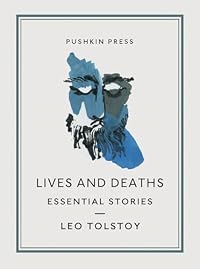
Lives and Deaths: Essential Stories
by Leo Tolstoy
On This Page
Description
Fresh translations of Tolstoy's richest shorter works by the award-winning Boris Dralyuk.Tags
Recommendations






Member Reviews
I borrowed [b:Lives and Deaths|51830647|Lives and Deaths|Leo Tolstoy|https://i.gr-assets.com/images/S/compressed.photo.goodreads.com/books/1568976998l/51830647._SX50_SY75_.jpg|73454877] from the library because I felt like reading something that had been through more than a century of peer review. This beautiful Pushkin Press edition appealed despite an ominous quote on the back from Orlando Figes: 'No other writer wrote so often, or so imaginatively, about the actual moment of dying'. I am terrified of death, but blithely disregarded Figes' warning and began reading. The first novella, 'The Death of Ivan Ilyich', is a literary masterpiece detailing the slow painful death of a judge aged 45. It's utterly existentially terrifying, to the show more point I had to put it aside and read some fanfiction about cartoon pirates so that I could sleep. Even then anxiety woke me up at 4am. I absolutely cannot say I wasn't warned, as in addition to Figes' comment the translator's introduction states states:
It was a stroke of genius by Tolstoy to begin with the funeral, from the perspective of a colleague who wants to get away and play cards. After showing the reader Ilyich's legacy, the narrative shifts into biographical mode to give a swift synopsis of his life then a meticulously detailed account of his slow painful death. As he deterioriates, he reflects upon how he has lived his life and upon his fear of death. His story captures the fundamental human experience of wanting desperately to keep on living:
The other three stories are much shorter and did not have the same detrimental mental effect, while also being exquisitely written and full of human (and horse) tragedy. I'm not sure whether I want to read [b:War and Peace|656|War and Peace|Leo Tolstoy|https://i.gr-assets.com/images/S/compressed.photo.goodreads.com/books/1413215930l/656._SY75_.jpg|4912783] now, although I have no doubt that the writing is exceptional. Tolstoy may be too much for my delicate sensibilities, although his ostensible 20th century successor [a:Vasily Grossman|19595|Vasily Grossman|https://images.gr-assets.com/authors/1655633035p2/19595.jpg] is one of my all-time favourite authors. [b:Lives and Deaths|51830647|Lives and Deaths|Leo Tolstoy|https://i.gr-assets.com/images/S/compressed.photo.goodreads.com/books/1568976998l/51830647._SX50_SY75_.jpg|73454877] certainly deserves five stars, but I'm withholding one because of the existential terror. show less
The novella is difficult to read, and difficult to translate - for that requires a much slower, more careful reading - but it is impossible to forget. However one understands the judgement meted out to Ivan Ilyich, and regardless of whether one agrees with it or rebels against it, one is changed forever by the trial.
It was a stroke of genius by Tolstoy to begin with the funeral, from the perspective of a colleague who wants to get away and play cards. After showing the reader Ilyich's legacy, the narrative shifts into biographical mode to give a swift synopsis of his life then a meticulously detailed account of his slow painful death. As he deterioriates, he reflects upon how he has lived his life and upon his fear of death. His story captures the fundamental human experience of wanting desperately to keep on living:
And he grew angry at the misfortune or at the people who were causing him trouble, who were killing him, and he could feel that the anger itself was killing him but he could not restrain it. It seems it should have been clear to him that his exasperation at circumstances and people aggravated his illness, and that he should therefore ignore all these unpleasant incidents, but his mind came to a wholly different conclusion: he said he needed peace, kept a close eye on anything that might disturb that peace and grew irritated at the slightest disturbance. His situation was made worse by the fact that he read medical books and consulted doctors. The deterioration of his condition was so gradual that he could deceive himself by comparing one day to another - there was hardly any difference. But when he consulted doctors, it seemed to him that he was indeed getting worse, and rather quickly too. Yet he consulted them constantly.
The other three stories are much shorter and did not have the same detrimental mental effect, while also being exquisitely written and full of human (and horse) tragedy. I'm not sure whether I want to read [b:War and Peace|656|War and Peace|Leo Tolstoy|https://i.gr-assets.com/images/S/compressed.photo.goodreads.com/books/1413215930l/656._SY75_.jpg|4912783] now, although I have no doubt that the writing is exceptional. Tolstoy may be too much for my delicate sensibilities, although his ostensible 20th century successor [a:Vasily Grossman|19595|Vasily Grossman|https://images.gr-assets.com/authors/1655633035p2/19595.jpg] is one of my all-time favourite authors. [b:Lives and Deaths|51830647|Lives and Deaths|Leo Tolstoy|https://i.gr-assets.com/images/S/compressed.photo.goodreads.com/books/1568976998l/51830647._SX50_SY75_.jpg|73454877] certainly deserves five stars, but I'm withholding one because of the existential terror. show less
Thanks to Edelweiss for my ARC.
Pushkin Press has put out a lovely collection of classic works by the great Leo Tolstoy. Boris Dralyuk has masterfully translated with great skill the clarity of thought that Tolstoy is known for. I highly recommend Dralyuks translation to those who love Tolstoy and especially so for those who come to his work anew.
Thoroughly well put together collection of translated classics.
Pushkin Press has put out a lovely collection of classic works by the great Leo Tolstoy. Boris Dralyuk has masterfully translated with great skill the clarity of thought that Tolstoy is known for. I highly recommend Dralyuks translation to those who love Tolstoy and especially so for those who come to his work anew.
Thoroughly well put together collection of translated classics.
Members
- Recently Added By
Author Information

2,482+ Works 129,115 Members
Count Lev Nikolayevich Tolstoy was born on September 9, 1828 in Russia. He is usually referred to as Leo Tolstoy. He was a Russian author who is regarded as one of the greatest authors of all time. Leo Tolstoy is best known for his novels War and Peace (1869) and Anna Karenina (1877). Tolstoy's fiction includes dozens of short stories and several show more novellas such as The Death of Ivan Ilyich, Family Happiness, and Hadji Murad. He also wrote plays and numerous philosophical essays. Tolstoy had a profound moral crisis and spiritual awakening in the 1870's which he outlined in his work, A Confession. His literal interpretation of the ethical teachings of Jesus, centering on the Sermon on the Mount, caused him to become a fervent Christian anarchist and pacifist. His ideas of nonviolent resistance which he shared in his works The Kingdom of God is Within You, had a profund impact on figures such as Mohandas Gandhi and Martin Luther King, Jr. On September 23, 1862 Tolstoy married Sophia Andreevna Behrs. She was the daughter of a court physician. They had 13 children, eight of whom survived childhood. Their early married life allowed Tolstoy much freedom to compose War and Peace and Anna Karenina with his wife acting as his secretary and proofreader. The Tolstoy family left Russia in the aftermath of the Russian Revolution and the subsequent establishment of the Soviet Union. Leo Tolstoy's relatives and descendants moved to Sweden, Germany, the United Kingdom, France and the United States. Tolstoy died of pneumonia at Astapovo train station, after a day's rail journey south on November 20, 1910 at the age of 82. (Bowker Author Biography) Count Leo Tolstoy was born in 1828 on the family estate of Yasnaya Polyana in the Tula province. He married in 1862 & was the father of 13 children. Tolstoy managed the estate of Yasnaya Polyana & ran its peasant schools, while writing his great novels, "War & Peace" (1869) & "Anna Karenina" (1877). He died in 1910. (Publisher Provided) show less
Classifications
- Genres
- General Fiction, Fiction and Literature
- DDC/MDS
- 891.733 — Literature & rhetoric Literatures of other languages East Indo-European and Celtic literatures Russian and East Slavic languages Russian fiction 1800–1917
- LCC
- PG3365 .A15 — Language and Literature Slavic languages and literatures. Baltic languages. Albanian language Slavic. Baltic. Albanian Russian literature Individual authors and works 1800-1870 Tolstoi
- BISAC
Statistics
- Members
- 20
- Popularity
- 1,275,736
- Reviews
- 2
- Rating
- (4.50)
- Languages
- English
- Media
- Paper, Ebook
- ISBNs
- 2
- ASINs
- 1