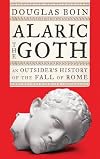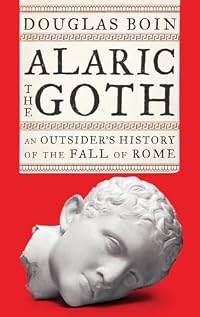
Alaric the Goth: An Outsider's History of the Fall of Rome
by Douglas Boin
On This Page
Description
"Did "barbarians" really cause the catastrophic collapse of civilization? Boin is the first to give an historically sound account from the "barbarian" perspective, through the life of Alaric the Goth. On August 24, 410 A.D., the Senate and the People of Rome awoke to a seismic shock. Intruders, led by a disaffected forty-year-old immigrant, known only as Alaric, had stormed the city. There were kidnappings, robbery, and acts of arson. The effects were long-lasting. Within two generations, show more Rome's world fell apart. A city predicted to rule an empire without end, in the words of its famous Latin poet Virgil, was governed by a savage band of foreigners, called Goths. Alaric the Goth offers a deeply researched look at the end of the Roman Empire but from a surprising point-of-view. Offering the first full-length biography of Alaric, a talented and frustrated immigrant living in a time of pervasive bigotry, state-supported Christian violence, and irrational xenophobia, it breaks out of decades of tired, traditional approaches to the period, most of which overidentify with the Roman people. And it reveals the lasting contributions Goths made to legal history, to the values of religious toleration, and to modern ideas of citizenship. By moving this man from the borders to the center of Rome's story, it asks readers to think deeply and differently about the lives of marginalized people too often invisible in our history books."-- show lessTags
Recommendations













Member Reviews
Alaric the Goth might be titled "The Life and Times of Alaric". He is the Barbarian leader who sacked Rome in 410, inspiring St. Augustine's The City of God. Alaric died soon after and was buried underneath a river bed with the choicest treasures of Rome never yet found. The primary focus is the period from the Battle of Adrianople in 378 to 410. It describes how the Goths were considered "outsiders", which is to say unwelcome immigrants, who were treated poorly by racist and xenophobic Roman citizens. They were abused while at the same time employed to the do the dirty work no one else wanted. The Goth's got their revenge. Alaric's life is not well documented so Boin takes the innovative approach of describing what we actually know show more about this period. For example we know Alaric spent time in Athens, and Boin describes Athens from archaeologic and written evidence - the popular plays, the city layout, it being a desirable address for up and coming Romans - and places it into context with Alaric's likely experiences there at that time. In this way we travel through his life and footsteps around the Roman Empire. The small details bring it alive in a way no other book about this period has before, that I have read. It's a fascinating and effective approach to history when documentation is otherwise sparse. This period is endlessly fascinating, Boin has placed the transition from Roman to Barbarian in technicolor showing both peaceful transition and violent change, as told through the microhistory of a single man. show less
This is very loosely a biographic sketch of Alaric, the leader of the Goths who led the Sack of Rome in 410, the first breach of the Eternal City's walls in roughly 800 years. There simply aren't the sources about Alaric to produce the kind of biography we've come to expect from more modern figures—even by the standards of the ancient world—so Douglas Boin mines textual, artistic, and archaeological evidence to produce a portrait of the world in which Alaric lived and thus outline the kind of person he might have been. Boin squeezes as much evidence as he can from the source base, and in the kind of accessible prose that would make this a good microhistory to hand to someone new to the history of the later Roman Empire.
However, I show more kept finding myself tripping over some of Boin's framing choices which show his analysis is (unthinkingly?) rooted in a modern U.S. American perspective. Whether you see it as coming from an intense desire to claim a relevance for the deep past, personal convictions, or an impish desire to needle, Boin's references to Christian "culture warriors" who lack the "religious tolerance" of the "immigrant" Goths. Discussions of the Roman border along the Rhine and Danube prompt Boin to write about the "border patrol", "border separation", and wealthy Romans pulling back to live in "gated communities." Boin never makes any comparison to the present-day U.S. overtly but at times I wished he had. If you're going to be provocative, you might as well provoke—and if you're going to use the problems of an ancient imperial hegemon to throw light on those of a modern one, you might as well be up front about that. show less
However, I show more kept finding myself tripping over some of Boin's framing choices which show his analysis is (unthinkingly?) rooted in a modern U.S. American perspective. Whether you see it as coming from an intense desire to claim a relevance for the deep past, personal convictions, or an impish desire to needle, Boin's references to Christian "culture warriors" who lack the "religious tolerance" of the "immigrant" Goths. Discussions of the Roman border along the Rhine and Danube prompt Boin to write about the "border patrol", "border separation", and wealthy Romans pulling back to live in "gated communities." Boin never makes any comparison to the present-day U.S. overtly but at times I wished he had. If you're going to be provocative, you might as well provoke—and if you're going to use the problems of an ancient imperial hegemon to throw light on those of a modern one, you might as well be up front about that. show less
The story of Alaric the Goth is more than the traditional view of a barbarian who sacked the glorious city of Rome in 410 that history has given him. In his exploration of Alaric's world and story, Boin draws the picture of a child of the borderlands, a Christian who is held separately from the Christians of Rome, a man who takes an opportunity to fight for the Roman Empire, but who is denied any opportunity at citizenship, and one whose charisma and strength ultimately makes him the leader who finds a home for a people without a land of their own.
As seen in his earlier book, Coming out Christian in the Roman World, Boin has a talent for drawing parallels between the ancient and modern worlds, both in his exploration of the themes of show more history and in his description of everyday life. It sound cliche to say that Boin's work makes the ancient world come alive, but it kind of does -- instead of just a world of emperors, wars, and monuments, we enter a world of families, writers, tourists, restaurants, politicians, the powerful, and the powerless.
As a historian, Boin had his work cut out for him in finding sources on Alaric and his life, which aren't well represented in existing primary sources. Instead he gives us a picture of Alaric informed by poetry, archaeology, early Christian writings, partisan histories, and (sometimes) conjecture. The reader benefits from Boin's thoughtful reading of these sources, and he walks us through the biases, context, traditional readings, and new interpretations of the texts.
Boin is a very readable storyteller and this book should appeal both to historians and to general readers of ancient history, the Roman Empire, and early Christianity. Highly recommended. show less
As seen in his earlier book, Coming out Christian in the Roman World, Boin has a talent for drawing parallels between the ancient and modern worlds, both in his exploration of the themes of show more history and in his description of everyday life. It sound cliche to say that Boin's work makes the ancient world come alive, but it kind of does -- instead of just a world of emperors, wars, and monuments, we enter a world of families, writers, tourists, restaurants, politicians, the powerful, and the powerless.
As a historian, Boin had his work cut out for him in finding sources on Alaric and his life, which aren't well represented in existing primary sources. Instead he gives us a picture of Alaric informed by poetry, archaeology, early Christian writings, partisan histories, and (sometimes) conjecture. The reader benefits from Boin's thoughtful reading of these sources, and he walks us through the biases, context, traditional readings, and new interpretations of the texts.
Boin is a very readable storyteller and this book should appeal both to historians and to general readers of ancient history, the Roman Empire, and early Christianity. Highly recommended. show less
In 410 AD, an army of Goths led by Alaric sacked Rome, an event that shocked the entire Roman world. For centuries, the Goths were painted as the evil villains of history for this. Douglas Boin writes the history of the 410 sacking from the perspective of the Goths and paints a sympathetic portrait of them. He also has lots of critical things to say about the Romans who ridiculed immigrants to the empire and imposed an extremely intolerant form of Christianity on the Empire.
This book is a valuable contribution to the history of the period. Other books describing the mass migrations of people during this period provide little understanding of the people doing the migration. Boin manages to bring the world of the goths to life.
The book show more is very readable albeit confusing in spots. It also strains to make parallels to our modern world. show less
This book is a valuable contribution to the history of the period. Other books describing the mass migrations of people during this period provide little understanding of the people doing the migration. Boin manages to bring the world of the goths to life.
The book show more is very readable albeit confusing in spots. It also strains to make parallels to our modern world. show less
In what seems to be a theme in history books I've read lately, the title of this book is fairly misleading. While Alaric is certainly the backbone tying the narrative of the book together, I would not call this an in-depth, detailed biography of the man. Instead, this focuses much more broadly on the portion of the title after the colon to tell the story of Rome in the late 4th century through a lens of immigration and assimilation with several pointed references to current events. I'm not familiar enough with the facts to know if that lens was fair or overly slanted, but I found myself wanting less commentary and more facts. This is a slight book and I think it would have been better if it had been about 50 pages longer (something I show more rarely say). Ultimately, this isn't one I can recommend to anyone as it will be too surface for serious students of the period but lacking background for newcomers. show less
A fairly light read for a book that straddles the line between academic and popular history. The author does the best he can with the very limited number of primary sources about the historic Alaric. It does provide an interesting perspective on the late Roman empire.
I guess it’s really a look at Rome at about 350 - 450AD. There’s not much good historical info about Alaric himself, so the author tries to fill in without actually making stuff up. I learned many things about Roman life at that time, but I think a good historian, had they worked on a history of Rome from 350-450, could have come up with something a little more solid. By trying to focus on Alaric, about whom so little can be known, something was lost. But still the book was very educational.
Members
- Recently Added By
Lists

Economist Books of the Year 2020
41 works; 5 members
Author Information

5 Works 317 Members
Douglas Boin is a professor of history at Saint Louis and the author of Coming Out Christian in the Roman World and two scholarly books on antiquity. He lives in Austin, Texas.
Awards and Honors
Notable Lists
Common Knowledge
- Original publication date
- 2020
- People/Characters
- Alaric
- Important events
- Sack of Rome (410)
- First words
- August 24 began as an ordinary day in the Eternal City.
- Last words
- (Click to show. Warning: May contain spoilers.)But there's no mistaking King Alaric's elegiac look, as he gazes beneath him at the place where the town's two bodies of water the Busento and the Crati Rivers, meet as one.
Classifications
- Genres
- History, Nonfiction, General Nonfiction, Biography & Memoir
- DDC/MDS
- 937.09092 — History & geography History of ancient world (to ca. 499) Italian Peninsula to 476 and adjacent territories to 476 Division of empire 395-476 A.D.
- LCC
- DG322.5 .A53 .B65 — History of Europe, Asia, Africa and Oceania City History of Italy Ancient Italy. Rome to 476 History By period Empire, 27 B.C. - 476 A.D. 284-476. Decline and fall
- BISAC
Statistics
- Members
- 198
- Popularity
- 164,545
- Reviews
- 9
- Rating
- (3.50)
- Languages
- English, Spanish
- Media
- Paper, Audiobook, Ebook
- ISBNs
- 5
- ASINs
- 2