Metamagical Themas: Questing for the Essence of Mind and Pattern
by Douglas Hofstadter
On This Page
Description
Includes articles, many of which originally appeared in Scientific American, on memes, innumeracy, William Safire, Frederic Chopin, Rubik's Cube, strange attractors, Lisp, Heisenburg's uncertainty principle, quantum mechanics, Alan Turing, sphexishness, Prisoner's dilemma, and other topics.Tags
Recommendations













Member Recommendations
Member Reviews
While Hofstadter's Godel Escher & Bach covers most of the same topics more systematically, Metamagical Themas does have the advantage of being easier to snack from. It came out in paperback the summer before I started college, and it warped my fragile young mind.
To think of this as merely a collection of articles Hofstadter wrote for Scientific American during the early 1980s (following up Martin Gardner) to to sell it short. The pieces are augmented and updated with addenda often longer than the pieces they add to. I first read this as an undergraduate in the early 1990s when the bulk of the ideas were knew to me. While some of the luster has gone away for me, it is still an impressive survey of thought in computer science, philosophy, and more in a searching style of essays similar to Michel de Montaigne. Topics include fonts, recursion, intracellular activity, language, game theory, Lisp, nuclear arms, and more. A damn fine and impressive anthology.
This is a collection of the columns Douglas Hofstadter wrote for Scientific American when he took over Martin Gardner's regular "Mathematical Games" column. (The name of this book and of Hofstadter's column is an anagram of the name of Gardner's column.) In my opinion, a few of the highlights of this book are:
(1) On pages 37-41, at the end of a chapter on self-referential sentences (i.e., sentences that refer to themselves), Hofstadter presents a short story by David Moser entitled "This is the Title of This Story, Which is Also Found Several Times in the Story Itself" that is made up of self-referential sentences. I thought this story was hilarious in a Monty-Pythonesque sort of way, but your mileage may vary.
(2) Chapter 29 is a show more fascinating discussion of "Prisoner's Dilemma Computer Tournaments". The Prisoner's Dilemma is a scenario in which two individuals each make (in secret) a decision to cooperate with the other individual or to "defect" instead. If you both cooperate, you both get rewarded. If one cooperates and the other defects, the defector gets a higher reward and the cooperator receives a penalty. If both defect, nothing happens. This scenario gets its name from the idea of two suspects being interrogated for a crime for which the police have a moderate amount of circumstantial evidence implicating the pair. Should a suspect rat his accomplice out or keep quiet? This chapter discusses tournaments in which individuals write computer programs to participate in a succession of prisoner's dilemma games with other programs. One of the more successful programs was a fairly simple one called TIT FOR TAT, which would cooperate on its first encounter with another program and then, on all subsequent encounters with that program, would do what the other program did on their immediately preceding encounter.
(3) Chapter 31, entitled "Irrationality is the Square Root of All Evil", reports on the "Luring Lottery" that Hofstadter set up for readers of his column. Hofstadter offered a cash prize to be awarded to one entrant in this contest. Entrants would each send in a number on a postcard which could be thought of as the quantity of lottery tickets being requested by that person. In other words, all else being equal, his/her odds of winning the prize would be proportional to the number he/she submitted. The catch is that the size of the prize would be $1,000,000/W, where W is the sum of all the numbers submitted, so it would have been in the interest of the group of entrants as a whole not to submit outrageously large numbers. This was something of a cooperate-or-defect dilemma like that mentioned in (2), and as might be guessed many entrants defected (some quite spectacularly). Hofstadter was obviously depressed by the results of his contest, feeling that it was a metaphor for many of society's problems. He announced his resignation from his column in the issue of Scientific American in which this chapter originally appeared. (The timing may have been coincidental; I don't recall.) show less
(1) On pages 37-41, at the end of a chapter on self-referential sentences (i.e., sentences that refer to themselves), Hofstadter presents a short story by David Moser entitled "This is the Title of This Story, Which is Also Found Several Times in the Story Itself" that is made up of self-referential sentences. I thought this story was hilarious in a Monty-Pythonesque sort of way, but your mileage may vary.
(2) Chapter 29 is a show more fascinating discussion of "Prisoner's Dilemma Computer Tournaments". The Prisoner's Dilemma is a scenario in which two individuals each make (in secret) a decision to cooperate with the other individual or to "defect" instead. If you both cooperate, you both get rewarded. If one cooperates and the other defects, the defector gets a higher reward and the cooperator receives a penalty. If both defect, nothing happens. This scenario gets its name from the idea of two suspects being interrogated for a crime for which the police have a moderate amount of circumstantial evidence implicating the pair. Should a suspect rat his accomplice out or keep quiet? This chapter discusses tournaments in which individuals write computer programs to participate in a succession of prisoner's dilemma games with other programs. One of the more successful programs was a fairly simple one called TIT FOR TAT, which would cooperate on its first encounter with another program and then, on all subsequent encounters with that program, would do what the other program did on their immediately preceding encounter.
(3) Chapter 31, entitled "Irrationality is the Square Root of All Evil", reports on the "Luring Lottery" that Hofstadter set up for readers of his column. Hofstadter offered a cash prize to be awarded to one entrant in this contest. Entrants would each send in a number on a postcard which could be thought of as the quantity of lottery tickets being requested by that person. In other words, all else being equal, his/her odds of winning the prize would be proportional to the number he/she submitted. The catch is that the size of the prize would be $1,000,000/W, where W is the sum of all the numbers submitted, so it would have been in the interest of the group of entrants as a whole not to submit outrageously large numbers. This was something of a cooperate-or-defect dilemma like that mentioned in (2), and as might be guessed many entrants defected (some quite spectacularly). Hofstadter was obviously depressed by the results of his contest, feeling that it was a metaphor for many of society's problems. He announced his resignation from his column in the issue of Scientific American in which this chapter originally appeared. (The timing may have been coincidental; I don't recall.) show less
In this entertaining and provocative book named after his recent column in Scientific American, Douglas Hofstadter presents a dazzling array of observations and ideas about how we perceive and think. With profound insight and an irrepressible sense of fun, he explores such subjects as artificial intelligence; sexist language in Chinese; experiments with the Prisoner's Dilemma; genetic evolution and its software counterpart; beautiful mathematical shapes known as "strange attractors"; nuclear war; and even National Enquirer hoaxes. Balanced between art and science, magic and logic, humor and rigor, Metamagical Themas (a rearrangement of the letters in "mathematical games") probes the deepest paradoxes and mysteries of the human mind and show more heart. show less
Even though I adored Godel, Escher, Bach (GEB), I had been putting off reading Metamagical Themas because of its immensity (800 small-type pages) for almost a year... but as soon as I read the first essay I realized my mistake and happily finished the book in a week and a half.
This is a collection of Hofstadter's Scientific American articles, published between 1981 and 1983, with an additional seven essays. Each piece comes complete with an newly-published postscript of considerable length.
Topics covered by these essays include: self-reference, self-replication (memes), games (Nomic, number games), skepticism, understanding large numbers, gender in language, chopin, parquet deformations, nonsense, the nature of creativity, typefaces, show more rubik's cube, strange attractors and turbulence, recursiveness in programming (LISP), Heisenberg's Uncertainty Principle, molecular biology, the Prisoner's Dilemma, nuclear war, Turing, and artificial intelligence as it pertains to Turing Tests, creativity, analogy, free will, perception, and pattern recognition. Throughout it all, puzzles, paradox, strange ideas, deep thoughts, and weird concepts are shared.
Hofstadter consistently presents complex ideas in a manner that any intelligent layperson can grasp. Of the 33 chapters, only one deeply mathematical section passed into the zone of inscrutability for me. Most of the time, a careful reading of his clear and precise prose leads you through these complex thoughts gracefully.
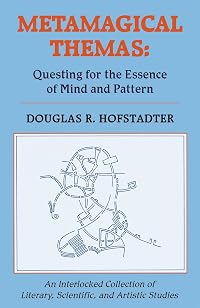
Each section opens with a simplified example of what Hofstadter calls “Whirly Art” - a personal creative diversion he has practiced for years in secret. It consists of drawing an image on ticker-tape to reflect an imaginary fugue, or canon. This endlessly fascinating man's closet is filled with these things and they need to somehow be published. I would be first in line for the inevitable 5 foot long coffee table book.
Obviously, I have barely touched on the magic that appears between these covers. Be assured that if you enjoyed GEB, you will enjoy this – but if you have not read that masterpiece, you should do so before reading this book.
Keylawk's review below, "Hofstadter cheerfully extrapolates a gloomy prognosis for human kind because of irrational greed", seems to me to be patently unfair for several reasons:
1. Hofstadter restricts discussion of nuclear war to approx 30 pages of the 800 page book
2. The discussion involves Prisoner's Dilemma, statistics, and cognitive science topics addressed throughout the book
3. Hofstadter is overly optimistic throughout the book, and the only time he is "gloomy" is when real world experiments with the Prisoner's Dilemma contradict his optimistic outlook
4. Any residual gloominess can be excused by the fact that this was written in the early to mid eighties, the height of the Cold War, when nuclear war was a fear that was shared by most rational people. show less
This is a collection of Hofstadter's Scientific American articles, published between 1981 and 1983, with an additional seven essays. Each piece comes complete with an newly-published postscript of considerable length.
Topics covered by these essays include: self-reference, self-replication (memes), games (Nomic, number games), skepticism, understanding large numbers, gender in language, chopin, parquet deformations, nonsense, the nature of creativity, typefaces, show more rubik's cube, strange attractors and turbulence, recursiveness in programming (LISP), Heisenberg's Uncertainty Principle, molecular biology, the Prisoner's Dilemma, nuclear war, Turing, and artificial intelligence as it pertains to Turing Tests, creativity, analogy, free will, perception, and pattern recognition. Throughout it all, puzzles, paradox, strange ideas, deep thoughts, and weird concepts are shared.
Hofstadter consistently presents complex ideas in a manner that any intelligent layperson can grasp. Of the 33 chapters, only one deeply mathematical section passed into the zone of inscrutability for me. Most of the time, a careful reading of his clear and precise prose leads you through these complex thoughts gracefully.
Each section opens with a simplified example of what Hofstadter calls “Whirly Art” - a personal creative diversion he has practiced for years in secret. It consists of drawing an image on ticker-tape to reflect an imaginary fugue, or canon. This endlessly fascinating man's closet is filled with these things and they need to somehow be published. I would be first in line for the inevitable 5 foot long coffee table book.
Obviously, I have barely touched on the magic that appears between these covers. Be assured that if you enjoyed GEB, you will enjoy this – but if you have not read that masterpiece, you should do so before reading this book.
Keylawk's review below, "Hofstadter cheerfully extrapolates a gloomy prognosis for human kind because of irrational greed", seems to me to be patently unfair for several reasons:
1. Hofstadter restricts discussion of nuclear war to approx 30 pages of the 800 page book
2. The discussion involves Prisoner's Dilemma, statistics, and cognitive science topics addressed throughout the book
3. Hofstadter is overly optimistic throughout the book, and the only time he is "gloomy" is when real world experiments with the Prisoner's Dilemma contradict his optimistic outlook
4. Any residual gloominess can be excused by the fact that this was written in the early to mid eighties, the height of the Cold War, when nuclear war was a fear that was shared by most rational people. show less
A supreme joy. I can dip into this book anytime, and gain something from what I read (even if I can't entirely grasp it).
"The Tale of Happiton" is one of the best pieces regarding nuclear disarmament I have read.
"The Tale of Happiton" is one of the best pieces regarding nuclear disarmament I have read.
Not as good as Hofstedter's incomparable "Goedel Escher Bach", with which there is slight overlap. A few essays (for example, the Rubik's Cube one) did not much interest me, but there is plenty here for everyone. Very worthwhile and highly recommended for both general reader and scientist.
Members
- Recently Added By
Lists

Mind Expanding Books by hackerkid
581 works; 8 members

Books With the Most Memorable Titles
478 works; 158 members
Author Information

29+ Works 23,037 Members
Douglas Hofstadter is College of Arts and Sciences Professor of Cognitive Science at Indiana University
Some Editions
Awards and Honors
Distinctions
Common Knowledge
- Canonical title
- Metamagical Themas: Questing for the Essence of Mind and Pattern
- Original publication date
- 1985
- People/Characters
- Alan Turing
- Dedication
- To Bloomington,
for all the times we shared. - First words
- The drawing on the cover is a somewhat atypical example of a non-representational form of art I devised and developed over a period of years quite a long time ago and which my sister Laura once rather light-heartedly dubbed "... (show all)Whirly Art".
- Last words
- (Click to show. Warning: May contain spoilers.)To preserve that sacred and beautiful facet from the menace created by the profane and awful facet is worth every effort we can muster, drawing on the power of the many subselves and inner voices that resonate within us and make us what we are.
- Blurbers
- Bernstein, Leonard; Gardner, Martin; Dennett, Daniel C.; Smullyan, Raymond
Classifications
Statistics
- Members
- 2,669
- Popularity
- 6,974
- Reviews
- 17
- Rating
- (4.08)
- Languages
- 6 — Danish, Dutch, English, French, German, Japanese
- Media
- Paper, Ebook
- ISBNs
- 16
- ASINs
- 8