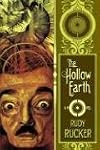
The Hollow Earth
by Rudy Rucker
On This Page
Description
In 1836, Mason Algiers Reynolds leaves his family's Virginia farm with his father's slave, a dog, and a mule. Branded a murderer, he finds sanctuary with his hero, Edgar Allan Poe, and together they embark on an expedition to the South Pole. It is there where strange people, and stranger creatures abound, that their bizarre adventures truly begin.Tags
Recommendations














Member Recommendations

Member Reviews
Having read Rucker's Postsingular about a month ago, I can say that this book really surprised me. It's difficult to see that the same author wrote both books. The Hollow Earth is so much more cohesive, and some of the science behind the ideas presented is actually explained in the accompanying "Editor's Note." The writing style is completely different.
I really enjoyed The Hollow Earth, and not just because I love anything dealing with the theory of Symmes' Hole. The premise of the novel - Edgar Allan Poe and friends travel through the South Pole into the hollow earth, an idea explored in several of Poe's works, but with some twists - is fascinating. Some of the characterizations are almost purposefully poor, to the point where they're show more hilarious. Poe is one of the flattest characters; he seems to have been made as wacky and unbalanced as possible. The number of people who die gruesome deaths, soon thereafter treated rather nonchalantly, also adds an odd surrealism to a book that otherwise successfully mimics the style of classic sci-fi adventure stories. It's a strange book, but much in keeping with the ideas and novels from which it draws its inspiration. show less
I really enjoyed The Hollow Earth, and not just because I love anything dealing with the theory of Symmes' Hole. The premise of the novel - Edgar Allan Poe and friends travel through the South Pole into the hollow earth, an idea explored in several of Poe's works, but with some twists - is fascinating. Some of the characterizations are almost purposefully poor, to the point where they're show more hilarious. Poe is one of the flattest characters; he seems to have been made as wacky and unbalanced as possible. The number of people who die gruesome deaths, soon thereafter treated rather nonchalantly, also adds an odd surrealism to a book that otherwise successfully mimics the style of classic sci-fi adventure stories. It's a strange book, but much in keeping with the ideas and novels from which it draws its inspiration. show less
Bought this because Rucker. ‘Twas a silly tale, but it was redeemed by the historical tie in. A beach read, but not the best Rucker nor the best acid-dropping fantasy, though there were some elements reminiscent of Niven's Integral Trees.
Mason Reynold narrates this rather odd tale involving a slave named Otha, a dog named Arf, and the arrogant and not-so-famous Edgar (Eddie) Allan Poe. Mason leaves his family farm, becomes accused of theivery and murder, and then meets Eddie Poe when he takes refuge in a town downriver. Eddie Poe is not the famous writer we know, but a struggling writer, alcoholic, and all around strange and detestable human being.
But it is Eddie's interest in a theory that the Earth is actually hollow that drives the main thread of the story as Mason becomes wrapped up in the fascination and follows Eddie and others into the twisted and strange hollow earth.
This is just about one of the weirdest stories that I have ever read, that touches upon rather show more uncomfortable subjects (like sex with corpses) and delves into various oddities. It is mostly this version of POe that offers the most discomfort and the everyday world before they enter the hollow earth. Once inside the story takes on a more surreal tone while managing to seem relatively plausible (for a book filled with shrimp-like pig things, flower people, and god-like sea cucumbers). I didn't know what to make of it while reading it, and I still don't know what to make of it. It certainly got more and more interesting as it went along, so I think I liked it. show less
But it is Eddie's interest in a theory that the Earth is actually hollow that drives the main thread of the story as Mason becomes wrapped up in the fascination and follows Eddie and others into the twisted and strange hollow earth.
This is just about one of the weirdest stories that I have ever read, that touches upon rather show more uncomfortable subjects (like sex with corpses) and delves into various oddities. It is mostly this version of POe that offers the most discomfort and the everyday world before they enter the hollow earth. Once inside the story takes on a more surreal tone while managing to seem relatively plausible (for a book filled with shrimp-like pig things, flower people, and god-like sea cucumbers). I didn't know what to make of it while reading it, and I still don't know what to make of it. It certainly got more and more interesting as it went along, so I think I liked it. show less
Bought this because Rucker. ‘Twas a silly tale, but it was redeemed by the historical tie in. A beach read, but not the best Rucker nor the best acid-dropping fantasy, though there were some elements reminiscent of Niven's Integral Trees.
My reactions to reading this novel in 2005.
I didn’t care for this novel very much.
First off, I’ve never been keen on the lost race/primitive alien culture story which is what you get when the narrator and Edgar Allan Poe reach the Hollow Earth.
Second, I was bored by all the details of that Hollow Earth. I didn’t even bother to follow all the details of the central Anomaly and Mirror Earths. Rucker’s afterword says it is a description of an Einstein-Rosen bridge which is also mentioned in Rucker’s non-fiction The Fourth Dimension.
The only thing I really liked about the book was its description of the alternate Poe as a con-artist and counterfeiter and how bits of Poe and his language (particularly “Berenice” and The show more Narrative of Arthur Gordon Pym) are worked in to Rucker’s story. show less
I didn’t care for this novel very much.
First off, I’ve never been keen on the lost race/primitive alien culture story which is what you get when the narrator and Edgar Allan Poe reach the Hollow Earth.
Second, I was bored by all the details of that Hollow Earth. I didn’t even bother to follow all the details of the central Anomaly and Mirror Earths. Rucker’s afterword says it is a description of an Einstein-Rosen bridge which is also mentioned in Rucker’s non-fiction The Fourth Dimension.
The only thing I really liked about the book was its description of the alternate Poe as a con-artist and counterfeiter and how bits of Poe and his language (particularly “Berenice” and The show more Narrative of Arthur Gordon Pym) are worked in to Rucker’s story. show less
Ratings
Members
- Recently Added By
Author Information

158+ Works 10,533 Members
Rudy Rucker is a mathematician, computer scientist, professor, and writer who has twice won the Philip K. Dick Award for best SF paperback original, and has published a number of successful popular books on mathematical subjects, including The Fourth Dimension and Infinity and the Mind. He lives in Los Gatos, California.
Some Editions
Work Relationships
Is contained in
Common Knowledge
- Original publication date
- 1990
- People/Characters
- Mason Algiers Reynolds; Edgar Allan Poe; Otha; Arf; Seela
- First words
- I went to Poe’s funeral yesterday.
- Last words
- (Click to show. Warning: May contain spoilers.)It’s too bad this MirrorEarth doesn’t have a hole down there, because if it did, I think I’d be tempted to go back inside, back to the wonderful Hollow Earth.
Classifications
Statistics
- Members
- 254
- Popularity
- 127,716
- Reviews
- 5
- Rating
- (3.33)
- Languages
- English, German
- Media
- Paper, Ebook
- ISBNs
- 8
- ASINs
- 2