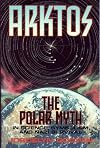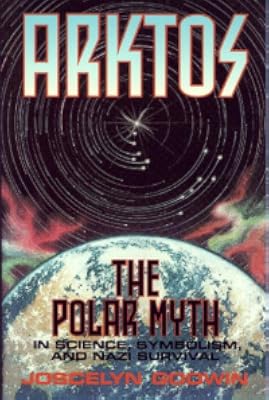
Arktos: The Polar Myth in Science, Symbolism, and Nazi Survival
by Joscelyn Godwin
On This Page
Description
Arktos is the first book ever written on the archetype of the Poles: celestial and terrestrial, North and South. This engrossing and sometimes hair-raising voyage through cosmology, occultism and conspiracy theory leads to startling revelations about the secrets of the Poles.Tags
Recommendations






















Member Recommendations

Member Reviews
Although published by Adventures Unlimited which tends not to be, shall we say, conventional in its authors (who cover conspiracy, lost worlds, free energy and what-have-you), Arktos is a serious and interesting account of polar mythology in popular culture, in the history of science and in esoteric lore.
Joscelyn Goodwin provides an intelligent and often wry overview that remains well within scholarly standards. It is a valuable addition to that shelf in the library that is dominated by the work of Goodrick Clark and it is a useful guide to the fringe science and theosophical speculation of a world now lost.
Given its hysterical conclusion in the exploits of educationally challenged SS officers and demented neo-Nazi diplomats, it is a show more world that we hope will never return. Hyperborea, Agartha, Thule, Shambhala, the Hollow Earth - these are names to conjure with in pulp science fiction, which is where they belong and should remain. show less
Joscelyn Goodwin provides an intelligent and often wry overview that remains well within scholarly standards. It is a valuable addition to that shelf in the library that is dominated by the work of Goodrick Clark and it is a useful guide to the fringe science and theosophical speculation of a world now lost.
Given its hysterical conclusion in the exploits of educationally challenged SS officers and demented neo-Nazi diplomats, it is a show more world that we hope will never return. Hyperborea, Agartha, Thule, Shambhala, the Hollow Earth - these are names to conjure with in pulp science fiction, which is where they belong and should remain. show less
Well, this was a disappointment. I'd been led to expect a scholarly overview of "polar mythology", but it turns out Godwin is a credulous esotericist himself. For example, noting that Blavatsky's and Guénon's accounts of prehistory contradict one another and that both rely on unidentified sources, his instinct is to try and reconcile them. Which is darkly amusing in a way, but it's not something I'd bought if I'd known what I was getting.
Arktos is an encyclopedic look at a fairly obscure topic: the prevalence of Hyperborean creation tales in modern occult and fascist literature. Godwin is even-handed in relating the links and legacies of this strange and singular concept.
Ratings
Members
- Recently Added By
Author Information

36+ Works 2,166 Members
Joscelyn Godwin is Professor of Music at Colgate University. He has written many books on music, mysticism, and Western esoteric traditions.
Common Knowledge
- Canonical title
- Arktos: The Polar Myth in Science, Symbolism, and Nazi Survival
- Original publication date
- 1993
- Important places
- Hyperborea; Shambala; Agartha; Antarctica
- First words
- As one could see from the simplest globe,the earth does not sit erect in its orbit around the sun but tilts at an awkward angle of about 23 1/2 degrees.
- Last words
- (Click to show. Warning: May contain spoilers.)In one sense, it is much to large to worry about; yet in another sense, even that would be but a twist on the spiral path that leads every creature eventually to Arcadia.
- Blurbers
- Michell, John; Goodrick-Clark, Nicholas; Kinney, Jay
Classifications
- Genres
- Nonfiction, Religion & Spirituality, History, General Nonfiction
- DDC/MDS
- 155 — Philosophy & psychology Psychology Differential and developmental psychology
- LCC
- BL2670 — Philosophy, Psychology and Religion Religions. Mythology. Rationalism Religions. Mythology. Rationalism History and principles of religions Arctic regions
- BISAC
Statistics
- Members
- 196
- Popularity
- 168,052
- Reviews
- 3
- Rating
- (3.26)
- Languages
- 5 — English, French, German, Italian, Spanish
- Media
- Paper
- ISBNs
- 10
- ASINs
- 1