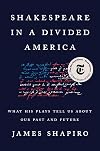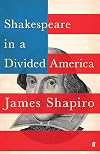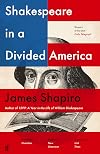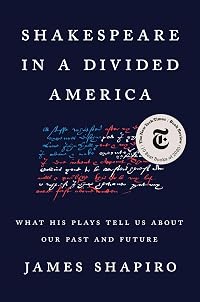
Shakespeare in a Divided America: What His Plays Tell Us About Our Past and Future
by James Shapiro
On This Page
Description
"From leading Shakespeare scholar James Shapiro, a timely and insightful examination of what the world's greatest dramatist can teach us about life in an America riven by conflict. The United States has always been divided, but Americans from all walks of life have also always shared a deep affinity for the plays William Shakespeare, even if their meaning has been fiercely contested. For well over two centuries now, Americans of all stripes--presidents and activists, writers and show more soldiers--have turned to his plays to prosecute the most intense and pivotal quarrels in the soul of the nation, a nation defined by its political and social pluralism. That prosecution dates back to pre-Revolutionary times, when Hamlet's famous soliloquy--"To be or not to be"--was appropriated both by defenders of British rule and those seeking to overthrow it. Shapiro traces Shakespeare's formative and crucial role in our nation's history, from the otherwise progressive John Quincy Adams's sinister opinions on race expressed via (and only via) his views on Othello; to the politically-charged rhetoric that gripped Lincoln's assassin, John Wilkes Booth; to the resounding American triumph of Shakespeare in Love, produced by Harvey Weinstein's then fledgling company, Miramax, which exploded a debate about adultery at the time of President Clinton's Oval Office affair with Monica Lewinsky. But Shapiro also reports firsthand on Shakespeare's undeniable contemporary significance, after a production of Julius Caesar, which depicted the assassination of a President Trump-like Julius Caesar, was exploited calculatedly by Breitbart and Fox News to ignite outrage. With style and unmatched expertise, Shapiro contends brilliantly that few writers or artists can shed as much light on the hot-button issues of American life--such as immigration, same-sex love, political violence, and class warfare--and that by better understanding the role of Shakespeare's plays in American history we might take steps towards mending our bitterly divided land"-- show lessTags
Recommendations













Member Reviews
Shapiro, James. Shakespeare in a Divided America. Penguin Press, 2020.
It is unusual for a work of stage history to make the New York Times top ten must read list, but one can see why Shakespeare in a Divided America made the list this year. Shapiro frames this cultural history of Shakespearean productions in America with a discussion of a right-wing protest of a recent production of Julius Caesar in which a Donald Trump lookalike played Caesar. He pairs that with a deadly 1849 riot at the opening of the Astor Opera House in Manhattan in which nativist working men broke up a production of Macbeth by a famous English actor. Throughout our history, Shapiro argues, Americans have used and abused the plays of Shakespeare to highlight all our show more cultural flashpoints: immigration, slavery and racism, political assassination, and gender roles. Here are some tidbits that I enjoyed. In the 19th century, Romeo was often played by women because macho leading men could not handle the lyricism in the part. Abigail Adams and John Quincey Adams were shocked by Desdemona’s sexual attraction to Othello. In The Tempest, Caliban was often used to reinforce racial stereotypes. John Wilkes Booth saw himself as a modern Brutus assassinating a tyrant Lincoln and could not understand why even Southern papers saw him as a villain rather than a self-sacrificing hero. The Taming of the Shrew had a revival after World War II, when there was pressure on working women to return to their duties as homemakers. Early drafts of Shakespeare in Love show the problems that the screenwriters and producers had with gender performance. Could Shakespeare kiss a cross-dressing Viola? Shapiro concludes that although we are seeing more culturally diverse performances these days, plays like Julius Caesar can still become embroiled in our politics. Recommended for anyone with even a passing interest in Shakespeare or in cultural criticism. show less
It is unusual for a work of stage history to make the New York Times top ten must read list, but one can see why Shakespeare in a Divided America made the list this year. Shapiro frames this cultural history of Shakespearean productions in America with a discussion of a right-wing protest of a recent production of Julius Caesar in which a Donald Trump lookalike played Caesar. He pairs that with a deadly 1849 riot at the opening of the Astor Opera House in Manhattan in which nativist working men broke up a production of Macbeth by a famous English actor. Throughout our history, Shapiro argues, Americans have used and abused the plays of Shakespeare to highlight all our show more cultural flashpoints: immigration, slavery and racism, political assassination, and gender roles. Here are some tidbits that I enjoyed. In the 19th century, Romeo was often played by women because macho leading men could not handle the lyricism in the part. Abigail Adams and John Quincey Adams were shocked by Desdemona’s sexual attraction to Othello. In The Tempest, Caliban was often used to reinforce racial stereotypes. John Wilkes Booth saw himself as a modern Brutus assassinating a tyrant Lincoln and could not understand why even Southern papers saw him as a villain rather than a self-sacrificing hero. The Taming of the Shrew had a revival after World War II, when there was pressure on working women to return to their duties as homemakers. Early drafts of Shakespeare in Love show the problems that the screenwriters and producers had with gender performance. Could Shakespeare kiss a cross-dressing Viola? Shapiro concludes that although we are seeing more culturally diverse performances these days, plays like Julius Caesar can still become embroiled in our politics. Recommended for anyone with even a passing interest in Shakespeare or in cultural criticism. show less
Shakespeare in a Divided America rewards its readers with an imaginative, creative, and informative look at several events in U.S. history, some of which are little known but all of which bear some sort of relationship to the plays of William Shakespeare. Shapiro's approach to 17th through 21st century events by relating them to Shakespearean drama is nothing short of inspirational. The temptation to apply the adjective unique to this book is nearly overpowering, but that word is overused to the extent of losing its significance in contemporary American English, and I would not belittle Shapiro's creation by applying what has become an inexact descriptor to it. Suffice it to say that I have never encountered any other book with such an show more innovative approach as this one.
One need not be a Shakespearean scholar to appreciate Shapiro's approach, nor need one be steeped in U.S. history to enjoy (and learn something from) this book. In fact, the less one knows, the more he or she may learn while enjoying the story—if one may use that word to describe nonfictional history. The reader will also pick up quite a few fascinating bits and pieces relating to censorship, differing artistic interpretations, and varying stagings of some of the plays. There is something in this book for everyone: dramaturgists, historians, political aficionados, and general readers just out to enjoy a romp in a well-composed literary field.
Did you know about the Astor Place riots in 1849 New York? Riots in which mobs overwhelmed police, attacked an opera house, committed arson at a nearby large, occupied hotel, and were finally beaten back by state militia, leaving twenty of their number lying shot dead in the city streets? Macbeth was being performed in the opera house.
Pretty much everyone who has graduated from public elementary school in the United States recognizes the name of John Wilkes Booth, but how many can name the play in which he acted not long before that history-changing night in the presidential box at Ford's Theater? Remember the assassination scene in Julius Caesar?
The chapter on miscegenation (a relatively new word replacing the predecessor term amalgamation) brings to light a great deal of angst, misgivings, castings and recastings that accompanied the staging of Othello. John Quincy Adams (to become the president in 1825) had some pithy remarks about that play that just never find their way into public school textbooks—but the reader will find them in Shapiro's book!
The Tempest and the character of Caliban figure strongly throughout the chapter on “Immigration.” Racial purity, prejudice, literacy tests, religion, sexual orientation, and nationalities were all weaponized by the U.S. to protect its “Protestant Anglo Saxon character.” After all, we wouldn't want any Caliban-type degenerates becoming American citizens or polluting our inherent Angle Saxon purity!
Romeo and Juliet and Taming of the Shrew have their places in the chapters on Manifest Destiny and on marriage. As You Like it and Twelfth Night and others appear now and again. However, concluding that Shapiro deals only with the more or less far distant past of the United States would be an error. The final chapter brings back Julius Caesar, this time in reference to the production staged at the Delacorte Theater in Central Park, New York City in 2017. Believing that the play was aimed at their newly enthroned idol, Donald Trump, right-wing extremists deluged everyone from the producer's children to the actors with the foulest of insults and death threats. During one performance, one right-wing “plant” began shouting aspersions, but his poor elocution did afford Shapiro the chance to put some laugh-out-loud levity in his book. Allow me to quote from page 215:
“[He] started shouting, 'You are all Nazis like Joseph Goebbels, you are all Goebbels....' Like many of those who heard him, I was confused, because it sounded like he was saying, 'You are all gerbils.' It was a very strange moment, as playgoers turned to each other, asking, 'gerbils?'”
Now, far be it from me to laud a book without picking a few nits here and there, so here come my two most severe criticisms of Shakespeare in a Divided America. First, ignore the subtitle of the book, “What His Plays Tell Us about Our Past and Future.” That part may promise just a bit more than the book delivers—but it's still a great read. Second, once the peritext (acknowledgments, bibliographical essays, and index) is removed, the book is a mere 221 pages long—and I wish the text had continued for that many more pages!
In a nutshell, Shapiro has written a fascinating look at a number of formative events in U.S. history, linking them rather intriguingly with popular Shakespearean dramatic productions and giving his readers “backstage peeks” at both the events and the plays. The book is worth not only the time one expends on its reading but on a second reading as well—making this one of the few books that go back into my “to be read again” stack. show less
One need not be a Shakespearean scholar to appreciate Shapiro's approach, nor need one be steeped in U.S. history to enjoy (and learn something from) this book. In fact, the less one knows, the more he or she may learn while enjoying the story—if one may use that word to describe nonfictional history. The reader will also pick up quite a few fascinating bits and pieces relating to censorship, differing artistic interpretations, and varying stagings of some of the plays. There is something in this book for everyone: dramaturgists, historians, political aficionados, and general readers just out to enjoy a romp in a well-composed literary field.
Did you know about the Astor Place riots in 1849 New York? Riots in which mobs overwhelmed police, attacked an opera house, committed arson at a nearby large, occupied hotel, and were finally beaten back by state militia, leaving twenty of their number lying shot dead in the city streets? Macbeth was being performed in the opera house.
Pretty much everyone who has graduated from public elementary school in the United States recognizes the name of John Wilkes Booth, but how many can name the play in which he acted not long before that history-changing night in the presidential box at Ford's Theater? Remember the assassination scene in Julius Caesar?
The chapter on miscegenation (a relatively new word replacing the predecessor term amalgamation) brings to light a great deal of angst, misgivings, castings and recastings that accompanied the staging of Othello. John Quincy Adams (to become the president in 1825) had some pithy remarks about that play that just never find their way into public school textbooks—but the reader will find them in Shapiro's book!
The Tempest and the character of Caliban figure strongly throughout the chapter on “Immigration.” Racial purity, prejudice, literacy tests, religion, sexual orientation, and nationalities were all weaponized by the U.S. to protect its “Protestant Anglo Saxon character.” After all, we wouldn't want any Caliban-type degenerates becoming American citizens or polluting our inherent Angle Saxon purity!
Romeo and Juliet and Taming of the Shrew have their places in the chapters on Manifest Destiny and on marriage. As You Like it and Twelfth Night and others appear now and again. However, concluding that Shapiro deals only with the more or less far distant past of the United States would be an error. The final chapter brings back Julius Caesar, this time in reference to the production staged at the Delacorte Theater in Central Park, New York City in 2017. Believing that the play was aimed at their newly enthroned idol, Donald Trump, right-wing extremists deluged everyone from the producer's children to the actors with the foulest of insults and death threats. During one performance, one right-wing “plant” began shouting aspersions, but his poor elocution did afford Shapiro the chance to put some laugh-out-loud levity in his book. Allow me to quote from page 215:
“[He] started shouting, 'You are all Nazis like Joseph Goebbels, you are all Goebbels....' Like many of those who heard him, I was confused, because it sounded like he was saying, 'You are all gerbils.' It was a very strange moment, as playgoers turned to each other, asking, 'gerbils?'”
Now, far be it from me to laud a book without picking a few nits here and there, so here come my two most severe criticisms of Shakespeare in a Divided America. First, ignore the subtitle of the book, “What His Plays Tell Us about Our Past and Future.” That part may promise just a bit more than the book delivers—but it's still a great read. Second, once the peritext (acknowledgments, bibliographical essays, and index) is removed, the book is a mere 221 pages long—and I wish the text had continued for that many more pages!
In a nutshell, Shapiro has written a fascinating look at a number of formative events in U.S. history, linking them rather intriguingly with popular Shakespearean dramatic productions and giving his readers “backstage peeks” at both the events and the plays. The book is worth not only the time one expends on its reading but on a second reading as well—making this one of the few books that go back into my “to be read again” stack. show less
There is no question this will be one of my top reads of 2021, and I can enthusiastically recommend it to anyone with an interest in both Shakespeare and American history. Actually, those who are interested only in Shakespeare or only in American history would probably each also find plenty to appreciate here.
In this book James Shapiro, a highly regarded Shakespeare scholar, explores the role of the bard's plays at eight points in American history as either a reflection of the then-current culture, or an influencer of that culture. His approach generally involves highlighting a dichotomy in how the plays, and in some cases the actors, are viewed from opposing social or political perspectives.
Shapiro's research is meticulous, whether he show more is analyzing documents from J. Q. Adams' college years, the 19th century actor Charlotte Cushman playing Romeo, or anecdotes involving Harvey Weinstein. Although I was familiar with the background against which he sets most of his discussions, I was completely unaware of the Astor Place riots in New York which resulted in the largest number of civilian casualties as a result of military action up to that point in the U.S. And it was triggered by competing productions of Macbeth!
Sadly, his concluding chapter, which covers the right-wing reaction to the NYC Public Theater's 2016 production of Julius Caesar, left me completely unnerved. Shapiro's analysis deftly highlights the inability to control fake news in the age of social media, and ends with the observation that it is not impossible that American culture of this century could mirror the English in the 17th century, when a vibrant artistic/theatrical scene was supplanted a few decades later by the beheading of a king and the ascendancy of the puritanical Oliver Cromwell. It would be nice to think it couldn't happen here - but based on this year's politics, I'm not so sure. show less
In this book James Shapiro, a highly regarded Shakespeare scholar, explores the role of the bard's plays at eight points in American history as either a reflection of the then-current culture, or an influencer of that culture. His approach generally involves highlighting a dichotomy in how the plays, and in some cases the actors, are viewed from opposing social or political perspectives.
Shapiro's research is meticulous, whether he show more is analyzing documents from J. Q. Adams' college years, the 19th century actor Charlotte Cushman playing Romeo, or anecdotes involving Harvey Weinstein. Although I was familiar with the background against which he sets most of his discussions, I was completely unaware of the Astor Place riots in New York which resulted in the largest number of civilian casualties as a result of military action up to that point in the U.S. And it was triggered by competing productions of Macbeth!
Sadly, his concluding chapter, which covers the right-wing reaction to the NYC Public Theater's 2016 production of Julius Caesar, left me completely unnerved. Shapiro's analysis deftly highlights the inability to control fake news in the age of social media, and ends with the observation that it is not impossible that American culture of this century could mirror the English in the 17th century, when a vibrant artistic/theatrical scene was supplanted a few decades later by the beheading of a king and the ascendancy of the puritanical Oliver Cromwell. It would be nice to think it couldn't happen here - but based on this year's politics, I'm not so sure. show less
Noted Shakespearean writer Shapiro focuses on eight historical events between 1833 and 2017 that have connections to Shakespeares plays as a way to discuss attitudes around elitism, race, immigration, sexuality, media manipulation, and more.
It’s an interesting read from a historical perspective, as well as illuminating how the Bard’s work is often adopted and interpreted by parties on both sides of an argument. But it’s also a sobering read as the obvious conclusion is that we haven’t really learned anything about how to function as a society over the last few centuries.
It’s an interesting read from a historical perspective, as well as illuminating how the Bard’s work is often adopted and interpreted by parties on both sides of an argument. But it’s also a sobering read as the obvious conclusion is that we haven’t really learned anything about how to function as a society over the last few centuries.
Interesting,only heard the abridged radio version, which was good but mostly the modern eras, from the two other excellent reviews already written by others who have read the actual book it's clear that it's more balanced in full.
Close readings of specific productions/films, including Shakespeare in Love and the Trump-evoking Julius Caesar that triggered right-wing outrage in recent years.
Ratings
Members
- Recently Added By
Lists

Phi Beta Kappa reading list
260 works; 8 members
Author Information

10+ Works 4,012 Members
Awards and Honors
Awards
Distinctions
Common Knowledge
- People/Characters
- William Shakespeare
Classifications
Statistics
- Members
- 358
- Popularity
- 88,525
- Reviews
- 6
- Rating
- (4.17)
- Languages
- English
- Media
- Paper, Audiobook, Ebook
- ISBNs
- 10
- ASINs
- 2