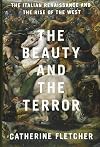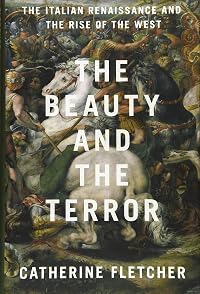
The Beauty and the Terror: An Alternative History of the Italian Renaissance
by Catherine Fletcher
On This Page
Description
"The Italian Renaissance shaped western culture--but it was far stranger and darker than many of us realise. We revere Leonardo da Vinci for his art but few now appreciate his ingenious designs for weaponry. We know the Mona Lisa for her smile but not that she was married to a slave-trader. We visit Florence to see Michelangelo's David but hear nothing of the massacre that forced the republic's surrender. In focusing on the Medici in Florence and the Borgias in Rome, we miss the vital show more importance of the Genoese and Neapolitans, the courts of Urbino and Mantua. Rarely do we hear of the women writers, Jewish merchants, the mercenaries, engineers, prostitutes, farmers and citizens who lived the Renaissance every day. In fact, many of the most celebrated artists and thinkers that have come to define the Renaissance--Leonardo and Michelangelo, Raphael and Titian, Machiavelli and Castiglione--emerged not during the celebrated 'rebirth' of the fifteenth century but amidst the death and destruction of the sixteenth century. For decades, a series of savage wars dominated Italy's political, economic and daily life, generating fortunes and new technologies, but also ravaging populations with famine, disease and slaughter. In this same short time, the birth of Protestantism, Spain's colonisation of the Americas and the rise of the Ottoman Empire all posed grave threats to Italian power, while sparking debates about the ethics of government and enslavement, religious belief and sexual morality. In 'The Beauty and the Terror,' Catherine Fletcher provides an enrapturing narrative history that brings all of this and more into view. Brimming with life, it takes us closer than ever before to the lived reality of this astonishing era and its meaning for today"-- show lessTags
Recommendations




















Member Reviews
That I gave this book a chance was mostly on the strength of the Fletcher's performance with her life and times of Alessandro de Medici. However, while this book is not lacking in virtue, I do have some issues with it, starting with the title. If truth in advertising was in effect, it would be called "Early Modern Italy: Cultural Efflorescence and Political Decline," as this is basically just a history of the so-called "Italian Wars," as the Italian peninsula became a cockpit for the Valois-Hapsburg dynastic conflict, and the Italian city-states became marginalized by the initial rise of the nation-state.
This is a reasonably good study so far as it goes, but whether Fletcher really achieves her goal of putting the players in the Italy show more of the time in proper relation to each other for the general reader is another question; I can see this work being too indigestible for that. Though it would probably make a good college undergrad textbook. I will say that what Fletcher does well is to incorporate the conflicts of religious practice and authority of the time into her general study; Martin Luther and various Catholic popes are as important in this narrative as any artist or king. show less
This is a reasonably good study so far as it goes, but whether Fletcher really achieves her goal of putting the players in the Italy show more of the time in proper relation to each other for the general reader is another question; I can see this work being too indigestible for that. Though it would probably make a good college undergrad textbook. I will say that what Fletcher does well is to incorporate the conflicts of religious practice and authority of the time into her general study; Martin Luther and various Catholic popes are as important in this narrative as any artist or king. show less
Ratings
Members
- Recently Added By
Lists

Library Non-Fiction
164 works; 1 member
Author Information

7 Works 494 Members
Awards and Honors
Awards
Distinctions
The Guardian Book of the Day (2020-03-12)
Common Knowledge
- Canonical title
- The Beauty and the Terror: An Alternative History of the Italian Renaissance
- People/Characters
- Charles VIII, King of France; Leonardo da Vinci; Michelangelo Buonarroti; Charles V, Holy Roman Emperor; Clement VII, Pope
Classifications
- Genres
- History, Nonfiction, Art & Design, General Nonfiction
- DDC/MDS
- 709.4509031 — Arts & recreation Arts History, geographic treatment, biography Europe Italy, Malta, San Marino, & Vatican City
- LCC
- DG540 .F55 — History of Europe, Asia, Africa and Oceania City History of Italy Medieval and modern Italy, 476- History By period Modern, 1492- 16th-18th centuries
- BISAC
Statistics
- Members
- 172
- Popularity
- 190,561
- Reviews
- 1
- Rating
- (4.00)
- Languages
- English, Spanish
- Media
- Paper, Audiobook, Ebook
- ISBNs
- 8
- ASINs
- 3