On This Page
Description
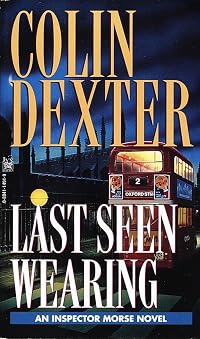
Morse was beset by a nagging feeling. Most of his fanciful notions about the Taylor girl had evaporated and he had begun to suspect that further investigation into Valerie's disappearance would involve little more than sober and tedious routine. The statements before Inspector Morse appeared to confirm the bald, simple truth. After leaving home to return to school, teenager Valerie Taylor had completely vanished, and the trail had gone cold. Until two years, three months and two days after show more Valerie's disappearance, somebody decides to supply some surprising new evidence for the case. show lessTags
Recommendations




Member Reviews
Second Morse. I had read Colin Dexter in the days when his novels were new. After years of TV adaptations of Morse,then Lewis and Endeavor, I thought it time to reread the books to see if my recollection of Dexter's Morse were different from the TV dramas. Last Seen Wearing is a monumental fuck-up on Morse's part. Asked to resolve a missing person case after the lead detective is killed in an automobile accident, Morse starts off with the erroneous assumption the the woman is dead.Lewis is the methodical fact checker, Morse takes flying leaps - this time into fantasyland. While trying to resolve this case, an related murder is committed.He puts the puzzle together just in time to let the missing woman (and murderer) disappear again. And show more he is already drinking too much. show less
I enjoyed this, the second Inspector Morse novel, even a little more than the first. Dexter has a gift for setting several scenarios and suspects in motion, which gives ample room for his protagonist’s equally prodigious gift for getting it wrong time and time again. It was interesting to see how the television adaptation upscaled many of the locales and characters compared to the book. What remains inexplicable to me is the appeal Morse seems to exercise on attractive young women. But the book is, after all, a mystery.
I suspect that this might have scored a five, had it not been for the television series of, 'Morse'. The book is, as I am already beginning to expect from Colin Dexter, excellently written and the plot twists and turns with admirable regularity. It is so well crafted that, despite, as aforementioned, having seen a television version of the story, I was convinced with twenty pages left, that the denouement had been changed from the book!
The novel Morse is much easier to understand as a character than the televised version: he makes mistakes, swears and does the football pools. Whilst I thoroughly enjoyed the character created for the small screen, it was difficult to understand why this paragon of detective skills with the intellect and show more breeding of an Oxford don was still a relatively humble chief inspector.
Since hitting on the amazingly novel (pardon the pun) idea of reading the books in order, it is fascinating to watch the development of the character and the relationship between Morse and his Watson, Lewis. It is too soon to expound upon this yet, however. show less
The novel Morse is much easier to understand as a character than the televised version: he makes mistakes, swears and does the football pools. Whilst I thoroughly enjoyed the character created for the small screen, it was difficult to understand why this paragon of detective skills with the intellect and show more breeding of an Oxford don was still a relatively humble chief inspector.
Since hitting on the amazingly novel (pardon the pun) idea of reading the books in order, it is fascinating to watch the development of the character and the relationship between Morse and his Watson, Lewis. It is too soon to expound upon this yet, however. show less
i enjoy irascible inspector morse with the best of 'em .. his drinking and moroseness and erudite ways ... but truth be told i own this volume solely for the quotation that begins Chapter Eight ... [dexter tends to do this .. draw from the world of letters and politics for quotes that set up his chapters or maybe just give him a chuckle]
source: Harry V. Wade ["American columnist" and my maternal grandfather ..]
"Gypsy Rose Lee, the strip-tease artist, has arrived in Hollywood with twelve empty trunks".
Gotta love the quip. And the squib. oh right .. and gotta love a good mystery.
source: Harry V. Wade ["American columnist" and my maternal grandfather ..]
"Gypsy Rose Lee, the strip-tease artist, has arrived in Hollywood with twelve empty trunks".
Gotta love the quip. And the squib. oh right .. and gotta love a good mystery.
A man who likes his pints, a total hornball (without even being suave or attractive to women like James Bond), and far from a Sherlock Holmes leaping from wrong conclusion to wrong conclusion (and thinking he’s wrong even when he’s right). Inspector Morse is a great character because he’s so fallibly human. There sure is a lot of sleaziness in Oxford too.
“He musn’t jump to conclusions though. But why the hell not? There was no eleventh commandment against jumping to conclusions, and so he jumped.” (p. 17)
“He musn’t jump to conclusions though. But why the hell not? There was no eleventh commandment against jumping to conclusions, and so he jumped.” (p. 17)
Valerie Taylor went missing 2 years ago. When what purports to be a letter from her arrives, Morse is assigned to re-open the cold case and if possible find her.
Lewis gets increasingly exasperated as Morse leaps from conclusion to conclusion based on little or no evidence. I knew how he felt. It does rather give the impression that Morse eventually stumbles across the truth by sheer chance rather than any powers of ratiocination.
Lewis gets increasingly exasperated as Morse leaps from conclusion to conclusion based on little or no evidence. I knew how he felt. It does rather give the impression that Morse eventually stumbles across the truth by sheer chance rather than any powers of ratiocination.
I remain firmly convinced that Dexter would have lapsed into obscurity without the far superior TV adaptations. The Morse of this book is a disagreeable, slightly pervy middle aged man with a crossword obsession - much less appealing to the predominately female fan base of the detective genre than John Thaw's tortured romantic. Positives about the book are its depiction of a rather broader and more realistic Oxford (comprehensives and rubbish dumps didn't feature in the TV adaptation of this one!) and its deft plotting, largely translated without change to the screen.
Members
- Recently Added By
Lists

The Guardian's 1000 Novels Everyone Must Read
1,005 works; 550 members

British Mystery
469 works; 13 members

Books Read in 2014
2,343 works; 89 members

Books Read in 2012
816 works; 34 members
Tozai Mystery Best 100 | The Top 100 Mystery Novels
111 works; 3 members
Author Information

124+ Works 18,831 Members
Norman Colin Dexter was born in Stamford, Lincolnshire, England on September 29, 1930. He received a bachelor's degree in classics in 1953 and a master's degree in 1958 at from Christ's College, Cambridge University. He taught classics for many years, but growing deafness forced him to retire in 1966. For the next two decades, he was the senior show more assistant secretary at the Oxford Delegacy of Local Examinations. He retired in 1988 to become a full-time writer. He was best known for creating the character Chief Inspector Morse. The Inspector Morse series began in 1975 with Last Bus to Woodstock and ended in 1999 with The Remorseful Day. The books were adapted into the television series Inspector Morse, which ran from 1987 to 2000. Dexter won the British Crime Writers' Gold Dagger Award for The Wench is Dead in 1989 and again in 1992 for The Way Through the Woods. He received the organization's lifetime achievement award, the Diamond Dagger, in 1997. He also wrote Cracking Cryptic Crosswords: A Guide to Solving Cryptic Crosswords in 2010. He died on March 21, 2017 at the age of 86. (Bowker Author Biography) show less
Awards and Honors
Notable Lists
Series

Belongs to Publisher Series
Den svarte serie (163)
Work Relationships
Is contained in
Has the adaptation
Is abridged in
Common Knowledge
- Canonical title
- Last Seen Wearing
- Original title
- Last Seen Wearing
- Original publication date
- 1976
- People/Characters
- Inspector Morse; Sergeant Lewis
- Important places
- Oxford, Oxfordshire, England, UK; Oxfordshire, England, UK
- Related movies
- Inspector Morse: Last Seen Wearing (1988 | IMDb)
- Dedication
- For J.C.F.P. and J.G.F.P.
- First words
- He felt quite pleased with himself.
- Last words
- (Click to show. Warning: May contain spoilers.)Some of them never did come home...never.
- Original language
- English
Classifications
Statistics
- Members
- 1,309
- Popularity
- 18,479
- Reviews
- 35
- Rating
- (3.68)
- Languages
- 15 — Chinese, Czech, Danish, Dutch, English, Estonian, Finnish, French, German, Italian, Japanese, Norwegian (Bokmål), Norwegian, Spanish, Swedish
- Media
- Paper, Audiobook, Ebook
- ISBNs
- 57
- UPCs
- 2
- ASINs
- 17