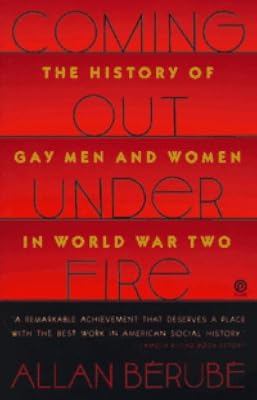
Coming out under fire
by Allan Bérubé
On This Page
Description
During World War II, as the United States called on its citizens to serve in unprecedented numbers, the presence of gay Americans in the armed forces increasingly conflicted with the expanding antihomosexual policies and procedures of the military. In Coming Out Under Fire, Allan Berube examines in depth and detail these social and political confrontation--not as a story of how the military victimized homosexuals, but as a story of how a dynamic power relationship developed between gay show more citizens and their government, transforming them both. Drawing on GIs' wartime letters, extensive interviews with gay veterans, and declassified military documents, Berube thoughtfully constructs a startling history of the two wars gay military men and women fough--one for America and another as homosexuals within the military. Berube's book, the inspiration for the 1995 Peabody Award-winning documentary film of the same name, has become a classic since it was published in 1990, just three years prior to the controversial "don't ask, don't tell" policy, which has continued to serve as an uneasy compromise between gays and the military. With a new foreword by historians John D'Emilio and Estelle B. Freedman, this book remains a valuable contribution to the history of World War II, as well as to the ongoing debate regarding the role of gays in the U.S. military. show lessTags
Recommendations






















Member Reviews
I've been researching a historical fiction novel about queer men and women in WWII for some time now, and from the preface, I knew this is the book I was looking for.
Incredibly broad but detailed in its scope, Berube delivers such a meaningful social history. At times, while reading, I felt his voice peeking through the writing, above the academic rigour, above the research to make a point all his own. Some would criticise this, but I liked it because it demonstrated to me how much this book meant to him.
What made this book stand out from the others was its consistent use of first person accounts and interviews. Berube constantly brought LGBTIQA people to the forefront of his book, quoted them and their life stories. I think this show more really added depth and power to the queer experience and gave his book credibility in a way that facts could not.
You read the text and are constantly reminded that someone, many people lived this experience. Queer people fought in a war only to find that their own military, their own country, did not consider them people, but sexual psychopaths, deviants and perverts.
And yet we persevered, says Berube, with an all-knowing wink the audience. And yet we survived.
The author gives us an alternate history, reveals how queer people had an affect on popular culture, how we transformed the military, how the military's oppressive policies only united us, literally and figuratively, to fight back, to write ourselves into history.
This book is so nuanced without being complicated.
It is compassionate. It is full of spirit.
It is a triumph. show less
Incredibly broad but detailed in its scope, Berube delivers such a meaningful social history. At times, while reading, I felt his voice peeking through the writing, above the academic rigour, above the research to make a point all his own. Some would criticise this, but I liked it because it demonstrated to me how much this book meant to him.
What made this book stand out from the others was its consistent use of first person accounts and interviews. Berube constantly brought LGBTIQA people to the forefront of his book, quoted them and their life stories. I think this show more really added depth and power to the queer experience and gave his book credibility in a way that facts could not.
You read the text and are constantly reminded that someone, many people lived this experience. Queer people fought in a war only to find that their own military, their own country, did not consider them people, but sexual psychopaths, deviants and perverts.
And yet we persevered, says Berube, with an all-knowing wink the audience. And yet we survived.
The author gives us an alternate history, reveals how queer people had an affect on popular culture, how we transformed the military, how the military's oppressive policies only united us, literally and figuratively, to fight back, to write ourselves into history.
This book is so nuanced without being complicated.
It is compassionate. It is full of spirit.
It is a triumph. show less
What I found most fascinating about this book is how the military's anti-gay policy was almost like a self fulfilling prophecy. Before cracking down on gays, it seems like they lived a relatively normal existence within the military, and it wasn't until they were stigmatized and forced to remain wholly within the closet that problems such as homophobia, stress and morale came into play. It's also pitiful how little has been done to change military policy since WWII. DADT isn't much of an improvent. Although I am opposed to all war, I believe that if we're still going to keep having them, all people (gay, straight, male or female) should be allowed to fight in them.
Hoo boy. I want to start this off by first acknowledging the important work Berube did in this book; this book was definitely groundbreaking when it was published, and importantly, legitimized the service of gay and lesbian veterans of World War II. Berube's work here also served a materially political purpose, which is something that many academics cannot say.
That being said, if you, like me, are suspicious at best of the citizen-soldier construct, this book can be difficult to get through. I found myself drowning in homo-nationalism so frequently that I had to put the book aside for weeks at a time. (You'll notice it took me ~six months to finish it, and that wasn't just because grad school got in the way.) The introduction to show more Berube's My Desire for History gives some context for his need to honor these veterans this way, but it still was difficult to grapple with as a reader who might have appreciated a little more nuanced look into the service of these individuals.
The best parts of the book for me were those centering around lesbian women in the military--they were mostly free from the horrifying culture of masculinity that Berube described with gay men serving, and so I enjoyed them much more. I will, as always in books like this, point out that though Berube pays lip service to bisexual and transgender people in the text, their actual appearances are minimal at best (which is to say that some of the folks interviewed or talked about might have identified as bisexual, though Berube is not explicit in identifying any,) and, in the case of transgender people in particular, are wholly absent (which is really interesting, given the rich history of particularly transgender people serving in the military.) Though I understand that wasn't Berube's intention per se, I am going to note it for potential readers. show less
That being said, if you, like me, are suspicious at best of the citizen-soldier construct, this book can be difficult to get through. I found myself drowning in homo-nationalism so frequently that I had to put the book aside for weeks at a time. (You'll notice it took me ~six months to finish it, and that wasn't just because grad school got in the way.) The introduction to show more Berube's My Desire for History gives some context for his need to honor these veterans this way, but it still was difficult to grapple with as a reader who might have appreciated a little more nuanced look into the service of these individuals.
The best parts of the book for me were those centering around lesbian women in the military--they were mostly free from the horrifying culture of masculinity that Berube described with gay men serving, and so I enjoyed them much more. I will, as always in books like this, point out that though Berube pays lip service to bisexual and transgender people in the text, their actual appearances are minimal at best (which is to say that some of the folks interviewed or talked about might have identified as bisexual, though Berube is not explicit in identifying any,) and, in the case of transgender people in particular, are wholly absent (which is really interesting, given the rich history of particularly transgender people serving in the military.) Though I understand that wasn't Berube's intention per se, I am going to note it for potential readers. show less
During World War II, as the United States called on its citizens to serve in unprecedented numbers, the presence of gay Americans in the armed forces increasingly conflicted with the expanding anti-homosexual policies and procedures of the military. In Coming Out Under Fire, Allan Berube examines in depth and detail these social and political confrontation, as a story of how a dynamic power relationship developed between gay citizens and their government, transforming them both. Drawing on G.I’s’ wartime letters, extensive interviews with gay veterans, and declassified military documents, Berube thoughtfully constructs a startling history of the two wars fought–one for America and another with the military as it clashed with their show more own identity. show less
I found it very interesting for the historical and personal information.
My memory for the details is not great this long after reading it, but I was persuaded, as the author intended, that more respect should have been given to those who served honorably and were treated badly; and that the primary effect of gathering up the gay troops to discharge them had the unintended consequence of letting them know how large a group they were.
My memory for the details is not great this long after reading it, but I was persuaded, as the author intended, that more respect should have been given to those who served honorably and were treated badly; and that the primary effect of gathering up the gay troops to discharge them had the unintended consequence of letting them know how large a group they were.
Review by Elaine Taylor May points out that Berube's is a pioneering work in the social history of gays in World War II. He finds that the experience of WWII was both that of increased surveillance and of a greater solidarity as a gay subculture developed in the military during wartime. In a time when the military needed manpower, the services were ambivalent about what to do about gays in the military. As military's psychiatrists sought to discover the gay personality type, new ways of dealing with gay servicemen included the "queer stockade" and "blue discharges" (less than honorable discharge) as well as rehabilitation for return to duty. A minority of these psychiatrists did not feel that homosexuality affected battlefield show more performance. The fact that the military did not allow women in combat zones meant that those who entertained the troops returned to the age old convention of men playing the parts of women. Developing a drag performance style designated as "camping," the gay servicemen claimed their own cultural space. Berube also recounts the battlefield performance of gay men, which included many acts of heroism. The period of tolerance in the immediate post-war period quickly yielded to homophobic witch hunts in the cold war.
Among the more interesting sections of this book is the one that deals with medicine's treatment of homosexuality. In "Pioneer Experts: Psychiatrists Discover the Gay GI," he describes the research undertaken by military psychiatrists to better diagnose homosexuality in men. They began by working on tests that determined if a serviceman had a gag reflex, which they assumed disappeared in gay men who had performed frequent oral sex on other men. They moved on to studies which categorized the personality characteristics of gay men -- effeminacy, superiority and fear. One main objective of this work was to weed out true homosexuals from straight men who used homosexuality as an excuse to get out of the military. Though this was not as common as it would be later in Vietnam, malingering was still seen as a problem by military officers. Berube's account also explains how the compassion of many psychiatrists led them to purposefully "misdiagnose" the patient, rather than put "homosexual" on the medical record they made up other diagnoses like "psychoneurosis" to protect the patient. In one of the ironies of history, the first challenge to the military's anti-gay policies was launched by a group of psychiatrists reporting to LTC Lewis H. Loeser at the 36th station hospital in Devonshire, UK. Their research, documented by 450 case histories argued that homosexuality did not make men less capable soldiers and urged the Army to abandon discrimination against homosexuals in the military. show less
Among the more interesting sections of this book is the one that deals with medicine's treatment of homosexuality. In "Pioneer Experts: Psychiatrists Discover the Gay GI," he describes the research undertaken by military psychiatrists to better diagnose homosexuality in men. They began by working on tests that determined if a serviceman had a gag reflex, which they assumed disappeared in gay men who had performed frequent oral sex on other men. They moved on to studies which categorized the personality characteristics of gay men -- effeminacy, superiority and fear. One main objective of this work was to weed out true homosexuals from straight men who used homosexuality as an excuse to get out of the military. Though this was not as common as it would be later in Vietnam, malingering was still seen as a problem by military officers. Berube's account also explains how the compassion of many psychiatrists led them to purposefully "misdiagnose" the patient, rather than put "homosexual" on the medical record they made up other diagnoses like "psychoneurosis" to protect the patient. In one of the ironies of history, the first challenge to the military's anti-gay policies was launched by a group of psychiatrists reporting to LTC Lewis H. Loeser at the 36th station hospital in Devonshire, UK. Their research, documented by 450 case histories argued that homosexuality did not make men less capable soldiers and urged the Army to abandon discrimination against homosexuals in the military. show less
This book is exhaustively thorough, which is good in a history book exploring new territory, especially when access to the participants is disappearing as they age and die. However, it makes for a choppy, sometimes repetitive read. If you want the details, read the book. If you just want the overall gist, see the movie instead.
Members
- Recently Added By
Lists

Books about World War II
241 works; 22 members

University Presses
155 works; 1 member
Author Information

9+ Works 572 Members
Awards and Honors
Awards
Work Relationships
Has the adaptation
Common Knowledge
- Canonical title
- Coming out under fire
- Original publication date
- 1990
- Important events
- World War II
- Related movies
- Coming Out Under Fire (1994 | IMDb)
- Dedication
- For Brian
Classifications
- Genres
- Nonfiction, LGBTQ+, History, General Nonfiction, Sexuality and Gender Studies, Biography & Memoir
- DDC/MDS
- 940.54 — History & geography History of Europe History of Europe 1918- Military history of World War II
- LCC
- D769.2 .B46 — History of Europe, Asia, Africa and Oceania History (General) World War II (1939-1945)
- BISAC
Statistics
- Members
- 530
- Popularity
- 56,387
- Reviews
- 9
- Rating
- (4.22)
- Languages
- English, Spanish
- Media
- Paper, Ebook
- ISBNs
- 7
- ASINs
- 5