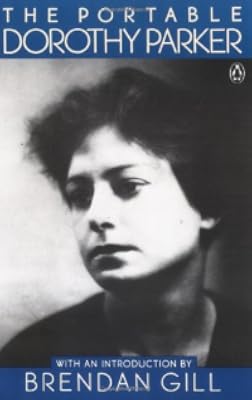
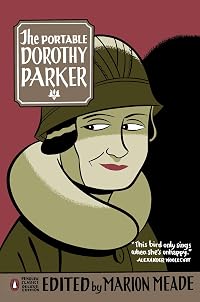
The Portable Dorothy Parker [1973 Deluxe Edition]
by Dorothy Parker
On This Page
Description
One of the most quotable of twentieth-century authors, Dorothy Parker has attained a wide-ranging and enthusiastic following. This revised and enlarged edition, with an introduction by Brendan Gill, comprises the original 1944 Portable, as selected and arranged by Dorothy Parker herself and including all her most celebrated poems and stories, along with a selection of her later stories, play reviews, articles, book reviews from Esquire, and the complete Constant Reader, her collected New show more Yorker book reviews. - Back cover. show lessTags
Recommendations






Member Reviews
Famous for her one-liners/zingers, Parker is typically referred to as a "wit" which always conjures up for me some sort of light-hearted banter setting up for some ultimate punchline*.
This definitely was not the case for Parker's short stories which are more like domestic psychological thrillers, be it the toxic relationships buoyed along by societal expectations (her shrewd insight into such tumultuous relationships reminds me of Yates and makes me wonder how personal a research she must have conducted) or a racist-and-don't-know-it at a house party.
Add to this Parker's ability to present to you one side of a character's story (some stories are literally just one person's side of the conversation) yet show you the entire intricate show more minefield of relationships in the narrative. Each story is an exercise in holding your breath and slowly shuddering and exhaling at the end.
*which I found was the case for the poems which didn't grab me as much as the stories did. I also found her cultural reviews dated less accessible, it feels necessary to be in that cultural zeitgeist while reading them. For the stories alone, the collection would be five stars. show less
This definitely was not the case for Parker's short stories which are more like domestic psychological thrillers, be it the toxic relationships buoyed along by societal expectations (her shrewd insight into such tumultuous relationships reminds me of Yates and makes me wonder how personal a research she must have conducted) or a racist-and-don't-know-it at a house party.
Add to this Parker's ability to present to you one side of a character's story (some stories are literally just one person's side of the conversation) yet show you the entire intricate show more minefield of relationships in the narrative. Each story is an exercise in holding your breath and slowly shuddering and exhaling at the end.
*which I found was the case for the poems which didn't grab me as much as the stories did. I also found her cultural reviews dated less accessible, it feels necessary to be in that cultural zeitgeist while reading them. For the stories alone, the collection would be five stars. show less
Once upon a time I had this idea that one should read a book from start to finish, and if one was being particularly through that included the preface and any appendix. However that technique has often left me hanging in one part of a book (really wishing that I was reading another part, farther in) - and if it's a book of collected stories and poems, it's not really vital that you go in order.
I've also begun reading this book more than once and ended up hopping about and only reading bits and pieces. So this time through - and I do intended to finish the whole of it this time (yes, really) - I went straight for the part I was most interested: the reviews of plays and books and other articles. I only wish there were more of these show more because Parker is such fun as a reviewer. More than once I've read a bit and laughed in agreement. Such as:
And that nicely sums up why I could never finish The Brothers Karamazov - I made the mistake of putting it down for a day and when I tried to pick it up again I was lost and unable to figure out who was who. I probably would have had to keep a cheat sheet of names to properly keep track, and so gave up and moved on to other books.
Here's a later review, to give you another idea of why I turned to these first. Here Parker confesses to be "a confirmed user of Whodunits":
The Parker who writes poetry and short stories almost seems a different person. Reading too many of those pieces makes me feel somewhat depressed - or at least feeling a bit too full of the angst of love and loss, or of really horrible people who seem to pop up regularly in her short stories. I'd enjoy her writing more if I could read it all in chronological order and have the reviews and essays as relief. But I do understand the why of the ordering - the first section is how Parker herself grouped her works, and the later was added after her death.
At least if you read all her reviews last you'll be left with the more lively person who's just shared her thoughts on a play or book. That's the Parker I think I like most.
_________________________
[Here I go off on a tangent. Just noting.] When looking up the word mandragora, wikipedia helpfully pushed me over to the page on mandrake - which seems fair because it probably wasn't the demon or the band. Anyway. Under in pop culture this caught my eye:
"...Not poppy, nor mandragora,
Nor all the drowsy syrups of the world,
Shall ever medicine thee to that sweet sleep
Which thou owedst yesterday."
Shakespeare: Othello III.iii
Parker was wonderfully well read, so I can't think this is a coincidence. But that's just my guess, seeing that the use of mandragora probably doesn't pop up all that often. Now of course I should go reread Othello and see about the context of that quote. show less
I've also begun reading this book more than once and ended up hopping about and only reading bits and pieces. So this time through - and I do intended to finish the whole of it this time (yes, really) - I went straight for the part I was most interested: the reviews of plays and books and other articles. I only wish there were more of these show more because Parker is such fun as a reviewer. More than once I've read a bit and laughed in agreement. Such as:
p. 420 "...There's only one thing I could wish about the whole play - I do wish they would do something about those Russian names. Owing to the local Russian custom of calling each person sometimes by all of his names, sometimes by only his first three or four, and sometimes by a nickname which has nothing to do with any of the other names, it is difficult for one with my congenital lowness of brow to gather exactly whom they are talking about. I do wish that as long as they are translating the thing, they would go right ahead, while they're at it, and translate Fedor Vasilyevich Protosov and Sergei Dmitrievich Abreskov and Ivan Petrovich Alexandrov into Joe and Harry and Fred."
--Vanity Fair review of Tolstoy's play Redemption, December 1918
And that nicely sums up why I could never finish The Brothers Karamazov - I made the mistake of putting it down for a day and when I tried to pick it up again I was lost and unable to figure out who was who. I probably would have had to keep a cheat sheet of names to properly keep track, and so gave up and moved on to other books.
Here's a later review, to give you another idea of why I turned to these first. Here Parker confesses to be "a confirmed user of Whodunits":
p. 568 "To me, the raveled sleeve of care is never more painlessly knitted up than in an evening alone in a chair snug yet copious, with a good light and an easily held little volume sloppily printed and bound in inexpensive paper. I do not ask much of it - which is just as well, for that is all I get. It does not matter if I guess the killer, and if I happen to discover, along around page 208, that I have read the work before, I attribute the fact not to the less than arresting powers of the author, but to my own lazy memory. I like best to have one book in my hand, and a stack of others on the floor beside me, so as to know the supply of poppy and mandragora will not run out before the small hours. In all reverence I say Heaven bless the Whodunit, the soothing balm on the wound, the cooling hand on the brow, the opiate of the people."
--Book review Of Ellery Queen: The New York Murders, from Esquire, January 1959
The Parker who writes poetry and short stories almost seems a different person. Reading too many of those pieces makes me feel somewhat depressed - or at least feeling a bit too full of the angst of love and loss, or of really horrible people who seem to pop up regularly in her short stories. I'd enjoy her writing more if I could read it all in chronological order and have the reviews and essays as relief. But I do understand the why of the ordering - the first section is how Parker herself grouped her works, and the later was added after her death.
At least if you read all her reviews last you'll be left with the more lively person who's just shared her thoughts on a play or book. That's the Parker I think I like most.
_________________________
[Here I go off on a tangent. Just noting.] When looking up the word mandragora, wikipedia helpfully pushed me over to the page on mandrake - which seems fair because it probably wasn't the demon or the band. Anyway. Under in pop culture this caught my eye:
"...Not poppy, nor mandragora,
Nor all the drowsy syrups of the world,
Shall ever medicine thee to that sweet sleep
Which thou owedst yesterday."
Shakespeare: Othello III.iii
Parker was wonderfully well read, so I can't think this is a coincidence. But that's just my guess, seeing that the use of mandragora probably doesn't pop up all that often. Now of course I should go reread Othello and see about the context of that quote. show less
The short stories still exhibit the writing talent of Ms. Parker, ninety years or so on. The dialogue is true to my memory of how contrived a lot of the chit-chat from my parents' days was; she writes so that inflections of speech, and therefore subtle meanings, are recorded faithfully. I loved her savage wit and her sharp awareness of bad form when someone commits a social crime.
Disappointment in love is a common theme. Ms Parker writes from her own experiences at how heart-braking it is.
There is an introduction to this collection written by Brendan Gill. It is worth reading for an overall evaluation of her work.
The copious number of poems, I have not dwelt on, but the final section is a selection of her reviews of books and theatre. show more These are often sparkling efforts, full of humour and outrage at the good and the bad. show less
Disappointment in love is a common theme. Ms Parker writes from her own experiences at how heart-braking it is.
There is an introduction to this collection written by Brendan Gill. It is worth reading for an overall evaluation of her work.
The copious number of poems, I have not dwelt on, but the final section is a selection of her reviews of books and theatre. show more These are often sparkling efforts, full of humour and outrage at the good and the bad. show less
I think Parker said it best in, “There's a hell of a distance between wise-cracking and wit. Wit has truth in it; wise-cracking is simply calisthenics with words." I think I adore her writing so much because there's so much truth in her wit and the only calisthenics you experience while reading her is unabated laughter.
This book has sat on my shelves for a decade. Until now. I'm glad I read it because now I can set it free. I've heard a lot about Dorothy Parker and I had built her into a cult hero poet in my mind...but found her poetry to be quite angsty and mostly centered about heteronormative romantic drama, beginnings and endings, and it was just not the sort of thing I'm drawn to.
Dorothy Parker is one of my short story idols. Readers who prefer action over rumination may find her stories dull and forgettable, but for the people watchers and neutral cynics, her writing is the cream of the character-driven crop. I can't read too many of them at once, however, because her deadpan descriptions of less-than-perfect people are, while humorous, also pretty depressing. Four stars because the last half of this edition consists of outdated reviews instead of more wit-infused gold.
Parker displayed a keen wit and the ability to deliver short but piercing observations on American life in the early twentieth century. Her short stories amuse and yet almost always depress as well. Her poems are bitter little pills. Her book and play reviews are not to be missed. Some of her very best writing is in these under appreciated gems.
Members
- Recently Added By
Lists

Rory Gilmore Book Club
193 works; 5 members

Books We'd Want on a Desert Island
203 works; 131 members

The Complete Rory Gilmore Reading List
506 works; 5 members
Author Information

147+ Works 10,284 Members
Poet and short story writer Dorothy Parker was born in New Jersey on August 22, 1893. When she was 5, her mother died and her father, a clothes salesman, remarried. Parker had a great antipathy toward her stepmother and refused to speak to her. She attended parochial school and Miss Dana's school in Morristown, New Jersey, for a brief time before show more dropping out at age 14. A voracious reader, she decided to pursue a career in literature. She began her career by writing verse as well as captions for a fashion magazine. During the years of her greatest fame, Dorothy Parker was known primarily as a writer of light verse, an essential member of the Algonquin Round Table, and a caustic and witty critic of literature and society. She is remembered now as an almost legendary figure of the 1920s and 1930s. Her reviews and staff contributions to three of the most sophisticated magazines of this century, Vanity Fair, the New Yorker, and Esquire, were notable for their put-downs. For all her highbrow wit, however, Dorothy Parker was liberal, even radical, in her political views, and the hard veneer of brittle toughness that she showed to the world was often a shield for frustrated idealism and soft sensibilities. The best of her fiction is marked by a balance of ironic detachment and sympathetic compassion, as in "Big Blonde," which won the O. Henry Award for 1929 and is still her best-remembered and most frequently anthologized story. The best of Dorothy Parker is readily and compactly accessible in The Portable Dorothy Parker. Her own selection of stories and verse for the original edition of that compilation, published in 1944, remains intact in the revised edition, but included also are additional stories, reviews, and articles. Parker died of a heart attack at the age of 73 in 1967. In her will, she bequeathed her estate to the Dr. Martin Luther King, Jr. foundation. Following King's death, her estate was passed on to the NAACP. (Bowker Author Biography) show less
All Editions
Series
Belongs to Publisher Series
Work Relationships
Is an expanded version of
Common Knowledge
- Canonical title
- The Portable Dorothy Parker [1973 Deluxe Edition]
- Original title
- The Portable Dorothy Parker
- Alternate titles
- The Collected Dorothy Parker
- Original publication date
- 1973
- People/Characters
- Dorothy Parker
- First words
- Dorothy Parker's reputation as one of the wittiest women of the twentieth century was made on tart quotes and agile one liners. -- from the Introduction
- Last words
- (Click to show. Warning: May contain spoilers.)I promise that I will have Alan send those pictures, but I put them away in "a special place"; the rest is history. Yours, Dorothy Parker
- Blurbers
- Woollcott, Alexander
- Original language
- English US
- Canonical DDC/MDS
- 818.5209
- Canonical LCC
- PS3531.A5855
- Disambiguation notice
- Do not combine with previous or subsequent editions of Collected/Portable Dorothy Parker. Besides the first section, the contents are very different.
Classifications
Statistics
- Members
- 2,051
- Popularity
- 10,176
- Reviews
- 17
- Rating
- (4.36)
- Languages
- English
- Media
- Paper
- ISBNs
- 5
- UPCs
- 1
- ASINs
- 6