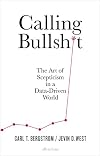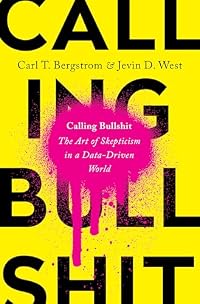
Calling Bullshit: The Art of Skepticism in a Data-Driven World
by Carl T. Bergstrom, Jevin D. West (Author)
On This Page
Description
"The world is awash in bullshit, and we're drowning in it. Politicians are unconstrained by facts. Science is conducted by press release. Startup culture elevates bullshit to high art. These days, calling bullshit is a noble act. Based on Carl Bergstrom and Jevin West's popular course at the University of Washington, Calling Bullshit is a modern handbook to the art of skepticism. Bergstrom, a computational biologist, and West, an information scientist, catalogue bullshit in its many forms, show more explaining and offering readers the tools to see through the obfuscations, deliberate and careless, that dominate every realm of our lives. They instruct readers to ask: Who is saying it? How do they know? What do they have to gain by persuading me? Are the numbers or results too good or too dramatic to be true? Is the claim comparing like with like or apples and oranges? Is it confirming your personal bias? In this lively guide to everything from misleading statistics to "fake news," Bergstrom and West help you recognize bullshit whenever and wherever you encounter it--in data, in conversation, even within yourself--and explain it to your crystal-loving aunt or casually racist uncle. Now more than ever, calling bullshit is crucial to a properly functioning community, whether it be a circle of friends, a network of academics, or the citizenry of a nation"-- show lessTags
Recommendations









Member Recommendations
Member Reviews
As Mark Twain famously quipped, 'there are lies, damned lies, and statistics'. In a world where we are all surrounded by data thrusted upon us from all sides and supposedly "to inform us", we should be cautious indeed to remember that numbers are nothing but that: numbers. Without context, they are pretty much useless. If collected following all sorts of biases, they will be meaningless apart from reinforcing already pre-existing biases (e.g. there are fascinating chapters on how algorithms and machine learning can be fertile grounds for bullshit...). More, even the way we chose to present them can seriously impact our understanding of issues!
I loved this book for a few reasons. First, because it outlines the most common fallacies show more pertaining to collecting data, interpreting them, and presenting them. We are all aware of how language can be used to manipulate an audience, but what about maths? As it turn out, data and how they are presented are no less prone to manipulating and exploiting -be it for ideological gains or out of mere ignorance. Then, because the authors are not preachy nor are they arrogant. They insist: when presented with bullshit (that they define similarly to Harry Frankfurt in his classic On Bullshit) we shouldn't assume maliciousness or stupidity. On the contrary, we are all prone to mistake and so, more often than not, bullshit with numbers should therefore be seen as being quite probably the product of incompetence (e.g. some serious bullshit peddled in some of our mass medias) or mere errors and common fallacies (e.g. where it can creep up even in medical research and/ or other scientific papers). Finally, because they are accessible in their explaining, despite the topic being, perhaps, intimidating at first (I mean, it's 300 pages+ on stats, graphs, pies and charts! It won't be fun for everyone...).
So where do we go from here? The authors rightly insist too in their concluding chapters: it's our duty, as concerned citizens, to call out bullshit when we see it. Again, it's not about being arrogant jerks calling others 'bullshitters!' for not knowing better (as they admit, they too can fall prey of fallacies despite scientific thinking being key to their jobs). It's about being warry of how data can be used to tell stories, and that these stories, if flawed because of flaws in the data sustaining them, can have a devastating impact from public health to democracy itself.
If you value critical thinking, then this book is a must read. show less
I loved this book for a few reasons. First, because it outlines the most common fallacies show more pertaining to collecting data, interpreting them, and presenting them. We are all aware of how language can be used to manipulate an audience, but what about maths? As it turn out, data and how they are presented are no less prone to manipulating and exploiting -be it for ideological gains or out of mere ignorance. Then, because the authors are not preachy nor are they arrogant. They insist: when presented with bullshit (that they define similarly to Harry Frankfurt in his classic On Bullshit) we shouldn't assume maliciousness or stupidity. On the contrary, we are all prone to mistake and so, more often than not, bullshit with numbers should therefore be seen as being quite probably the product of incompetence (e.g. some serious bullshit peddled in some of our mass medias) or mere errors and common fallacies (e.g. where it can creep up even in medical research and/ or other scientific papers). Finally, because they are accessible in their explaining, despite the topic being, perhaps, intimidating at first (I mean, it's 300 pages+ on stats, graphs, pies and charts! It won't be fun for everyone...).
So where do we go from here? The authors rightly insist too in their concluding chapters: it's our duty, as concerned citizens, to call out bullshit when we see it. Again, it's not about being arrogant jerks calling others 'bullshitters!' for not knowing better (as they admit, they too can fall prey of fallacies despite scientific thinking being key to their jobs). It's about being warry of how data can be used to tell stories, and that these stories, if flawed because of flaws in the data sustaining them, can have a devastating impact from public health to democracy itself.
If you value critical thinking, then this book is a must read. show less
Like everyone else, I believe that I can't be fooled by...anything, ever. Knowing that it's just that certainty that makes one vulnerable, I deliberately give myself little booster shots of skepticism by reading every one of these books that comes out. But despite having a longish career in medical research spent dealing with data, there's always something. These days I think my greatest vulnerability is my own experience: often I overlook the simplest grounds for calling bullshit while trying to track down that perfect point for Fisking. I don't need to look at the tables if someone is claiming to have invented cold fusion, I just have to remember the second law of thermodynamics. Vaccination denialism: do you know what the show more consequences are for being vulnerable to [inside horrible malady here]?
Booster shots. This is a good one. Like many others, the authors have feared to be dry or boring and in consequence are entertaining as hell. These guys have had a live audience to practice on so they are particularly clear, straightforward, and spot on.
Of course, the one I've read most recently is always the best...no, really, this one may be. Highly and indiscriminately recommended. We all need less bullshit to wade through, especially those of us who are reading while walking and might be more vulnerable by dint of just not paying attention.
Library copy show less
Booster shots. This is a good one. Like many others, the authors have feared to be dry or boring and in consequence are entertaining as hell. These guys have had a live audience to practice on so they are particularly clear, straightforward, and spot on.
Of course, the one I've read most recently is always the best...no, really, this one may be. Highly and indiscriminately recommended. We all need less bullshit to wade through, especially those of us who are reading while walking and might be more vulnerable by dint of just not paying attention.
Library copy show less
[3.75] Don’t let the eye-grabbing title B.S. you. If you’re expecting a lighthearted, entertaining and humorous roadmap to guide you through the cesspools of fake news, this isn’t your book. But if you’re not easily intimidated by math-driven and science-focused examples of misinformation, “Calling Bullshit” will offer many intriguing insights. I’ve red-flagged nearly 50 informational nuggets for future reference, including a dozen that will be integrated into my college-level media literacy class that pinpoints strategies for ferreting out fake news.
True, many of the book’s premises have been explored before. For example, a 4-minute video I’ve been using in my classes for years hits on some of the exact strategies show more for guarding against misinformation and disinformation. Still, Bergstrom and West serve up some excellent examples that vividly illustrate how data can be manipulated to fool unsuspecting audiences. The authors refer to a headline that screamed “Airport Security Trays Carry More Germs Than Toilets.” This fact was true, but the study only looked at respiratory viruses, the kind often transmitted through droplets on people’s hands when they cough or sneeze. Most of us don’t sneeze onto toilet seats or caress the seats with our hands.
The book offers timely perspectives on artificial intelligence as it highlights the problem of algorithm bias. “When we train machines to make decisions based on data that arise in a biased society, the machines learn and perpetuate those same biases,” write the authors.
“Calling Bullshit” also explores the dangers of confirmation bias (our tendency to notice, believe, and share information that is consistent with our preexisting beliefs) and illusory truth effect (The more often we see something, the more likely we are to believe it). Some reviewers who have described the book as “dense” aren’t spreading fake news. Had the authors spent a bit less time on statistics-focused examples and broadened their focus to include misinformation that had nothing to do with math or science, “Calling Bullshit” would have been more accessible to the general reader. Then again, the subtitle foreshadows the fact that the authors are focusing on our “data-driven world.” show less
True, many of the book’s premises have been explored before. For example, a 4-minute video I’ve been using in my classes for years hits on some of the exact strategies show more for guarding against misinformation and disinformation. Still, Bergstrom and West serve up some excellent examples that vividly illustrate how data can be manipulated to fool unsuspecting audiences. The authors refer to a headline that screamed “Airport Security Trays Carry More Germs Than Toilets.” This fact was true, but the study only looked at respiratory viruses, the kind often transmitted through droplets on people’s hands when they cough or sneeze. Most of us don’t sneeze onto toilet seats or caress the seats with our hands.
The book offers timely perspectives on artificial intelligence as it highlights the problem of algorithm bias. “When we train machines to make decisions based on data that arise in a biased society, the machines learn and perpetuate those same biases,” write the authors.
“Calling Bullshit” also explores the dangers of confirmation bias (our tendency to notice, believe, and share information that is consistent with our preexisting beliefs) and illusory truth effect (The more often we see something, the more likely we are to believe it). Some reviewers who have described the book as “dense” aren’t spreading fake news. Had the authors spent a bit less time on statistics-focused examples and broadened their focus to include misinformation that had nothing to do with math or science, “Calling Bullshit” would have been more accessible to the general reader. Then again, the subtitle foreshadows the fact that the authors are focusing on our “data-driven world.” show less
Brandolini’s law, which states that “the amount of energy needed to refute bullshit is an order of magnitude bigger than that needed to produce it,” explains why there is so much bullshit in the world. As Uriel Fanelli put it, “an idiot can create more bullshit than you could ever hope to refute.”
So creating bullshit is easy; refuting it is hard. And it is precisely this asymmetry that explains why bullshit persists and how it can even grow over time.
So how can one hope to rid the world of increasing levels of bullshit? Since it’s easier to create bullshit than to refute it, simply refuting each new instance of bullshit seems like a losing battle. The better strategy is educational; if you can inoculate enough people show more against falling for bullshit in the first place, bullshit never gains enough traction to require costly efforts at refutation.
This, in essence, is the goal of the book. The authors want to immunize you against bullshit, with a focus on the quantitative variety. While it’s relatively easy to identify old-school bullshit based on flowery language and empty rhetoric, new-school bullshit is more insidious and sophisticated with its use of statistics, charts, graphs, and scientific-sounding claims. This is the bullshit that is more persuasive, harder to refute, and ultimately more dangerous.
The authors first note that while arguments based on statistical and scientific reasoning can appear intimidating, there are basic fallacies that one can look out for that do not require any advanced mathematical ability. It is rarely necessary to look into the “black box”—the authors’ term for complex equations, algorithms, or scientific processes—when the problem with bullshit is often the data that feeds into the black box. Recognizing that the data is biased or unrepresentative of the larger population, for example, is an easy method of spotting bullshit that does not require any skills in higher mathematics.
The authors then take the reader on a tour of quantitative fallacies with several examples, all explained clearly and with humor. The reader will learn how to differentiate between correlation and causation, spot biased and unrepresentative data and small sample sizes, identify selection biases in samples, understand how data can be manipulated visually, and more. The reader will also learn how to properly evaluate scientific claims, and how the anti-vaxx movement is based on a single, thoroughly-debunked scientific study that massively confuses correlation with causation, among many other problems.
One of my favorite chapters, chapter 8, has the authors calling bullshit on arguments that claim that artificial intelligence will take over the world. This has always been bullshit and likely always will be, as the authors demonstrate the limits of how machines are designed to “think.”
The book ends with a couple summary chapters on how to spot and refute bullshit, and also on the difference between calling legitimate bullshit and becoming what the authors refer to as a “well-actually guy.” Perhaps the most important point of the book is the idea that the goal of calling bullshit is not to demonstrate your intelligence and puff up your ego; it’s to counter the spread of misinformation in the world and its direct and indirect consequences.
Overall, I suppose that if the reader has a lot of experience with informal logic and spotting fallacies—particularly of a quantitative nature—then this book might not offer anything particularly new. Although even then the book is filled with interesting, updated examples and a ton of polemical humor which makes the book a fun read. If, on the other hand, the reader has limited experience with these concepts, this book is a must read as it shows how quantitative bullshit can be spotted and refuted with even the most limited of mathematical ability. show less
So creating bullshit is easy; refuting it is hard. And it is precisely this asymmetry that explains why bullshit persists and how it can even grow over time.
So how can one hope to rid the world of increasing levels of bullshit? Since it’s easier to create bullshit than to refute it, simply refuting each new instance of bullshit seems like a losing battle. The better strategy is educational; if you can inoculate enough people show more against falling for bullshit in the first place, bullshit never gains enough traction to require costly efforts at refutation.
This, in essence, is the goal of the book. The authors want to immunize you against bullshit, with a focus on the quantitative variety. While it’s relatively easy to identify old-school bullshit based on flowery language and empty rhetoric, new-school bullshit is more insidious and sophisticated with its use of statistics, charts, graphs, and scientific-sounding claims. This is the bullshit that is more persuasive, harder to refute, and ultimately more dangerous.
The authors first note that while arguments based on statistical and scientific reasoning can appear intimidating, there are basic fallacies that one can look out for that do not require any advanced mathematical ability. It is rarely necessary to look into the “black box”—the authors’ term for complex equations, algorithms, or scientific processes—when the problem with bullshit is often the data that feeds into the black box. Recognizing that the data is biased or unrepresentative of the larger population, for example, is an easy method of spotting bullshit that does not require any skills in higher mathematics.
The authors then take the reader on a tour of quantitative fallacies with several examples, all explained clearly and with humor. The reader will learn how to differentiate between correlation and causation, spot biased and unrepresentative data and small sample sizes, identify selection biases in samples, understand how data can be manipulated visually, and more. The reader will also learn how to properly evaluate scientific claims, and how the anti-vaxx movement is based on a single, thoroughly-debunked scientific study that massively confuses correlation with causation, among many other problems.
One of my favorite chapters, chapter 8, has the authors calling bullshit on arguments that claim that artificial intelligence will take over the world. This has always been bullshit and likely always will be, as the authors demonstrate the limits of how machines are designed to “think.”
The book ends with a couple summary chapters on how to spot and refute bullshit, and also on the difference between calling legitimate bullshit and becoming what the authors refer to as a “well-actually guy.” Perhaps the most important point of the book is the idea that the goal of calling bullshit is not to demonstrate your intelligence and puff up your ego; it’s to counter the spread of misinformation in the world and its direct and indirect consequences.
Overall, I suppose that if the reader has a lot of experience with informal logic and spotting fallacies—particularly of a quantitative nature—then this book might not offer anything particularly new. Although even then the book is filled with interesting, updated examples and a ton of polemical humor which makes the book a fun read. If, on the other hand, the reader has limited experience with these concepts, this book is a must read as it shows how quantitative bullshit can be spotted and refuted with even the most limited of mathematical ability. show less
Bullshit uses linear regression…?
They say that it's absurd to claim that women will be running faster than men at some point in the future, but it's worth pointing out that in a pragmatic, real way women are already running faster than men, in the sense that for a very large percentage of men, there are women out there running faster than them. So to call that claim "bullshit" might be fun, but it's already quite inaccurate on the face of it.
In order to make the debunking mean anything, you have to be very careful about exactly what you are debunking. In this case, it sounds like it's something measurable happening among the very top runners in the world, but it's hard to say. Maybe there is some trend among the general population, show more but again, it's hard to say from the article, and it would take some careful writing to even say what that would mean. We would have to know exactly what the original claim involved, and what parts of it the debunkers were debunking. But by then the joy of the "bullshit calling" might be lost.
Unfortunately, the love of debunking, as we used to call "bullshit calling", leads to a lot of facile and inaccurate claims: enthusiastic debunking is often a form of bullshit. No stuff like that in the book.
The only way to avoid falling for the bullshit of a particular filter bubble is to conscientiously practice "bullshit diversity" (i.e., read a wide variety of outlets you know have identifiable and different ideologies).
I won't get into the specifics, but if you choose to only read conservative sites or only read liberal sites, you're being bullshitted. ...Some might argue the difference is one of degree/volume of bullshit (i.e., "Fox News is far worse than CNN."), but that perspective is actually just one of the more common and troubling symptoms of full-blown bullshititis.
Put another way, Jeff Bezos owns the Washington Post (and affiliated publications). Carlos Slim owns more of the New York Times than the Salzbergers. ATT owns CNN. Laurene Jobs owns The Atlantic. The Murdochs own Fox/NY Post/Etc. The Mercers own Breitbart. Haim Saban owns Univision. Comcast owns NBC/MSNBC. Pierre Omidyar owns The Intercept. And The Guardian--while admirably owned by the Scott Trust--lets The Rockefeller Foundation /Ford Foundation/Gates Foundation/Etc. ghostwrite articles. Which one of these billionaires/multinational corporations do you trust?
Answer: "None. Become scientifically literate."
“Calling Bullshit” is a perfect example of re-creating the wheel. Decades ago two professors wrote a book called “Logic and Contemporary Rhetoric: The Use of Reason in Everyday Life”. The book became a classic and has been used in colleges for many decades. If every college student read and learned the skills taught in this book there would be no need for this hyped bullshit book. Brene Brown in her book “Braving the Wilderness” has a chapter on Speaking Truth to Bullshit - and refers to another book written by Harry G. Frankfurt called “On Bullshit” (2005). Just saying this is not a new phenomenon. show less
They say that it's absurd to claim that women will be running faster than men at some point in the future, but it's worth pointing out that in a pragmatic, real way women are already running faster than men, in the sense that for a very large percentage of men, there are women out there running faster than them. So to call that claim "bullshit" might be fun, but it's already quite inaccurate on the face of it.
In order to make the debunking mean anything, you have to be very careful about exactly what you are debunking. In this case, it sounds like it's something measurable happening among the very top runners in the world, but it's hard to say. Maybe there is some trend among the general population, show more but again, it's hard to say from the article, and it would take some careful writing to even say what that would mean. We would have to know exactly what the original claim involved, and what parts of it the debunkers were debunking. But by then the joy of the "bullshit calling" might be lost.
Unfortunately, the love of debunking, as we used to call "bullshit calling", leads to a lot of facile and inaccurate claims: enthusiastic debunking is often a form of bullshit. No stuff like that in the book.
The only way to avoid falling for the bullshit of a particular filter bubble is to conscientiously practice "bullshit diversity" (i.e., read a wide variety of outlets you know have identifiable and different ideologies).
I won't get into the specifics, but if you choose to only read conservative sites or only read liberal sites, you're being bullshitted. ...Some might argue the difference is one of degree/volume of bullshit (i.e., "Fox News is far worse than CNN."), but that perspective is actually just one of the more common and troubling symptoms of full-blown bullshititis.
Put another way, Jeff Bezos owns the Washington Post (and affiliated publications). Carlos Slim owns more of the New York Times than the Salzbergers. ATT owns CNN. Laurene Jobs owns The Atlantic. The Murdochs own Fox/NY Post/Etc. The Mercers own Breitbart. Haim Saban owns Univision. Comcast owns NBC/MSNBC. Pierre Omidyar owns The Intercept. And The Guardian--while admirably owned by the Scott Trust--lets The Rockefeller Foundation /Ford Foundation/Gates Foundation/Etc. ghostwrite articles. Which one of these billionaires/multinational corporations do you trust?
Answer: "None. Become scientifically literate."
“Calling Bullshit” is a perfect example of re-creating the wheel. Decades ago two professors wrote a book called “Logic and Contemporary Rhetoric: The Use of Reason in Everyday Life”. The book became a classic and has been used in colleges for many decades. If every college student read and learned the skills taught in this book there would be no need for this hyped bullshit book. Brene Brown in her book “Braving the Wilderness” has a chapter on Speaking Truth to Bullshit - and refers to another book written by Harry G. Frankfurt called “On Bullshit” (2005). Just saying this is not a new phenomenon. show less
Siamo circondati da notizie false e tendenziose. Come sopravvivere?
Cosa si intende per "bullshit"? In italiano sono le cazzate, o forse meglio le stronzate, nel senso di affermazioni che non solo necessariamente false (anche se di solito lo sono), ma sono infiocchettate in modo da cercare di impressionarci o convincerci, senza preoccuparsi che siano vere o false: con un giro di parole, notizie false e tendenziose. Un esempio che portano gli autori è scrivere la recensione di un libro senza averlo letto. (Io il libro l'ho letto, ma non è questo il punto). È molto facile farlo con i numeri e le statistiche, e infatti questa è la parte principale del libro; ma lo si può fare in tanti altri modi, come per esempio i clickbait dei siti show more web di "notizie". Ma a parte tutti gli esempi portati, i due capitoli finali "accorgersi delle stronzate" e "confutare le stronzate" dovrebbero essere letti da tutti per formarsi gli anticorpi sempre più necessari in un mondo dove creare testi fasulli è diventata una banalità. show less
Cosa si intende per "bullshit"? In italiano sono le cazzate, o forse meglio le stronzate, nel senso di affermazioni che non solo necessariamente false (anche se di solito lo sono), ma sono infiocchettate in modo da cercare di impressionarci o convincerci, senza preoccuparsi che siano vere o false: con un giro di parole, notizie false e tendenziose. Un esempio che portano gli autori è scrivere la recensione di un libro senza averlo letto. (Io il libro l'ho letto, ma non è questo il punto). È molto facile farlo con i numeri e le statistiche, e infatti questa è la parte principale del libro; ma lo si può fare in tanti altri modi, come per esempio i clickbait dei siti show more web di "notizie". Ma a parte tutti gli esempi portati, i due capitoli finali "accorgersi delle stronzate" e "confutare le stronzate" dovrebbero essere letti da tutti per formarsi gli anticorpi sempre più necessari in un mondo dove creare testi fasulli è diventata una banalità. show less
This book was a mixed bag of sorts. On the one hand, the authors recognise that bullshit is high art, spread through fake news factories and hammering away at our critical facilities through volume and confirmation bias alone.
On the other hand, Calling Bullshit treats itself as high art. It contains gems such as "you must treat others with kindness because the power you've gained is tremendous, and there's no need to be too high and mighty". I could also express the book in pamphlet form for what it's worth - without losing an iota of coherency - in its current state, it simply felt bloated.
I'm afraid I have to disagree with the author's treatment of the topic - to give out one line of a rebuttal, he prefers pages of exposition. Given show more the book's title, it's ironic that I could make a strong case against the book itself as to how bullshit cloaks itself in a veneer of volume and intellect. Studies showing 'females could run faster than males in 2156' are refuted as bullshit because 'by this logic, 100-meter races could be run in negative time by 2536', and the core argument that females might run faster than males in the future is never addressed by the authors.
I could even argue that the book's climax, in which the authors show how 'well, actually...' person is different from the 'bullshit denier', is simply what the authors do all along. Well-intentioned claims that the wage pay gap exists because recommendations for women mention their communication abilities more than their intelligence are downplayed in the book just because some tweets misquoted the original study. Examples like these make for extremely frustrating reading.
This book feels like an introductory primer for tackling misinformation, which is okay for most, I guess, but not for me. show less
On the other hand, Calling Bullshit treats itself as high art. It contains gems such as "you must treat others with kindness because the power you've gained is tremendous, and there's no need to be too high and mighty". I could also express the book in pamphlet form for what it's worth - without losing an iota of coherency - in its current state, it simply felt bloated.
I'm afraid I have to disagree with the author's treatment of the topic - to give out one line of a rebuttal, he prefers pages of exposition. Given show more the book's title, it's ironic that I could make a strong case against the book itself as to how bullshit cloaks itself in a veneer of volume and intellect. Studies showing 'females could run faster than males in 2156' are refuted as bullshit because 'by this logic, 100-meter races could be run in negative time by 2536', and the core argument that females might run faster than males in the future is never addressed by the authors.
I could even argue that the book's climax, in which the authors show how 'well, actually...' person is different from the 'bullshit denier', is simply what the authors do all along. Well-intentioned claims that the wage pay gap exists because recommendations for women mention their communication abilities more than their intelligence are downplayed in the book just because some tweets misquoted the original study. Examples like these make for extremely frustrating reading.
This book feels like an introductory primer for tackling misinformation, which is okay for most, I guess, but not for me. show less
Members
- Recently Added By
Lists

Book wishlist
78 works; 1 member
Author Information

3 Works 612 Members

Common Knowledge
- Original publication date
- 2020-08-04
Classifications
- Genres
- Philosophy, General Nonfiction, Science & Nature, Nonfiction
- DDC/MDS
- 149.73 — Philosophy and Psychology Philosophical schools of thought Other philosophical systems and doctrines Agnosticism Skepticism
- LCC
- B837 .B47 — Philosophy, Psychology and Religion Philosophy (General) By period Modern Special topics and schools of philosophy
- BISAC
Statistics
- Members
- 564
- Popularity
- 52,119
- Reviews
- 16
- Rating
- (3.91)
- Languages
- Chinese, English, Spanish
- Media
- Paper, Audiobook, Ebook
- ISBNs
- 14
- ASINs
- 4