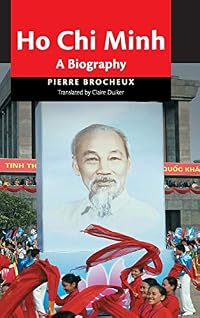
Ho Chi Minh: A Biography
by Pierre Brocheux
On This Page
Description
Ho Chi Minh is one of the towering figures of the twentieth century, considered an icon and father of the nation by many Vietnamese. Pierre Brocheux's biography of Ho Chi Minh is a brilliant feat of historical engineering. In a concise and highly readable account, he negotiates the many twists and turns of Ho Chi Minh's life and his multiple identities, from impoverished beginnings as a communist revolutionary to his founding of the Indochina Communist Party and the League for the show more Independence of Vietnam and ultimately to his leadership of the Democratic Republic of Vietnam and his death in 1969. Biographical events are adroitly placed within the broader historical canvas of colonization, decolonization, communism war, and nation building. Brocheux's vivid and convincing portrait of Ho Chi Minh goes further than any previous biography in explaining both the myth and the man, as well as the times in which he was situated. show lessTags
Recommendations



















Member Reviews
A biography of Ho Chi Minh, regarded by many as the father of his country — and a figure who also became an icon for elements of the American left during the Vietnam War — poses a problem, Pierre Brocheux announces in his preface. The biographer cites American historian Alexander Woodside, who argues against writing "another biography while certain periods of the subject's life are still obscure and questions remain about the man even today."
Surprisingly, Mr. Brocheux does not confront this epistemological issue head-on in "Ho Chi Minh" (Cambridge University Press, 288 pages, $35). It is in the nature of biography to probe what Herman Melville called "the ambiguities." It is impossible for biographers — or historians for that show more matter — to wait until all the evidence is in and verified. That never happens. There is always more evidence and, sad to say, always more data that disappear along with dying witnesses to history.
Or is Ho a special case? Mr. Brocheux seems to think so. Recently opened Soviet archives are heavily restricted, he reports, and the Chinese, he adds, are engaged in using their archives for patriotic purposes, ensuring that the available papers are "carefully screened."
Determined to heap even more difficulties on himself, Mr. Brocheux notes that Ho Chi Minh's tracks are vanishing at a "vertiginous pace" in Paris, Moscow, and Vietnam — the places Ho inhabited like a character in a John le Carré novel, changing his name from Nguyen Sinh Cung to Nguyen Tat Thanh to Nguyen Ai Quoc and finally to Ho Chi Minh. But wait! It gets worse: Ho gave four birth dates:1890, 1893, 1900, and 1903. Mr. Brocheux is much attached to 1890, noting in a footnote that Ho would have been 55 in 1945, "a suitable age to become President of the Democratic Republic of Vietnam." Okay, but is it verifiable? Apparently not.
With Mr. Woodside's doubts shadowing Ho's latest biographer, Mr. Brocheux acknowledges that five biographies in French, Russian, and English have preceded his. So why, indeed, another? The answer, Mr. Brocheux avows, is Montesquieu: "One's character is based largely on that of the people with whom one lives. … Knowledge opens the mind. … Travel also greatly expands the mind; we leave the circle of our nation's prejudices, and are hardly in a position to take on those of another."
This Enlightenment view of self and society provides a kind of grid that is meant to confine and clarify the elusive Ho's movements. Born in the Vietnamese village of Hoang Tru, a student in the imperial city of Hué, world traveler (by 1918, he has been to Paris, parts of Africa, America, and England), first a French socialist and then a communist (1918–23), and reputedly a student in Moscow (1923), Ho joined a Soviet mission in Canton (1924), returned to Moscow in 1927, and then was on the move again in Europe and Southeast Asia, founding the Vietnamese Communist Party in 1930. The British then arrested him in Hong Kong, and his death was announced in 1932, but more of the same peregrinations continue, culminating in Hanoi on September 2, 1945, when Ho declared Vietnam's independence from the French. Of course he was involved in plenty more history up to 1969 dying this time for good), six years before the communists declared Vietnam re-united in April 1975.
Like the proverbial cat, Ho's many lives have baffled biographers, Mr. Brocheux insinuates, though I wish he had engaged in more of a debate with his predecessors. It seems to me, especially in the case of someone as slick as Ho, Mr. Brocheux ought to open up a debate with biographers. Instead he hugs his Montesquieu:
Both the regional and family backgrounds of Ho Chi Minh suggest a certain geographical and sociological determinism, as well as individual destiny. Nghe An province is known as the forge of great men, from the conventional to the rebellious, and as the theater of historical events that gave birth to a tradition of heroism and sacrifice for the common good.
Ho, the biographer argues, clev erly merged this Confucian world view with communist teachings — or rather this was the line he took as a nationalist who believed he al so needed an ideology to unite his people.
But Ho was no more successful in providing his country with a co herent dogma than he was in articulating a consistent self. For all the ambiguities, Mr. Brocheux certainly provides a clear conclusion "Ho, steeped in Confucian humanism, gave into — or rather was crushed under the weight of — an implacable system that he had helped put in place through his in disputable charisma." show less
Surprisingly, Mr. Brocheux does not confront this epistemological issue head-on in "Ho Chi Minh" (Cambridge University Press, 288 pages, $35). It is in the nature of biography to probe what Herman Melville called "the ambiguities." It is impossible for biographers — or historians for that show more matter — to wait until all the evidence is in and verified. That never happens. There is always more evidence and, sad to say, always more data that disappear along with dying witnesses to history.
Or is Ho a special case? Mr. Brocheux seems to think so. Recently opened Soviet archives are heavily restricted, he reports, and the Chinese, he adds, are engaged in using their archives for patriotic purposes, ensuring that the available papers are "carefully screened."
Determined to heap even more difficulties on himself, Mr. Brocheux notes that Ho Chi Minh's tracks are vanishing at a "vertiginous pace" in Paris, Moscow, and Vietnam — the places Ho inhabited like a character in a John le Carré novel, changing his name from Nguyen Sinh Cung to Nguyen Tat Thanh to Nguyen Ai Quoc and finally to Ho Chi Minh. But wait! It gets worse: Ho gave four birth dates:1890, 1893, 1900, and 1903. Mr. Brocheux is much attached to 1890, noting in a footnote that Ho would have been 55 in 1945, "a suitable age to become President of the Democratic Republic of Vietnam." Okay, but is it verifiable? Apparently not.
With Mr. Woodside's doubts shadowing Ho's latest biographer, Mr. Brocheux acknowledges that five biographies in French, Russian, and English have preceded his. So why, indeed, another? The answer, Mr. Brocheux avows, is Montesquieu: "One's character is based largely on that of the people with whom one lives. … Knowledge opens the mind. … Travel also greatly expands the mind; we leave the circle of our nation's prejudices, and are hardly in a position to take on those of another."
This Enlightenment view of self and society provides a kind of grid that is meant to confine and clarify the elusive Ho's movements. Born in the Vietnamese village of Hoang Tru, a student in the imperial city of Hué, world traveler (by 1918, he has been to Paris, parts of Africa, America, and England), first a French socialist and then a communist (1918–23), and reputedly a student in Moscow (1923), Ho joined a Soviet mission in Canton (1924), returned to Moscow in 1927, and then was on the move again in Europe and Southeast Asia, founding the Vietnamese Communist Party in 1930. The British then arrested him in Hong Kong, and his death was announced in 1932, but more of the same peregrinations continue, culminating in Hanoi on September 2, 1945, when Ho declared Vietnam's independence from the French. Of course he was involved in plenty more history up to 1969 dying this time for good), six years before the communists declared Vietnam re-united in April 1975.
Like the proverbial cat, Ho's many lives have baffled biographers, Mr. Brocheux insinuates, though I wish he had engaged in more of a debate with his predecessors. It seems to me, especially in the case of someone as slick as Ho, Mr. Brocheux ought to open up a debate with biographers. Instead he hugs his Montesquieu:
Both the regional and family backgrounds of Ho Chi Minh suggest a certain geographical and sociological determinism, as well as individual destiny. Nghe An province is known as the forge of great men, from the conventional to the rebellious, and as the theater of historical events that gave birth to a tradition of heroism and sacrifice for the common good.
Ho, the biographer argues, clev erly merged this Confucian world view with communist teachings — or rather this was the line he took as a nationalist who believed he al so needed an ideology to unite his people.
But Ho was no more successful in providing his country with a co herent dogma than he was in articulating a consistent self. For all the ambiguities, Mr. Brocheux certainly provides a clear conclusion "Ho, steeped in Confucian humanism, gave into — or rather was crushed under the weight of — an implacable system that he had helped put in place through his in disputable charisma." show less
Ratings
Members
- Recently Added By
Author Information

Pierre Brocheux is Professor of Contemporary History at Universit Paris VII-Denis Diderot and the author of Ho Chi Mink A Biography and The Mekong Delta: Ecology, Economy, and Revolution, 1860-1960. Daniel Hmery is Professor of Contemporary History at Universit Paris VII-Denis Diderot and the author of In the Servitude of Power: Energy and show more Civilization through the Ages, among other books. show less
Some Editions
Awards and Honors
Awards
Series
Belongs to Publisher Series
Work Relationships
Is an adaptation of
Common Knowledge
- Canonical title*
- Hô Chi Minh. Du révolutionnaire à l'icône
- Original title
- Hô Chi Minh. Du révolutionnaire à l'icône
- Original publication date
- 2003-10-03 (1e édition originale française, Biographie, Payot) (1e édition originale française, Biographie, Payot)
- People/Characters
- Ho Chi Minh
- Important places
- Vietnam
- Original language*
- Français
*Some information comes from Common Knowledge in other languages. Click "Edit" for more information.
Classifications
- Genres
- History, Nonfiction, Biography & Memoir, General Nonfiction, Politics and Government, Business
- DDC/MDS
- 959.704 — History & geography History of Asia Southeast Asia: Myanmar, Thailand, Laos, Cambodia, Vietnam Vietnam 1949-
- LCC
- DS560.72 .H6 .B8313 — History of Europe, Asia, Africa and Oceania Asia History of Asia Southeast Asia French Indochina Democratic Republic (North Vietnam), 1945-
- BISAC
Statistics
- Members
- 57
- Popularity
- 536,886
- Reviews
- 1
- Rating
- (3.10)
- Languages
- Danish, English, French
- Media
- Paper
- ISBNs
- 4