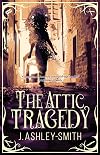
The Attic Tragedy
by J. Ashley-Smith
On This Page
Description
Sylvie never called them ghosts, but that's what they were—not that George ever saw them herself. The new girl, Sylvie, is like a creature from another time, with her old-fashioned leather satchel, her white cotton gloves and her head in the clouds. George watches her drift around the edge of the school playing fields, guided by inaudible voices. When George stands up for Sylvie, beating back Tommy Payne and his gang of thugs, it brings her close to the ethereal stranger; though not as show more close as George would have liked. In the attic of Sylvie's father's antique shop, George's scars will sing and her longing will drive them both toward a tragedy as veiled and inevitable as Sylvie's whispering ghosts. show lessTags
Recommendations


























Member Reviews
It’s been a couple of days that I finished this hot mess, and, I am sorry to say, the more time is passing, the greater my dislike of this novelette. Yes, OK, I do get that the protagonist has had some tragic experience(s), which, apart from her mother’s illness and her own unfortunate looks and general lack of popularity, are not, however, shown to the reader. Nor do we learn what Sylvie's unspecified "problem" is, except that it earns her "a note that kept her off all games" at school. The supernatural element was not at all convincing, the “ghosts” seemingly nothing but a figment of Sylvie’s imagination. It even remains unclear whether Sylvie herself believes in them or whether it's all make-believe on her part. We do not, show more of course, get a very clear image of Sylvie herself, as we get to see everything through George's eyes.
George's actions and reactions are not explained, are maybe as inexplicable to herself as to the reader: Her refusing to talk to the policewoman (who is only trying to be friendly and helpful any way she knows how) to the point of lying to her about her attackers seems brattish and uncalled-for. After a lifetime of avoiding sports she, out of the blue, starts training martial arts: "I trained because I wanted to." She does not go to uni after all when she finally could, in spite of having put in applications previous to her mother's death. As we see all of this happening through George's pov, we, no more than herself, can account for her actions, or lack thereof.
Mistaking simple acts of kindness and friendship for proofs of love is where George's tragedy begins in earnest, an obsession reminiscent of [This Sweet Sickness] makes her fashion her "love" for Sylvie into the main focus and pivoting angle of her own life and her every thought and action. Which is a very unhealthy thing to do, to say the least, and definitely very, very unfair to the (ostensibly) "loved" one.
What I think this story is lacking, to gain some merit and to make it suitable for its (supposedly) intended ya audience, is a mature counterpoint: someone or some event offering guidance to George and, eventually, helping her to move on. Sylvie's father, who is supposed to be an adult and who might just have tried to counter-act instead of aiding and abetting George on her merry way to self-destruction, even seems to develop a similar stance, echoing George's feelings for "the love of our lives that had rejected us both" - or is this, again, just George's way of looking at things? We never learn.
In particular I do not care for the glorification of self-harming, featuring “singing” scars and "singing" blades that George calls her “treasures” and the representation of "love" as putting the other one into a box, denying them the right to their own feelings and trying to mould them into something they are not, will never be and maybe have never been, "my Sylvie" existing solely in George's mind.
I would not recommend this at all to ya readers, or those suffering from any kind of mental instability. show less
George's actions and reactions are not explained, are maybe as inexplicable to herself as to the reader: Her refusing to talk to the policewoman (who is only trying to be friendly and helpful any way she knows how) to the point of lying to her about her attackers seems brattish and uncalled-for. After a lifetime of avoiding sports she, out of the blue, starts training martial arts: "I trained because I wanted to." She does not go to uni after all when she finally could, in spite of having put in applications previous to her mother's death. As we see all of this happening through George's pov, we, no more than herself, can account for her actions, or lack thereof.
Mistaking simple acts of kindness and friendship for proofs of love is where George's tragedy begins in earnest, an obsession reminiscent of [This Sweet Sickness] makes her fashion her "love" for Sylvie into the main focus and pivoting angle of her own life and her every thought and action. Which is a very unhealthy thing to do, to say the least, and definitely very, very unfair to the (ostensibly) "loved" one.
What I think this story is lacking, to gain some merit and to make it suitable for its (supposedly) intended ya audience, is a mature counterpoint: someone or some event offering guidance to George and, eventually, helping her to move on. Sylvie's father, who is supposed to be an adult and who might just have tried to counter-act instead of aiding and abetting George on her merry way to self-destruction, even seems to develop a similar stance, echoing George's feelings for "the love of our lives that had rejected us both" - or is this, again, just George's way of looking at things? We never learn.
In particular I do not care for the glorification of self-harming, featuring “singing” scars and "singing" blades that George calls her “treasures” and the representation of "love" as putting the other one into a box, denying them the right to their own feelings and trying to mould them into something they are not, will never be and maybe have never been, "my Sylvie" existing solely in George's mind.
I would not recommend this at all to ya readers, or those suffering from any kind of mental instability. show less
“Sylvie never called them ghosts, but that’s what they were” … from this opening sentence, I felt immediately drawn into this story, intrigued to discover how this apparently supernatural element would influence the story-telling. However, it quickly became clear that this was to be no traditional “ghost” story rather, it would explore how we are all shaped by our past experiences and losses, and how these continue to “whisper” to us throughout our lives. Through his exquisitely drawn characters, not just George and Sylvie but also all the peripheral ones, whose behaviour influenced how the girls’ friendship developed, and subsequently changed, the author took me on an emotionally-charged, often very disturbing show more journey. I’m reluctant to go into too much detail about this because I don’t want to spoil the wonderful subtlety and poignancy of the story-telling as it reveals the deeply-felt emotions of young women coming to terms with who they are, as well as their developing, often confusing, sexuality. I think that the shared, erotically-charged nature of the early months of George and Sylvie’s friendship, and how this changed, leaving George heart-broken and bereft, was handled with an impressive sensitivity and restraint by the author.
This emotional honesty and integrity extended to his exploration of some very dark themes, including self-harming, sexual violence, homophobia, bullying, suicidal thoughts. Although each of these was explored in a powerfully visceral way, at no point did I feel that there was anything gratuitously explicit about his portrayals – a difficult balance to achieve, but one which the author achieved in an admirably sensitive way.
The author’s characterisations were so evocative that I’m sure the voices of George and Sylvie will continue to whisper to me, ensuring that their stories will not be forgotten, instead acting as a powerful reminder of how our memories can conjure up our ghosts from the past. Sometimes these will be painful, but the good ones can offer hope, can enable us to gain strength from them and to use those insights to create a more optimistic future for ourselves. “Dear god, set me free from all the pain” a foreword quote from Aeschylus, serves as a reminder throughout the story that pain is part of living and cannot be avoided. It is particularly resonated throughout George’s story, capturing her moments of profound despair and her search for relief from her all-encompassing emotional pain. Does she achieve this? You’ll need to read the book to find out!
When I finished this book, I felt I was experiencing such an emotional-overload that I needed to take time to reflect on it before writing this review but, as I settle down now to do so, several days later, I feel I’m still reeling from the impact of this very powerful, poignant and profoundly sad story. I’m full of admiration for the author’s ability to create such multi-layered complexity within just fifty-three pages – a perfect demonstration of how the end result of less really can result in being so much more!
However, although short, this shouldn’t be seen as a fast-read because it encompasses a range of themes and emotions which encourage reflection. I recently listened to a talk by an author who spoke of how reading slowly and reflectively enables the “magic” in stories to happen in “the spaces in-between” which are thus created. J. Ashley-Smith’s eloquent prose, with not one word feeling wasted, encouraged me to constantly reflect on what I was reading and the magic did indeed happen. So, please don’t rush your reading of this story, allow time for the magic to happen for you too.
With many thanks to Meerkat Press for an ARC of this story and the opportunity to read this very special story. show less
This emotional honesty and integrity extended to his exploration of some very dark themes, including self-harming, sexual violence, homophobia, bullying, suicidal thoughts. Although each of these was explored in a powerfully visceral way, at no point did I feel that there was anything gratuitously explicit about his portrayals – a difficult balance to achieve, but one which the author achieved in an admirably sensitive way.
The author’s characterisations were so evocative that I’m sure the voices of George and Sylvie will continue to whisper to me, ensuring that their stories will not be forgotten, instead acting as a powerful reminder of how our memories can conjure up our ghosts from the past. Sometimes these will be painful, but the good ones can offer hope, can enable us to gain strength from them and to use those insights to create a more optimistic future for ourselves. “Dear god, set me free from all the pain” a foreword quote from Aeschylus, serves as a reminder throughout the story that pain is part of living and cannot be avoided. It is particularly resonated throughout George’s story, capturing her moments of profound despair and her search for relief from her all-encompassing emotional pain. Does she achieve this? You’ll need to read the book to find out!
When I finished this book, I felt I was experiencing such an emotional-overload that I needed to take time to reflect on it before writing this review but, as I settle down now to do so, several days later, I feel I’m still reeling from the impact of this very powerful, poignant and profoundly sad story. I’m full of admiration for the author’s ability to create such multi-layered complexity within just fifty-three pages – a perfect demonstration of how the end result of less really can result in being so much more!
However, although short, this shouldn’t be seen as a fast-read because it encompasses a range of themes and emotions which encourage reflection. I recently listened to a talk by an author who spoke of how reading slowly and reflectively enables the “magic” in stories to happen in “the spaces in-between” which are thus created. J. Ashley-Smith’s eloquent prose, with not one word feeling wasted, encouraged me to constantly reflect on what I was reading and the magic did indeed happen. So, please don’t rush your reading of this story, allow time for the magic to happen for you too.
With many thanks to Meerkat Press for an ARC of this story and the opportunity to read this very special story. show less
A little surprised that something this short was published on its own. Dark and nasty in a number of ways; fascinating world building, strong characterisation, beautiful writing
Beautifully written, this novella was a short and dark visit inside the mind of a young woman.
Georgina, (George), became friends with Sylvie in a rather dark antique shop. There, Sylvie shares a secret; she can tell where an object has been just by touching it. George though? George never shares her secret with Sylvie or anyone else, (at least not verbally). Why not? You'll have to read this to find out!
Right from the get-go, right from the opening line:"Sylvie never called them ghosts, but that's what they were." THE ATTIC TRAGEDY had me in its grip. This is a poignant tale about unrequited love, about feeling that you're different, that you're never a part of things, never at home, even in your own body. During your teen years, (which show more is where this book began), one is always feeling awkward and out of place to start with. Add in a few of the issues these teens were experiencing and it adds up to an almost unbearable state. Did I mention there's a supernatural aspect to this story as well? At least, I think there was...
I'm surprised at how much feeling the author was able to pack into this novella, (perhaps novelette, technically speaking). Please believe me when I say, Mr. Ashley-Smith can write. In one scene where George wants to reach out to Sylvie, there's this description:
"My fingers stretched and recoiled, daring then afraid, expanding and contracting like some skittish undersea creature; the kind of thing that dwells in shadow on the ocean floor, its hideous misshapen body an insult to nature."
So vivid, so beautiful, so easy to picture. My heart went out to both of these young women, but especially to George. I have to wonder what would have happened had things worked out differently. I do know I'll be thinking about both of them for a while.
This was my first experience with this author and I hope to read more of his work in the future!
Highly recommended!
Available today, here: https://amzn.to/30tiaRB
*Thanks to Meerkat Press for the digital copy of this book in exchange for my honest feedback. This is it!* show less
Georgina, (George), became friends with Sylvie in a rather dark antique shop. There, Sylvie shares a secret; she can tell where an object has been just by touching it. George though? George never shares her secret with Sylvie or anyone else, (at least not verbally). Why not? You'll have to read this to find out!
Right from the get-go, right from the opening line:"Sylvie never called them ghosts, but that's what they were." THE ATTIC TRAGEDY had me in its grip. This is a poignant tale about unrequited love, about feeling that you're different, that you're never a part of things, never at home, even in your own body. During your teen years, (which show more is where this book began), one is always feeling awkward and out of place to start with. Add in a few of the issues these teens were experiencing and it adds up to an almost unbearable state. Did I mention there's a supernatural aspect to this story as well? At least, I think there was...
I'm surprised at how much feeling the author was able to pack into this novella, (perhaps novelette, technically speaking). Please believe me when I say, Mr. Ashley-Smith can write. In one scene where George wants to reach out to Sylvie, there's this description:
"My fingers stretched and recoiled, daring then afraid, expanding and contracting like some skittish undersea creature; the kind of thing that dwells in shadow on the ocean floor, its hideous misshapen body an insult to nature."
So vivid, so beautiful, so easy to picture. My heart went out to both of these young women, but especially to George. I have to wonder what would have happened had things worked out differently. I do know I'll be thinking about both of them for a while.
This was my first experience with this author and I hope to read more of his work in the future!
Highly recommended!
Available today, here: https://amzn.to/30tiaRB
*Thanks to Meerkat Press for the digital copy of this book in exchange for my honest feedback. This is it!* show less
I received this novella as an electronic ARC from the publisher because I had reviewed an earlier book they had published. The Attic Tragedy had less magic (or horror) in it than I expected, but a provided a fairly deft mix of coming-of-age and coming-to-accept yourself, in which two teens cross in the midst of their journeys to find themselves. This is clearly a story with LGBTQ themes, but don’t let that knowledge pre-define it for you: The Attic Tragedy is a story of two girls fighting their individual demons while they struggle to find their paths forward in life. Their brief friendship catalyzes each search, but in very different ways. A touching, well-written piece.
This is poignant and beautifully written. A tale of identities found and lost, of emotion, inlaid with a delicious hint of something otherworldly.
I wouldn't call this a feel-good book, and there are certainly scenes that will be triggers for people, but this is a little gem of dark toned prose.
I wouldn't call this a feel-good book, and there are certainly scenes that will be triggers for people, but this is a little gem of dark toned prose.
How could you sum up a life – a whole life – with just a few words? How could you even try?
There’s a new girl in town, Sylvie, and she is not like everyone else. George (Georgina) watches her around the school, fascinated… After an unfortunate incident they become friends. But George wants more than the friendship Sylvie can offer.
In the attic of Sylvie’s father’s antique shop, between the ghosts and hidden gems of other people’s previous lives, their friendship grows. But will that be enough…
This was not the story I thought it would be, it was something much better. It is difficult to put my thoughts and feelings here to paper (or better said, screen). I have read it a month ago and still have trouble explaining other show more than to say it is a beautiful story. It is very well written and in its beauty there’s also a little sadness. However, it is a sadness that will leave you with a warm, soft feeling.
*Thanks to Meerkat Press for the digital copy of this book in exchange for my honest feedback. show less
There’s a new girl in town, Sylvie, and she is not like everyone else. George (Georgina) watches her around the school, fascinated… After an unfortunate incident they become friends. But George wants more than the friendship Sylvie can offer.
In the attic of Sylvie’s father’s antique shop, between the ghosts and hidden gems of other people’s previous lives, their friendship grows. But will that be enough…
This was not the story I thought it would be, it was something much better. It is difficult to put my thoughts and feelings here to paper (or better said, screen). I have read it a month ago and still have trouble explaining other show more than to say it is a beautiful story. It is very well written and in its beauty there’s also a little sadness. However, it is a sadness that will leave you with a warm, soft feeling.
*Thanks to Meerkat Press for the digital copy of this book in exchange for my honest feedback. show less
 This review was written for LibraryThing Early Reviewers.
Members
- Recently Added By
Lists

READ IN 2020
172 works; 1 member
Author Information
3 Works 66 Members
Some Editions
Awards and Honors
Awards
Common Knowledge
- Original publication date
- 2020-06-09
- People/Characters
- Sylvie; Georgina/George; Tommy Payne; Darren; Christophe; Tansy Rimer
- Epigraph
- Dear gods, set me free from all the pain. —Aeschylus
- Dedication
- To K, for the enduring love of stories locked in strange old things.
- First words
- Sylvie never called them ghosts, but that's what they were.
- Original language
- English
Classifications
Statistics
- Members
- 34
- Popularity
- 838,031
- Reviews
- 18
- Rating
- (3.63)
- Languages
- English
- Media
- Paper, Ebook
- ISBNs
- 2
- ASINs
- 1