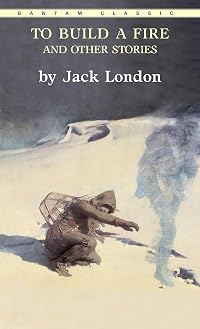
To Build a Fire and Other Stories
by Jack London
On This Page
Description
"To Build a Fire," the best-known of Jack London's many short stories, tells the tale of a solitary traveler on the Yukon Trail accompanied only by his dog as they endure the extreme cold. A classic narrative of a battle for survival against the forces of nature, "To Build a Fire" is London at his best. Also included here are "The Red One," "All Gold Canyon," "A Piece of Steak," "The Love of Life," "Flush of Gold," "The Story of Keesh," and "The Wisdom of the Trail." A vital collection of show more works by one of the greatest short-story writers in American literature, this edition is sure to delight audiences of all ages. show lessTags
Recommendations

















Member Reviews
The love of money may be the root of all evil, but it can also be the route of danger.
An unnamed man turns off the main Yukon trail as he hikes to join “the boys” at an old prospectors’ claim. It’s cold. Very cold (−75°F, which is −59°C):
“As he turned to go on, he spat speculatively. There was a sharp, explosive crackle.”
He’s alone, apart from a husky he’s never shown any affection and whose tail is “drooping discouragement”.
That’s it. A simple survival story: a linear narrative of a single day, over a handful of pages. It’s not my usual fare, but the writing is superb: immersive, realistic, with visceral details of bodily and mental sensations, and perfectly paced.
Image: “As he looked apathetically show more about him, his eyes chanced on the dog.” Illustration by Frank Schoonover (Image source)
He starts out confidently, despite the warnings of an old-timer. He’s observant, knows the danger of thin ice above bubbling springs, the risk of getting wet, and how to make fire:
“He had been out before in two cold snaps.”
When he’s cautious or spots danger, he congratulates himself, but he’s “without imagination” and “not given much to thinking”. Time and again a trivial decision is laden with foreboding and his overconfidence is contrasted with the dog’s primordial instinct for self-preservation.
“What were frosted cheeks? A bit painful, that was all; they were never serious.”
Jack London cleverly tricks the reader into a parallel form of arrogance: I felt I knew better than the prospector as I noted each stupid action or wrong choice that I assumed would lead to a doom he deserved.
Image: “He cherished the flame carefully and awkwardly. It meant life, and it must not perish.” (Image source)
Note: This is a review of the better-known 1908 version of the story, not the 1902 original that, among other differences, omits the dog.
Quotes
• “The only caresses it [the dog] had ever received were the caresses of the whip-lash and of harsh and menacing throat-sounds that threatened the whip-lash.”
• “This man did not know cold. Possibly all the generations of his ancestry had been ignorant of cold, of real cold, of cold one hundred and seven degrees below freezing-point. But the dog knew; all its ancestry knew, and it had inherited the knowledge. And it knew that it was not good to walk abroad in such fearful cold.”
• “The circulation of wet and freezing feet cannot be restored by running when it is seventy-five below. No matter how fast he runs, the wet feet will freeze the harder.”
• “He remembered the advice of the old-timer on Sulphur Creek, and smiled… Well, here he was; he had had the accident; he was alone; and he had saved himself… Any man who was a man could travel alone.”
See also
• Hans Christian Andersen’s The Little Match Girl.
• Stephen Crane’s The Open Boat is another survival tale that I read a couple of weeks before this and reviewed HERE.
• How to build a fire in the snow, on Survival World, HERE.
Short story club
I read this as one of the stories in The Art of the Short Story, by Dana Gioia, from which I'm aiming to read one story a week with The Short Story Club, starting 2 May 2022.
You can read this story here.
You can join the group here. show less
An unnamed man turns off the main Yukon trail as he hikes to join “the boys” at an old prospectors’ claim. It’s cold. Very cold (−75°F, which is −59°C):
“As he turned to go on, he spat speculatively. There was a sharp, explosive crackle.”
He’s alone, apart from a husky he’s never shown any affection and whose tail is “drooping discouragement”.
That’s it. A simple survival story: a linear narrative of a single day, over a handful of pages. It’s not my usual fare, but the writing is superb: immersive, realistic, with visceral details of bodily and mental sensations, and perfectly paced.
Image: “As he looked apathetically show more about him, his eyes chanced on the dog.” Illustration by Frank Schoonover (Image source)
He starts out confidently, despite the warnings of an old-timer. He’s observant, knows the danger of thin ice above bubbling springs, the risk of getting wet, and how to make fire:
“He had been out before in two cold snaps.”
When he’s cautious or spots danger, he congratulates himself, but he’s “without imagination” and “not given much to thinking”. Time and again a trivial decision is laden with foreboding and his overconfidence is contrasted with the dog’s primordial instinct for self-preservation.
“What were frosted cheeks? A bit painful, that was all; they were never serious.”
Jack London cleverly tricks the reader into a parallel form of arrogance: I felt I knew better than the prospector as I noted each stupid action or wrong choice that I assumed would lead to a doom he deserved.
Image: “He cherished the flame carefully and awkwardly. It meant life, and it must not perish.” (Image source)
Note: This is a review of the better-known 1908 version of the story, not the 1902 original that, among other differences, omits the dog.
Quotes
• “The only caresses it [the dog] had ever received were the caresses of the whip-lash and of harsh and menacing throat-sounds that threatened the whip-lash.”
• “This man did not know cold. Possibly all the generations of his ancestry had been ignorant of cold, of real cold, of cold one hundred and seven degrees below freezing-point. But the dog knew; all its ancestry knew, and it had inherited the knowledge. And it knew that it was not good to walk abroad in such fearful cold.”
• “The circulation of wet and freezing feet cannot be restored by running when it is seventy-five below. No matter how fast he runs, the wet feet will freeze the harder.”
• “He remembered the advice of the old-timer on Sulphur Creek, and smiled… Well, here he was; he had had the accident; he was alone; and he had saved himself… Any man who was a man could travel alone.”
See also
• Hans Christian Andersen’s The Little Match Girl.
• Stephen Crane’s The Open Boat is another survival tale that I read a couple of weeks before this and reviewed HERE.
• How to build a fire in the snow, on Survival World, HERE.
Short story club
I read this as one of the stories in The Art of the Short Story, by Dana Gioia, from which I'm aiming to read one story a week with The Short Story Club, starting 2 May 2022.
You can read this story here.
You can join the group here. show less
A fantastic short story, with no wasted pages, or even a wasted sentence. In it, London crafts a story about the arrogance of man, and the brutality of nature. His writing about Survival is superb, and it builds and builds to an inevitable climax that is both expected, and somehow shocking at the same time.
I never knew Kipling and Stevenson were his literary heroes, but it stands to reason. His writing has the same strengths and defects as theirs does: great raconteur-ism, vivid scenes, relentless, graphic gore, a tendency to turgid prose, and thumpingly condescending portraits of the non-white "others" who people his exotic landscapes (portraits that actually seem meant, in London's case, to pay them tribute). There's still something worth looking for in fiction to be found here--maybe a sense, even if a failed sense, of the mythic. How many of the "best-selling and highest paid" authors of today (whoever they are) will we say the same about in a hundred years?
A good collection of short stories from an early master of the modern American style, but none are really essential to the contemporary reader. The titular story, 'To Build a Fire', is one of the best, with a style and setting that will be familiar to those who have read Jack London's two most famous works, The Call of the Wild and White Fang. The cold bites into you.
In the Dover Thrift edition, this story is accompanied by a number of others of varying quality. None are poor but few are remarkable either. Regarding the large chunk of stories immediately following the titular opener – 'To the Man on Trail', 'The Law of Life', 'The God of His Fathers', 'All Gold Canyon', 'The Chinago', 'Mauki' and 'The Heathen' – I can take them or show more leave them. They are all rather dated, though 'All Gold Canyon' has a musty, frontiersman vibe that is still welcome.
The two boxing stories, 'A Piece of Steak' and 'The Mexican', are excellent. The sport seems to lend itself well to a pacy, blow-by-blow style, while its masculine, hard-luck nature is meat and drink for writers like London (see also Hemingway). 'A Piece of Steak' is particularly good, perhaps the finest story in this collection.
These are followed by 'The Pearls of Parlay', a strange story with an engrossing hurricane set-piece, and 'War', a nice, concise story about the vagaries of war which joins 'To Build a Fire' and 'A Piece of Steak' as one of the jewels here. The collection ends with 'Told in the Drooling Ward', another strange but affecting tale – something that is nice but doesn't linger.
In summary, Jack London is always an interesting writer, but only the reputations of The Call of the Wild and White Fang have survived into modern times and, from what I have read since, there is no real reason to revise this. show less
In the Dover Thrift edition, this story is accompanied by a number of others of varying quality. None are poor but few are remarkable either. Regarding the large chunk of stories immediately following the titular opener – 'To the Man on Trail', 'The Law of Life', 'The God of His Fathers', 'All Gold Canyon', 'The Chinago', 'Mauki' and 'The Heathen' – I can take them or show more leave them. They are all rather dated, though 'All Gold Canyon' has a musty, frontiersman vibe that is still welcome.
The two boxing stories, 'A Piece of Steak' and 'The Mexican', are excellent. The sport seems to lend itself well to a pacy, blow-by-blow style, while its masculine, hard-luck nature is meat and drink for writers like London (see also Hemingway). 'A Piece of Steak' is particularly good, perhaps the finest story in this collection.
These are followed by 'The Pearls of Parlay', a strange story with an engrossing hurricane set-piece, and 'War', a nice, concise story about the vagaries of war which joins 'To Build a Fire' and 'A Piece of Steak' as one of the jewels here. The collection ends with 'Told in the Drooling Ward', another strange but affecting tale – something that is nice but doesn't linger.
In summary, Jack London is always an interesting writer, but only the reputations of The Call of the Wild and White Fang have survived into modern times and, from what I have read since, there is no real reason to revise this. show less
Oh my goodness, I have not felt the cold like this since I watched Dr. Zhivago and wanted to help get the ice out of Omar Shariff's beard. Fantastic descriptions that make you shiver with cold and fear.
A really interesting short story about a man who is traveling alone (with a dog) in extremely frigid temperatures. This story is brutal and had me on the edge of my seat.
To Build a Fire is a bittersweet tale of a man last few hours before his death. It was a a melancholy experience to read about this callous man who begins to freeze while he walks to meet some other men. It is such a cold day that the man had been forewarned. He is so stubborn he believes the warnings are from weaker people than he. I liked this adventure even though I prefer happier endings and would only recommend it to students who can maturely reason the man’s death and see that the dog makes the ending a happy one.
Members
- Recently Added By
Published Reviews
35 livres cultes à lire au moins une fois dans sa vie
Quels sont les romans qu'il faut avoir lu absolument ? Un livre culte qui transcende, fait réfléchir, frissonner, rire ou pleurer… La littérature est indéniablement créatrice d’émotions. Si vous êtes adeptes des classiques, ces titres devraient vous plaire.
De temps en temps, il n'y a vraiment rien de mieux que de se poser devant show more un bon bouquin, et d'oublier un instant le monde réel. Mais si vous êtes une grosse lectrice ou un gros lecteur, et que vous avez épuisé le stock de votre bibliothèque personnelle, laissez-vous tenter par ces quelques classiques de la littérature. show less
Quels sont les romans qu'il faut avoir lu absolument ? Un livre culte qui transcende, fait réfléchir, frissonner, rire ou pleurer… La littérature est indéniablement créatrice d’émotions. Si vous êtes adeptes des classiques, ces titres devraient vous plaire.
De temps en temps, il n'y a vraiment rien de mieux que de se poser devant show more un bon bouquin, et d'oublier un instant le monde réel. Mais si vous êtes une grosse lectrice ou un gros lecteur, et que vous avez épuisé le stock de votre bibliothèque personnelle, laissez-vous tenter par ces quelques classiques de la littérature. show less
added by Joop-le-philosophe
Lists

Books Read in 2023
5,547 works; 145 members

Books Read in 2016
110 works; 1 member

Forbes: The 25 Greatest Short Stories of All Time
25 works; 4 members

el
1,139 works; 1 member
Author Information

1,804+ Works 81,756 Members
One of the pioneers of 20th century American literature, Jack London specialized in tales of adventure inspired by his own experiences. London was born in San Francisco in 1876. At 14, he quit school and became an "oyster pirate," robbing oyster beds to sell his booty to the bars and restaurants in Oakland. Later, he turned on his pirate show more associates and joined the local Fish Patrol, resulting in some hair-raising waterfront battles. Other youthful activities included sailing on a seal-hunting ship, traveling the United States as a railroad tramp, a jail term for vagrancy and a hazardous winter in the Klondike during the 1897 gold rush. Those experiences converted him to socialism, as he educated himself through prolific reading and began to write fiction. After a struggling apprenticeship, London hit literary paydirt by combining memories of his adventures with Darwinian and Spencerian evolutionary theory, the Nietzchean concept of the "superman" and a Kipling-influenced narrative style. "The Son of the Wolf"(1900) was his first popular success, followed by 'The Call of the Wild" (1903), "The Sea-Wolf" (1904) and "White Fang" (1906). He also wrote nonfiction, including reportage of the Russo-Japanese War and Mexican revolution, as well as "The Cruise of the Snark" (1911), an account of an eventful South Pacific sea voyage with his wife, Charmian, and a rather motley crew. London's body broke down prematurely from his rugged lifestyle and hard drinking, and he died of uremic poisoning - possibly helped along by a morphine overdose - at his California ranch in 1916. Though his massive output is uneven, his best works - particularly "The Call of the Wild" and "White Fang" - have endured because of their rich subject matter and vigorous prose. (Bowker Author Biography) show less
Some Editions
Awards and Honors
Series
Belongs to Publisher Series
Work Relationships
Is contained in
Common Knowledge
- Canonical title
- To Build a Fire and Other Stories
- Original title
- To Build a Fire
- Alternate titles*
- Farsi un fuoco
- Original publication date
- 1908 (To Build a Fire) (To Build a Fire)
- Important places
- Yukon Territory, Canada
- Related movies
- To Build a Fire (2003 | Luca Armenia | IMDb)
- First words
- Day had broken cold and grey, exceedingly cold and grey, when the man turned aside from the main Yukon trail and climbed the high earth-bank, where a dim and little-travelled trail led eastward through the fat spruce timberla... (show all)nd.
- Last words
- (Click to show. Warning: May contain spoilers.)Then it turned and trotted up the trail in the direction of the camp it knew, where were the other food-providers and fire-providers.
- Original language*
- Inglese
- Disambiguation notice
- This short collection contains only three stories:
To build a fire
The Chinago
Love of life.
Please do not combine it with any of the much longer works with the same name. This work should h... (show all)ave the ISBN 0146000978; there is one copy combined here which has the Penguin 60s title but an incorrect ISBN, which has pulled in an incorrect cover.
*Some information comes from Common Knowledge in other languages. Click "Edit" for more information.
Classifications
Statistics
- Members
- 1,329
- Popularity
- 18,086
- Reviews
- 26
- Rating
- (3.83)
- Languages
- English, French, Italian
- Media
- Paper, Audiobook, Ebook
- ISBNs
- 81
- UPCs
- 2
- ASINs
- 24