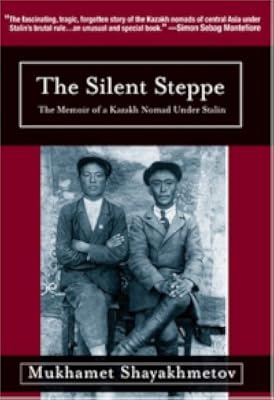
Silent Steppe: The Memoir of a Kazakh Nomad Under Stalin
by Mukhamet Shayakhmetov
On This Page
Description
"This rare and moving book is a first-hand account of the genocide of the Kazakh nomads in the 1920s and 30s. Nominally Muslim, the Kazakhs and their culture owed as much to shamanism and paganism as to Islam; their ancient traditions and economy depended on the breeding and herding of stock across the vast steppes of central Asia, and their independent, nomadic way of life was anathema to the Soviets." "Mukhamet Shayakhmetov was born into a family of nomadic Kazakh herdsmen in 1922, the show more year of the consolidation of Soviet rule across his people's vast steppe-land. As the devastating Soviet policy of collectivization of agriculture took hold, it set off wide spread famine; in 1932-34 over one million Knzakhs died; more than one quarter of the indigenous population. Seven-year-old Shayakhmetov and his mother and sisters were left to fend for themselves after his father was branded a kulak (well-off peasant and thus class enemy), stripped of his possessions, and sent to a prison camp where he died. In the following years the family traveled thousands of miles across Kazakhstan by foot, surviving on the charity of relatives. Told with dignity and detachment, this central Asian Wild Swans awakens the reader to the. show lessTags
Recommendations











Member Recommendations
Member Reviews
Although it mostly was a rather factual account of the author's young life in the 30s and 40s, the simplicity of the narrative really makes it rather powerful. The willful destruction of the nomadic life of the Kazakhs by both forcing them into collective farms and then making famine worse by taking away their meager food supplies was a completely unknown story to me and I was very taken by his telling of it.
"The pattern of our year was dictated by the needs of our herds and flocks", 7 August 2015
This review is from: Silent Steppe (Hardcover)
Until reading this work, I had never thought of how Stalin's policies impinged on the nomadic peoples of Central Asia. In this memoir, written by the son of a traditional Kazakh herding 'aul' (community), we follow his life from childhood in the 20s - a life of migration, of clan solidarity and traditional ways, to Stalin's disastrous enforced collectivisation in the early 30s. With a combination of corruption, ill-management and and drought, there was a mass famine, which the author only survived by the skin of his teeth.
"Three years earlier, my mother had ridden a white horse along this same route, show more sitting astride her silver-edged saddle studded with precious gems, with a child in a travel-cradle fastened to the front of her swaddle, leading a camel by a long rein attached to her left wrist. It was impossible to know what she was thinking now as she traipsed along in a state of semi-starvation."
He writes of being banned from school as the son of a 'kulyk' (wealthy peasant), of homelessness, of the freezing winters ...and at last of the onset of World War 2. We know he went on to do well in his chosen career of teaching, becoming a headmaster, and living into old age (this book was written in early 2000s.)
As another reviewer states, this is a 'flat', factual recounting of events, rather than an emotional or literary work, but informative, covering a place about which we hear little in the West. The introduction tells us that only "a fragment - perhaps some 5% of the stock-rearing population - has to this day survived." show less
This review is from: Silent Steppe (Hardcover)
Until reading this work, I had never thought of how Stalin's policies impinged on the nomadic peoples of Central Asia. In this memoir, written by the son of a traditional Kazakh herding 'aul' (community), we follow his life from childhood in the 20s - a life of migration, of clan solidarity and traditional ways, to Stalin's disastrous enforced collectivisation in the early 30s. With a combination of corruption, ill-management and and drought, there was a mass famine, which the author only survived by the skin of his teeth.
"Three years earlier, my mother had ridden a white horse along this same route, show more sitting astride her silver-edged saddle studded with precious gems, with a child in a travel-cradle fastened to the front of her swaddle, leading a camel by a long rein attached to her left wrist. It was impossible to know what she was thinking now as she traipsed along in a state of semi-starvation."
He writes of being banned from school as the son of a 'kulyk' (wealthy peasant), of homelessness, of the freezing winters ...and at last of the onset of World War 2. We know he went on to do well in his chosen career of teaching, becoming a headmaster, and living into old age (this book was written in early 2000s.)
As another reviewer states, this is a 'flat', factual recounting of events, rather than an emotional or literary work, but informative, covering a place about which we hear little in the West. The introduction tells us that only "a fragment - perhaps some 5% of the stock-rearing population - has to this day survived." show less
There aren't very many books in English that come out of Central Asia, particularly from this period. Mukhamet Shayakhmetov is one of the very few people still alive who are old enough to remember Stalin's Great Terror of the mid-thirties, as well as what life was like for the Kazakhs before the unending march of Soviet progress ended their way of life forever.
Shayakhmetov writes clearly and plainly, without pretensions or self-pity, almost in a journalistic fashion. I learned a lot from his story. History needs more books like this.
Shayakhmetov writes clearly and plainly, without pretensions or self-pity, almost in a journalistic fashion. I learned a lot from his story. History needs more books like this.
Ratings
Members
- Recently Added By
Lists

Central Asia
59 works; 2 members
Author Information

2 Works 69 Members
Some Editions
Awards and Honors
Common Knowledge
- Original publication date
- 2006
- First words
- For as long as anyone could remember, a stock-breeder's entire life in the steppe had been bound up with his animals.
- Last words
- (Click to show. Warning: May contain spoilers.)On the way we stopped for an hour to feed it and let it rest; and so it was that an elderly woman and young girl from our village came across us on our journey and went running on ahead through the light, crumbly snow, trying to get to Kamyshenka first to spread the joyful news - not only to my family, but to all the other villagers as well - that after two years and ten months at war, I had finally come home.
Classifications
Statistics
- Members
- 66
- Popularity
- 473,486
- Reviews
- 3
- Rating
- (3.25)
- Languages
- English
- Media
- Paper
- ISBNs
- 2