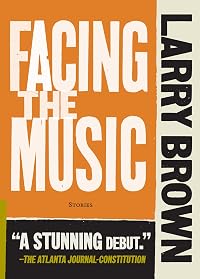
Facing the Music
by Larry Brown
On This Page
Description
Facing the Music, Larry Brown's first book, was originally published in 1988 to wide critical acclaim. As the St. Petersburg Times review pointed out, the central theme of these ten stories "is the ageless collision of man with woman, woman with man—with the frequent introduction of that other familiar couple, drinking and violence. Most often ugly, love is nevertheless graceful, however desperate the situation."There's some glare from the brutally bright light Larry Brown shines on his show more subjects. This is the work of a writer unafraid to gaze directly at characters challenged by crisis and pathology. But for readers who are willing to look, unblinkingly, along with the writer, there are unusual rewards.
. show less
Tags
Recommendations















Member Reviews
Larry Brown is a remarkable and innovative writer. His stories in this volume are raw, human, and evocative. Human desperation is at the heart of many of them, whether desperation for love, money, or simple peace. He writes with a lean style and an eagle eye for hidden emotion. Some of his stories are straightforward, while others toy with the form, as though he'd decided to see how much he could rearrange a story and still have it make sense. This collection of stories is a wonderful read, a slice of sun-baked southern life that sizzles with vitality.
A truly striking collection of disparate and desperate characters from the back lanes and dive bars, and the woodlands and cotton fields of North Mississippi.
***
1) Facing The Music -
In with a bang. One husband contemplates his fidelity while his wife hopes to distract him from watching the late movie on TV... A very powerful opening salvo you won't easily forget.
2) Kubuku Rides (This Is it) -
A heartbreaking portrayal of secrets and lies, and addiction within the family.
3) The Rich -
A revealing moment in the life of Mr Pellisher, a travel agent who is poor, but who associates with the rich...
4) Old Frank and Jesus -
Devastating and possibly a quintessential Larry Brown short tale of one man's life lived hard. Opening lines:
'Mr show more Parker's on the couch, reclining. He's been there all morning, almost, trying to decide what to do. Things haven't gone like he's planned. They never do.'
5) Boy and Dog -
Prose poetry in the form of short simple phrases, sequenced statements of fact tell how a boy's lunch is ready - but he's not coming in. His dog has been hit outside on the road, and is already dead. But then the killer Mustang comes back - 'It was hunting its hubcap.' - and the boy picks up a brick...
6) Julie: A Memory -
Brown in slightly more experimental mode with this one. A series of interlocking and overlapping narratives are told in almost rhythmically alternating sentences. It feels like 'cut-up' technique - only it works! You can sense exactly what's been going on as the tale of two young lovers unravels. Violence and tragedy pervade the scene once again - but it's never gratuitous, just real.
7) Samaritans -
A lonesome barfly one hot and bright mid-afternoon does what he can for a pathetic and peripatetic family out in the parking lot. He could end up ruing their acquaintance. This reader was entranced.
8) Night Life -
Gary's a bachelor mechanic who doesn't find meeting women that easy. Connie is a married mother whose just left her husband she's been with since the age of sixteen. Their stop-start liaisons have an edge of black humour about them, but ultimately are full of aching pathos as the sad realities of their unfulfilled lives emerge.
9) Leaving Town -
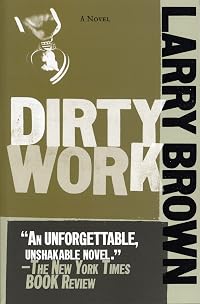
All of Brown's stories have something about them that could lend themselves well to film adaptation, but THIS really is the one that leaves you with that feeling at its end that you've just experienced something truly memorable. Using the alternate viewpoints technique he later uses to such good effect in his excellent post-Vietnam novel 'Dirty Work', Brown tells of a blue collar brief encounter between a hard-working handyman and his fragile customer. He will do everything he can for his own partner's disabled little girl, while his female client is alone and recovering from an abusive relationship. If this 'movie' had a theme tune, it'd probably be written by Jimmy Webb.
10) The End of Romance -
'"Just go in and get some beer," she said. "We got to talk."' So begins the closing story in this collection. A couple are out for a drive and it's clear that they both have a lot to get off their chests. Their talk is interrupted in the most unexpected way. Brown's final lines somehow manage to leave you with a smile on your face, despite the most awful of circumstances.
***
Hard to believe that this was Brown's first published collection back in 1988. While it's clear that he is evidently trying his hand at a few different approaches with the method, the accumulative effect is somewhat akin to a series of well-landed body blows. The punches hit hard and you find yourself waking up still almost dazed - thinking of an ending, or seeing the characters all around you out in the world: clocking in at the depot, eating lunch, shopping in a supermarket, driving home. A superb book of short stories from the late and much missed prince of the 'Rough South'. Five stars. show less
***
1) Facing The Music -
In with a bang. One husband contemplates his fidelity while his wife hopes to distract him from watching the late movie on TV... A very powerful opening salvo you won't easily forget.
2) Kubuku Rides (This Is it) -
A heartbreaking portrayal of secrets and lies, and addiction within the family.
3) The Rich -
A revealing moment in the life of Mr Pellisher, a travel agent who is poor, but who associates with the rich...
4) Old Frank and Jesus -
Devastating and possibly a quintessential Larry Brown short tale of one man's life lived hard. Opening lines:
'Mr show more Parker's on the couch, reclining. He's been there all morning, almost, trying to decide what to do. Things haven't gone like he's planned. They never do.'
5) Boy and Dog -
Prose poetry in the form of short simple phrases, sequenced statements of fact tell how a boy's lunch is ready - but he's not coming in. His dog has been hit outside on the road, and is already dead. But then the killer Mustang comes back - 'It was hunting its hubcap.' - and the boy picks up a brick...
6) Julie: A Memory -
Brown in slightly more experimental mode with this one. A series of interlocking and overlapping narratives are told in almost rhythmically alternating sentences. It feels like 'cut-up' technique - only it works! You can sense exactly what's been going on as the tale of two young lovers unravels. Violence and tragedy pervade the scene once again - but it's never gratuitous, just real.
7) Samaritans -
A lonesome barfly one hot and bright mid-afternoon does what he can for a pathetic and peripatetic family out in the parking lot. He could end up ruing their acquaintance. This reader was entranced.
8) Night Life -
Gary's a bachelor mechanic who doesn't find meeting women that easy. Connie is a married mother whose just left her husband she's been with since the age of sixteen. Their stop-start liaisons have an edge of black humour about them, but ultimately are full of aching pathos as the sad realities of their unfulfilled lives emerge.
9) Leaving Town -
All of Brown's stories have something about them that could lend themselves well to film adaptation, but THIS really is the one that leaves you with that feeling at its end that you've just experienced something truly memorable. Using the alternate viewpoints technique he later uses to such good effect in his excellent post-Vietnam novel 'Dirty Work', Brown tells of a blue collar brief encounter between a hard-working handyman and his fragile customer. He will do everything he can for his own partner's disabled little girl, while his female client is alone and recovering from an abusive relationship. If this 'movie' had a theme tune, it'd probably be written by Jimmy Webb.
10) The End of Romance -
'"Just go in and get some beer," she said. "We got to talk."' So begins the closing story in this collection. A couple are out for a drive and it's clear that they both have a lot to get off their chests. Their talk is interrupted in the most unexpected way. Brown's final lines somehow manage to leave you with a smile on your face, despite the most awful of circumstances.
***
Hard to believe that this was Brown's first published collection back in 1988. While it's clear that he is evidently trying his hand at a few different approaches with the method, the accumulative effect is somewhat akin to a series of well-landed body blows. The punches hit hard and you find yourself waking up still almost dazed - thinking of an ending, or seeing the characters all around you out in the world: clocking in at the depot, eating lunch, shopping in a supermarket, driving home. A superb book of short stories from the late and much missed prince of the 'Rough South'. Five stars. show less
Mostly incredibly dark and gritty stories...reading this collection was like driving slowly by a car wreck at times: hard to read, but impossible to put down.
When a writer you admire dies, it can take a long time for the realization to sink in. It’s strange, really; here is a person with whom you’ve taken a hundred road trips, a person with whom you’ve interacted while sitting on a toilet, a person with whom you’ve gone to bed, even—and yet, after they’re gone, nothing changes drastically. You continue to take them on road trips, and into the bathroom, and into your bed, and maybe it isn’t until you’ve contemplated the very last sentence of that writer’s very last book for the fiftieth or sixtieth time that you finally understand it: It’s over. That’s everything. Barring the insult of a posthumous publication of some half-finished manuscript the writer had deemed show more unready for public consumption, there will never again be anything new.
It’s a safe bet that quite a few of Larry Brown’s faithful readers have come to this sad conclusion at various points since the gritty Mississippi writer died of a heart attack. I certainly have. Brown is a personal favorite, and though he left behind five novels—Dirty Work, Joe, Father and Son, Fay and The Rabbit Factory— two collections of short stories—Facing the Music and Big, Bad Love¬—a memoir—On Fire—and a collection of essays—Billy Ray’s Farm—it still seems as if the big sleep silenced one of the most honest and distinct voices in all of contemporary literature several hundred thousand words too soon.
But rather than pine for what might have been, it is more of a service to the legacy of a writer of Brown’s talent and importance to revisit what is. And there’s no better place to start than with Facing the Music, the 1987 collection of short stories that first introduced Larry Brown, his down-and-out characters, and his raw, plainspoken style to the literary world.
In praise of the ten stories in Facing the Music, Southern Lit legend and fellow Mississippian Barry Hannah writes that Brown “rediscovers real stuff, like great writers do.âÂ? The âÂÂreal stuffâÂ? to which Hannah refers are the bleak circumstances of the men and women of BrownâÂÂs rural SouthâÂÂdesperate people who know better and want better, but wind up hurting themselves and the people they love because they just canâÂÂt seem to set their minds to actually doing better. ItâÂÂs this inability to change that make them feel so honest-to-God real and humanâÂÂLarry Brown isnâÂÂt afraid to tell the cold, hard truth, which is this: when it comes to change, most people canâÂÂt, and don't.
In the title story, for instance, the narratorâÂÂs wife craves intimacy after her breasts have been removed, but the narrator wonâÂÂt give it to her because heâÂÂs repulsed by her now-disfigured body. In âÂÂKukabu Rides,âÂ? a womanâÂÂs alcoholism controls her to the point that nothingâÂÂnot her conscious, not a series of drunken car wrecks, not her love for her child, not even her husbandâÂÂs tearful pleadingâÂÂcan keep her from cracking the seal on another bottle. And in âÂÂThe End of Romance,âÂ? a man and woman who would be better off apart witness a gory shooting at a gas station and decide that their violent, hate-filled relationship is at least preferable to facing the world alone.
The opportunity to do the right thingâÂÂor the better thing, at leastâÂÂis always present in a Brown story; itâÂÂs just that his character can never get up enough positive momentum to take advantage.
Facing the Music may not be BrownâÂÂs masterpiece, or even his best short story collectionâÂÂyou could certainly argue in favor of Big, Bad Love for that distinction. But after only a few pages of Facing the Music it becomes easy to understand what compelled Algonquin editor Shannon Ravenel, after discovering one of BrownâÂÂs stories in Mississippi Quarterly, to contact the then Oxford firefighter, who had barely graduated high school, about putting the book together. Those heartbreakingly hopeless situations, that spare, inimitable style--Larry Brown knew exactly what he was doing from the very beginning. show less
It’s a safe bet that quite a few of Larry Brown’s faithful readers have come to this sad conclusion at various points since the gritty Mississippi writer died of a heart attack. I certainly have. Brown is a personal favorite, and though he left behind five novels—Dirty Work, Joe, Father and Son, Fay and The Rabbit Factory— two collections of short stories—Facing the Music and Big, Bad Love¬—a memoir—On Fire—and a collection of essays—Billy Ray’s Farm—it still seems as if the big sleep silenced one of the most honest and distinct voices in all of contemporary literature several hundred thousand words too soon.
But rather than pine for what might have been, it is more of a service to the legacy of a writer of Brown’s talent and importance to revisit what is. And there’s no better place to start than with Facing the Music, the 1987 collection of short stories that first introduced Larry Brown, his down-and-out characters, and his raw, plainspoken style to the literary world.
In praise of the ten stories in Facing the Music, Southern Lit legend and fellow Mississippian Barry Hannah writes that Brown “rediscovers real stuff, like great writers do.âÂ? The âÂÂreal stuffâÂ? to which Hannah refers are the bleak circumstances of the men and women of BrownâÂÂs rural SouthâÂÂdesperate people who know better and want better, but wind up hurting themselves and the people they love because they just canâÂÂt seem to set their minds to actually doing better. ItâÂÂs this inability to change that make them feel so honest-to-God real and humanâÂÂLarry Brown isnâÂÂt afraid to tell the cold, hard truth, which is this: when it comes to change, most people canâÂÂt, and don't.
In the title story, for instance, the narratorâÂÂs wife craves intimacy after her breasts have been removed, but the narrator wonâÂÂt give it to her because heâÂÂs repulsed by her now-disfigured body. In âÂÂKukabu Rides,âÂ? a womanâÂÂs alcoholism controls her to the point that nothingâÂÂnot her conscious, not a series of drunken car wrecks, not her love for her child, not even her husbandâÂÂs tearful pleadingâÂÂcan keep her from cracking the seal on another bottle. And in âÂÂThe End of Romance,âÂ? a man and woman who would be better off apart witness a gory shooting at a gas station and decide that their violent, hate-filled relationship is at least preferable to facing the world alone.
The opportunity to do the right thingâÂÂor the better thing, at leastâÂÂis always present in a Brown story; itâÂÂs just that his character can never get up enough positive momentum to take advantage.
Facing the Music may not be BrownâÂÂs masterpiece, or even his best short story collectionâÂÂyou could certainly argue in favor of Big, Bad Love for that distinction. But after only a few pages of Facing the Music it becomes easy to understand what compelled Algonquin editor Shannon Ravenel, after discovering one of BrownâÂÂs stories in Mississippi Quarterly, to contact the then Oxford firefighter, who had barely graduated high school, about putting the book together. Those heartbreakingly hopeless situations, that spare, inimitable style--Larry Brown knew exactly what he was doing from the very beginning. show less
The late, great Larry Brown is one of my favorite authors, and this collection of short stories is great introduction to his work. In fact, his later work may not top it. With his stark, brutal prose, Brown describes the stark, brutal lives of the working class in rural Mississippi. His stories are gripping and moving.
Rough, desperate lives are portrayed with honesty & compassion.
The more I read of Larry Brown the more it seems the literate public lost something great when he died in 2004, only 53 years old. Known chiefly for his novels, Facing the Music is a book of short stories, and his first published book.
Read the rest of my review of Facing the Music on my blog, The Nerd is the Word.
http://nerdword.blogspot.com/2006/01/3-facing-music.html
Read the rest of my review of Facing the Music on my blog, The Nerd is the Word.
http://nerdword.blogspot.com/2006/01/3-facing-music.html
Members
- Recently Added By
Published Reviews
ThingScore 79
Ten raw and strictly 100-proof stories make up one of the more exciting debuts of recent memory - fiction that's gritty and genuine, and funny in a hard-luck way."
added by Polaris-
"Unpredictability, combined with a hard-eyed realism and a virtuoso display of style keeps the reader riveted to what Brown tells us about people we've often seen but never really known."
added by Polaris-
"Tough Stuff. Good stuff."
added by Polaris-
Lists

Top Five Books of 2013
1,562 works; 721 members

Books Read in 2016
4,666 works; 197 members
Author Information

15+ Works 3,307 Members
Larry Brown is the author of eight books, including Fay, Father and Son, and the memoir On Fire. He received the Mississippi Institute of Arts and Letters Award for Literature and the Southern Book Critics Circle Award for Fiction in 1992 and 1997. He received the University of North Carolina's second Thomas Wolfe Prize and Lectureship. He lives show more near Oxford, Mississippi show less
Series
Belongs to Publisher Series
Work Relationships
Is contained in
Contains
Common Knowledge
- Canonical title
- Facing the Music
- Original title
- Facing the Music
- Original publication date
- 1988
- Important places
- Mississippi, USA
- Related movies
- Kubuku Rides (This Is It | 2006 | IMDb)
- Dedication
- for Mary Annie
- First words
- I cut my eyes sideways because I know what's coming.
- Last words
- (Click to show. Warning: May contain spoilers.)"She did it," I said.
- Blurbers
- Crews, Harry; Hannah, Barry; Morris, Willie; Douglas, Ellen; Butler, Jack
Classifications
Statistics
- Members
- 216
- Popularity
- 151,801
- Reviews
- 8
- Rating
- (3.94)
- Languages
- English, French
- Media
- Paper, Ebook
- ISBNs
- 6
- UPCs
- 1
- ASINs
- 2