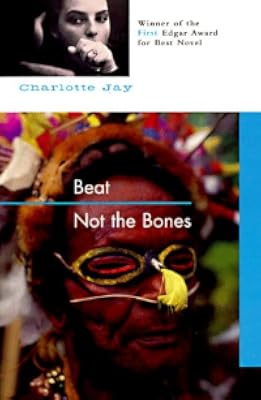
Beat Not the Bones
by Charlotte Jay
On This Page
Description
Suicide, or murder? Newly arrived in Papua, where even the luscious vegetation conspires with the bureaucrats to bewilder her, Stella Warwick is determined to prove her husband did not take his own life.Tags
Recommendations






























Member Reviews
First Line: It is said of a young man in a popular song that he has the moon in his pocket. Alfred Jobe had two moons in his.
David Warwick is a distinguished anthropologist living in Marapai on New Guinea. He is in charge of protecting the natives from exploitation. His young wife is in Australia taking care of her invalid father. When Stella is told that her husband has committed suicide, she doesn't believe it and travels to Marapai to investigate for herself.
At first, I wanted to slap Stella silly because she's exactly the type of woman who drives me nuts: "She had come here for comfort and peace, to be helped by her husband's friend, to be looked after, to be guided and directed as she had always been." Stella is a young woman who's show more been convent-educated-- not because her family is Catholic, but because her father believed that this sort of education would make her more biddable and "womanly". Stella fully believes that she will be able to find the answers to her questions simply because she's young and nice and pretty and has always behaved. Pah.
When Stella finally realizes that she's been lied to by just about everyone in Marapai, she finally develops the beginnings of a spine and takes her impromptu investigation to a different level-- even leaving Marapai for a bit:
"Behind them the wharf grew smaller with extraordinary rapidity. With each moment Marapai was more infinitesimal. An hour ago it had been the whole island, now it was almost swallowed up. As they moved towards the long coastline stretching ahead, the land they were seeking reached out to them, hungry and waiting for victims."
Even though I found Stella exasperating for the most part, I did admire her sheer stubbornness. Once she had an idea in her head, she clung to it like a barnacle, and since she was so young and innocent, the men she was trying to deal with went out of their way to avoid scraping her off their keels.
I can see why this book was the winner of the very first Edgar Award for Best Novel. There's an innocent young heroine looking for the truth. There are well-camouflaged bad guys. Several characters have been in the tropics too long, and they've either had nervous breakdowns, or they're right on the verge of them. And they're all in a lush, alien landscape where the weather, the colors-- almost everything around them-- is just more than human senses can take in and protect itself against.
At the beginning, I read this book because it took place in a part of the world I knew very little about. By book's end I knew I'd just finished reading a well-crafted mystery. I'll definitely be looking for Charlotte Jay's other books. show less
David Warwick is a distinguished anthropologist living in Marapai on New Guinea. He is in charge of protecting the natives from exploitation. His young wife is in Australia taking care of her invalid father. When Stella is told that her husband has committed suicide, she doesn't believe it and travels to Marapai to investigate for herself.
At first, I wanted to slap Stella silly because she's exactly the type of woman who drives me nuts: "She had come here for comfort and peace, to be helped by her husband's friend, to be looked after, to be guided and directed as she had always been." Stella is a young woman who's show more been convent-educated-- not because her family is Catholic, but because her father believed that this sort of education would make her more biddable and "womanly". Stella fully believes that she will be able to find the answers to her questions simply because she's young and nice and pretty and has always behaved. Pah.
When Stella finally realizes that she's been lied to by just about everyone in Marapai, she finally develops the beginnings of a spine and takes her impromptu investigation to a different level-- even leaving Marapai for a bit:
"Behind them the wharf grew smaller with extraordinary rapidity. With each moment Marapai was more infinitesimal. An hour ago it had been the whole island, now it was almost swallowed up. As they moved towards the long coastline stretching ahead, the land they were seeking reached out to them, hungry and waiting for victims."
Even though I found Stella exasperating for the most part, I did admire her sheer stubbornness. Once she had an idea in her head, she clung to it like a barnacle, and since she was so young and innocent, the men she was trying to deal with went out of their way to avoid scraping her off their keels.
I can see why this book was the winner of the very first Edgar Award for Best Novel. There's an innocent young heroine looking for the truth. There are well-camouflaged bad guys. Several characters have been in the tropics too long, and they've either had nervous breakdowns, or they're right on the verge of them. And they're all in a lush, alien landscape where the weather, the colors-- almost everything around them-- is just more than human senses can take in and protect itself against.
At the beginning, I read this book because it took place in a part of the world I knew very little about. By book's end I knew I'd just finished reading a well-crafted mystery. I'll definitely be looking for Charlotte Jay's other books. show less
The narrative is beguiling. It offers an exotic locale which Charlotte Jay documents in meticulous detail while using the other worldly tropics as an assist in building suspense. It also weaves in the chillingly real historical context that adds great depth to the horror of the crime. It's not hard to see what the CWA committee found so compelling in its decision to crown the book with first Award.
This can be firmly placed in the psychological thriller genre. The uncertainties of the interior landscapes are just as prominent as those in the exterior settings. All of the characters, including the protagonist, are wracked by indecision. Jay is evenhanded in that regard but it made it difficult to find much sympathy with any of them. This show more tale deserved the Edgar but I would not put it in the 'page turner' class. show less
This can be firmly placed in the psychological thriller genre. The uncertainties of the interior landscapes are just as prominent as those in the exterior settings. All of the characters, including the protagonist, are wracked by indecision. Jay is evenhanded in that regard but it made it difficult to find much sympathy with any of them. This show more tale deserved the Edgar but I would not put it in the 'page turner' class. show less
This book by Charlotte Jay, written in 1952 won the first ever Edgar Allan Poe Award. I have made it my mission to try to read all the Edgar award books. Mystery and suspense is my favourite genre, and it will be nice to see how the genre has evolved. This book is set in Papua just after the end of WWII. It's probably one of the best books I've ever read that portrays the atrocities and iniquities of colonialism. It also is written in descriptive and beautiful language that distinctly depicts the setting in which the book is written - the thick encroaching jungle, the beautiful flowers and trees and the almost impossibly blue ocean that surrounds it. The book is about Stella Warwick and her quest to find out what actually happened to show more her husband while he was stationed in Papua. All the bureaucrats are telling her that he committed suicide, but that is not the David Warwick she knows, so she comes to the island to figure it out. Not even she is prepared for the devastating truth that she uncovers. Yes, some of the society norms in the book are dated, especially the role of women women played in a colonial province, but Ms. Jay has crafted a complex and frightening suspense thriller that is terrible in its realism. I enjoyed the book, and look forward to continuing my journey with the other books that have won this prestigious award. show less
When Stella Warwick hears that her husband David, an anthropologist working on New Guinea to protect the indigenous people from exploitation while she cares for her invalid father in Australia, has committed suicide she is disbelieving and travels there to find out the truth. She has been told that he committed suicide due to worry over his mounting debts soon after returning from a trip deep into the jungle but Stella wants to know more and keeps asking questions of her husband’s former colleagues, the people who travelled with him and the boys who do menial work for the Australians. In the end she believes the only way to find the answers will be to recreate his final journey into the jungle.
Beat Not The Bones has an excellent sense show more of its setting both in terms of its physical geography – the heat, humidity, isolation and wild jungle are depicted so well I swear I started to feel sweaty despite reading the book on cold winter days – and its social status as a colonial outpost of Australian government and business interests. As cringe-making as it might be now the reality is that in the 1950’s behaviour towards the country and its people by Australian interests was undoubtedly as patronising as is described in the book. Even the people who are portrayed as enlightened treat the Papuans as little more than ‘the white man’s burden’. Sometimes when I read historical fiction that takes place in times or places where sensibilities are very different from current ones I get the sense that things are altered just a little (even unintentionally) to fit in more comfortably with modern ideas, usually by the insertion of at least one incredibly forward-thinking individual and/or the careful omission of the least palatable facts. For better or worse this contemporary story has none of that ‘glossing over the nasty bits’ feel.
The characters were a less successful aspect of the book for me. Stella for example is a woman so sheltered from life and so utterly dependent upon men (her father, husband and random strangers as long as they are men) that she is barely functional as an independent human being. Perhaps she is a realistic depiction of a woman of her time (though my mother, being roughly the same age, would vehemently disagree) but regardless of that I found it very difficult to care what happened to her. Even when she started developing a smidgen of independent thought towards the end I found I’d lost interest in what happened to her. Although they too were probably credible portrayals none of the other characters generated much in the way of my empathy, with the possible exception of Stella’s travelling companion in the jungle who does seem to suffer from the consequences of his own prior actions and a heat-induced madness (I’m more sympathetic to the latter).
While I found the overall story mildly interesting I must say I wasn’t completely gripped I put the book down for several days a couple of times and was never drawn back to it in any hurry. The main reason for this was the almost gothic, certainly melodramatic, style of writing that did have me rolling my eyes a few times. The ending though was remarkably strong and tackled the thorny issue of there being consequences for the evil that one does during one’s life. Overall I’d recommend the book, especially if you enjoy visiting your tropical locations virtually rather than in person or could do with being reminded that no matter how screwy our current world is we have made some fairly amazing social advances in 60 years. show less
Beat Not The Bones has an excellent sense show more of its setting both in terms of its physical geography – the heat, humidity, isolation and wild jungle are depicted so well I swear I started to feel sweaty despite reading the book on cold winter days – and its social status as a colonial outpost of Australian government and business interests. As cringe-making as it might be now the reality is that in the 1950’s behaviour towards the country and its people by Australian interests was undoubtedly as patronising as is described in the book. Even the people who are portrayed as enlightened treat the Papuans as little more than ‘the white man’s burden’. Sometimes when I read historical fiction that takes place in times or places where sensibilities are very different from current ones I get the sense that things are altered just a little (even unintentionally) to fit in more comfortably with modern ideas, usually by the insertion of at least one incredibly forward-thinking individual and/or the careful omission of the least palatable facts. For better or worse this contemporary story has none of that ‘glossing over the nasty bits’ feel.
The characters were a less successful aspect of the book for me. Stella for example is a woman so sheltered from life and so utterly dependent upon men (her father, husband and random strangers as long as they are men) that she is barely functional as an independent human being. Perhaps she is a realistic depiction of a woman of her time (though my mother, being roughly the same age, would vehemently disagree) but regardless of that I found it very difficult to care what happened to her. Even when she started developing a smidgen of independent thought towards the end I found I’d lost interest in what happened to her. Although they too were probably credible portrayals none of the other characters generated much in the way of my empathy, with the possible exception of Stella’s travelling companion in the jungle who does seem to suffer from the consequences of his own prior actions and a heat-induced madness (I’m more sympathetic to the latter).
While I found the overall story mildly interesting I must say I wasn’t completely gripped I put the book down for several days a couple of times and was never drawn back to it in any hurry. The main reason for this was the almost gothic, certainly melodramatic, style of writing that did have me rolling my eyes a few times. The ending though was remarkably strong and tackled the thorny issue of there being consequences for the evil that one does during one’s life. Overall I’d recommend the book, especially if you enjoy visiting your tropical locations virtually rather than in person or could do with being reminded that no matter how screwy our current world is we have made some fairly amazing social advances in 60 years. show less
The first winner of the Edgar for Best Novel, this book by an Australian writer is set in Papua New Guinea shortly after WWII. Although it has an excellent sense of atmosphere and setting, I found the psychological thriller to be far less than thrilling, and couldn't begin to care about the characters.
As they say in Minnesota..."That was different!" Although the book contains a mystery, which is solved by the end of the book (although with a loose end or two left hanging), it is primarily a psychological and to some extent, an anthropological study. Set in Papua New Guinea shortly after WWII, when it was evidently an Australian protectorate, the book can shock the contemporary reader with the assumptions and prejudices the white show more characters display. The difference in attitudes toward the natives between the best and worst of the white men (for it is they who wield the power) is slight. Only a very few characters seem to be able to think of the Papuans as adult human beings with a worthwhile culture. To the rest, they are either "the white man's burden" or simply the denizens of a country which is to be exploited, and if they are wiped out in the process, so be it.
The protagonist, Stella Warwick, has lived an incredibly sheltered life with an invalid father, but has somehow been courted and married by David Warwick, an anthropologist who was employed in Papua New Guinea. She did not join him immediately because of her father's illness, and after a mysterious letter from David causes her father's death by stroke, she learns that David has committed suicide. Or has he? Stella travels to Papua New Guinea to find out the truth, and her growing independence of thought and action is really the central feature of the book.
The setting is masterfully done, as is the portrait of a colonial society. I was reminded (dimly, as I read it over 40 years ago) of Joseph Conrad's HEART OF DARKNESS. But I must confess that this book did not meet my criteria for a mystery novel; for one thing, I found it rather slow going, and somehow the mystery of David Warwick's death did not seem to be central to the plot. Since the MWA does not list nominees for this award until 1956, I don't know what the competition may have been. show less
As they say in Minnesota..."That was different!" Although the book contains a mystery, which is solved by the end of the book (although with a loose end or two left hanging), it is primarily a psychological and to some extent, an anthropological study. Set in Papua New Guinea shortly after WWII, when it was evidently an Australian protectorate, the book can shock the contemporary reader with the assumptions and prejudices the white show more characters display. The difference in attitudes toward the natives between the best and worst of the white men (for it is they who wield the power) is slight. Only a very few characters seem to be able to think of the Papuans as adult human beings with a worthwhile culture. To the rest, they are either "the white man's burden" or simply the denizens of a country which is to be exploited, and if they are wiped out in the process, so be it.
The protagonist, Stella Warwick, has lived an incredibly sheltered life with an invalid father, but has somehow been courted and married by David Warwick, an anthropologist who was employed in Papua New Guinea. She did not join him immediately because of her father's illness, and after a mysterious letter from David causes her father's death by stroke, she learns that David has committed suicide. Or has he? Stella travels to Papua New Guinea to find out the truth, and her growing independence of thought and action is really the central feature of the book.
The setting is masterfully done, as is the portrait of a colonial society. I was reminded (dimly, as I read it over 40 years ago) of Joseph Conrad's HEART OF DARKNESS. But I must confess that this book did not meet my criteria for a mystery novel; for one thing, I found it rather slow going, and somehow the mystery of David Warwick's death did not seem to be central to the plot. Since the MWA does not list nominees for this award until 1956, I don't know what the competition may have been. show less
Once Stella Warwick was meant to come to Marapai in Papua New Guinea as a young Australian bride. Now, a little over 6 months later, she comes to find out who murdered her husband.
Although her husband, a distinguished anthropologist in charge of protecting the natives from exploitation, was over 20 years older than her, and in reality she barely knew him, Stella feels that the verdict of suicide after David's death is really out of character.
David Warwick died over 3 days walk into the jungle away, and as Stella attempts to visit there, she becomes aware that everyone is telling her lies. Nobody wants her to uncover the truth.
The novel is as much about how the officials of the Australian protectorate and handling cultural and climatic show more differences, as it is about whether David Warwick was murdered or whether he committed suicide. The story is played out against the background of interaction and conflict between a supposedly primitive culture and Australian civilisation.
Charlotte Jay lived and worked in Papua New Guinea 1942-1950 and obviously placed BEAT NOT THE BONES in a setting with which she was very familiar. This was her second mystery novel and Anthony Boucher commented on "its deft plot".
BEAT NOT THE BONES gives the reader plenty to think about. show less
Although her husband, a distinguished anthropologist in charge of protecting the natives from exploitation, was over 20 years older than her, and in reality she barely knew him, Stella feels that the verdict of suicide after David's death is really out of character.
David Warwick died over 3 days walk into the jungle away, and as Stella attempts to visit there, she becomes aware that everyone is telling her lies. Nobody wants her to uncover the truth.
The novel is as much about how the officials of the Australian protectorate and handling cultural and climatic show more differences, as it is about whether David Warwick was murdered or whether he committed suicide. The story is played out against the background of interaction and conflict between a supposedly primitive culture and Australian civilisation.
Charlotte Jay lived and worked in Papua New Guinea 1942-1950 and obviously placed BEAT NOT THE BONES in a setting with which she was very familiar. This was her second mystery novel and Anthony Boucher commented on "its deft plot".
BEAT NOT THE BONES gives the reader plenty to think about. show less
An enjoyable though dated read. Felt like Jay was attempting to induce a feeling of claustrophobia with the whites hemmed in on all sides by savagery and decay, I did not find this attempt successful.
Members
- Recently Added By
Lists

Anthony Boucher's Best Crime Fiction of the Year
115 works; 5 members

Edgar Award
418 works; 15 members

Books With Complete Sentence Titles
502 works; 17 members
Author Information

13 Works 231 Members
Awards and Honors
Awards
Distinctions
Series
Belongs to Publisher Series
Common Knowledge
- Canonical title
- Beat Not the Bones
- Original publication date
- 1952
- Important places
- Papoea-Nieuw-Guinea; Papua New Guinea
- First words
- It is said of a young man in a popular song that he had the moon in his pocket.
- Last words
- (Click to show. Warning: May contain spoilers.)"you'll see," he said again.
Classifications
Statistics
- Members
- 138
- Popularity
- 237,624
- Reviews
- 9
- Rating
- (3.28)
- Languages
- English, French, German
- Media
- Paper, Audiobook, Ebook
- ISBNs
- 13
- ASINs
- 8