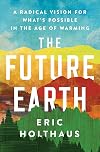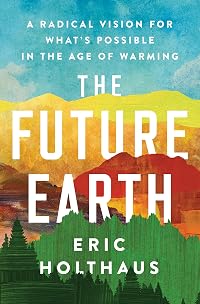
The Future Earth: A Radical Vision for What's Possible in the Age of Warming
by Eric Holthaus
On This Page
Description
Eric Holthaus offers a radical vision of our future, specifically how to reverse the short- and long-term effects of climate change over the next three decades. Anchored by world-class reporting, interviews with futurists, climatologists, biologists, economists, and climate change activists, it shows what the world could look like if we implemented radical solutions on the scale of the crises we face.Tags
Recommendations













Member Reviews
Couched in aggressively self-righteous "woke" social justice terminology (e.g. mutualism, intersectionality, consent, radical decolonizing, BLM/LGBT activism, etc.), the tone is strident and abrasive to the point that it erodes the otherwise valid message. It's more of an anti-capitalist manifesto and a rejection of neoliberalism than a serious discussion of climate change.
If we manage to get past the introductory first third of the book, things pick up somewhat, as an outline of what we should do over the coming few decades is presented. It's wildly ambitious, using the Green New Deal as a starting point, but going well beyond that from the get go, and becoming more radical from there. It's a ludicrously optimistic vision of the show more future, but shows what could potentially be possible if we wanted it. But starting well to the left of Bernie Sanders is so unrealistic in today's political climate that it's hard to take any of it seriously. For instance, he advocates "listening and care" exercises as a viable way to contend with wealthy conservative elderly religious SUV drivers, as if half the country wasn't willfully ignorant, racist, selfish, or otherwise obstructionist.
On the climate science side, he's sloppy and misleading. Nuclear power is not even mentioned as a potential power source. He repeats the misnomer that fossil fuels are comprised of dinosaurs. He singles out air travel as particularly shameful, but largely glosses over the much larger carbon footprint of meat consumption. Meanwhile, he wants the world to at least be carbon neutral by 2050, while simultaneously providing hundreds of millions of air conditioners to India and electrifying all of Africa. Where the power for all of this will come from is unclear.
The socioeconomic side is even less coherent. He wants to add 6 states to the US (DC, Puerto Rico, Guam, etc.), accept millions of climate refugees, create a 1,000 mile tall national park in the middle of the country from Texas to Canada, return huge swatches of land to Native Americans, create an extensive public transportation network including thousands of miles of high-speed rail and hyperloop tracks. Along with a worldwide Universal Basic Income, a 4-day work week, and a resurgence of small towns across the midwest. But at the same time, he wants to diminish the federal government, relying instead on community based governance, reject capitalism, tax the rich until everyone is equal, and decouple the economy from growth. Almost no numbers are provided to show how any of this adds up, to me it seems quite contradictory. show less
If we manage to get past the introductory first third of the book, things pick up somewhat, as an outline of what we should do over the coming few decades is presented. It's wildly ambitious, using the Green New Deal as a starting point, but going well beyond that from the get go, and becoming more radical from there. It's a ludicrously optimistic vision of the show more future, but shows what could potentially be possible if we wanted it. But starting well to the left of Bernie Sanders is so unrealistic in today's political climate that it's hard to take any of it seriously. For instance, he advocates "listening and care" exercises as a viable way to contend with wealthy conservative elderly religious SUV drivers, as if half the country wasn't willfully ignorant, racist, selfish, or otherwise obstructionist.
On the climate science side, he's sloppy and misleading. Nuclear power is not even mentioned as a potential power source. He repeats the misnomer that fossil fuels are comprised of dinosaurs. He singles out air travel as particularly shameful, but largely glosses over the much larger carbon footprint of meat consumption. Meanwhile, he wants the world to at least be carbon neutral by 2050, while simultaneously providing hundreds of millions of air conditioners to India and electrifying all of Africa. Where the power for all of this will come from is unclear.
The socioeconomic side is even less coherent. He wants to add 6 states to the US (DC, Puerto Rico, Guam, etc.), accept millions of climate refugees, create a 1,000 mile tall national park in the middle of the country from Texas to Canada, return huge swatches of land to Native Americans, create an extensive public transportation network including thousands of miles of high-speed rail and hyperloop tracks. Along with a worldwide Universal Basic Income, a 4-day work week, and a resurgence of small towns across the midwest. But at the same time, he wants to diminish the federal government, relying instead on community based governance, reject capitalism, tax the rich until everyone is equal, and decouple the economy from growth. Almost no numbers are provided to show how any of this adds up, to me it seems quite contradictory. show less
In June I was notified that I'd won a copy of this book through a Goodreads giveaway. In true 2020 fashion, I didn't actually receive the book until December.
In those six months, some of the events Mr. Holthaus writes about (in a speculative fiction sense) did not come true. Luckily, he was right about Trump not winning the election, but he didn't predict how much of an ordeal the election itself and Trump's refusal to concede has become. Additionally, he did not foresee how large the COVID-19 pandemic would loom. (The entire west coast being on fire this late summer/fall does fit into his narrative, though.)
The focus of this book is what it will take to bring our planet back from the precipice of collapse in the wake of climate show more change. Mr. Holthaus is very optimistic that the global population will somehow all unite to embrace the common good (in the form of an even Greener New Deal) and turn things around by 2050. I'm a cynic. In light of the events of the last 6 months, I don't see humans coming together to care about the residents of tiny island nations anymore than they care about their neighbors with different political views or the people who live just over the national border. (While I'm viewing this from an American perspective, this is a global issue.)
In addition to the overall thesis of the book, the organization is muddled. After a rambling introduction, the middle section of the book is divided into three decades (2020s, 2030s, 2040s), each of which alternates between things which have actually happened and Mr. Holthaus's speculative timeline which is written in past tense. It gets really confusing, especially the parts which (as I previously mentioned) take place between when the book was written and when I was finally able to read it. I imagine this issue will be exacerbated as the overlap between what was future and what is past increases. This isn't a book with much longevity. show less
In those six months, some of the events Mr. Holthaus writes about (in a speculative fiction sense) did not come true. Luckily, he was right about Trump not winning the election, but he didn't predict how much of an ordeal the election itself and Trump's refusal to concede has become. Additionally, he did not foresee how large the COVID-19 pandemic would loom. (The entire west coast being on fire this late summer/fall does fit into his narrative, though.)
The focus of this book is what it will take to bring our planet back from the precipice of collapse in the wake of climate show more change. Mr. Holthaus is very optimistic that the global population will somehow all unite to embrace the common good (in the form of an even Greener New Deal) and turn things around by 2050. I'm a cynic. In light of the events of the last 6 months, I don't see humans coming together to care about the residents of tiny island nations anymore than they care about their neighbors with different political views or the people who live just over the national border. (While I'm viewing this from an American perspective, this is a global issue.)
In addition to the overall thesis of the book, the organization is muddled. After a rambling introduction, the middle section of the book is divided into three decades (2020s, 2030s, 2040s), each of which alternates between things which have actually happened and Mr. Holthaus's speculative timeline which is written in past tense. It gets really confusing, especially the parts which (as I previously mentioned) take place between when the book was written and when I was finally able to read it. I imagine this issue will be exacerbated as the overlap between what was future and what is past increases. This isn't a book with much longevity. show less
This book speculates about the future of climate and life in our fast changing world. The author makes educated predictions about the decades to come laying out the work the world has ahead of it. Although it starts out quite depressing, this is one of the most positive and inspirational books I've ever read on the subject.
Liked the premise, but it took a long time to get to, and I kinda feel like science fiction does a better job at really delving into the possibilities.
I gave this 100 pages. And then I stopped, as I'll do when a book doesn't interest me. For a forecaster (Holthaus), there's not any forecasting here, just conjecture. He also spends pages and pages making the same basic point.
For what it's worth, I agree with the basic premise: anthropogenic climate change is real and we have to take drastic action immediately to combat it.
For what it's worth, I agree with the basic premise: anthropogenic climate change is real and we have to take drastic action immediately to combat it.
Ratings
Members
- Recently Added By
Lists

Climate Change
50 works; 1 member
Author Information
2 Works 127 Members
Awards and Honors
Awards
Classifications
- Genres
- Science & Nature, Nonfiction, General Nonfiction
- DDC/MDS
- 363.738 — Society, government, & culture Social problems and social services Public Safety - Police, Crime Investigation Environmental Issues - Pollution, Recycling, Global Warming Pollution Pollutants by source
- LCC
- QC981.8 .G56 .H658 — Science Physics Physics Meteorology. Climatology Climatology and weather
- BISAC
Statistics
- Members
- 127
- Popularity
- 257,561
- Reviews
- 5
- Rating
- (2.89)
- Languages
- English, Swedish
- Media
- Paper, Audiobook, Ebook
- ISBNs
- 10
- ASINs
- 2