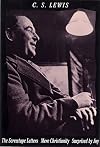
The Screwtape Letters / Mere Christianity / Surprised by Joy
by C. S. Lewis
On This Page
Tags
Recommendations














Member Reviews
A friend and I have been reading Mere Christianity together book by book. She's a devout Christian and I'm agnostic; the experience of being able to discuss this book with her was far better than the book itself (which is not to say the book is not good).
Lewis begins (in "Book I: Right and Wrong as a Clue to the Meaning of the Universe") by trying to lay out a rhetorically sound argument for Christianity from outside Christianity. I disagreed with him at almost every turn in Book I, sometimes because I disagreed with him and sometimes because he has a tendency to use analogies which don't quite hold up to close reading. This tendency (and a habit of not quoting sources (particularly the Bible) when doing so would be very helpful) made show more it sometimes difficult to follow him (and made me very glad of my friend, who could explain some Christian precepts and with whom I could suss out a salvageable meaning in some of his more frustrating analogies), even when I found I probably agreed with him. A good book in that it made me think and engage, if one with which I am at odds because of my views and because of some of Lewis's failings in his discussion. There are also some moments in which Lewis enlightens some Christian beliefs elegantly. Guardedly recommended for anyone interested in Christianity, religion, or C.S. Lewis. show less
Lewis begins (in "Book I: Right and Wrong as a Clue to the Meaning of the Universe") by trying to lay out a rhetorically sound argument for Christianity from outside Christianity. I disagreed with him at almost every turn in Book I, sometimes because I disagreed with him and sometimes because he has a tendency to use analogies which don't quite hold up to close reading. This tendency (and a habit of not quoting sources (particularly the Bible) when doing so would be very helpful) made show more it sometimes difficult to follow him (and made me very glad of my friend, who could explain some Christian precepts and with whom I could suss out a salvageable meaning in some of his more frustrating analogies), even when I found I probably agreed with him. A good book in that it made me think and engage, if one with which I am at odds because of my views and because of some of Lewis's failings in his discussion. There are also some moments in which Lewis enlightens some Christian beliefs elegantly. Guardedly recommended for anyone interested in Christianity, religion, or C.S. Lewis. show less
Ratings
Members
- Recently Added By
Author Information

534+ Works 523,642 Members
C. S. (Clive Staples) Lewis, "Jack" to his intimates, was born on November 29, 1898 in Belfast, Ireland. His mother died when he was 10 years old and his lawyer father allowed Lewis and his brother Warren extensive freedom. The pair were extremely close and they took full advantage of this freedom, learning on their own and frequently enjoying show more games of make-believe. These early activities led to Lewis's lifelong attraction to fantasy and mythology, often reflected in his writing. He enjoyed writing about, and reading, literature of the past, publishing such works as the award-winning The Allegory of Love (1936), about the period of history known as the Middle Ages. Although at one time Lewis considered himself an atheist, he soon became fascinated with religion. He is probably best known for his books for young adults, such as his Chronicles of Narnia series. This fantasy series, as well as such works as The Screwtape Letters (a collection of letters written by the devil), is typical of the author's interest in mixing religion and mythology, evident in both his fictional works and nonfiction articles. Lewis served with the Somerset Light Infantry in World War I; for nearly 30 years he served as Fellow and tutor of Magdalen College at Oxford University. Later, he became Professor of Medieval and Renaissance English at Cambridge University. C.S. Lewis married late in life, in 1957, and his wife, writer Joy Davidman, died of cancer in 1960. He remained at Cambridge until his death on November 22, 1963. (Bowker Author Biography) show less
Work Relationships
Contains
Common Knowledge
- Canonical title
- The Screwtape Letters / Mere Christianity / Surprised by Joy
Classifications
Statistics
- Members
- 96
- Popularity
- 335,191
- Reviews
- 1
- Rating
- (4.63)
- Languages
- English, Finnish, Spanish
- Media
- Paper
- ISBNs
- 1
- ASINs
- 5