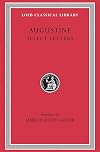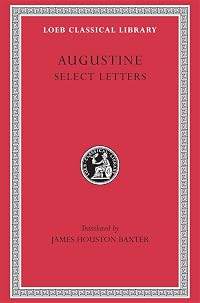
Saint Augustine: Select Letters (Loeb Classical Library #239)
by Augustine
On This Page
Description
Letters of Augustine (354-430CE) are important for the study of ecclesiastical history and Augustine's relations with other theologians.Tags
Recommendations






Member Reviews
The following excerpts are from a letter written by St. Augustine a year before his death at age 75. They provide a glimpse of the type of person St. Augustine was and the general theme and tone of the select letters.
On Praise
For when good men are praised, the praise confers a benefit on those who bestow it, not on those who receive it. For as far as concerns the good, the fact that they are good is sufficient, but the others, whose interest it is to imitate the good, are to be congratulated when they bestow praise on the good, since by doing so they show that they are pleased by those whom they praise in sincerity. ... Why should I not therefore find pleasure in being praised by you, when you are (unless I am mistaken in you) a good show more man and bestow your praise upon the things which you admire and which it is profitable and wholesome for you to admire, even if they be lacking in me? This benefits not only you, but me too, for if they are lacking in me, it is wholesome for me to be shamed and inflamed with desire to acquire them. And so the qualities I recognize in your praises as my own I rejoice in possessing and in having you love them and me for their sake; those on the other hand that I fail to recognize as mine I yearn to acquire, not only in order to possess them for myself, but also to keep those who have a genuine love for me from being deluded when they praise me.
On His Confessions
Take them, my son, take, excellent Sir, Christian that you are not on the surface only, but with Christian love--take, I repeat, those books of my Confessions that you asked for; in them behold me, so that you praise me not beyond what I am; in them give your belief to me, not to others who speak of me; in them observe me and see what I was of myself, by myself, and if anything in me gives you pleasure, join me in praising for it Him Whom I desired to have praise from me, and not myself; for "He hath made us and not we ourselves" --indeed we had destroyed ourselves, but He Who made us, re-made us. And when in them you find me, pray for me that I may not suffer defeat, but may be made complete; pray my son, pray. show less
On Praise
For when good men are praised, the praise confers a benefit on those who bestow it, not on those who receive it. For as far as concerns the good, the fact that they are good is sufficient, but the others, whose interest it is to imitate the good, are to be congratulated when they bestow praise on the good, since by doing so they show that they are pleased by those whom they praise in sincerity. ... Why should I not therefore find pleasure in being praised by you, when you are (unless I am mistaken in you) a good show more man and bestow your praise upon the things which you admire and which it is profitable and wholesome for you to admire, even if they be lacking in me? This benefits not only you, but me too, for if they are lacking in me, it is wholesome for me to be shamed and inflamed with desire to acquire them. And so the qualities I recognize in your praises as my own I rejoice in possessing and in having you love them and me for their sake; those on the other hand that I fail to recognize as mine I yearn to acquire, not only in order to possess them for myself, but also to keep those who have a genuine love for me from being deluded when they praise me.
On His Confessions
Take them, my son, take, excellent Sir, Christian that you are not on the surface only, but with Christian love--take, I repeat, those books of my Confessions that you asked for; in them behold me, so that you praise me not beyond what I am; in them give your belief to me, not to others who speak of me; in them observe me and see what I was of myself, by myself, and if anything in me gives you pleasure, join me in praising for it Him Whom I desired to have praise from me, and not myself; for "He hath made us and not we ourselves" --indeed we had destroyed ourselves, but He Who made us, re-made us. And when in them you find me, pray for me that I may not suffer defeat, but may be made complete; pray my son, pray. show less
Ratings
Members
- Recently Added By
Author Information

1,932+ Works 57,974 Members
Saint Augustine was born to a Catholic mother and a pagan father on November 13, 354, at Thagaste, near Algiers. He studied Latin literature and later taught rhetoric in Rome and Milan. He originally joined the Manicheans, a religious sect, but grew unhappy with some of their philosophies. After his conversion to Christianity and his baptism in show more 387, Augustine developed his own approach to philosophy and theology, accommodating a variety of methods and different perspectives. He believed that the grace of Christ was indispensable to human freedom, and he framed the concepts of original sin and just war. His thoughts greatly influenced the medieval worldview. One of Augustine's major goals was a single, unified church. He was ordained a priest in 391 and appointed Bishop of Hippo, in Roman Africa, in 396. Augustine was one of the most prolific Latin authors in terms of surviving works, and the list of his works consists of more than one hundred separate titles. His writings and arguments with other sects include the Donatists and the Pelagians. On the Trinity, The City of God, and On Nature and Grace are some of his important writings. Confessions, which is considered his masterpiece, is an autobiographical work that recounts his restless youth and details the spiritual experiences that led him to Christianity. Many of Augustine's ideas, such as those concerning sin and predestination, became integral to the doctrines of the Roman Catholic Church. In the Catholic Church he is a saint and pre-eminent Doctor of the Church, and the patron of the Augustinians. He is the patron saint of brewers, printers, and theologians. Augustine died on August 28, 430. (Bowker Author Biography) show less
Some Editions
Series
Belongs to Publisher Series
Loeb Classical Library (239)
Classifications
Statistics
- Members
- 126
- Popularity
- 260,000
- Reviews
- 1
- Rating
- (4.50)
- Languages
- English, Latin, Multiple languages
- Media
- Paper, Ebook
- ISBNs
- 4
- ASINs
- 2