On This Page
Description
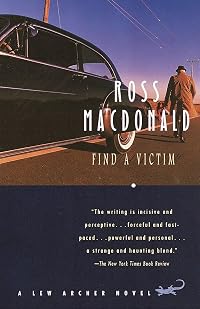
A hitchhiker stumbles to his knees on the side of a dark road. Private detective Lew Archer stops his car. When he gets to the young man, Archer realizes that he has stumbled into a mess—for the hitchhiker is dying of a gunshot wound.In a matter of hours, Archer is suspected by the law, hired by a target-shooting trucking magnate, and propositioned by an adulterer’s wife. A hijacked truck full of liquor and an evidence box full of marijuana, $20,000 from a big-time bank heist by a show more small-time crook, corruption, adultery, incest, prodigal daughters and abused wives, and a band of sinners on the loose in the hills—all make the little town of Las Cruces seem a lot more interesting than noted in the guide book. As the murder rate rises, Archer finds himself caught up in a mystery in which everyone is a suspect and everyone a victim. show lessTags
Recommendations













Member Reviews
The fifth in the Lew Archer series is a classic whodunnit in which Archer, on the road between Los Angeles and Sacramento, stumbles into a fresh murder in the kind of small town where everyone knows everybody else, and no one tells all they know. Some readers may find the "solution" too easy to guess, but since I'm not a puzzle person, I had a grand time riding along on Archer's incomprehension and occasional misunderstandings. There is some ridiculous marijuana-related material—apparently MacDonald believed grass to be a fast-acting addictive narcotic barely distinguishable from opium. I also thought it funny that Archer happened to be carrying a case of 500 joints in the back seat of his car, supposedly to deliver to some sort of show more crime committee in the capital. Oh, that? Nothing in the box, officer! Aside from the reefer madness, there are the usual vivid characterizations, snappy dialogue, and wry narrative asides that keep me coming back to MacDonald. This is my favorite in the series so far, after The Way Some People Die (#3). show less
"I wished that I was made of steel and powered by electricity."
Find a Victim, the fifth Lew Archer novel, starts off with Archer pulling over for what he at first thinks is a hitchhiker, but ends up being a mortally wounded man. Archer rushes him to the nearest town, where is awkward reception and the man's death inspire him to solve the murder of truck driver Tony Aquista.
This opening underlines the appeal of Lew Archer and the direction that later novels would follow, as Archer is more of a sympathetic soul than some of your other hard-boiled gumshoes from the fifties. Archer is a veteran of both the streets and the war; he's familiar with death and deceit. What he isn't familiar with, however, is apathy. Archer wades through the same show more swamp of sex, drugs, corruption and degradation as an observer and occasional judge, but not with cynical detachment of his contemporaries.
As he snoops around the city of Las Cruces (Also known as "The City of Crosses," or the multiple of Crux, both obvious allusions to the multiple betrayals and double-crosses occurring among our cast of characters), his compassion towards the frailties of human nature affect him and drive him to dig deeper more than any paycheck or thoughtless moral code. At one point he even seeks out employment to justify his involvement in the case, but even that is abandoned as he gets closer to the truth no one in interested in, and the justice nobody else appears to be looking for.
Plot-wise, there isn't much groundbreaking material: Cheating husbands, frustrated wives, corrupt officials, duplicitous businessmen, violent criminals, cheap dives, loose women... You know the score. But MacDonald's prose will occasionally sweep in with something lyrical or unexpected, and Archer's tough exterior yields a soul of empathy and understanding just often enough to reveal his true search in Find a Victim isn't for justice, but humanity. show less
Find a Victim, the fifth Lew Archer novel, starts off with Archer pulling over for what he at first thinks is a hitchhiker, but ends up being a mortally wounded man. Archer rushes him to the nearest town, where is awkward reception and the man's death inspire him to solve the murder of truck driver Tony Aquista.
This opening underlines the appeal of Lew Archer and the direction that later novels would follow, as Archer is more of a sympathetic soul than some of your other hard-boiled gumshoes from the fifties. Archer is a veteran of both the streets and the war; he's familiar with death and deceit. What he isn't familiar with, however, is apathy. Archer wades through the same show more swamp of sex, drugs, corruption and degradation as an observer and occasional judge, but not with cynical detachment of his contemporaries.
As he snoops around the city of Las Cruces (Also known as "The City of Crosses," or the multiple of Crux, both obvious allusions to the multiple betrayals and double-crosses occurring among our cast of characters), his compassion towards the frailties of human nature affect him and drive him to dig deeper more than any paycheck or thoughtless moral code. At one point he even seeks out employment to justify his involvement in the case, but even that is abandoned as he gets closer to the truth no one in interested in, and the justice nobody else appears to be looking for.
Plot-wise, there isn't much groundbreaking material: Cheating husbands, frustrated wives, corrupt officials, duplicitous businessmen, violent criminals, cheap dives, loose women... You know the score. But MacDonald's prose will occasionally sweep in with something lyrical or unexpected, and Archer's tough exterior yields a soul of empathy and understanding just often enough to reveal his true search in Find a Victim isn't for justice, but humanity. show less
review of
Ross MacDonald's Find a Victim
by tENTATIVELY, a cONVENIENCE - January 28-29, 2021
Ok, I'm still on a Ross MacDonald roll. I've gotten to that point of fannish enthusiasm where when I checked out the Paul Neuman vehicle based on one of the last MacDonalds I reviewed (The Moving Target - https://www.goodreads.com/review/show/3767166180 ) but renamed Harper I was displeased by such details as having the detective, Lew Archer, chewing gum the whole time. THAT. IS. ALL. WRONG.
Just as I was beginning to wonder if all of MacDonald's novels start w/ a Missing Person this one comes along & starts w/ a dying man by the highway who Archer just happens to find while he's driving along minding his own beeswax. That was a relief b/c I was show more afraid I might have to dig up MacDonald's corpse & feed it ice cream. &, then, of all things, there's an epigraph that explains the title right off the Wuhan bat soup:
"A man feared the he might find an assassin;
Another that he might find a victim.
One was more wise than the other.
STEPHEN CRANE"
Ok, I'm a sucker for all the tropes of hard-b(o)iled detective novels, esp the sense of humor that the detective has. Anyone who's ever worked in a job where the harsher realities of life are more to the fore than usual knows that a sense of humor helps one endure the grimness.
""Can I help you?" she said in a distant way.
""A man in my car needs help, badly. I'll bring him in while you call a doctor."
"Her eyebrows moved downward, a worried cleft between them. "Is he sick?"
""With lead poisoning. He's been shot."" - p 2
Now, that lead poisoning joke has probably been used by others. Why it's even possible that an entire novel cd be made just out of passages that contain it. Imagine that. On the New York Times Best Seller List, prominently displayed in bkstores (do they still exist?) across the world. It gets me every time. But more important than shooting victim jokes are drive-ins. Visionary developer James Rouse wrote a bk about the shopping mall as the new religious center. Little did he know. Actually, he was all wet, the DRIVE-IN is the new religious center. Now that culture has been reduced to non-essential it's only at the drive-in where I can go to soak the horror & the comedy & the Westerns that're the very CRUX of our great nation.
"I missed the green arrow and had to wait. The hospital was visible in the distance, a long white box of a building pierced with lights. Nearer the highway, the lighted screen of an outdoor theater, on which two men were beating each other to the rhythm of passionate music, rose against the night like a giant dream of violence." - p 5
I can always go for a good sexy description too.
"I watched her sway out after him, wondering if she could be Anne Meyer. She didn't look like any motel manager I had ever seen. More likely an actress who hadn't quite made the grade down south, or a very successful amateur tart on the verge of turning pro. Whatever her business was, there had to be sex in it. She was as full of sex as a grape is full of juice, and so young that it hadn't begin to sour." - pp 19-20
Can't you just imagine her popping out of the toaster, all hot & bothered?
Then there's money: have you ever noticed how frequently it features in crime & crime fiction? I've heard that money's the root of all evil - does that mean that if we get rid of money there wd be no more crime?
"["]The other ten comes out of my pocket." He grimaced painfully, as if he were describing a surgical operation that he faced, a moneyectomy. "Seven thousand dollars more or less."" - p 33
Avoid Moneyectomy at all cost! Wait. That doesn't work, does it?
This here per-TICK-ular novel is a good hard look at typical male abusiveness of women & some of the generic dynamic surrounding it. It's pretty nasty, I'm sick of it, just like I'm sick of 'real' life.
""What kind of trouble did she have with your father? You said something about his corrupting her."
""Did I? I didn't mean to. He did a terrible thing to her. Don't ask me what it was." Emotion rose in her throat, thickening her voice and almost choking her, like blood from an internal hemorrhage. "Most of the men in this city are barbarians where women are concerned. It's a wretched place for a girl to try and grow up. It's like living among savages."" - p 41
Actually, I reckon "savages" are getting an undeserved bad rep here.
""Cruel?"
""I don't mean he beat her, anyway not where it showed. Mental cruelty was what she complained of. He must of been a Tartar at that, to make her want to kill herself."
""She tried to kill herself?"
""That's right. She took a handful of sleeping-pills, way back when they were first married. Brand tried to cover up and pass it off as an accident, but I got the truth of it from Annie. Annie was with them in those days."" - p 118
""She was a sweet little piece. I wonder what happened to her."
""Don't you ever get enough of it?"" - p 152
There's a touch of "Reefer Madness" in this that weakens the realism a bit. Every time I got stoned I went on a killing spree, I didn't act crazy like this fool.
"She came up to me like an eager child who had been promised a gift. "What did Donny send me?"
""This." I closed the door behind me and gave her the packet wrapped in butcher's paper.
"Her fingers tore it open, scattered the brown cigarettes on the rug. She went down on her knees to retrieve them, snatching at them as if they were live worms that might wriggle away from her. She stood up with four of them in her hand and one in her mouth.
"I flicked my lighter and lit it for her. I told myself that it was necessary, that she had the habit anyway, that police departments paid off informers with dope every day in the year. But I couldn't shake off the feeling as I watched her that I had bought a small piece of her future."
I'm wearing red long underwear at the moment. Everyone knows that only hicks do that.
"His myopic eyes focused on me for the first time, took in my face, the wreckage of my clothes. "You're not—are you a policeman?" His hand went to his mouth.
""A special agent from Washington," I said. "We've had our eye on you for wearing red pajamas. Watch it, Gunnison."" - p 81
Humor & Poetry, Poetry & Humor - the twin poles of the Barber, Samuel.
"I drove east toward the phantom mountains. When I was a few miles outside the city limits, something broke like a capsule behind my eyes. It leaked darkness through my brain and numbness through my body. I stopped the car on the shoulder of the road. Somewhere in the hills to the southwest, the Cyclops eye of the air beacon still scanned the starless sky. I wished that I was made of steel and powered by electricity." - p 89
Archer is an introspective detective, perhaps most of them are.. at least in fiction - I don't think I've ever met one in 'real life'. I like introspection & prefer to culturally encourage it.
""I suppose I asked for that," she said. "You have been kind to me, though, last night, and again today. I can't help wondering if it's simply a technique. Is this your crimeside manner, Mr. Archer? Your psychological third-degree?"
"There was enough truth in the question to make me wince. "I'm playing it as straight as I can with you. I don't deny that I've been tempted to use people, play on their feelings, push them around. Those are the occupational diseases of my job."
""And you don't have them?"
""I have them." Jo Summer's changing smile wavered smokily behind my eyes. "This is a dirty business I'm in. All I can do is watch myself and keep it as clean as I can." I felt as if she'd put me on the spot, and I changed the direction of the conversation" - pp 111-112
Fictional detectives are stubborn, they usually stick w/ their investigation until they get to the truth - I doubt that 'real life' detectives are generally that fortunate, stubborn or otherwise. Of course, in fiction there's often a preference for satisfying the reader w/ closure. I admit to preferring that & to preferring happy endings. They're hard to get otherwise.
"I found a doctor and had eight stitches put in my face. The doctor seemed to take it as a matter of course and asked no questions. When the job was finished, though, he asked me for twenty-five dollars in cash. He was that kind of a doctor, or I was that kind of a patient.
"When I left his office, I had a powerful impulse to climb into my car and drive away from Las Crices and never come back. I couldn't think of a single solid reason for staying. So I drove across town to the courthouse, accompanied by my Messianic complex." - pp 127-128
Another highly satisfactory romp thru human depravity. I'm glad to be reading about it instead of living it. show less
Ross MacDonald's Find a Victim
by tENTATIVELY, a cONVENIENCE - January 28-29, 2021
Ok, I'm still on a Ross MacDonald roll. I've gotten to that point of fannish enthusiasm where when I checked out the Paul Neuman vehicle based on one of the last MacDonalds I reviewed (The Moving Target - https://www.goodreads.com/review/show/3767166180 ) but renamed Harper I was displeased by such details as having the detective, Lew Archer, chewing gum the whole time. THAT. IS. ALL. WRONG.
Just as I was beginning to wonder if all of MacDonald's novels start w/ a Missing Person this one comes along & starts w/ a dying man by the highway who Archer just happens to find while he's driving along minding his own beeswax. That was a relief b/c I was show more afraid I might have to dig up MacDonald's corpse & feed it ice cream. &, then, of all things, there's an epigraph that explains the title right off the Wuhan bat soup:
"A man feared the he might find an assassin;
Another that he might find a victim.
One was more wise than the other.
STEPHEN CRANE"
Ok, I'm a sucker for all the tropes of hard-b(o)iled detective novels, esp the sense of humor that the detective has. Anyone who's ever worked in a job where the harsher realities of life are more to the fore than usual knows that a sense of humor helps one endure the grimness.
""Can I help you?" she said in a distant way.
""A man in my car needs help, badly. I'll bring him in while you call a doctor."
"Her eyebrows moved downward, a worried cleft between them. "Is he sick?"
""With lead poisoning. He's been shot."" - p 2
Now, that lead poisoning joke has probably been used by others. Why it's even possible that an entire novel cd be made just out of passages that contain it. Imagine that. On the New York Times Best Seller List, prominently displayed in bkstores (do they still exist?) across the world. It gets me every time. But more important than shooting victim jokes are drive-ins. Visionary developer James Rouse wrote a bk about the shopping mall as the new religious center. Little did he know. Actually, he was all wet, the DRIVE-IN is the new religious center. Now that culture has been reduced to non-essential it's only at the drive-in where I can go to soak the horror & the comedy & the Westerns that're the very CRUX of our great nation.
"I missed the green arrow and had to wait. The hospital was visible in the distance, a long white box of a building pierced with lights. Nearer the highway, the lighted screen of an outdoor theater, on which two men were beating each other to the rhythm of passionate music, rose against the night like a giant dream of violence." - p 5
I can always go for a good sexy description too.
"I watched her sway out after him, wondering if she could be Anne Meyer. She didn't look like any motel manager I had ever seen. More likely an actress who hadn't quite made the grade down south, or a very successful amateur tart on the verge of turning pro. Whatever her business was, there had to be sex in it. She was as full of sex as a grape is full of juice, and so young that it hadn't begin to sour." - pp 19-20
Can't you just imagine her popping out of the toaster, all hot & bothered?
Then there's money: have you ever noticed how frequently it features in crime & crime fiction? I've heard that money's the root of all evil - does that mean that if we get rid of money there wd be no more crime?
"["]The other ten comes out of my pocket." He grimaced painfully, as if he were describing a surgical operation that he faced, a moneyectomy. "Seven thousand dollars more or less."" - p 33
Avoid Moneyectomy at all cost! Wait. That doesn't work, does it?
This here per-TICK-ular novel is a good hard look at typical male abusiveness of women & some of the generic dynamic surrounding it. It's pretty nasty, I'm sick of it, just like I'm sick of 'real' life.
""What kind of trouble did she have with your father? You said something about his corrupting her."
""Did I? I didn't mean to. He did a terrible thing to her. Don't ask me what it was." Emotion rose in her throat, thickening her voice and almost choking her, like blood from an internal hemorrhage. "Most of the men in this city are barbarians where women are concerned. It's a wretched place for a girl to try and grow up. It's like living among savages."" - p 41
Actually, I reckon "savages" are getting an undeserved bad rep here.
""Cruel?"
""I don't mean he beat her, anyway not where it showed. Mental cruelty was what she complained of. He must of been a Tartar at that, to make her want to kill herself."
""She tried to kill herself?"
""That's right. She took a handful of sleeping-pills, way back when they were first married. Brand tried to cover up and pass it off as an accident, but I got the truth of it from Annie. Annie was with them in those days."" - p 118
""She was a sweet little piece. I wonder what happened to her."
""Don't you ever get enough of it?"" - p 152
There's a touch of "Reefer Madness" in this that weakens the realism a bit. Every time I got stoned I went on a killing spree, I didn't act crazy like this fool.
"She came up to me like an eager child who had been promised a gift. "What did Donny send me?"
""This." I closed the door behind me and gave her the packet wrapped in butcher's paper.
"Her fingers tore it open, scattered the brown cigarettes on the rug. She went down on her knees to retrieve them, snatching at them as if they were live worms that might wriggle away from her. She stood up with four of them in her hand and one in her mouth.
"I flicked my lighter and lit it for her. I told myself that it was necessary, that she had the habit anyway, that police departments paid off informers with dope every day in the year. But I couldn't shake off the feeling as I watched her that I had bought a small piece of her future."
I'm wearing red long underwear at the moment. Everyone knows that only hicks do that.
"His myopic eyes focused on me for the first time, took in my face, the wreckage of my clothes. "You're not—are you a policeman?" His hand went to his mouth.
""A special agent from Washington," I said. "We've had our eye on you for wearing red pajamas. Watch it, Gunnison."" - p 81
Humor & Poetry, Poetry & Humor - the twin poles of the Barber, Samuel.
"I drove east toward the phantom mountains. When I was a few miles outside the city limits, something broke like a capsule behind my eyes. It leaked darkness through my brain and numbness through my body. I stopped the car on the shoulder of the road. Somewhere in the hills to the southwest, the Cyclops eye of the air beacon still scanned the starless sky. I wished that I was made of steel and powered by electricity." - p 89
Archer is an introspective detective, perhaps most of them are.. at least in fiction - I don't think I've ever met one in 'real life'. I like introspection & prefer to culturally encourage it.
""I suppose I asked for that," she said. "You have been kind to me, though, last night, and again today. I can't help wondering if it's simply a technique. Is this your crimeside manner, Mr. Archer? Your psychological third-degree?"
"There was enough truth in the question to make me wince. "I'm playing it as straight as I can with you. I don't deny that I've been tempted to use people, play on their feelings, push them around. Those are the occupational diseases of my job."
""And you don't have them?"
""I have them." Jo Summer's changing smile wavered smokily behind my eyes. "This is a dirty business I'm in. All I can do is watch myself and keep it as clean as I can." I felt as if she'd put me on the spot, and I changed the direction of the conversation" - pp 111-112
Fictional detectives are stubborn, they usually stick w/ their investigation until they get to the truth - I doubt that 'real life' detectives are generally that fortunate, stubborn or otherwise. Of course, in fiction there's often a preference for satisfying the reader w/ closure. I admit to preferring that & to preferring happy endings. They're hard to get otherwise.
"I found a doctor and had eight stitches put in my face. The doctor seemed to take it as a matter of course and asked no questions. When the job was finished, though, he asked me for twenty-five dollars in cash. He was that kind of a doctor, or I was that kind of a patient.
"When I left his office, I had a powerful impulse to climb into my car and drive away from Las Crices and never come back. I couldn't think of a single solid reason for staying. So I drove across town to the courthouse, accompanied by my Messianic complex." - pp 127-128
Another highly satisfactory romp thru human depravity. I'm glad to be reading about it instead of living it. show less
As a private detective Lew Archer is used to cases coming to him. But when he encounters a dying man on the side of the highway between Los Angeles and Sacramento, he quickly finds himself enmeshed in the investigation of a hijacked shipment of bourbon, the question of a missing woman, and the hostile relationship between a local businessman and the county sheriff. As corpses start to pile up, Archer must untangle the threads before more people die — with his own body possibly among them.
As the fifth book published in his Lew Archer series, Ross Macdonald's novel offers a nice mix of the fresh and the familiar. By this point he was increasingly focused on the elements that made his books so great, namely the characters revealed by his show more protagonist's investigations. Yet Macdonald starts the novel in a way unusual with his books, as he drops Archer into the middle of events, giving him a need to find a justification to stay with the case and see it through. The amount of effort this entails for his central character provided for a nice change of pace from his other works, and shows how willing Macdonald was to tweak with his formula to produce yet another engrossing tale of temptation and murder in postwar America. show less
As the fifth book published in his Lew Archer series, Ross Macdonald's novel offers a nice mix of the fresh and the familiar. By this point he was increasingly focused on the elements that made his books so great, namely the characters revealed by his show more protagonist's investigations. Yet Macdonald starts the novel in a way unusual with his books, as he drops Archer into the middle of events, giving him a need to find a justification to stay with the case and see it through. The amount of effort this entails for his central character provided for a nice change of pace from his other works, and shows how willing Macdonald was to tweak with his formula to produce yet another engrossing tale of temptation and murder in postwar America. show less
On his way to Sacramento, Archer finds a man bloody and dying on the side of the road. He gets him in his car and gets him to a hospital, where the man dies from his gunshot wounds. And the case begins…
It's a nice paced story, with all of the usual chaos of an Archer novel. And with an ending that has the murderer as someone I would not have guessed! Not the first time in this series that Mr. Macdonald has done that to me! I'm sure Archer will steer far clear of Las Cruces in future novels!
“You didn’t bring the trouble. I’ve had it all along.”
“My legs forgot about me.”
“Money and marijuana, the stuff that dreams are made of.” - but at book's end, what becomes of them???
It's a nice paced story, with all of the usual chaos of an Archer novel. And with an ending that has the murderer as someone I would not have guessed! Not the first time in this series that Mr. Macdonald has done that to me! I'm sure Archer will steer far clear of Las Cruces in future novels!
“You didn’t bring the trouble. I’ve had it all along.”
“My legs forgot about me.”
“Money and marijuana, the stuff that dreams are made of.” - but at book's end, what becomes of them???
This book certainly has the noir atmosphere down. It felt dark and shabby throughout, although not without sympathy for some of the victims that Archer comes across; Jo in particular suffers a great deal. I didn't predict the final revelation involving Jo's grandfather. For the most part I think everything was wrapped up, with few or no extraneous characters. I wouldn't suggest starting with this book in the series. It is better for those who are already familiar with Archer and his world.
This entry in the Lew Archer series was a bit too hardboiled for my tastes. However, the ending was surprisingly heartrending so maybe it deserves another ½ star...
Members
- Recently Added By
Lists

Best Noir Fiction
160 works; 14 members

Anthony Boucher's Best Crime Fiction of the Year
115 works; 5 members

Books Read in 2016
4,666 works; 199 members
Author Information

103+ Works 14,274 Members
Some Editions
Awards and Honors
Distinctions
Series

Belongs to Publisher Series
Common Knowledge
- Canonical title
- Find a Victim
- Original title
- Find a Victim
- Original publication date
- 1954
- People/Characters
- Lew Archer; Tony Aquista; Sheriff Brandon Church; Danelaw; Sal Braga; Don Kerrigan (show all 13); Kate Kerrigan; Anne Meyer; Hilda Church; Jo Summer; Jerry Mae; Mr. MacGowan; Bozey
- Important places
- Las Cruces
- Epigraph
- A man feared that he might find an assassin; Another that he might find a victim. One was more wise than the other. - Stephen Crane
- Dedication
- To Ivan von Auw, Jr.
- First words
- He was the ghastliest hitchhiker who ever thumbed me.
- Last words
- (Click to show. Warning: May contain spoilers.)Church washed and bandaged her bleeding hands before they took her away.
- Original language
- Inglés
Classifications
Statistics
- Members
- 495
- Popularity
- 61,297
- Reviews
- 15
- Rating
- (3.92)
- Languages
- 11 — Danish, English, Estonian, Finnish, French, German, Norwegian (Bokmål), Norwegian, Portuguese, Spanish, Swedish
- Media
- Paper, Audiobook, Ebook
- ISBNs
- 41
- ASINs
- 18