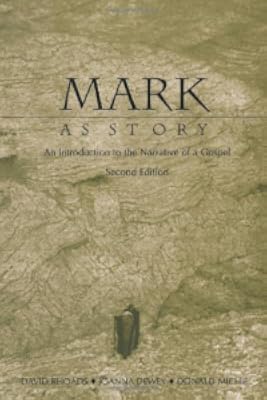
Mark As Story: An Introduction to the Narrative of a Gospel
by David Rhoads, Joanna Dewey, Donald M. Michie
On This Page
Description
"For thirty years, Mark as Story has introduced readers to the rhetorical and narrative skill that makes Mark so arresting and compelling a story. Rhoads, Dewey, and Michie have helped to pioneer our appreciation of the Gospels, and Mark in particular, as narratives originally created in an oral culture for oral performance. New in this edition are a revised preface and an afterword describing the significant role Mark as Story has played in the development of narrative criticism"--Publisher show more description show lessTags
Recommendations









Member Reviews
Some of the criticisms I have gotten from my peers about this book is that they didn't like the liberties the authors took in "translating" the gospel of Mark. The authors are not translating the Gospel of Mark. They are illustrating how Mark works as a story that one may hear around a campfire. I don't see the "liberalism" that the first reviewer has identified. Rhoads/Dewey/Michie employ literary criticism to unpack the significance of the various facets of Mark's gospel. If you are a student of scripture and you want to learn to read the oft overly-familiar bible with a fresh lens, Mark as Story will give you a fresh start at reading the scriptures.
A good introduction to the Gospel of Mark as a narrative story. The authors apply the practice of literary analysis, and look at the storytelling narratives in the book of Mark. While the authors assume Mark is historically accurate, this book can be read without cringing by people who do not see accuracy in the narrative, as it deals solely with literary analysis. In fact, for those who have devoured works of the Biblical scholars, this work actually helps to sort out some of the tangled webs of history and tradition; so many techniques used in the book are so obviously literary that it begins to look, on its face, as if the author was telling a story rather than reporting history, which uses different techniques to engage the reader. show more Overall, a good complement to any library on comparative religions, biblical criticism, or freethought. show less
When people read the Bible, whether at home or in church, only read short passages at a time. The three authors of this book, all seminary and college professors, seek to remind readers that each book of the Bible originally was an organic whole, meant to be read as a single story.
This is an important lesson, and the Gospel of Mark is an excellent example; it is perhaps the most complete narrative in the Bible. Unlike many other Biblical writings, it is not a composite of multiple narratives and it does not show evidence of significant editorial additions or excisions. So it offers an ancient version of what modern readers might call, "the author's vision."
After a brief introduction to their enterprise, the authors offer their own show more translation of the gospel, written in modern form with paragraphs and modern punctuation. They then explore the main narrative aspects of Mark: the narrator, the setting, the plot, the characters, and the (assumed or ideal) reader.
It should be noted that their examination uses modern categories for study, rather than ancient ones; this makes the study readily accessible to modern students, but one wonders if their analysis misses some authorial intent by not paying attention to the ancient rhetorical categories.
Regardless, there are real benefits to this study. It encourages people to look at the Gospel of Mark in a new and relevant way. The overall study challenges the verse by verse approach most people have when reading the Bible (encouraged by commentaries, reference notes in study Bibles, and many pastors in their preaching), reminding people that the Bible was not written to be a reference book like an encyclopedia, where one reads brief articles about specific subjects, but instead includes writings that once stood on their own as complete works.
The book is well geared for college students and Bible study groups. It is written in a clear way, with plenty of explanation and examples to encourage engagement with the primary text. However, the book is not ground-breaking for those who are well-read about the gospels in general and Mark in particular. Additionally, once you accept this approach, the interpretation of the writers seems a bit superficial. Frankly, the examination of the narrator, especially, and the characters seemed rather thin in this study. show less
This is an important lesson, and the Gospel of Mark is an excellent example; it is perhaps the most complete narrative in the Bible. Unlike many other Biblical writings, it is not a composite of multiple narratives and it does not show evidence of significant editorial additions or excisions. So it offers an ancient version of what modern readers might call, "the author's vision."
After a brief introduction to their enterprise, the authors offer their own show more translation of the gospel, written in modern form with paragraphs and modern punctuation. They then explore the main narrative aspects of Mark: the narrator, the setting, the plot, the characters, and the (assumed or ideal) reader.
It should be noted that their examination uses modern categories for study, rather than ancient ones; this makes the study readily accessible to modern students, but one wonders if their analysis misses some authorial intent by not paying attention to the ancient rhetorical categories.
Regardless, there are real benefits to this study. It encourages people to look at the Gospel of Mark in a new and relevant way. The overall study challenges the verse by verse approach most people have when reading the Bible (encouraged by commentaries, reference notes in study Bibles, and many pastors in their preaching), reminding people that the Bible was not written to be a reference book like an encyclopedia, where one reads brief articles about specific subjects, but instead includes writings that once stood on their own as complete works.
The book is well geared for college students and Bible study groups. It is written in a clear way, with plenty of explanation and examples to encourage engagement with the primary text. However, the book is not ground-breaking for those who are well-read about the gospels in general and Mark in particular. Additionally, once you accept this approach, the interpretation of the writers seems a bit superficial. Frankly, the examination of the narrator, especially, and the characters seemed rather thin in this study. show less
My first exposure to narrative criticism in New Testament studies, and I still think it's a good place to start, even though much work has been done in the field since.
Contradictory in assertions, inconsistent in method, repetitious in details, smug in attitude—no, I didn't like it at all.
Contradictory in assertions, inconsistent in method, repetitious in details, smug in attitude—no, I didn't like it at all.
David performed this translation in Geneva and did seminars for us. Wonderful!
Members
- Recently Added By
Lists

Reading list
170 works; 1 member
Author Information

14+ Works 864 Members
David Rhoads is Professor of New Testament at Lutheran School of Theology at Chicago.
6+ Works 651 Members
1 Work 586 Members
Common Knowledge
- Important events
- John preaches and baptizes (Mark 1:1-8); Baptism of Jesus of Nazareth (Mark 1:9-11); Jesus' temptation in the desert (Mark 1:12-13); Jesus calls his disciples (Mark 1:16-20, 2:13-17); Jesus calms the stormy sea (Mark 4:35-41); Jesus heals man with palsy (Mark 2:1-12) (show all 47); Jesus raises Jairus’ daughter from the dead (Mark 5:21-43); Jesus’ parable of the sower (Mark 4:1-20); Jesus’ parables of the mustard seed and the yeast (Mark 4:30-34); Jesus heals a leper (Mark 1:40-45); Jesus sends the 12 Apostles (Mark 6:7-13); Beheading of John the Baptist (Mark 6:21-29); Jesus feeds the 5,000 (Mark 6:30-44); Jesus walks on the sea (Mark 6:45-56); Jesus feeds 4,000 (Mark 8:1-10); Jesus heals a blind man (Mark 8:22-26); Peter’s confession of Christ (Mark 8:27-30); Transfiguration (Mark 9:2-13); Jesus restores a lunatic (Mark 9:14-29); Jesus’ prophecy of His suffering (Mark 9:30-32); Jesus blesses small children (Mark 10:13-16); The rich young man (Mark 10:17-27); Jesus restores the sight of 2 blind men (Mark 10:46-52); Jesus anointed in Bethany (Mark 14:3-9); Jesus’ triumphant entry to Jerusalem (Mark 11:1-11); The cursing of the fig tree (Mark 11:12-14,20-26); Jesus purges the Temple (Mark 11:15-19); The widow’s mite (Mark 12:41-44); Judas agrees to betray Jesus (Mark 14:10-11); Jesus and disciples prepare for Passover (Mark 14:12-16); Last Supper (Mark 14:17-25); Garden of Gethsemane (Mark 14:32-42); Jesus taken captive (Mark 14:43-52); Jesus’ trial (Mark 14:53-65); Peter denies Jesus (Mark 14:54-72); Jesus before Pilate (Mark 15:2-5); Jesus sentenced to death by Pilate (Mark 15:6-19); Crucifixion of Jesus of Nazareth (Mark 15:20-28); Jesus’ words on the cross (Mark 15:24-37); Jesus’ death (Mark 15:37-41); Jesus’ burial (Mark 15:42-47); Jesus’ resurrection (Mark 16:1-11); Easter (Mark 16:1-13); Road to Emmaus (Mark 16:12-13); Jesus revealed to his disciples (Mark 16:14); The Great Commission (Mark 16:15-18); Ascension (Mark 16:19-20)
Classifications
Statistics
- Members
- 584
- Popularity
- 50,363
- Reviews
- 10
- Rating
- (3.75)
- Languages
- English
- Media
- Paper, Ebook
- ISBNs
- 4
- ASINs
- 5