On This Page
Tags
Recommendations















Member Reviews
Tactics of Mistake
Gordon R. Dickson (1998)
ISBN: 0812545311
[i]The young lieutenant-colonel was drink, apparently, and determined to rush upon disaster.[/i]
From the moment when young Alliance Officer Cletus Grahame makes his drunken entry into the ship's dining hall and introduces himself to the enemy -- the very powerful Dow DeCastries -- the reader is swept up into the world of intrigue. Grahame and DeCastries represent the battle between the Collation and the Alliance. Cletus has the difficult job of bringing down a man who holds the lives of billions in his hands, and he's not off to a good start. In a game of wits, it would seem that Cletus is out of his league from the start.
And he can't foresee the future and know that his family show more will go on to be the power Dorsai warriors whose exploits Dickson would continue to write about for many years to come, tracing them from their early days in the Chantry Guild and on to The Final Encyclopedia and an attempt to reconnect man to his history, no matter how far he's roamed.
I loved the Dorsai books, especially Tactics of Mistake and Lost Dorsai. Gordon R. Dickson had a wonderful ability to create characters and fascinating situations. Tactics of Mistake is one of the best of the set. show less
Gordon R. Dickson (1998)
ISBN: 0812545311
[i]The young lieutenant-colonel was drink, apparently, and determined to rush upon disaster.[/i]
From the moment when young Alliance Officer Cletus Grahame makes his drunken entry into the ship's dining hall and introduces himself to the enemy -- the very powerful Dow DeCastries -- the reader is swept up into the world of intrigue. Grahame and DeCastries represent the battle between the Collation and the Alliance. Cletus has the difficult job of bringing down a man who holds the lives of billions in his hands, and he's not off to a good start. In a game of wits, it would seem that Cletus is out of his league from the start.
And he can't foresee the future and know that his family show more will go on to be the power Dorsai warriors whose exploits Dickson would continue to write about for many years to come, tracing them from their early days in the Chantry Guild and on to The Final Encyclopedia and an attempt to reconnect man to his history, no matter how far he's roamed.
I loved the Dorsai books, especially Tactics of Mistake and Lost Dorsai. Gordon R. Dickson had a wonderful ability to create characters and fascinating situations. Tactics of Mistake is one of the best of the set. show less
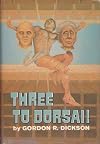
Three to Dorsai! is a 1975 omnibus volume containing three books in Gordon R. Dickson's Childe series: 1959's Dorsai!, 1962's Necromancer, and 1971's The Tactics of Mistake. The oldest book appears third. The author added an introduction, prologue, and interludes between the novels, and an epilogue. The extra material, aside from the introduction, is stated to be excerpts from the last two books of the Cycle. (Mr. Dickson explained that there would be 12 books, three set in the past, three set in the present, and six set in the future. All of the books in this omnibus are set in the future.)
While the Dorsai have been mentioned in things I have read, this is my introduction to the series. My best friend recommended The Tactics of show more Mistake. That volume was available among my county's libraries only through this omnibus, so I checked it out. I looked up the series online and saw there were other titles, but I have no idea if they truly carried out the author's original intention.
The interludes between the three books take place at the Final Encyclopedia, which is in orbit around Earth. According to the introduction, over 87% percent of the structure is energy. It's supposed to store all of the information about humanity and its "immediate environment" up until the interludes take place, although there are 'dark areas' where they don't have information that should be available. The prologue, interludes, and the epilogue consist of conversations between Hal Mayne, the author of the poem 'The Enchanted Tower,' and an old journalist named Tam Olyn. The prologue explains how the poem is helping Hal to connect historical events to humanity's evolutionary development.
PROLOGUE:
The First Encyclopedia is Tam Olyn's responsibility. He comes to talk with Hal, who has made a discovery.
a. The year is 2342.
b. Hal types 'PRIME CHARACTER to CREATIVE CONCEPT to INDIVIDUALS to SUB-CULTURE to CULTURAL CONCEPT to RACE CHANGE (EVOLUTION)', with an arrow pointing to the right over the words 'culture,' 'concept,' and 'change'.
c. Sir John Hawkwood, a mercenary soldier at the beginning of the 14th century, started this evolutionary process through his actions. He was a prime character. (We get the character's title and first name from the introduction. Hal calls him only 'Hawkwood'.)
d. Hal is expecting the culmination of the evolution to occur in months or up to two years in the future.
e. Hal suspects there was another prime character in 2083.
INTERLUDE:
a. Paul Formain has been identified as that prime character.
b. The Exotic Splinter Culture was founded as a result of the events in Necromancer. We learn a little about what three of the characters did next.
c. 'Necromancer' is the name Hal gives the unknown animating spirit in the novel of that name.
d. What Paul Formain called 'the Alternate Universe,' Hal calls 'the Creative Universe'.
e. Hal dubs Sir John Hawkwood a 'Man of War' and the Necromancer as a 'Man of Philosophy.
What interests me most about this interlude is that the evolving splinter groups of humanity aren't viable unless they breed back with 'Earth-born, full-spectrum human stock'.
[SECOND] INTERLUDE:
a. Tam compares Cletus Grahame to Hawkwood. Hal agrees he was a Man of War.
b. Hal believes that the three types of Prime Character are the war chief, the wise man, and the shaman. He's now searching for the Man of Faith.
c. Hal's words remind Tam of what he experienced when he first entered the Final Encyclopedia.
EPILOGUE:
a. Tam feels the mind of Hal at work with the Final Encyclopedia.
b. We read about Donal Graeme's final voyage.
c. Hal isn't even 25 years old.
d. The identity of the Necromancer is revealed.
If you want to experience three of the Dorsai books, this omnibus volume might be a good place to start. show less
While the Dorsai have been mentioned in things I have read, this is my introduction to the series. My best friend recommended The Tactics of show more Mistake. That volume was available among my county's libraries only through this omnibus, so I checked it out. I looked up the series online and saw there were other titles, but I have no idea if they truly carried out the author's original intention.
The interludes between the three books take place at the Final Encyclopedia, which is in orbit around Earth. According to the introduction, over 87% percent of the structure is energy. It's supposed to store all of the information about humanity and its "immediate environment" up until the interludes take place, although there are 'dark areas' where they don't have information that should be available. The prologue, interludes, and the epilogue consist of conversations between Hal Mayne, the author of the poem 'The Enchanted Tower,' and an old journalist named Tam Olyn. The prologue explains how the poem is helping Hal to connect historical events to humanity's evolutionary development.
PROLOGUE:
The First Encyclopedia is Tam Olyn's responsibility. He comes to talk with Hal, who has made a discovery.
a. The year is 2342.
b. Hal types 'PRIME CHARACTER to CREATIVE CONCEPT to INDIVIDUALS to SUB-CULTURE to CULTURAL CONCEPT to RACE CHANGE (EVOLUTION)', with an arrow pointing to the right over the words 'culture,' 'concept,' and 'change'.
c. Sir John Hawkwood, a mercenary soldier at the beginning of the 14th century, started this evolutionary process through his actions. He was a prime character. (We get the character's title and first name from the introduction. Hal calls him only 'Hawkwood'.)
d. Hal is expecting the culmination of the evolution to occur in months or up to two years in the future.
e. Hal suspects there was another prime character in 2083.
INTERLUDE:
a. Paul Formain has been identified as that prime character.
b. The Exotic Splinter Culture was founded as a result of the events in Necromancer. We learn a little about what three of the characters did next.
c. 'Necromancer' is the name Hal gives the unknown animating spirit in the novel of that name.
d. What Paul Formain called 'the Alternate Universe,' Hal calls 'the Creative Universe'.
e. Hal dubs Sir John Hawkwood a 'Man of War' and the Necromancer as a 'Man of Philosophy.
What interests me most about this interlude is that the evolving splinter groups of humanity aren't viable unless they breed back with 'Earth-born, full-spectrum human stock'.
[SECOND] INTERLUDE:
a. Tam compares Cletus Grahame to Hawkwood. Hal agrees he was a Man of War.
b. Hal believes that the three types of Prime Character are the war chief, the wise man, and the shaman. He's now searching for the Man of Faith.
c. Hal's words remind Tam of what he experienced when he first entered the Final Encyclopedia.
EPILOGUE:
a. Tam feels the mind of Hal at work with the Final Encyclopedia.
b. We read about Donal Graeme's final voyage.
c. Hal isn't even 25 years old.
d. The identity of the Necromancer is revealed.
If you want to experience three of the Dorsai books, this omnibus volume might be a good place to start. show less
A much enjoyed reading copy of three of Dickson's best Dorsai novels.
Ratings
Members
- Recently Added By
Author Information

293+ Works 33,317 Members
A naturalized American who was born in Canada on November 1, 1923, Gordon Rupert Dickson is a popular science fiction writer. Dickson graduated from the University of Minnesota in 1948 and made his home in Minneapolis. Among his many novels, especially notable is Soldier, Ask Not, which won the Hugo Award in 1965. For many years, Dickson's most show more engrossing project was his Childe Cycle, a series of novels about humanity's evolutionary potential, which included a group of futuristic books that are popularly known as the Dorsai Cycle. Dickson also wrote hundreds of short stories and novelettes including Call Him Lord, for which he received a Nebula Award in 1966. (Bowker Author Biography) show less
Some Editions
Series

Belongs to Publisher Series
Science Fiction Book Club (1388)
Work Relationships
Contains
Common Knowledge
- Canonical title
- Three to Dorsai!
- Original publication date
- 1975 (omnibus) (omnibus)
- People/Characters
- Hal Mayne (tracing the line of human evolutionary development, looking for prime characters); Tam Olyn (the old man Hal talks to -- neither of these are in the three novels, just the connections)
- Important places
- The Final Encyclopedia, in close orbit around the Earth
- First words
- A dot of light was born and abruptly expanded, resolving the darkness progressively into a growing circle of shape and color. [In bold print in the original]
- Last words
- (Click to show. Warning: May contain spoilers.)After a bit, he got creakily to his feet and crept quietly from the carrel, shutting its door behind him on the still and silent figure of Hal, as someone might turn his back and close his eyes on the true meaning of forever.
Classifications
- Genres
- Fiction and Literature, Science Fiction
- DDC/MDS
- 813.0876 — Literature & rhetoric American literature in English American fiction in English By type Genre fiction Adventure fiction Speculative fiction
- LCC
- PZ4 .D553 — Language and Literature Fiction and juvenile belles lettres Fiction and juvenile belles lettres Fiction in English
Statistics
- Members
- 254
- Popularity
- 127,245
- Reviews
- 3
- Rating
- (3.96)
- Languages
- English
- Media
- Paper
- ASINs
- 7