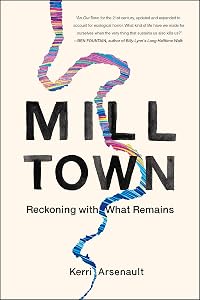
Mill Town: Reckoning with What Remains
by Kerri Arsenault 
On This Page
Description
"A galvanizing and powerful debut, Mill Town is an American story, a human predicament, and a moral wake-up call that asks: what are we willing to tolerate and whose lives are we willing to sacrifice for our own survival? Kerri Arsenault grew up in the rural working class town of Mexico, Maine. For over 100 years the community orbited around a paper mill that employs most townspeople, including three generations of Arsenault's own family. Years after she moved away, Arsenault realized the show more price she paid for that seemingly secure childhood. The mill, while providing livelihoods for nearly everyone, also contributed to the destruction of the environment and the decline of the town's economic, moral, and emotional health in a slow-moving catastrophe, earning the area the nickname "Cancer Valley." In Mill Town, Arsenault undertakes an excavation of a collective past, sifting through historical archives and scientific reports, talking to family and neighbors, and examining her own childhood to present a portrait of a community that illuminates not only the ruin of her hometown and the collapse of the working-class of America, but also the hazards of both living in and leaving home, and the silences we are all afraid to violate. In exquisite prose, Arsenault explores the corruption of bodies: the human body, bodies of water, and governmental bodies, and what it's like to come from a place you love but doesn't always love you back"-- show lessTags
Recommendations









Member Reviews
Throw away Hillbilly Elergy and pick up this amazing recounting of life and overwhelming death in Mexico and Rumford, Maine, home to a massive paper plant that actively employed and killed many of its residents. The author blends her love of her childhood home with her research on dioxin and other deadly chemicals released during the papermaking process. The (mis) fortunes of the two towns are completely tied to the mill and to the various companies that have owned it and how the owners decimated the Androscoggin River and the land surrounding it. There's also a fascinating history of Arsenault's Acadian ancestors, who migrated from France and Canada and were considered expendable and well suited to be obedient, work hard, and were show more sadly defeated when they finally rose up and went on strike against the dreadful mill conditions. The combination of the author's love of her hometown and her dread as she counts the cancer-related deaths is heart-wrenching. Even the dry bones of the endless bureaucratic denial of blame comes to life with her compelling narrative.
Quotes: “A kind of fatalism slipped unconsciously into our routines, transforming into a handing over of control to the powers that be. Silence is an accumulating force.”
“Sometimes our recollections can be suspect because memory accumulates actual events and muddles them with how we want them to unfold.”
“The meek will inherit the earth, Father Cyr told me, but he never said in what condition it would be when we finally assumed ownership.” show less
Quotes: “A kind of fatalism slipped unconsciously into our routines, transforming into a handing over of control to the powers that be. Silence is an accumulating force.”
“Sometimes our recollections can be suspect because memory accumulates actual events and muddles them with how we want them to unfold.”
“The meek will inherit the earth, Father Cyr told me, but he never said in what condition it would be when we finally assumed ownership.” show less
Another book that has been on my TBR for a long time! I was interested in it because as a child, we spent summers in northern Maine. I remember well the sulfur like smell that enveloped a mill town we sometimes drove through. I actually started this read a while ago but then got distracted.Somehow reading it now with all that is going on politically, it may be even more relevant than it was four years ago.
This well written nonfiction work is part memoir, part environmental expose part sociological study. The author grew up in a working class paper mill town in Maine where the residents were exposed to toxins and the cancer rates were high. That was the price they paid for steady jobs and a chance for their children to escape the mill show more life. As an adult, she goes back to investigate the various environmental hazards and political cover ups. She also explores her heritage, having been descended from the French Canadiens known as Acadians who were often discriminated against, called in an 1881 Labor report from Massachusetts, "a horde of industrial invaders”.
Winner of numerous prizes and accolades, this is very much an American story. There is a line that truly resonated with me “I simultaneously defend and disparage where I grew up, not because I’m nostalgic for the way things were; because I’m nostalgic for the way I thought they were.”
Don’t be put off by the exploration of Arsenault’s various ancestors, her personal experiences or some of the technical findings related to the environmental hazards.This book does go in different directions, but it is a worthwhile read and, as I said above, perhaps even more meaningful now than it was four years ago.
Thanks to #NetGalley and @StMartinsPress for the DRC. show less
This well written nonfiction work is part memoir, part environmental expose part sociological study. The author grew up in a working class paper mill town in Maine where the residents were exposed to toxins and the cancer rates were high. That was the price they paid for steady jobs and a chance for their children to escape the mill show more life. As an adult, she goes back to investigate the various environmental hazards and political cover ups. She also explores her heritage, having been descended from the French Canadiens known as Acadians who were often discriminated against, called in an 1881 Labor report from Massachusetts, "a horde of industrial invaders”.
Winner of numerous prizes and accolades, this is very much an American story. There is a line that truly resonated with me “I simultaneously defend and disparage where I grew up, not because I’m nostalgic for the way things were; because I’m nostalgic for the way I thought they were.”
Don’t be put off by the exploration of Arsenault’s various ancestors, her personal experiences or some of the technical findings related to the environmental hazards.This book does go in different directions, but it is a worthwhile read and, as I said above, perhaps even more meaningful now than it was four years ago.
Thanks to #NetGalley and @StMartinsPress for the DRC. show less
This was a memoir along with an in-depth look at a number of environmental and sociological factors that lead the small towns of Rumford and Mexico Maine down a path of decline. The author mixed her own memories and family history (Acadian) with research into population studies and court findings in an effort to discern whether the pollution of the Androscoggin River was a cause of a cancer cluster and other health issues that beset the communities.
This book wandered through many related topics and was occasionally frustrating in its lack of resolution, but then I guess that was the point after all. The author describes the environment and the people with great clarity and sensitivity. This was clearly a personal journey and I show more appreciated the fact that she invited the reader along to get to know her hometown from inside out. show less
This book wandered through many related topics and was occasionally frustrating in its lack of resolution, but then I guess that was the point after all. The author describes the environment and the people with great clarity and sensitivity. This was clearly a personal journey and I show more appreciated the fact that she invited the reader along to get to know her hometown from inside out. show less
Everything is poisoned, paper mills are toxic waste factories, the government is lying (either outright or by omission) to us. Some people like reading tragic fiction, I apparently gravitate towards the real thing.
I found this to be a depressing but necessary read, especially being a Mainer. Now please excuse me while I go and Google dioxin...
I found this to be a depressing but necessary read, especially being a Mainer. Now please excuse me while I go and Google dioxin...
Powerful. What starts as an investigation into Maine's "Cancer Valley" meanders, like a river itself, into personal narrative, local history, politics, activism, and more. Aresenault never promises answers, but this book will make you ask questions.
MEmoir/ History / Political Treatise... all in one package. I'll be honest, I picked up this book thinking it would be a bit closer to my own history of being in and around a mill town. In my case, the actual mill town was, by my time - roughly when Arsenault was graduating HS - , just a neighborhood of a larger County seat town it was founded just outside of around the same time as the mill Arsenault writes about. I know what it is like to live in such an area and have the mill be such an important aspect of your life, and I was expecting a bit more of an examination of that side of life. Which is NOT what we get here. Instead, we get much more of the specific familial and mill history of Arsenault and this particular mill and its show more alleged past and current environmental misdeeds. We even get a screed against Nestle along the way, and even a few notes of misandrist feminism. Also quite a bit of heaping of anti-capitalist diatribe, all tied up in Arsenault's own complicated emotions of being someone who cares about her home town, but who it was never enough for. (The exact dichotomy I was hoping would have been explored directly far more than it actually was, fwiw, as that is exactly what I struggle with myself.) Overall, your mileage may vary on this book depending on just how ardent you are in your own political beliefs and just how much they coincide with Arsenault's own, but there was nothing here to really hang a reason on for detracting from the star level of the review, and hence it gets the full 5* even as I disagreed with so much of it and was so heavily disappointed that it didn't go the direction I had hoped. Recommended. show less
This was an interesting and original contribution to recent works on rural America. The author grew up in (and eventually left, after a couple of young adult post-college returns) the eponymous setting of Mexico, Maine, a remote small town that was built around and whose economy still depends on an enormous paper mill. She returns regularly to care for her aging parents, and eventually starts to delve into the public health issues that the mill causes and the poverty that is still persistent despite a supposedly "good" employer in town offering many secure jobs.
I actually think much of what the town goes through and what Arsenault reports on is unique, and is not directly applicable to most other rural places. I say that because Mexico show more departs from the precarity of other "company towns" when it's clear their mill isn't in danger of being closed or moved offshore, despite many ownership changes. Also, the residents are almost 100% white (with strong Acadian ancestry) with few immigrants, which is increasingly uncommon anywhere in the US and was never true in regions like the South and the Southwest. But as a memoir, it was original and relatable. show less
I actually think much of what the town goes through and what Arsenault reports on is unique, and is not directly applicable to most other rural places. I say that because Mexico show more departs from the precarity of other "company towns" when it's clear their mill isn't in danger of being closed or moved offshore, despite many ownership changes. Also, the residents are almost 100% white (with strong Acadian ancestry) with few immigrants, which is increasingly uncommon anywhere in the US and was never true in regions like the South and the Southwest. But as a memoir, it was original and relatable. show less
Members
- Recently Added By
Published Reviews
“Mill Town” is preoccupied with a poisonous irony: Rumford’s citizens live and work in a place that makes them unwell, yet they cling to their jobs with prideful obstinacy, ignoring patterns of illness, swallowing the mill’s denials and accepting their lot with a collective shrug that Arsenault, once she learns the extent of the cancer and the mill’s likely responsibility for it, show more finds mysterious and troubling.... Yet, as she soon realizes, the answer to her questions is bound up in their very formulation. Rumford relies wholly on the mill. Few have questioned the bargain that asked them to trade physical health for economic well-being because nobody has a choice about whether to accept it. The residents’ adversary is too powerful, their need too great. show less
added by Lemeritus
Parts of who we are tend to be defined by the places we’re from. We are more than our hometowns, but forever OF our hometowns. And telling our own stories of those places can be far more complicated than we anticipate....There are long shadows cast in “Mill Town.” Arsenault proves unafraid of the many ghosts of Mexico, leaning into the bleaker aspects of the town’s past, present and show more future when warranted. Truth is vital when writing a book like this one, and the truth isn’t always pretty. Or easy. That said, this is also a book of celebration, a story that fully acknowledges and embraces the bright benefits of small-town life. show less
added by Lemeritus
Arsenault’s “Mill Town” takes readers to an interior region of Maine, the kind of place that most people don’t think about when they imagine the coastal wonders of the so-called “Vacationland.” She grew up there, in the town of Mexico, a descendant of Acadian immigrants, whose historical reception sounds all too familiar in the annals of American xenophobia.... what Arsenault has show more provided is a model of persistence, thoughtful reflection and vividly human personal narrative in uncovering a heartbreaking story that could be told in countless American towns, along countless American rivers. show less
added by Lemeritus
Lists

Must-Read Maine
146 works; 91 members

Top Five Books of 2023
767 works; 317 members
Author Information

1+ Work 226 Members
Kerri Arsenault grew up in the rural working-class town of Mexico, Maine. For more than a hundred years the community orbited around a paper mill that employed most townspeople, including three generations of Arsenault's family. Years after she moved away, Arsenault realized the price she paid for her happy childhood. The mill, while providing show more social and economic cohesion for the community, also contributed to its demise and-the destruction of the environment in a slow-moving catastrophe, earning the area the nickname "Cancer Valley." Mill Town is a work of narrative nonfiction, investigative memoir, and cultural criticism that illuminates the rise and collapse of the working class, the hazards of loving and leaving home, and the ambiguous nature of toxics and disease. Mill Town is a moral wake-up call that asks: Who or what are we willing to sacrifice for our own survival? show less
Kerri Arsenault is a LibraryThing Author, an author who lists their personal library on LibraryThing.
Awards and Honors
Awards
Distinctions
Notable Lists
Common Knowledge
- Canonical title
- Mill Town: Reckoning with What Remains
- Important places
- Maine, USA
- Epigraph
- Find out just what a people will submit to, and you have found the exact amount of injustice and wrong which will be imposed upon them; and these will continue till they are resisted with either words or blows, or with both. ... (show all)The limits of tyrants are prescribed by the endurance of those whom they oppress. -Frederick Douglass, in a speech concerning West India Emancipation, delivered at Canandaigua, New York, August 3, 1857
- Dedication
- For John Freeman
- First words
- Preamble: Mexico, Maine is a small paper mill town that lies in a valley, or "River Valley" as we now call the area, because I suppose you can't have one without the other.
Chapter 1, What Goes Around, Comes Around: From the porch steps of the house where I grew up, you'll see the end of the road. - Quotations
- Our geologic past foretold everything about our future. But in this future, lives are un-lived, secrets never revealed, and stories remain unwritten about how much we all lose. In this future, I learn of asphalt lakes, people... (show all) bulleted with disease, burning tires scarring the sky, the forsaken buried in unmarked graves, the evisceration and erasure of home. In this future, we pardon legislators who convince us nature will sort itself out. In this future, we will have forgotten everything that came before, and our only legacy for those who will supersede us is the promise of ruin.
...we have become inured to this kind of discourse, a gaslighting of sorts in which the definitions of words are as slippery as the sludge itself. If we aren’t sure what things mean, our circuits get scrambled and we lose t... (show all)he thread, then we lose control. And if we lose control, someone else takes over, and where are we then?
Some worried a controversy would sully town pride. Millworkers didn’t want to lose their jobs. Other folks just didn’t want to die. Those who were already sick got mad. The mill kept reiterating there were no facts to bac... (show all)k up such destructive claims and didn’t seem concerned the film’s claims might be true.
...we eschewed those smarter or more worldly than us because they made us feel small, whether or not that was their intent. I remember harboring resentments toward white-collar professionals who were full of blue-chip solutio... (show all)ns and not blue-collar common sense.
I used to think our lives orbited around love, for love was why we bothered to get up in the morning. But after talking to Dot, and considering my town, my family, my own stifled voice, life seems to revolve around the silenc... (show all)es we’re afraid to violate. And as the studies show, this isn’t just a problem in Mexico, Maine. It’s a human problem.
What’s in or what’s out by deed or command are decisions made by those with knowledge or prestige: historians, experts, even modest archivists at small town halls. We depend on experts to collate and curate the past so th... (show all)e future will know what went on. It’s a powerful profession, more powerful than we sometimes understand, because the facts they choose to memorialize or highlight can be corrupted by motives other than just their job. We are vulnerable, in a way, to their all-seeing eyes observing and recording history as it unfolds while most of us are just getting through our day.
When International Paper of Jay, Maine, the Brown Company in New Hampshire, and the Oxford Paper Company in Rumford, Maine—who were responsible for the mess—ignored these recommendations, Maine attorney general Frank Cowa... (show all)n, in an unusual environmental action for 1942, filed a lawsuit against them. The case resulted in an order by the Maine Supreme Court demanding the mills reduce their discharges at once. Editors at the Lewiston Daily Sun wrote in response: “Only the foolhardy would desire clean water at the expense of slashed payrolls, lost industry and a ghost town.”
It seems the less you have—in education, money, health insurance, or work, as the article cites—the more you are prepared to endure. And that signifies what’s out of balance in a world gone askew, in a world where the d... (show all)efinition of “need” has transformed to “greed.”
In Maine, we clear-cut our forests while tourists exalt them. Pollution bankrupts the fresh air we advertise. We let dioxins invade our environment, which end up in lobsters tourists eat. We celebrate Thoreau’s voice but dr... (show all)own it out with the growl of chain saws. What gives our town life could also be what’s killing it. As the folksy Maine saying goes, “You can’t get they-ahh from hee-yahh.” In other words, the way life should be, the idealized state of Thoreau and tourists, may have never actually existed except in the landscape of our minds.
TRUMP TOWER AROSE as an edifice to signify its owner’s wealth, but it symbolized additional sins. The $100 million tower was built on the footprint of Bonwit Teller, an art deco luxury goods department store that had embrac... (show all)ed an extravagance of its own: crafted from limestone, platinum, bronze, aluminum, nickel, and garlanded with ornate metalwork and original friezes, Bonwit Teller also sold expensive perfumes, furs, and ladies hats in pilastered and paneled rooms. Before its demolition by Trump, the Metropolitan Museum of Art offered to rescue the friezes and other architectural remnants. But Trump had other plans. He envisioned a tall, “expensive-looking” building that showed off “real art, not like the junk … at the Bonwit Teller,” he told New York magazine. So under his direction, the friezes were jackhammered, the metalwork disappeared, and the building was ravaged then sighed to the ground. And some of the undocumented Polish workers who helped build Trump Tower under dangerous conditions went unpaid until they took Trump to court.
“He will destroy the working man,” my father always said about Reagan; and he wasn’t wrong. Harold Meyerson of the Washington Post wrote that Reagan’s strike breaking was “an unambiguous signal that employers need f... (show all)eel little or no obligation to their workers, and employees got that message loud and clear.” My father’s hatred of Reagan consumed our family and we weren’t allowed to utter his name unless we called him “that fucking asshole,” as my father constantly did.
The Supreme Court’s Citizens United decision in favor of corporate personhood later confirmed that spending money is the same as and essential to protected speech, which allowed politicians to bankroll their interests as de... (show all)ep as their pockets would go. While spending money doesn’t guarantee political outcomes (people still need to vote), the Supreme Court arguably legitimized the idea that the more money you have and spend, the more say you have. Before the 1980s and ’90s rolled up their mats, Neutron Jack and many CEOs like him wiped their feet on the social contract between people and the places they worked, contributing to the decline of unions and obliterating the voice of the working-class all across the land.
Janet’s comment—“don’t make us look like rednecks”—spoke to a dilemma I fight to resolve: what others think of the working-class versus how I perceive what it means to me. In the past, in a different system that n... (show all)o longer exists, the working-class were seen as honorable, hardworking, loyal people who made machines that made the machines that made the world go around. That’s the identity I’ve always worn. Somewhere along the way as manufacturing declined, so did the perceptions of who we are. Now there’s a sense Janet sensed: people see the working-class as rednecks who like their guns and bad food, don’t care about the planet, are racist or just plain dumb. While there are always those who may fit that node, the former definitions also still apply and neither perception is wholly true. In fact, the majority of humans don’t ever live up to clichés and can’t or shouldn’t be reduced and reduced and reduced to a single serving at an all-you-can-eat buffet.
The meek will inherit the earth, Father Cyr told me many years ago. He just never said what condition it would be in when we finally assumed ownership.
“Papermaking in the US, that probably won’t be around in twenty or so years,” he grimly begins our conversation. The United States, he says, was so successful in manufacturing things like textiles, paper, and shoes beca... (show all)use we had virtually no environmental or workplace protection, no unions, allowed child labor, and had immigrants willing to do the work for a lot less money. “In other words,” he says, “industry in the US operated like a colonial enterprise. We were able to have an extraordinary amount of economic success that way. That’s no longer possible.”
China’s indirect effect on US papermaking is that containerboard producers used to make boxes for nearly all US consumption of consumer goods, like sneakers and toys. Now that China supplies so much of our nondurable goods ... (show all)consumption, the boxes that protect them during shipment have to be made in China.
“It takes fifty to sixty years to grow an oak. It takes five to grow a eucalyptus in South America. Eucalyptus trees are cloned, so all the fibers are the same, which makes for much more pulp consistency and more efficient ... (show all)papermaking. In Maine, the wood pulp is a different mix every time. So it’s cheaper to grow trees and manufacture paper in South America and ship it to the US than to make it in the US.
In the lead-up to the election, it seemed Democrats had already accepted the deconstruction of the working-class and had moved on to more cerebral things. I remember their discourse about gender-neutral bathrooms, but those c... (show all)onversations didn’t pay the rent; it’s not that we were unsympathetic to such causes but we had nothing left to give. We already had enough to worry about, like the possibility of being crushed by a paper roller, getting cancer, or how to make ends meet. We also wanted to be reasonably sure that the whop-whop-whopping of helicopter blades was not because the town was under attack. Losing your mill job is like losing your identity (as the strikes of the 1980s had shown). Those are identity politics in a working-class town.
In Mexico, voting for Trump was a backlash to all the prosperity out of reach, a backlash to the world going global while Rumford and Mexico just ran in place, a backlash to the working-class not having a loud enough voice.
Such misdemeanors, like not living in Maine anymore or marrying someone from Massachusetts (from “away”), can lower your percentage of likability, your credibility, your authenticity. Flatlanders, I used to jokingly call ... (show all)them, which was anyone not born in Maine or those who moved away and are gone too long. Tick tock says the clock the minute you depart. If you lived on Maine’s southern coast you may be considered a flatlander because of your proximity to Massachusetts, whose residents we also called “Massholes,” a specific breed of know-it-alls on our ski slopes even though they never quite deciphered the ski codes or perhaps human etiquette; they’d barge down the hill in neon outerwear and spill all their beer before it reached their mouths. You’d be wrong if you think after a certain number of years of living in Maine you’ll be “from Maine” because it doesn’t work that way either.
It’s not like it was in the good old days where college, hard work, hard knocks, and loyalty ratcheted us up and out of the stratum we were born into. Now, those in the middle with the middle skill sets were seeing the stee... (show all)pest earning declines. Globalization, with its open cultural and economic borders, couldn’t remove those kinds of barriers no matter how hard it tried.
By leaving, I had put an end to the repetition of what small towns used to encourage: stay and open a store using your surname or pick up where your parents left off. I was the American Dream in ambition and scope while at th... (show all)e same time I was killing that dream with every step farther from home.
But we can and probably should go back home to confront what made us leave, what made us fall in and out of love with the places that create us, or to see what we left behind. Because each time I go home, I face a referendum ... (show all)on the success or failure of my relationship with it, like a dialogue between two people in a deep and complicated relationship.
The poverty level in Maine is increasing at more than twice the rate of neighboring states and eight times the rate of the rest of the nation.
in classrooms, boardrooms, living rooms: even though we are generally alike in our desire to be fed, clothed, housed, loved, we zero in on differences—in political parties and at dinner parties—perpetuating a cycle of div... (show all)isiveness that does nobody any good.
Most humans are simply not privy to the political and financial worlds whose verdicts affect us.
How men can be “induced” to working in less than great conditions is like the Hatter asking Alice in Wonderland, “Why is a raven like a writing desk?” Sometimes there’s no clear answer to the riddle at all. - Last words
- (Click to show. Warning: May contain spoilers.)Chapter 16, The Truth Lies Somewhere: Robert Frost, in his poem "Evil Tendencies Cancel," enumerated this idea that life and death were two sides of the same coin and that the trophic levels of nature could end the chestnut's demise.
(Click to show. Warning: May contain spoilers.)Coda: Finally, slowly, cumulatively, but inexorably with an exhausted flush, the river debouches and slips softly into the arms of the Atlantic Ocean. - Canonical DDC/MDS
- 974.175
- Canonical LCC
- F29.M49
Classifications
- Genres
- Sociology, Nonfiction, Biography & Memoir, General Nonfiction, Science & Nature, History
- DDC/MDS
- 974.175 — History & geography History of North America Northeastern United States (New England and Middle Atlantic states) Maine Franklin; Oxford
- LCC
- F29 .M49 — Local History of the United States, Canada and Latin America United States local history Maine
- BISAC
Statistics
- Members
- 226
- Popularity
- 144,850
- Reviews
- 11
- Rating
- (3.67)
- Languages
- English, Italian
- Media
- Paper, Audiobook, Ebook
- ISBNs
- 9
- ASINs
- 2