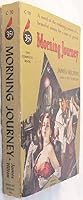
Morning Journey
by James Hilton
On This Page
Description
Morning Journeyby James HiltonGeorge Hare (of Hare, Briggs, Burton, and Kurtnitz) met Carey Arundel for the first time at the annual Critics' Dinner at Verino's. She was to receive a plaque for the best actress performance of the year, Greg Wilson was to get the actor's, and Paul Saffron the director's. These dinners were rather stuffy affairs, but the awards were worth getting; this year Morning Journey was the picture that had swept the board, all the winners having scored in it. George show more had seen the picture and thought it good, if a trifle tricky. He was far more concerned with his luck in being next to Carey at the dinner, for his own well-concealed importance in the movie world did not always receive such rewards. George had an eye for beauty which, combined with a somewhat cynical nose for fame, made him take special notice of her. Of course he had seen her on the stage as well as on the screen, but he thought she looked best of all in real life-which meant, even more remarkably, that she looked really alive at a party such as this, not merely brought to life by ambition or liquor.We are delighted to publish this classic book as part of our extensive Classic Library collection. Many of the books in our collection have been out of print for decades, and therefore have not been accessible to the general public. The aim of our publishing program is to facilitate rapid access to this vast reservoir of literature, and our view is that this is a significant literary work, which deserves to be brought back into print after many decades. The contents of the vast majority of titles in the Classic Library have been scanned from the original works. To ensure a high quality product, each title has been meticulously hand curated by our staff. Our philosophy has been guided by a desire to provide the reader with a book that is as close as possible to ownership of the original work. We hope that you will enjoy this wonderful classic work, and that for you it becomes an enriching experience. show lessTags
Recommendations






Member Reviews
James Hilton was an English novelist and screenwriter who published more than 20 novels. Morning Journey published in 1951 was written towards the end of his life, he died in 1954. He had popular success with a trio of novels made into films; [Lost Horizon], [Goodbye Mr Chips] and [Random Harvest]. His other novels are not widely read today, but I dug this one out as part of my 1951 reading project.
The novel starts with a celebration dinner for the popular and critically acclaimed release of the Hollywood made film Morning Journey. Carey Arundel is the female lead and is nervous of making her speech, but is overshadowed by her ex-husband and director of the film Paul Saffron. He uses his time at the microphone to criticise the Hollywood show more machine and Carey's acting in particular. Carey seeks solace in a friendly lawyer sitting next to her and the vast majority of this novel is written by its author as a back story, which focuses on the life of Carey and her relationship with Paul Saffron. It is written in omniscient style with the dialogue and actions of the characters expressing their feelings and points of view. The character of Paul seems to be based to some extent on the real life film director Orson Wells. Paul is an egotist and a control freak in his work as a stage and film director; he is brilliantly innovative and considers himself a genius and although he can be charming he lets nothing stand in the way of his own ambitions. He does not suffer fools gladly and his mercurial talent results in constant battles with the money men who control his work and the unfortunate actors and technicians who come within his orbit. His talent brings him some success, but his character can lead him to throw it all away on a whim, in which he is never wrong.
Carey Arundel is the central character in the novel and it is her story that is told. Hilton sketches in her background, and the story takes off when she meets Paul for the first time and much of the first part of the book is their early struggles to succeed in the world of the theatre. Paul recognises a certain something when he sees Carey perform in a supporting role in a local theatre production in Ireland. They move to London with Paul knocking on the doors of anybody who will give him a break and some money to direct a stage play. It is Carey who must get a job as a waitress to support her new husband. They eventually get a success with Paul directing Carey in a comedy play. They decide to try their luck in America, but the restless Paul goes to Europe where he discovers his talents work equally well in the cinema. Carey meets a millionaire on the boat to America and is charmed into a new relationship. Her life takes a different path to Paul, but she is fated to once again become Pauls supporting partner for the Hollywood film Morning Journey.
It is a good story although somewhat predictable; the supporting female behind the super talented, but errant male. Hilton nearly pulls it off, because of a brilliant portrayal of Paul, and he nearly does the same for Carey, but towards the end of the novel it is a bit of a stretch to understand her choices and to believe in her devotion to her ex husband. I think what the story lacks is any attempt to explore the sexual relationship between Carey and her male admirers. She is depicted as a beautiful and sensual women, but this does not come through in the story telling. The ease with which she attracts men is rather like one might see in a 1940's film, the charming millionaire whose son, also falls in love with Carey, the lawyer, the film producer and then Paul who seems just to take Carey for granted. Carey is a woman of independent means, she is intelligent and caring and Hilton reveals to his readers her thoughts throughout most of the book and one might question whether he does such a good job in this respect.
Hiltons writing flows nicely and the dialogue particularly between Carey and Paul is excellent. The story takes place over a 23 year period taking in the financial crash of 1926 and the second world war, all of which affects his male characters to a certain extent. He uses his experience as a screenwriter in Hollywood to create a realistic background to the later part of the novel. I enjoyed the reading experience and was interested to keep turning the pages I could not decide whether I was reading a popular novel or something more literate. 3.5 stars. show less
The novel starts with a celebration dinner for the popular and critically acclaimed release of the Hollywood made film Morning Journey. Carey Arundel is the female lead and is nervous of making her speech, but is overshadowed by her ex-husband and director of the film Paul Saffron. He uses his time at the microphone to criticise the Hollywood show more machine and Carey's acting in particular. Carey seeks solace in a friendly lawyer sitting next to her and the vast majority of this novel is written by its author as a back story, which focuses on the life of Carey and her relationship with Paul Saffron. It is written in omniscient style with the dialogue and actions of the characters expressing their feelings and points of view. The character of Paul seems to be based to some extent on the real life film director Orson Wells. Paul is an egotist and a control freak in his work as a stage and film director; he is brilliantly innovative and considers himself a genius and although he can be charming he lets nothing stand in the way of his own ambitions. He does not suffer fools gladly and his mercurial talent results in constant battles with the money men who control his work and the unfortunate actors and technicians who come within his orbit. His talent brings him some success, but his character can lead him to throw it all away on a whim, in which he is never wrong.
Carey Arundel is the central character in the novel and it is her story that is told. Hilton sketches in her background, and the story takes off when she meets Paul for the first time and much of the first part of the book is their early struggles to succeed in the world of the theatre. Paul recognises a certain something when he sees Carey perform in a supporting role in a local theatre production in Ireland. They move to London with Paul knocking on the doors of anybody who will give him a break and some money to direct a stage play. It is Carey who must get a job as a waitress to support her new husband. They eventually get a success with Paul directing Carey in a comedy play. They decide to try their luck in America, but the restless Paul goes to Europe where he discovers his talents work equally well in the cinema. Carey meets a millionaire on the boat to America and is charmed into a new relationship. Her life takes a different path to Paul, but she is fated to once again become Pauls supporting partner for the Hollywood film Morning Journey.
It is a good story although somewhat predictable; the supporting female behind the super talented, but errant male. Hilton nearly pulls it off, because of a brilliant portrayal of Paul, and he nearly does the same for Carey, but towards the end of the novel it is a bit of a stretch to understand her choices and to believe in her devotion to her ex husband. I think what the story lacks is any attempt to explore the sexual relationship between Carey and her male admirers. She is depicted as a beautiful and sensual women, but this does not come through in the story telling. The ease with which she attracts men is rather like one might see in a 1940's film, the charming millionaire whose son, also falls in love with Carey, the lawyer, the film producer and then Paul who seems just to take Carey for granted. Carey is a woman of independent means, she is intelligent and caring and Hilton reveals to his readers her thoughts throughout most of the book and one might question whether he does such a good job in this respect.
Hiltons writing flows nicely and the dialogue particularly between Carey and Paul is excellent. The story takes place over a 23 year period taking in the financial crash of 1926 and the second world war, all of which affects his male characters to a certain extent. He uses his experience as a screenwriter in Hollywood to create a realistic background to the later part of the novel. I enjoyed the reading experience and was interested to keep turning the pages I could not decide whether I was reading a popular novel or something more literate. 3.5 stars. show less
I always love James Hilton's novels. They always carry themes of lost love, family conflict and making the best of the hand you are dealt. Some may find his work to be "dated" ( written between 1920 and 1954) but I find them to still be fresh. I have read 7 of his novels and am only half way through his catalog.
Ratings
Members
- Recently Added By
Author Information

49+ Works 9,359 Members
James Hilton was born in Leigh, Lancashire, England on September 9, 1900. While attending the Leys School in Cambridge, he published several stories in the school magazine. In 1918, he won a scholarship to Christ's College, Cambridge, where he joined the University Officer Training Squadron. Before he saw any action, the war ended. He published show more his first novel, Catherine Herself, in 1920, while still an undergraduate. After Cambridge, he became a freelance journalist, writing chiefly for The Manchester Guardian and later The Irish Independent and reviewing fiction for The Daily Telegraph. During this time, he had several more of his novels published, though without conspicuous success. In 1931, he enjoyed his first popular success with And Now Goodbye and was able to take up writing fiction full time. His other works include Lost Horizon, which won the Hawthornden Prize, Goodbye Mr. Chips, and Random Harvest, all of which were made into highly successful motion pictures. In 1935, he was invited to Hollywood to work as a screenwriter. He wrote screenplays for Camille, Foreign Correspondent, Forever and a Day, The Story of Dr. Wassell, The Tuttles of Tahiti, and We Are Not Alone. He won the Best Screenplay Oscar for Mrs. Miniver in 1942. During his Hollywood years, he continued to write novels including Nothing So Strange, Morning Journey, and Time and Time Again. He also served as the narrator for Madame Curie and the adaptation of his novel So Well Remembered, in addition to hosting CBS Radio's Hallmark Playhouse from 1948 until 1953. He died of liver cancer on December 20, 1954. (Bowker Author Biography) show less
Awards and Honors
Distinctions
Series
Belongs to Publisher Series
Common Knowledge
- Original publication date
- 1951
Classifications
- Genres
- Fiction and Literature, General Fiction, Romance
- DDC/MDS
- 839.78 — Literature & rhetoric German & related literatures Other Germanic literatures Swedish literature Swedish miscellany
- LCC
- PZ3 .H5677 — Language and Literature Fiction and juvenile belles lettres Fiction and juvenile belles lettres Fiction in English
- BISAC
Statistics
- Members
- 60
- Popularity
- 515,817
- Reviews
- 2
- Rating
- (3.90)
- Languages
- English, Norwegian (Bokmål), Swedish
- Media
- Paper
- ISBNs
- 4
- ASINs
- 8